Codex vs Claude Code In-Depth Comparison: How Frontend and Backend Developers Should Choose
Codex vs Claude Code In-Depth Comparis…
Codex excels at UI/frontend work while Claude Code dominates backend logic—here's how to choose.
This article compares Codex and Claude Code across pricing, stability, and core capabilities. Codex offers better value, fewer rate limits, and superior frontend UI development, while Claude Code excels at logical reasoning and backend architecture. The recommendation: master both tools and use them in combination based on project needs.
The Three-Giant Era of AI Coding Tools
AI coding tools have entered a period of explosive growth, but the ones truly standing in the top tier come down to three names: Cursor, Claude Code, and Codex. For developers, choosing which tool to use—and how to combine them—has become a critical decision that directly impacts productivity.
The core technical foundation of AI coding tools is Large Language Models (LLMs). These models learn programming language syntax rules, design patterns, and best practices by pre-training on massive code repositories (such as public GitHub repos, Stack Overflow, etc.). The leading AI coding tools today correspond to different model providers: Cursor uses a multi-model architecture (supporting GPT-4, Claude, etc.), Claude Code is developed by Anthropic and built on the Claude model series, and Codex is part of OpenAI's product line. These tools have evolved from initial code completion (like GitHub Copilot's single-line suggestions) to intelligent agents (AI Agents) capable of understanding project context, performing multi-file edits, and even autonomously completing complex development tasks.
This article shares insights based on hands-on experience, providing an in-depth comparison of Codex and Claude Code across dimensions like installation format, pricing, and user experience—helping you find the AI coding assistant that best fits your needs.
Codex's Four Forms: The APP Emerges as the Best Option
Evolution from Plugin to Standalone Application
Codex currently has four usage forms:
- SR/UI format - Graphical interface
- Terminal (CLI) - Command-line interaction
- Web-based - Direct browser usage
- Plugin format - Integrated into IDEs like VS Code
In the past, most developers used Codex as a plugin, integrating it into various development tools. But with the release of the standalone Codex APP, things have changed—the APP form is now considered the most powerful way to use it.
The core advantage of a standalone APP over an IDE plugin lies in the freedom of resource scheduling and context management. Plugin forms are constrained by the host IDE's process management and memory allocation, while standalone APPs can independently manage their own computing resources, maintain larger context windows, and implement more complex multi-turn conversation state management. Additionally, standalone APPs can directly call OS-level APIs to achieve deep integration of file system monitoring, terminal command execution, browser preview, and other features that are often restricted in plugin sandbox environments. OpenAI's Codex APP also introduces a cloud-based sandbox execution environment where code can run and be verified in isolated containers, reducing dependency on the local environment.
The standalone APP not only offers more complete functionality but also works alongside traditional development tools like VS Code to form a more efficient workflow. For users without development experience, the APP's visual presentation is also much more accessible.
Codex vs Claude Code: Core Differences Compared
Price Comparison: Codex Offers Better Value
From a pricing perspective, the cost of using the Codex APP is significantly lower than Claude Code. For individual developers or budget-constrained teams, this is an advantage that can't be ignored. By comparison, Cursor's subscription fees aren't cheap either—many users report that "every renewal feels painful," with costs adding up considerably over six months of use.
Stability Comparison: Rate Limiting and Account Bans
Stability is a critical differentiator between the two:
- Claude Code: Frequently experiences rate limiting and account bans, seriously disrupting development continuity
- Codex: Currently has no rate limiting or account ban issues
The rate limiting and account ban mechanisms in AI coding tools are essentially the provider's strategy for managing GPU inference resources. Every inference call from a large language model consumes expensive GPU compute, especially for long-context conversations and complex code generation tasks. Anthropic's Claude Code employs a relatively aggressive usage control strategy—when users send a large volume of requests or consume too many tokens in a short period, the system triggers rate limiting protection. This is particularly impactful for development scenarios requiring sustained high-frequency interaction (such as iterative debugging or large-scale refactoring). OpenAI's Codex may mitigate this through subscription tiers and more abundant compute reserves, but in the long run, as user bases grow, every provider faces the challenge of balancing compute supply with user demand.
Regarding "quality degradation" (decline in model output quality), while some users have reported similar issues with Codex, in practical usage scenarios, no noticeable quality degradation has been observed. This point still requires verification from more users.
Capability Focus: Frontend UI vs Backend Logic
This is a highly valuable practical summary:
| Dimension | Codex | Claude Code |
|---|---|---|
| Core Strengths | UI details, color coordination, animations, interaction cues | Logical correctness, code structure, feature implementation |
| Best For | Frontend developers, APP developers | Backend developers, logic-intensive projects |
| Interaction Mode | More intuitive in APP form | Primarily terminal/CLI |
In simple terms: Codex is better at making things "look good," while Claude Code is better at making things "work well." Frontend developers tend to prefer Codex's command over visual details, while backend developers value Claude Code's performance in logical reasoning and code architecture.
The performance differences between AI coding tools on frontend and backend tasks are rooted in differences in training data distribution and model optimization directions. OpenAI's models have invested heavily in multimodal training resources for vision-related tasks, giving them a better understanding of color theory, layout aesthetics, animation timing, and other visual design concepts. Anthropic's Claude model series, on the other hand, is renowned for long-text reasoning and logical consistency—its Constitutional AI training methodology makes the model more reliable when handling complex conditional branches, data flow, error handling, and other logic-intensive tasks. Furthermore, Codex APP's real-time preview feature lets developers instantly see UI rendering results and iterate quickly, and this visual feedback loop further strengthens its advantage in frontend development.
Practical Recommendations: It's Not Either/Or—It's a Combination
Why You Should Master All Three Tools
A pragmatic perspective: In the current landscape, you should learn to use all three tools—Cursor, Claude Code, and Codex. Here's why:
- Different companies may provide accounts for different AI tools
- Different project types suit different tools
- Tools complement rather than exclude each other
- AI tools iterate extremely fast—mastering one more gives you one more safety net
Developer Workflow Migration Reference
The following tool migration path is quite representative:
- Phase 1: Used Cursor for over six months—great experience but expensive
- Phase 2: Switched to Claude Code with domestic models—cheaper but degraded experience
- Phase 3: Ultimately settled on Codex APP + VS Code combination
As a frontend developer, Codex's advantages in visual presentation and UI details, combined with the APP form's convenience, make it the preferred solution currently. However, the specific choice still depends on your own tech stack and use case.
The concept of using multiple AI tools in coordination stems from the software engineering principle of "Best Tool for the Job." In real-world development, a complete project typically involves UI design, business logic, database operations, API design, test writing, and many other dimensions—a single tool can rarely achieve optimal results across all of them. A mature developer workflow might look like: using Codex to rapidly build frontend interfaces and interaction prototypes, using Claude Code to handle complex backend algorithms and architecture design, and using Cursor for daily code editing and small-scale modifications. This combination strategy is similar to designers using Figma, Photoshop, and Illustrator simultaneously—each tool has its irreplaceable core scenario.
Summary: Match Tools to Your Development Scenario
There's no absolute "best answer" when choosing AI coding tools—the key is matching them to your development scenario:
- Seeking cost-effectiveness and stability → Codex
- Prioritizing UI and frontend experience → Codex
- Needing strong logical reasoning and backend architecture → Claude Code
- Wanting a mature IDE integration experience → Cursor
In today's rapidly iterating AI coding tool landscape, maintaining an open mindset and using multiple tools in parallel is the best strategy for boosting development efficiency. As model capabilities continue to improve and tool forms continue to evolve, today's optimal choice may need to be reassessed in just a few months. The most important ability for developers isn't binding to any single tool—it's the meta-skill of rapidly adapting to and switching between tools.
Related articles

Claude Code for Test Development in Practice: An AI Programming Workflow That Doubles Your Efficiency
A practical guide to Claude Code for test development: auto-generating test scripts, Plan Mode workflows, MCP + Playwright integration, and Subagent parallel tasks to build systematic AI-assisted workflows.

Hermes Agent Hands-On Review: An AI Efficiency Revolution for Indie Game Developers
Indie game developer reviews Hermes Agent vs OpenClaude: intelligent context compression, real-time Memory, remote control via Telegram, and practical use cases in game dev, social media, and email.
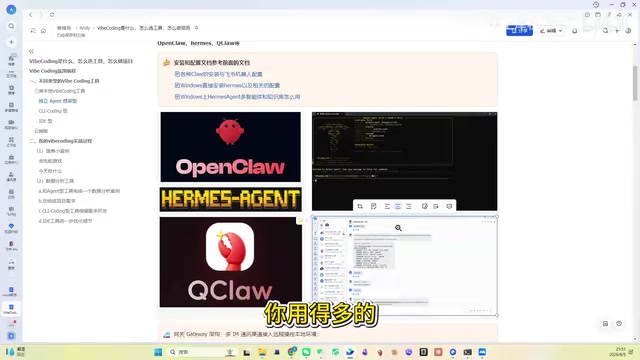
Vibe Coding Beginner's Guide: Tool Selection Across Three Categories with Practical Examples
A comprehensive guide to Vibe Coding's three tool categories: Agent frameworks, CLI Coding, and IDE tools, with practical examples including Snake game and data analysis workbench.