Complete Breakdown of Andrew Ng's LangChain Course: Five Core Components and Hands-On Guide
LangChain simplifies LLM application development through five modular, composable components.
LangChain is an open-source framework created by Harrison Chase to solve the pain point of excessive glue code in LLM application development. Built on principles of modularity and composition, it comprises five core components—Models, Prompts, Indexes, Chains, and Agents—covering the complete development pipeline from model interaction, prompt management, and external data integration (RAG) to chain invocations and intelligent agents, significantly lowering the barrier to building complex AI applications.
Course Background: Why Do Developers Need LangChain?
With the rapid development of Large Language Models (LLMs), the barrier to AI application development is being significantly lowered. LLMs are ultra-large-scale neural networks trained on the Transformer architecture, represented by GPT-4, Claude, Gemini, and others. Through massive text pre-training, they've acquired powerful language understanding and generation capabilities. By driving LLMs with prompts, developers can build AI applications faster than ever before. However, Andrew Ng pointed out a key issue at the beginning of the course: Real-world applications often require multiple LLM calls and output parsing, which involves a significant amount of "glue code" that needs to be written.
So-called "glue code" refers to the boilerplate code used to chain multiple API calls, parse model outputs, handle error states, and manage context memory. This type of code is both tedious and difficult to reuse—it almost needs to be rewritten from scratch across different projects, seriously slowing down AI application development efficiency.
LangChain is an open-source framework born to solve this exact pain point. Created by Harrison Chase, it aims to make the development process of LLM applications simpler and more efficient. This course was jointly created by Andrew Ng and Harrison Chase, published through the DeepLearning.ai platform, and is widely recognized as one of the best resources for systematically learning LangChain.
The Birth of LangChain and Its Open-Source Community Ecosystem
Abstracted from Frontline Development Practices
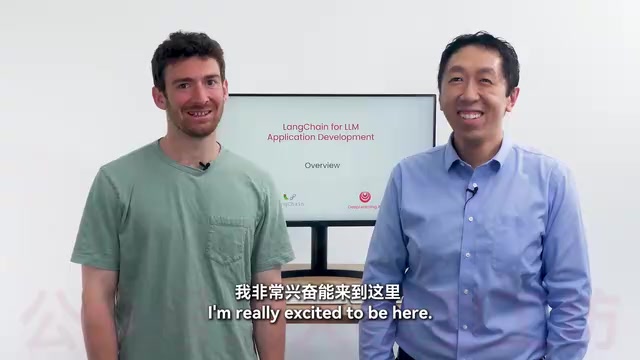
Harrison Chase shared the origin story of LangChain during the course. Through conversations with numerous frontline developers, he discovered that teams building complex LLM applications shared many common abstraction layers in their development patterns. LangChain is the distillation and encapsulation of these universal patterns, standardizing repetitive work so developers can focus on business logic itself.
This design philosophy of "extracting abstractions from practice" makes LangChain naturally aligned with real development scenarios, rather than being a purely academic framework. Each of its components corresponds to specific problems that developers repeatedly encounter when building real applications.
The Powerful Driving Force of the Open-Source Community
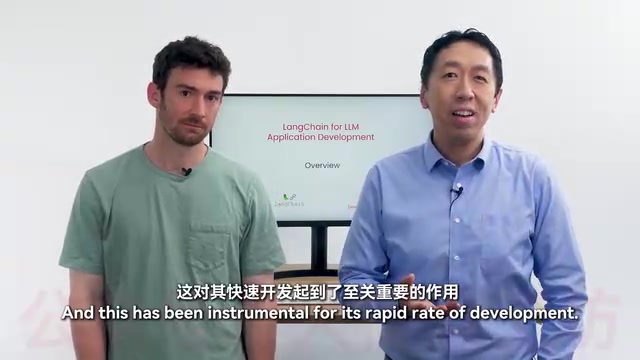
LangChain's development pace has been remarkable. Beyond having a large user base, the project has attracted hundreds of open-source contributors to participate in development. Andrew Ng specifically emphasized that this active community participation is the key driving force behind LangChain's rapid iteration—"This team ships code and new features at an incredible pace."
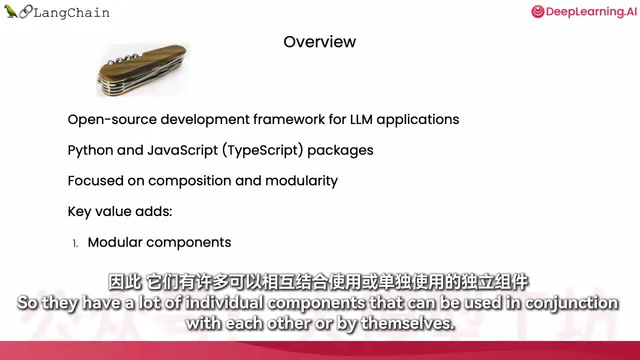
Currently, LangChain offers development packages in two versions: Python and JavaScript, covering the mainstream development ecosystem. Both versions focus on the design principles of Composition and Modularity, making it easy for developers to choose flexibly based on their tech stack.
Detailed Core Architecture: LangChain's Five Key Components
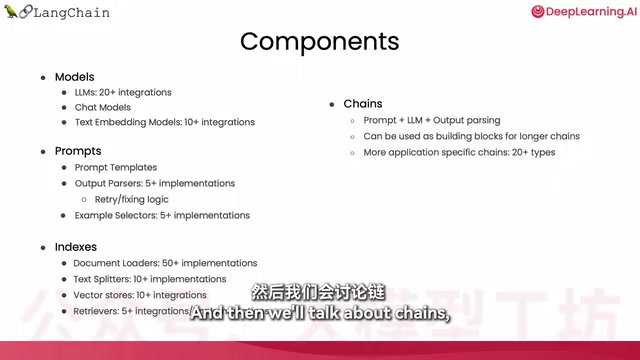
LangChain's design philosophy is to decompose complex LLM applications into composable, modular components. Each component can be used independently or flexibly combined with other components. The course systematically covers the following five core modules:
1. Models: A Unified Model Interaction Layer
The Models layer is LangChain's foundation, responsible for interacting with various LLMs. LangChain provides unified interface wrappers for different model providers (such as OpenAI, Anthropic, Google, etc.), enabling developers to easily switch underlying models without major code modifications. This abstraction design greatly improves project maintainability and flexibility.
It's worth noting that different model providers vary in API design, pricing models, and context window lengths. LangChain's Models layer shields these differences through unified abstraction, allowing developers to switch between models by modifying minimal configuration when evaluating different models' performance or cost, avoiding the risk of Vendor Lock-in.
2. Prompts: Systematic Prompt Management
Prompts are the key to making models "do useful and interesting things." Prompt Engineering has evolved into an independent discipline, encompassing various technical paradigms such as Zero-shot prompting, Few-shot prompting, and Chain-of-Thought. LangChain provides tools like Prompt Templates to help developers systematically manage and reuse prompts, avoiding the maintenance difficulties caused by hard-coding.
Through template-based management, developers can separate dynamic variables in prompts (such as user inputs, retrieval results) from fixed instruction structures. This facilitates version control and enables quick reuse and adjustment of prompt strategies across different scenarios. This module is particularly practical for application scenarios that require frequent prompt strategy adjustments.
3. Indexes: External Data Integration and Indexing
The Indexes module addresses the problem of data integration—how to ingest external data and combine it with models. This is the foundation for implementing advanced applications like RAG (Retrieval-Augmented Generation).
RAG (Retrieval-Augmented Generation) is one of the most mainstream paradigms for enterprise AI application deployment today. Since LLM training data has timeliness limitations (a "knowledge cutoff date") and cannot directly access enterprise private databases, RAG dynamically retrieves relevant document fragments during inference and injects them into the prompt context, enabling the model to answer based on the latest information or proprietary domain knowledge. LangChain's Indexes module provides tools such as Document Loaders, Text Splitters, and Vector Stores, covering the complete RAG pipeline, allowing LLMs to answer based on domain-specific knowledge rather than relying solely on general knowledge from training data.
4. Chains: End-to-End Chain Invocations
Chains are one of LangChain's core concepts, linking multiple modular components into end-to-end application workflows. Through chain composition, developers can quickly build complete business scenarios without writing flow control logic from scratch. For example, a typical Q&A chain might include three steps: data retrieval, prompt construction, and model invocation.
The design of Chains is inspired by the Pipeline concept in functional programming—each component's output becomes the next component's input, forming a clear data flow. LangChain also supports various chain types such as Sequential Chains and Router Chains, capable of handling complex business logic like conditional branching and parallel execution, meeting application needs ranging from simple to complex.
5. Agents: LLM-Powered Intelligent Agents
Agents are the component type specifically highlighted as "exciting" in the course. Unlike the predefined workflows of Chains, Agents use LLMs as a Reasoning Engine, allowing the model to autonomously decide which tool to call next and what action to take.
The core operating mechanism of Agents is typically based on the ReAct (Reasoning + Acting) framework: at each step, the model first "thinks" (Reasoning), outputting its current reasoning process; then decides on an "action" (Acting), calling external tools such as search engines, code interpreters, or database queries; and finally "observes" (Observation) the results returned by the tools, entering the next think-act-observe cycle until the task is complete. This iterative mechanism of "think-act-observe" enables Agents to handle complex multi-step tasks that cannot be solved through a single inference pass. This represents a more advanced form of LLM application development and is one of the core technical approaches in the current AI Agent field.
Course Value and Learning Recommendations
Who Is This Course For?
This course is positioned as a systematic tutorial "from beginner to advanced," suitable for the following audiences:
- Engineers with programming experience who want to quickly get started with LLM application development
- Product managers and technical leaders interested in AI applications who want to understand mainstream development frameworks
- Developers with existing LLM experience who want to systematically improve their development efficiency
Recommended Learning Path
The course unfolds in a progressive order of Models → Prompts → Indexes → Chains → Agents, and it's recommended to study sequentially. Each module includes hands-on code and project examples—practical implementation is the best way to master LangChain.
You might not have noticed, but LangChain iterates very quickly, and some APIs in the course may have already been updated. It's recommended to simultaneously reference the LangChain official documentation while studying to get the latest interface information.
Summary: Accelerate Your AI Application Development with LangChain
Through its modular and composable design, LangChain standardizes common patterns in LLM application development, significantly lowering the barrier to building complex AI applications. From simple prompt management to advanced intelligent agents, LangChain provides a complete toolchain. As Andrew Ng said, after completing this course, you'll be able to "quickly assemble truly cool applications"—and perhaps even contribute to LangChain's open-source ecosystem yourself.
Key Takeaways
- LangChain is an open-source framework created to solve the problem of excessive glue code in LLM application development, available in both Python and JavaScript versions
- The framework's core design principles are composition and modularity, comprising five key components: Models, Prompts, Indexes, Chains, and Agents
- The Indexes module is the foundation for implementing RAG (Retrieval-Augmented Generation), enabling LLMs to access external knowledge bases and private data
- Agents are based on the ReAct framework, using LLMs as reasoning engines that autonomously complete complex multi-step tasks through "think-act-observe" loops
- LangChain has hundreds of open-source contributors, and community-driven rapid iteration is its core competitive advantage
- The course was jointly created by Andrew Ng and LangChain founder Harrison Chase, covering a complete learning path from beginner to advanced
Related articles
 Tutorials
Cursor + Codex Dual-IDE Collaboration: A Practical Methodology for Open-Source Project Customization
A complete methodology for open-source project customization based on real-world experience, detailing the Cursor+Codex dual-IDE workflow, seven-stage process, MVP validation, and AI source code reading techniques.
 Tutorials
Cursor Multi-Agent in Practice: Building a Full-Stack Next.js Blog in 50 Minutes
Build a full-stack blog in 50 minutes using Cursor IDE's multi-Agent mode with Next.js, Clerk auth, and Supabase. Learn the 4-phase AI Agent workflow and key integration pitfalls.
 Tutorials
Building an AI Software Factory from Scratch: A Cursor Engineer's Hands-On Experience with Multi-Agent Collaboration
Cursor engineer Eric shares practical insights on building an AI software factory: automation levels, guardrail design, parallel Agent management, and scaling to 1000+ Agents for 24/7 development.