Cosmos Unified Agents Platform: A New Paradigm for AI Agent Collaboration Through Shared Context and Memory

Cosmos platform enables AI Agents to share context and memory for true multi-Agent collaboration.
The Cosmos Unified Agents Platform addresses a critical gap in enterprise AI: the lack of coordination between multiple AI Agents. By providing shared context and memory infrastructure, Cosmos aims to transform isolated Agents into collaborative teams, solving the 'organizational IQ' problem that prevents enterprises from realizing the full productivity potential of AI tools.
The Era of Isolated AI Agents Is Coming to an End
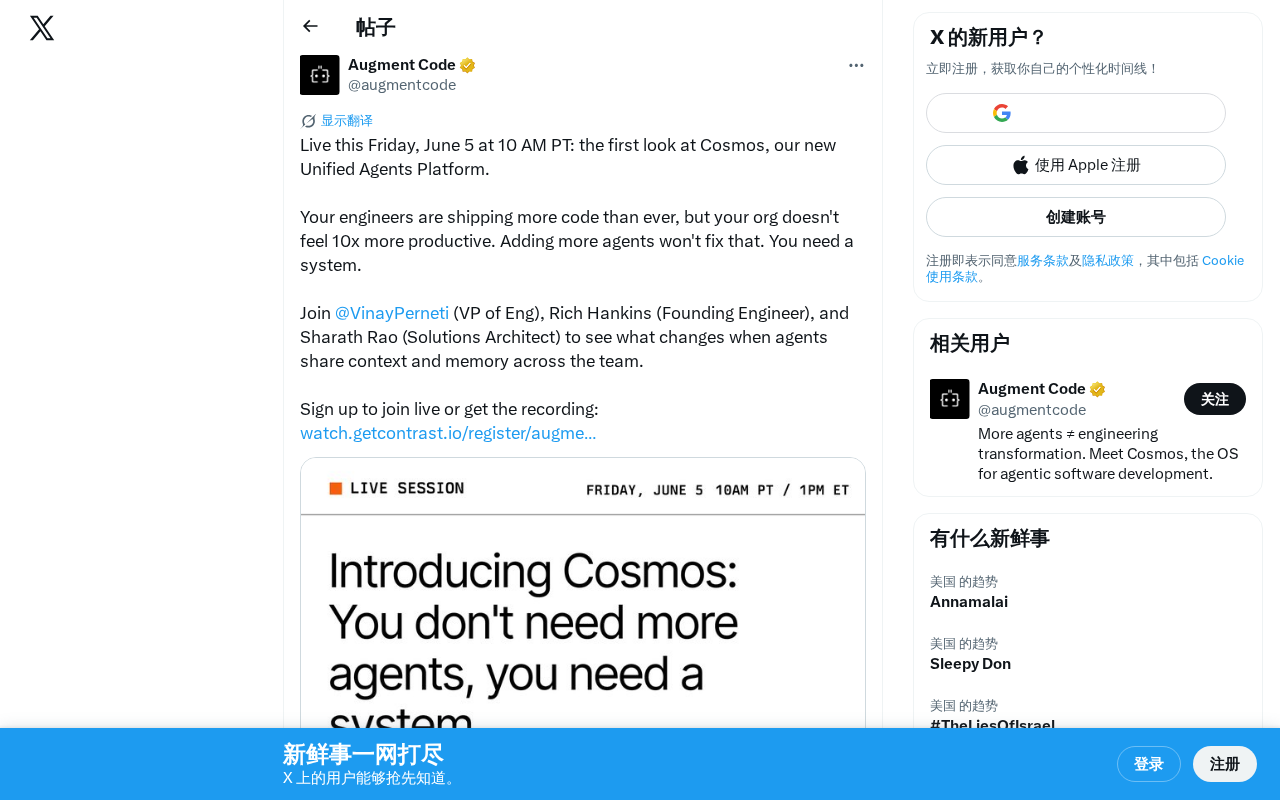
A thought-provoking phenomenon is troubling an increasing number of technical teams: engineers are writing more code than ever with the help of AI tools, yet overall organizational productivity hasn't achieved a 10x improvement. Where's the problem?
The answer may not lie in "adding more agents," but rather in the lack of a systematic coordination mechanism. This is precisely the core problem that the Cosmos Unified Agents Platform aims to solve.
Design Philosophy of the Cosmos Unified Agents Platform
From Isolation to Collaboration: Breaking Down AI Agent Information Silos
Cosmos positions itself as a "Unified Agents Platform," with the core concept of enabling multiple AI Agents to share context and memory. This means different Agents are no longer isolated islands operating independently, but can collaborate efficiently like a real team.
In AI Agent architecture, context refers to the environmental information, conversation history, and relevant data that an Agent can access while executing tasks. Memory is divided into short-term memory (information within the current session) and long-term memory (knowledge persistently stored across sessions). Current mainstream large language models (LLMs) are constrained by context window size—even the most advanced models like Claude and GPT-4 have upper limits on the amount of information they can process—and a single Agent can often only handle a limited amount of information. Memory sharing in multi-Agent systems typically relies on vector databases (such as Pinecone, Weaviate, Chroma) for semantic retrieval, or structured knowledge graphs to maintain relationships between entities. The unified memory layer proposed by Cosmos is essentially a shared state management system across multiple Agents, similar to shared state storage in distributed systems, but with added dimensions of semantic understanding and permission control.
The dilemma most enterprises face when deploying AI Agents today is this: each Agent can only see the small slice of the domain it's responsible for, lacking awareness of overall project status, team decision history, and cross-module dependencies. While code output has increased, coordination costs, rework rates, and integration issues haven't decreased—they may even be worse.
Coordination cost is a classic concept in organizational theory, first systematically articulated by Fred Brooks in The Mythical Man-Month: as team size grows, communication paths increase exponentially (n nodes have n(n-1)/2 communication paths), leading to diminishing marginal productivity. This principle applies equally to AI Agent deployment. When enterprises run multiple AI Agents simultaneously (such as code generation Agents, testing Agents, documentation Agents, and code review Agents), the lack of a unified information synchronization mechanism produces coordination problems similar to those in human teams: duplicated work, contradictory outputs, and suboptimal decisions due to information asymmetry. Research shows that 40-60% of time in software development is spent on communication and coordination rather than actual coding. If AI Agents cannot solve this structural problem, their value will be significantly diminished.
Systems Thinking Rather Than Tool Stacking
The Cosmos team explicitly stated in their launch preview: "Adding more agents won't fix that. You need a system." This statement directly addresses a common misconception in the current AI tools market—enterprises tend to continuously introduce new AI tools while neglecting the collaboration and information flow between them.
The value of a unified platform lies in providing a shared "cognitive layer" that allows all Agents to access team-level knowledge bases, project context, and historical decision records, thereby producing more consistent and higher-quality outputs. This design philosophy shares similarities with the "Service Mesh" concept in microservices architecture—rather than having each service handle communication, security, and observability on its own, these cross-cutting concerns are provided through a unified infrastructure layer. In the world of AI Agents, Cosmos aims to become such an infrastructure layer, extracting context management, memory persistence, and inter-Agent communication from individual Agent implementations and managing them centrally.
Technical Team Lineup and Product Delivery Capability
This debut presentation features three core members: VP of Engineering Vinay Perneti, Founding Engineer Rich Hankins, and Solutions Architect Sharath Rao. The team composition—including both product-level technical decision-makers and frontline architecture practitioners—suggests that Cosmos is not merely a concept demo but a product with actual delivery capability.
Notably, the involvement of a Solutions Architect indicates that Cosmos is already considering real-world enterprise deployment scenarios. In enterprise software, Solutions Architects are typically responsible for matching product capabilities with customers' specific business needs and technical environments. The presence of this role suggests that Cosmos may already have validation feedback from early customers.
Industry Trend: From Single Agents to Multi-Agent Orchestration
Multi-Agent Collaboration Becomes a New Focus for AI Infrastructure
Cosmos's emergence is not an isolated case. Multi-Agent collaboration and orchestration has become one of the hottest directions in AI infrastructure. From Microsoft's AutoGen to LangChain's LangGraph to open-source frameworks like CrewAI, the industry is shifting from "what can a single Agent do" to "how can multiple Agents collaborate efficiently."
Multi-Agent orchestration refers to the technology of coordinating multiple AI Agents to collaboratively complete complex tasks according to specific workflows, communication protocols, and decision logic. Microsoft's AutoGen adopts a conversational orchestration model, allowing multiple Agents to collaborate through message passing, inspired by human team discussion patterns. LangChain's LangGraph is based on the concept of directed graphs, modeling Agent workflows as state machines that support conditional branching, loops, and human-in-the-loop nodes. CrewAI introduces the concept of role-playing, assigning each Agent clear responsibilities, goals, and backstories to simulate real team division of labor. The common challenge across these frameworks is: how to ensure global consistency while maintaining Agent autonomy, how to handle conflicts and deadlocks between Agents, and how to maintain system predictability as scale increases. Cosmos's differentiated positioning appears to lie in its emphasis on "unified context," which may mean it's not just an orchestration framework but a more foundational shared cognitive infrastructure.
The Real Bottleneck of Enterprise AI
The pain point Cosmos targets is universal: in enterprise environments, the value of AI tools depends not only on the strength of individual capabilities but also on whether they can integrate into existing workflows and team collaboration patterns. The ability to share context and memory is essentially solving the "organizational IQ" problem for AI Agents—enabling a group of intelligent individuals to truly form collective intelligence.
The concept of Organizational IQ originates from research at MIT Sloan School of Management, referring to an organization's ability as a whole to process information, make decisions, and adapt to change. Unlike individual IQ, organizational IQ is highly dependent on information flow efficiency, shared mental models, and collective memory systems. In the context of AI Agents, this means that even if each Agent possesses powerful individual reasoning capabilities, the overall system's performance may fall far below the sum of its parts without effective information sharing and coordination mechanisms—this is the so-called "intelligence paradox." Google's famous Project Aristotle research confirmed similar findings: the key to team effectiveness lies not in the simple addition of individual capabilities but in psychological safety and information transparency. This finding has direct implications for multi-Agent system design, suggesting that "trust mechanisms" and "information visibility" between Agents may be more important than the capability ceiling of any single Agent.
Key Questions Worth Watching About the Cosmos Platform
Although Cosmos's vision is exciting, several key questions are worth validating after the official product launch:
-
Privacy and Permission Control: When Agents share context, how is access to sensitive information properly managed? In enterprise environments, different teams and roles have strict hierarchical access controls (such as RBAC—Role-Based Access Control). A unified Agent platform needs to find a precise balance between promoting information sharing and protecting information security. This is not just a technical issue but also involves compliance requirements (such as GDPR, SOC 2) and enterprise governance policies.
-
Context Quality Management: How do shared memory and context remain accurate and timely? Outdated information can be more dangerous than no information at all. This challenge is technically known as the "knowledge decay" problem—as codebases evolve, requirements change, and team members rotate, previously stored contextual information may become inaccurate or even misleading. Effective solutions may need to incorporate timestamp marking, confidence scoring, and automatic expiration mechanisms.
-
Integration Ecosystem Compatibility: Can it seamlessly integrate with existing development toolchains (IDEs, CI/CD, project management tools)? Enterprise development environments typically consist of dozens of tools (GitHub/GitLab, Jira, Slack, Jenkins/GitHub Actions, VS Code, etc.), and the adoption threshold for a new platform largely depends on its integration depth with the existing tool ecosystem. Historical experience shows that even platforms with advanced concepts will see significantly reduced adoption rates if they require enterprises to substantially change their existing workflows.
The answers to these questions will determine whether Cosmos can transform from an attractive concept into AI infrastructure that enterprises are truly willing to adopt.
Key Takeaways
Related articles

Claude Code for Test Development in Practice: An AI Programming Workflow That Doubles Your Efficiency
A practical guide to Claude Code for test development: auto-generating test scripts, Plan Mode workflows, MCP + Playwright integration, and Subagent parallel tasks to build systematic AI-assisted workflows.

Hermes Agent Hands-On Review: An AI Efficiency Revolution for Indie Game Developers
Indie game developer reviews Hermes Agent vs OpenClaude: intelligent context compression, real-time Memory, remote control via Telegram, and practical use cases in game dev, social media, and email.
Vibe Coding Beginner's Guide: Tool Selection Across Three Categories with Practical Examples
A comprehensive guide to Vibe Coding's three tool categories: Agent frameworks, CLI Coding, and IDE tools, with practical examples including Snake game and data analysis workbench.