Costco's Business Model Explained: You Serve Whoever Pays You

Costco's membership model forces it to serve members — its profit structure is its conscience.
Costco's 14% gross margin isn't charity — it's structural. By earning nearly all profit from membership fees rather than product markups, Costco is incentivized to minimize prices through streamlined SKUs and bare-bones operations. Its 92%+ renewal rate acts as a built-in feedback mechanism, instantly punishing any decline in value. Compared to Amazon Prime's ecosystem lock-in, Costco's model reveals a universal principle: companies serve whoever pays them.
With Only a 14% Gross Margin, How Does Costco Make Money?
Costco's gross margin is only 14% — roughly half of Walmart's. Many people's first reaction is "what a conscientious company," but the reality is far more nuanced — Costco doesn't make money from selling products; it makes money from membership fees.
Costco's membership fee model is what economists call a "two-part tariff" — consumers first pay a fixed access fee (the membership), then purchase goods at near-cost prices. This pricing strategy was first systematically described by economist Walter Oi in 1971 when studying Disneyland admission tickets. The core logic: a company captures consumer surplus through the fixed fee while pushing marginal product profits extremely low, thereby maximizing transaction volume. For Costco, membership fee revenue in fiscal year 2024 was approximately $4.7 billion — nearly equal to its entire net profit. This means product sales themselves are merely a "break-even" tool; the real profit engine is that annual membership card.
This distinction is crucial. Costco doesn't keep prices low out of goodness — its business model dictates that it can only serve its members' interests. Reportedly, Costco has an ironclad internal rule: any gross margin exceeding 14% requires senior executive approval. This isn't a moral constraint — it's a structural one. Goodness doesn't need executive sign-off, but price hikes do.
This leads to a core question: what exactly has Costco given up in order to serve its members?
Streamlined SKUs: The Philosophy of Trade-offs
Costco carries only about 4,000 SKUs (Stock Keeping Units), while Walmart has over 100,000. This means many things you want to buy simply can't be found at Costco.
SKU (Stock Keeping Unit) is the basic unit retailers use to measure product variety — every distinct product specification, color, and package counts as one SKU. By keeping SKUs at around 4,000, Costco typically retains only 1–3 brands per category. This strategy is known in supply chain management as the "category killer" approach — when only one or two suppliers are selected for a category, Costco can concentrate its entire purchasing volume with them in exchange for wholesale prices far below market rates. By some estimates, Costco's average sales per SKU is tens of times higher than Walmart's, and this "volume-for-price" bargaining leverage is the foundation of its low-price strategy. At the same time, fewer SKUs mean extremely high inventory turnover — Costco's inventory turnover is about 30 days, much faster than Walmart's approximately 42 days, resulting in greater capital efficiency.
Beyond that, Costco has no fancy shelving, no shopping bags, no staff to help you pack — the warehouse-style displays are bare-bones. These aren't an "austere aesthetic" — they're deliberate sacrifices.
There's an elegant analogy here: it's like hosting a dinner on a budget — you either serve many dishes where each is mediocre, or fewer dishes where each one is impressive. Costco chose the latter.
The logic chain behind this is crystal clear:
- More SKUs → scattered purchasing → less bargaining power with suppliers → can't push prices down
- Fancier shelves → higher operating costs → costs passed on to prices
Every single "sacrifice" points to the same goal: driving prices as low as possible. Costco doesn't want to make these trade-offs — its revenue model forces it to. When your income comes from membership fees rather than product markups, you must make members feel it's "worth it," or they won't renew.
Renewal Rate: Costco's Built-in Braking System
Some might ask: doesn't the membership fee model have a weakness — what if the products are expensive and low-quality? Wouldn't members lose out?

The answer is: the renewal rate is the safety net. Costco's renewal rate exceeds 92% per store in North America and is about 90% globally. This is essentially a "contract renewed annually" — if the tenant isn't happy, they move out, and the landlord panics more than anyone.
In the SaaS (Software as a Service) industry, Retention Rate and Churn Rate are core metrics for measuring product health, often called the "North Star Metric." Costco applied this concept — decades before the internet era — to physical retail. A 92% North American renewal rate means fewer than 8% of members choose to leave each year, which is top-tier for subscription-based businesses. For comparison, Netflix's monthly churn rate is about 2–3%, which translates to an annual retention rate far below Costco's. More critically, renewal rate is a "lagging but honest" indicator: it comprehensively reflects user satisfaction across price, quality, shopping experience, and every other dimension. Any deterioration in a single area will show up in the next renewal cycle.
Last year, when Costco raised the annual fee for regular members by $5, it simultaneously increased the cashback cap for Executive members from $1,000 to $1,250. That level of anxiety over a $5 increase exists because every percentage point drop in renewal rate means tens of millions of dollars in evaporated revenue.

The most brilliant insight here is: the renewal rate isn't a performance metric — it's a brake, and one that members themselves control.
Why Is This Brake "Built Into the System"?
Here's a software engineering analogy: when you write code, you still need a QA team to find bugs. But Costco doesn't even need a QA team — the users are the QA team. And this feedback mechanism is immediate:
- Quality drops → renewal rate drops instantly
- No need to wait for complaints or guess at causes
- The data directly tells you "something's wrong"
Unlike many internet products where bugs ship, users complain, and the company reacts after the fact, Costco's renewal rate is a real-time mirror reflecting every subtle change in service quality.
Who's stopping Costco from going bad? The members themselves. A built-in brake is the most reliable kind.
Costco vs. Amazon Prime: Same Membership Fees, Completely Different Paths
Both use membership fee models, but Costco and Amazon Prime "serve their members" in entirely different ways.
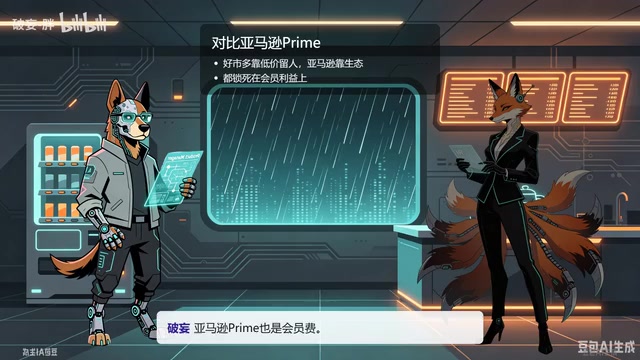
| Dimension | Costco | Amazon Prime |
|---|---|---|
| Retention method | Low prices | Ecosystem |
| Core moat | Ultimate value for money | Logistics + streaming + AWS infrastructure |
| Source of user stickiness | Saving money on every purchase | Can't leave the entire ecosystem |
Costco's way of "serving members" is cutting prices — squeezing every product's price to the minimum on your behalf. Amazon's way of "serving members" is making you unable to leave — you don't depend on any single low-priced product, but on the entire ecosystem.
Amazon Prime's membership system is a textbook "ecosystem lock-in" strategy. Prime initially offered only free two-day shipping, but Amazon gradually bundled in Prime Video streaming, Prime Music, Prime Reading, Prime Gaming, Amazon Photos unlimited storage, and more. In behavioral economics, this is known as the "sunk cost effect" combined with "switching cost accumulation" — when users have built up watch histories, music playlists, cloud photos, and other digital assets within one ecosystem, the psychological and practical cost of migrating to a competitor skyrockets. As of 2024, there are over 200 million Prime members globally, with the annual fee at $139 in the U.S. Unlike Costco, Prime's stickiness doesn't rely on price advantages in individual purchases — it relies on users' dependence on an entire digital life infrastructure.
Different methods, same direction: both are locked onto serving member interests. Because both collect money from members, they can only serve members. This is the principle of "judge by actions, not intentions" — you don't need to assess a company's conscience; you just need to see who's paying them.
The Deeper Insight: Great Business Models Have Built-in Error Correction
Costco's case reveals a core principle of business model design: great business models have built-in error-correction mechanisms.
The renewal rate is Costco's error-correction mechanism — it doesn't need external regulation or moral constraints. The system itself punishes any deviation from user interests. This is more reliable than any corporate culture manifesto.
Costco's "built-in error-correction mechanism" insight aligns closely with the institutional economics theory of Nobel laureate Douglass North. North argued that good institutional design should make participants' self-interested behavior automatically lead to socially optimal outcomes, rather than relying on individual moral awareness. In Costco's model, management's self-interested pursuit of profit maximization is perfectly aligned with the goals of lowering product prices and improving the member experience — because only satisfied members renew, and renewals are the profit source. This "incentive compatibility" mechanism design is far more robust and sustainable than relying on an entrepreneur's personal conscience or external regulation.
But it's worth noting that not all fee-based models have this kind of brake. In some business models, user feedback is delayed, ambiguous, or even blocked. When a system "doesn't even have brakes," going bad is just a matter of time.
Back to that core principle: you serve whoever pays you. To judge whether a company will treat you well, you don't need to listen to what it says — just look at where its money comes from.
Key Takeaways
Related articles
Claude Code Installation & Setup Guide: Low-Cost Vibe Coding with Chinese AI Models
Step-by-step guide to installing Claude Code and configuring it with Chinese models like DeepSeek for low-cost vibe coding, including Node.js setup and CCSwitcher usage.
Keyroll: An In-Depth Look at a Stability-Focused Claude Refill Tool
In-depth review of Keyroll, a stability-focused Claude refill tool. Analyzing its core strengths, security implications, and compliance considerations for developers facing usage limits.

OpenLLMVTuber: A Deep Dive into the Open-Source AI Virtual Character Framework
Deep dive into OpenLLMVTuber, a 10K-star open-source AI virtual character framework integrating ASR, LLM, TTS, and Live2D with voice interruption, visual perception, and modular architecture.