Coze Workflow Development Tutorial: A Complete Guide to Building AI Apps with Zero Code
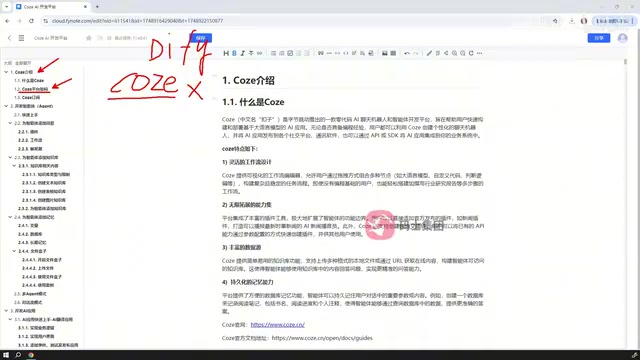
A complete guide to building AI apps on ByteDance's Coze platform using workflows, agents, and plugins.
This guide covers ByteDance's Coze platform for zero-code AI application development. It explains the platform's two main app types (Agents and AI Applications), workflow node orchestration, plugin system, and API integration. The article also compares Coze with Dify, helping readers choose the right AI development platform based on their needs for open-source flexibility vs. out-of-the-box convenience.
What Is Coze? ByteDance's AI Development Platform
Coze is an AI tool platform launched by ByteDance that enables users to build various AI applications with zero code. Its positioning is similar to Dify — both are AI application development platforms — but they differ significantly in product architecture and feature focus.
AI application development platforms (also known as LLMOps platforms) have been a rapidly emerging technology category since 2023. As large language model (LLM) capabilities continue to grow, the core challenge for enterprises and individual developers has shifted from "can the model do it" to "how to quickly package model capabilities into usable applications." Traditional AI application development requires writing extensive prompt engineering code, handling API call chains, managing context windows, and more — all with a high technical barrier. LLMOps platforms emerged to address this pain point, using visual orchestration and pre-built components to reduce AI application development cycles from weeks to hours. Major players in the market today include open-source options like Dify and LangFlow, as well as commercial platforms like Coze, Baidu AppBuilder, and Alibaba Bailian.
For users looking to get started quickly with AI application development, Coze offers a low-barrier entry point — supporting Agent construction, workflow orchestration, conversation flow design, and other core capabilities that allow even non-technical users to assemble practical AI applications.
Coze's Platform Architecture and Core Concepts
Two Main Application Types
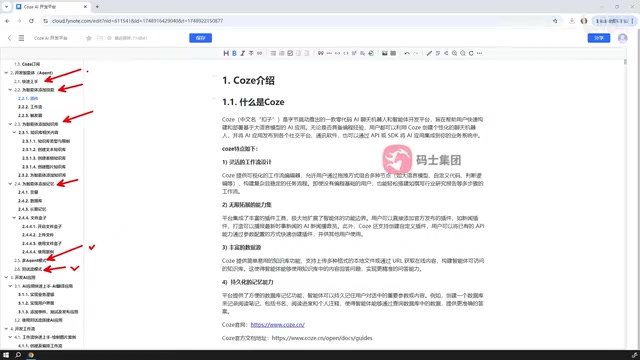
Unlike Dify, which supports five application types (chatbots, agents, text applications, workflows, and conversation flows), Coze's application building is divided into just two categories:
- Agent: Has conversational capabilities, can invoke tools and nest workflows — ideal for building interactive AI assistants
- AI Application: Supports nested workflows and provides a visual drag-and-drop interface, allowing users to build complete applications with frontend pages
This simplified classification reduces cognitive overhead for users, but it doesn't mean the functionality is simple. AI Applications can embed complex workflow logic and support visual interface building, where users can generate application pages through drag-and-drop to implement scenarios like image generation, conversations, PPT creation, and more.
Subscription and Pricing
Coze offers a free personal plan and a paid enterprise plan. The personal plan includes a daily free quota that's sufficient for learning and lightweight use. For enterprise-level, high-frequency use cases, a paid subscription is required.
Agent Development: From Single Agent to Multi-Agent Collaboration
Getting Started with Agent Building
Agents are the most fundamental and commonly used application type in Coze. The Agent is one of the most important technical paradigms in the AI field today. Unlike traditional single-turn Q&A, Agents possess autonomous planning, tool invocation, and multi-step reasoning capabilities. Their core architecture typically includes four modules: a perception module (receiving user input), a planning module (decomposing complex tasks into subtasks), an execution module (calling tools or APIs to complete specific operations), and a memory module (maintaining conversation history and long-term knowledge). The theoretical foundation of this architecture comes from the ReAct (Reasoning + Acting) framework, proposed by Google Research in 2022, whose core idea is to let LLMs alternate between "thinking" and "acting" during the reasoning process to handle more complex tasks.
In Coze, an Agent can include:
- Skills: Define what the Agent can do
- Knowledge Base: Provide the Agent with domain-specific knowledge
- Memory: Give the Agent contextual memory capabilities
The underlying technology behind the knowledge base feature is Retrieval-Augmented Generation (RAG). The RAG workflow consists of three stages: first, documents are converted into high-dimensional vectors through an Embedding model and stored in a vector database (such as Milvus, Pinecone, or Weaviate); second, when a user asks a question, the system converts the question into a vector as well and performs similarity search in the vector database to find the most relevant document fragments; finally, the retrieved content is injected as context into the LLM's Prompt, allowing the model to generate answers based on this specialized knowledge. RAG effectively addresses the LLM "hallucination" problem and knowledge timeliness issues, making it one of the most commonly used technical approaches in enterprise AI applications.
Single Agent vs. Multi-Agent Modes
Coze supports both single Agent and multi-Agent modes. Single Agent is suitable for simple Q&A or task-processing scenarios, while multi-Agent mode is designed for complex business processes where multiple Agents collaborate to complete tasks — similar to an AI team working together.
Multi-Agent collaboration (Multi-Agent System) originates from the field of distributed artificial intelligence and has gained widespread attention in the LLM domain with the emergence of frameworks like AutoGen, CrewAI, and MetaGPT. The core idea is to assign a complex task to multiple Agents with different roles and specializations, who work together through predefined communication protocols and collaboration strategies. For example, in a content production scenario, you could set up a "Research Agent" for information gathering, a "Writing Agent" for content generation, and a "Review Agent" for quality control — the three working together in a pipeline or discussion-based manner. The advantage of this approach is that each Agent can focus on its area of expertise, often producing higher overall output quality than a single Agent handling all tasks.
Coze Workflow Development: Node-Based Logic Orchestration
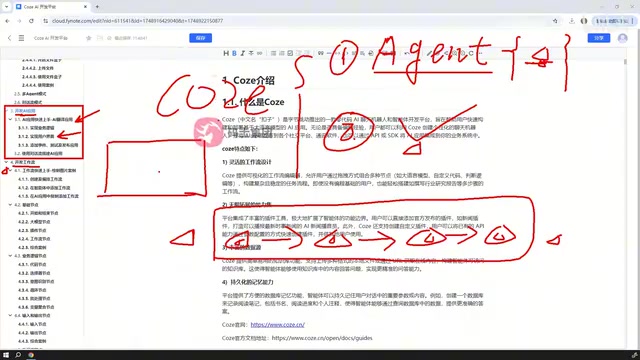
Workflows are one of the most core capabilities in Coze. They allow users to connect different nodes and have the LLM execute tasks according to preset logical steps. Workflows can be nested within both Agents and AI Applications.
Workflow Orchestration is essentially a visual representation of a Directed Acyclic Graph (DAG). Each node represents an independent processing unit (such as an LLM call, data transformation, or conditional judgment), and the connections between nodes define data flow direction and execution order. This design pattern has a long history in software engineering — from early Apache Airflow to modern n8n and Zapier, all adopt similar concepts. In the AI domain, the unique value of workflow orchestration lies in its ability to chain together complex AI operations like Prompt Chaining, RAG retrieval, and tool invocation into reproducible, debuggable automated processes, significantly reducing the development and maintenance costs of AI applications.
Complete Overview of Workflow Node Types
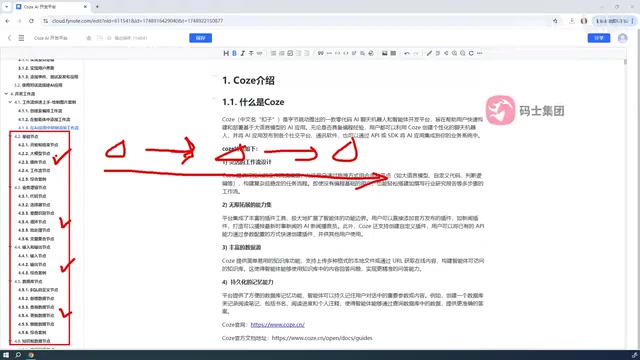
Coze's workflow nodes are extremely rich, far exceeding Dify's node count. The main categories include:
| Node Category | Description |
|---|---|
| Basic Nodes | Fundamental building blocks of workflows |
| Business Logic Nodes | Logic control such as conditional branching and loops |
| Input/Output Nodes | Data reception and return |
| Database Nodes | Data storage and retrieval operations |
| Knowledge & Data Nodes | Knowledge base retrieval and data processing |
| Image Processing Nodes | Image generation, editing, etc. |
| Component Nodes | Reusable functional modules |
Third-Party Nodes and Extensibility
Beyond the officially provided nodes, Coze also supports nodes submitted by third-party users. If existing nodes don't meet your needs, you can search for community-contributed nodes on the platform or develop custom plugins to extend functionality. This open ecosystem strategy draws from the successful experiences of developer communities like npm and PyPI, continuously expanding the platform's capabilities through community contributions.
Plugin System and API Code Integration
Three Sources of Plugins
- Official Plugins: Standard plugins maintained by the Coze team
- Community Plugins: Plugins submitted and shared by other users
- Custom Plugins: Proprietary plugins developed by users for their specific needs
Plugins can be used as nodes within workflows or mounted directly onto Agents, allowing the Agent to automatically invoke them during task execution. This plugin mechanism is essentially a productized encapsulation of Function Calling — the LLM determines when to call external tools during a conversation, automatically generates parameters conforming to the plugin interface specification, and integrates the results into its response after the call completes.
Integrating Coze Agents via API
Coze supports calling pre-built Agents through Python and Java code. This means developers can integrate Agents built on Coze into their own products, interacting with Agents through API-based conversations for more flexible business integration. API calls typically use RESTful interfaces or WebSocket persistent connections, with support for streaming output that makes the conversation experience smoother and more natural.
Coze vs. Dify: How to Choose?
The core differences between the two can be summarized as:
- Open Source: Dify is open source and supports private deployment; Coze is not open source and can only be used on the official platform
- Node Richness: Coze's node count and flexibility surpass Dify's
- Application Types: Dify supports 5 application types; Coze simplifies to 2
- Ecosystem: Coze is backed by ByteDance's ecosystem, with deep integration into products like Doubao
Coze leverages ByteDance's technology ecosystem, forming deep synergies with multiple products within the group. At the model level, Coze integrates ByteDance's proprietary Doubao large model by default while also supporting other mainstream models. The Doubao model has significant advantages in Chinese language understanding and multimodal processing, and as an in-house model, it offers natural advantages in call costs and response speed. At the distribution level, Agents built on Coze can be published with one click to the Doubao App, Feishu (Lark), WeChat Official Accounts, and other channels — this "build and distribute" capability significantly reduces the deployment cost of AI applications. Additionally, ByteDance's rich business scenarios in short video, e-commerce, education, and other domains provide Coze with abundant real-world application demands and data feedback.
Recommendation: If you need private deployment or deep customization, choose Dify. If you're looking for quick onboarding and rich ready-to-use nodes, choose Coze. For industries with extremely high data security requirements like finance and healthcare, Dify's private deployment capability is an irreplaceable advantage. For small and medium teams looking to quickly validate business ideas, Coze's zero-maintenance, out-of-the-box characteristics are more attractive.
Conclusion
As ByteDance's AI development platform, Coze opens the door to AI application development for everyday users with its zero-code, low-barrier approach. From Agent building to workflow orchestration, from plugin extensions to code integration, Coze provides a complete AI application development toolchain. For users looking to quickly validate AI application ideas and monetize AI capabilities, mastering Coze's workflow development is a skill worth investing in. As AI Agent technology continues to evolve and LLM capabilities keep improving, low-code AI development platforms like Coze will play an increasingly important role in the era where "everyone is an AI developer."
Related articles
Anjney Midha: The Rise from Singapore to Helm of a16z's AI Investment Empire
Deep dive into Anjney Midha, the key figure behind a16z's AMP fund, covering investments in Anthropic, Mistral, and Black Forest Labs, and his Outputmaxxing philosophy.
Pi: A Lightweight AI Coding Agent Framework — Setup & Hands-On Guide
A deep dive into Pi, a minimalist AI coding Agent framework covering multi-model support, extensions, skill loading, and hands-on custom extension building with model mixing strategies.

Why the Mayor of Los Angeles Has No Real Power: A City Designed to Be the Anti-New York
Why does LA's mayor seem powerless during crises like wildfires? It's not about competence — it's a century-old system designed to prevent corruption by radically decentralizing power.