Creating 3D City Map Time Animations with Claude: Visualizing a Millennium of Architectural Evolution

Analyzing the technical challenges of using Claude AI to create 3D city map animations spanning 1,000 years of building history.
A Twitter user challenged Claude AI to create a 3D map animation showing buildings appearing over a 1,000-year timeline for major cities. This article examines the core technical challenges — from sourcing historical building data via OpenStreetMap and city open data platforms, to 3D rendering with Mapbox GL JS, CesiumJS, and deck.gl, to performance optimization with LOD techniques. While Claude can generate solid prototype code, data completeness and engineering concerns still require human expertise.
A Fun AI Programming Challenge
Recently, a Twitter user posed a creative programming challenge to Claude AI: create a 3D map view animation showing buildings slowly appearing over time, with a time slider spanning from 1,000 years ago to the present, applicable to all major cities.
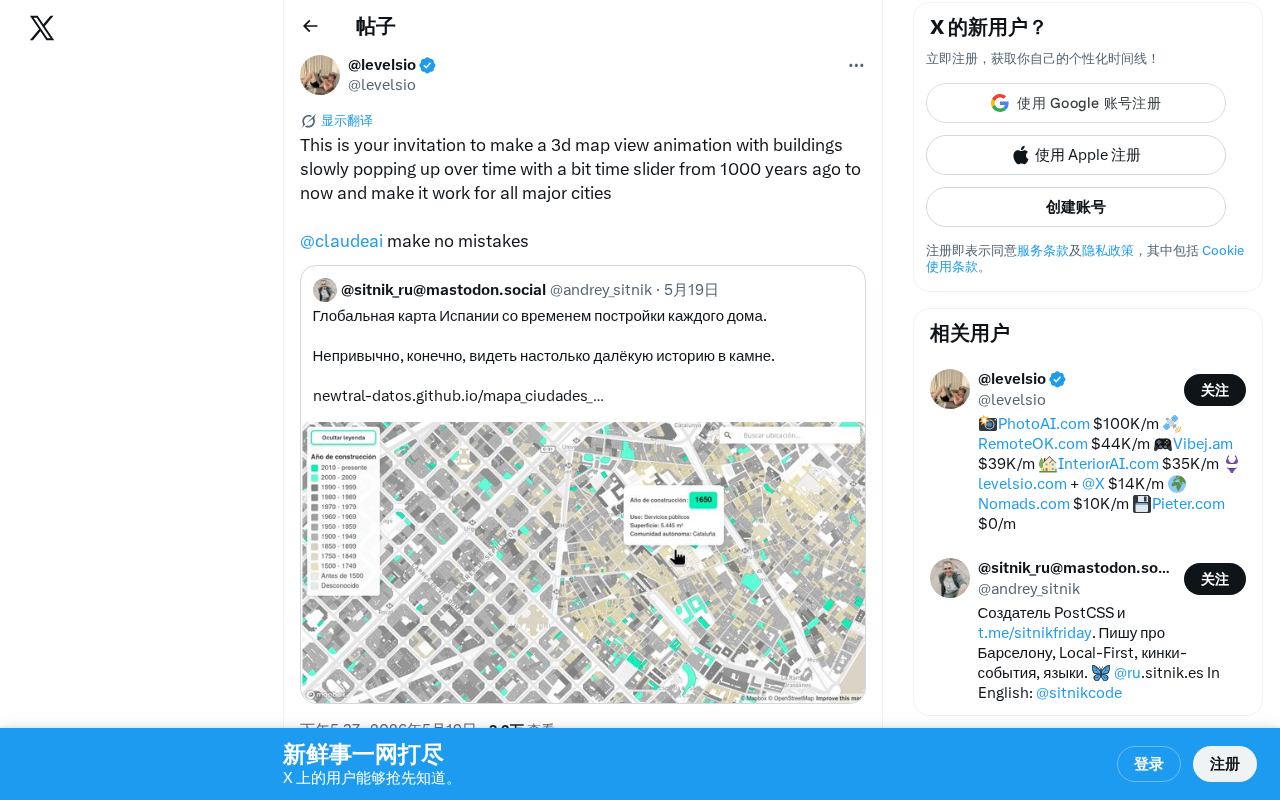
At the end of the post, the user specifically emphasized "@claudeai make no mistakes," reflecting high expectations for Claude's programming capabilities.
Technical Challenges of City 3D Map Time Animations
The Complexity of Obtaining Historical Building Data
To implement such a city building visualization project, the first challenge is acquiring historical building data. Building age data for major cities worldwide isn't readily available. Possible data sources include:
- OpenStreetMap: Some buildings are tagged with construction years (
building:start_datetag) - City open data platforms: For example, New York's PLUTO dataset includes building age information
- Historical map digitization projects: Such as the David Rumsey Map Collection
OpenStreetMap (OSM) is the world's largest open-source geographic database, with data contributed by millions of volunteers. Its building data is recorded through the building tag system, where the building:start_date tag marks a building's construction year. However, globally, buildings tagged with construction years account for less than 5% of all entries. OSM data quality also varies by region — coverage is higher in Europe and North America, while building data in many Asian and African cities remains sparse. Additionally, OSM uses a crowdsourcing model, meaning data accuracy depends on contributors' expertise, and historical building date annotations are particularly prone to errors.
New York's PLUTO (Primary Land Use Tax Lot Output) dataset is a model example of city open data. Maintained by the New York City Department of City Planning, it contains detailed information on over 850,000 lots across the city, with the YearBuilt field recording each building's construction year, with data traceable back to the 17th century. Similar datasets are uncommon in other cities, which is why New York is often the go-to city for this type of visualization project.
However, covering a time span from "1,000 years ago to the present" means that early data is extremely scarce for most cities. Historically rich cities like London, Paris, and Beijing may have some historical records, but a complete millennium-long building timeline remains a massive challenge. Even for London, with its rich historical archives, building records from before the Great Fire of 1666 are extremely limited. And while Beijing has detailed imperial architecture archives, historical data on ordinary residential buildings is virtually nonexistent.
Technical Implementation Path for 3D Map Rendering and Animation
From a technical perspective, this project can be broken down into several core modules:
- 3D Map Rendering: Using libraries like Mapbox GL JS, CesiumJS, or deck.gl for 3D building rendering
- Time Animation Control: Implementing a time slider that controls building visibility based on construction year
- Building Growth Animation: A "pop-up" effect achieved by transitioning building height from 0 to actual height
- Multi-city Support: Requires a unified data format and switching mechanism
The current mainstream Web 3D map rendering libraries each have their strengths: Mapbox GL JS is WebGL-based and provides an out-of-the-box 3D building layer (fill-extrusion), making it ideal for rapid prototyping, though it's a commercial product requiring an API key with usage limits; CesiumJS focuses on 3D globe visualization, supporting terrain, oblique photography, and BIM model loading, excelling at city-level fine-grained rendering and commonly used in digital twin projects — its open-source CesiumJS version is free but the 3D Tiles data service requires payment; deck.gl, developed and open-sourced by Uber, specializes in GPU-accelerated rendering of large-scale data, with its GeoJsonLayer and PolygonLayer efficiently handling hundreds of thousands of building polygons, making it particularly suited for data-intensive visualization scenarios. All three are built on the WebGL technology stack but differ significantly in data format support, rendering pipeline design, and performance optimization strategies, requiring developers to choose based on project requirements and data characteristics.
The Capability Boundaries of Claude AI for Generating 3D Visualization Code
Feasibility of Code Generation
Claude can indeed generate complete front-end code to implement this type of visualization project. Using Mapbox GL JS's 3D building layers combined with custom time-filtering logic is entirely technically feasible. A basic implementation might include:
- Using
mapbox-gl'sfill-extrusionlayer to render 3D buildings - Dynamically filtering buildings via the
filterproperty based on time slider values - CSS animations or WebGL shaders to achieve building "growth" effects
Mapbox GL JS's fill-extrusion layer is one of the most convenient ways to implement Web-based 3D building rendering. It extrudes 2D polygons (building footprints) vertically into 3D volumes, using the fill-extrusion-height property to control building height and fill-extrusion-base to control the base starting height. The layer supports data-driven styling, meaning colors and opacity can be dynamically set based on each building's attributes (such as construction year, use, and height). Combined with filter expressions, developers can implement time-based building filtering — for example, displaying only buildings constructed before a certain year. By using a requestAnimationFrame loop to update filter conditions, a building "growth" animation over time can be achieved. More advanced implementations can leverage custom WebGL shaders, passing the current time value via uniform variables to calculate each building's visibility and height interpolation directly on the GPU, resulting in smoother animation performance.
The Gap Between Ideal and Reality
However, the "make no mistakes" requirement is nearly impossible to fully satisfy in a real project. The main limitations include:
- Data completeness: No single data source provides complete building data spanning a millennium for all major cities
- Performance optimization: Large cities may have hundreds of thousands of buildings, and real-time 3D rendering requires sophisticated LOD (Level of Detail) management
- Historical accuracy: Many buildings have been rebuilt or renovated, and a simple "appearance time" cannot capture their full history
LOD (Level of Detail) is a core optimization technique in 3D graphics. Its basic principle is: objects farther from the viewer are rendered with simplified geometric models, while nearby objects use high-precision models. In city 3D visualization scenarios, a city may contain hundreds of thousands of buildings, and rendering all of them at maximum precision simultaneously would challenge even modern GPUs to maintain a smooth 60fps frame rate. Common LOD strategies include: distance-based geometric simplification (representing distant buildings as simple blocks), view frustum culling (rendering only objects within the camera's visible range), occlusion culling (skipping rendering of objects completely hidden behind other buildings), and tiled loading (dividing the map into pyramid-style multi-level tiles and loading data at the appropriate precision on demand). Both Mapbox's vector tile system and Cesium's 3D Tiles specification have built-in multi-level LOD management mechanisms that automatically switch between building models of different precision based on camera distance.
Implications for AI Programming Capabilities
This case effectively illustrates the current positioning of AI programming assistants: they excel at rapidly generating prototype code and technical architectures, but data acquisition, performance tuning, and edge case handling in complex projects still require deep involvement from human developers.
From a broader perspective, AI programming assistants (such as Claude, GitHub Copilot, Cursor, etc.) perform excellently at generating code for "known patterns" — they can quickly scaffold a complete application framework including map initialization, layer configuration, event listeners, and UI controls. However, when projects involve real-time availability verification of external APIs, memory management strategies for large-scale data, and cross-browser compatibility debugging — these "engineering" concerns — AI-generated code often requires extensive testing and iterative optimization by human developers.
For developers looking to attempt similar projects, the recommendation is to start with a single city (such as New York, which has the most comprehensive data), implement core functionality first, then gradually expand. Claude can serve as an excellent programming partner, helping to quickly build frameworks and solve specific technical problems, but overall project planning and data strategy still need human oversight.
Industry Trends in Urban Digital Twins and Historical Visualization
Urban Digital Twin is a core concept in the smart city domain in recent years, referring to the creation of virtual mirrors of physical cities through digital means to enable real-time monitoring, simulation prediction, and decision optimization of urban operations. Multiple cities worldwide have launched digital twin projects, such as Singapore's Virtual Singapore (with over $73 million in investment), Helsinki's Helsinki 3D+ (providing open city 3D model data), and Shanghai's urban digital twin platform. These projects typically integrate BIM building models, IoT sensor data, traffic flow, meteorological data, and other multi-source information to build a holographic digital foundation for cities.
Historical urban visualization is an important extension of digital twins. It serves not only urban planning (understanding urban evolution patterns to guide future development) and cultural heritage preservation (digital documentation and virtual reconstruction of historical buildings), but also has broad applications in real estate assessment (analyzing regional development history to judge appreciation potential), tourism showcasing (immersive historical experiences), and education. The project proposed by the Twitter user is essentially a lightweight urban historical digital twin application.
Conclusion
This seemingly simple tweet actually proposes a comprehensive project integrating Geographic Information Systems (GIS), historical data, 3D visualization, and front-end engineering. It serves both as a test of AI programming capabilities and as a highly attractive project direction for creative developers. As urban digital twins and historical visualization receive increasing attention, such projects hold significant practical value and visual impact. With the gradual adoption of the WebGPU standard and continuous improvements in browser 3D rendering capabilities, implementing larger-scale, higher-precision urban historical visualizations on the Web will become increasingly feasible in the future.
Related articles

Claude Code for Test Development in Practice: An AI Programming Workflow That Doubles Your Efficiency
A practical guide to Claude Code for test development: auto-generating test scripts, Plan Mode workflows, MCP + Playwright integration, and Subagent parallel tasks to build systematic AI-assisted workflows.

Hermes Agent Hands-On Review: An AI Efficiency Revolution for Indie Game Developers
Indie game developer reviews Hermes Agent vs OpenClaude: intelligent context compression, real-time Memory, remote control via Telegram, and practical use cases in game dev, social media, and email.

Vibe Coding Beginner's Guide: Tool Selection Across Three Categories with Practical Examples
A comprehensive guide to Vibe Coding's three tool categories: Agent frameworks, CLI Coding, and IDE tools, with practical examples including Snake game and data analysis workbench.