Cursor Auto-Review Mode Explained: Smart Tiered Approval for More Efficient AI Programming
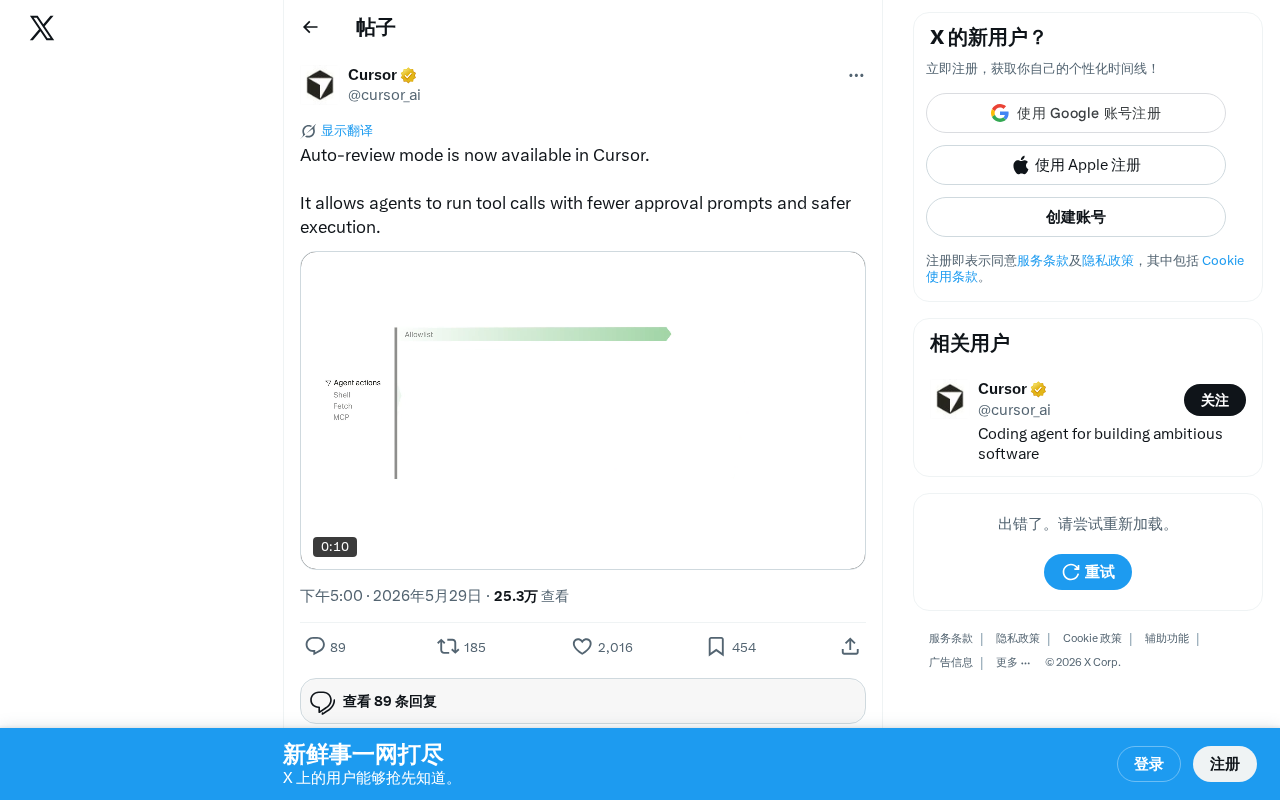
Cursor's Auto-review mode uses intelligent risk tiering to auto-approve safe AI operations while flagging risky ones.
Cursor's new Auto-review mode introduces smart tiered approval for AI Agent tool calls, automatically approving low-risk operations like file reads while requiring manual confirmation for high-risk actions like deletions. The feature addresses the core tension between automation efficiency and safety in AI programming, using multi-dimensional risk assessment. This article explores how it works, compares approaches from Claude Code, Copilot, and Devin, and examines implications like automation bias.
Cursor's New Feature: Auto-Review Mode Officially Launches
Cursor recently announced the launch of its brand-new Auto-review mode, a feature that allows the AI Agent to reduce manual approval prompts when executing tool calls while maintaining a safer execution environment. This update marks a new balance point between automation and security for AI programming assistants.
What Is Auto-Review Mode? What Pain Points Does It Solve?
In traditional AI programming assistant workflows, every tool call the Agent executes—such as file read/write, terminal command execution, or code modification—typically requires the user to manually click to confirm. A tool call refers to the mechanism by which a large language model requests external operations through a structured format. This concept originated from the Function Calling capability introduced by OpenAI in 2023, which was later widely adopted and evolved into the more general Tool Use paradigm. In the context of programming assistants, typical tool calls include reading and writing to the file system, executing terminal Shell commands, searching codebases, calling APIs, and more. Each tool call essentially represents the AI model crossing the boundary from "pure text generation" to "real-world operations," which is why strict permission controls are necessary.
From a technical implementation perspective, after a user issues a natural language instruction to the Agent, the large language model generates a structured JSON object declaring the tool name and parameters to be called (e.g., {tool: 'write_file', path: '/src/app.js', content: '...'}). The programming assistant's runtime environment parses this JSON, maps it to actual operations on the local system, executes it, and returns the results to the model for the next round of reasoning. In this process, the runtime environment acts as a "gatekeeper." Auto-review mode essentially introduces intelligent pass/block decision logic at this gatekeeper layer, replacing the previous simple "block everything and wait for confirmation" strategy.
Current mainstream permission models typically use a "whitelist + per-call confirmation" approach, where allowed operations are predefined, and operations not on the whitelist require user approval each time. While this mechanism is secure, it frequently interrupts workflows in practice and reduces development efficiency—especially when the Agent needs to execute multiple consecutive steps to complete a complex task.
The core idea behind Auto-review mode is: Let the Agent self-review its own tool calls, automatically approve low-risk operations, and only request user confirmation for high-risk operations. This means developers can collaborate more smoothly with AI without having to press the "confirm" button at every step.
Why Auto-Review Mode Deserves Attention
Rebalancing Efficiency and Security
A core contradiction in current AI programming tools is: The higher the degree of automation, the greater the potential risk; the more security approvals required, the worse the user experience. Cursor's Auto-review mode attempts to find a better balance between these two.
The tiered risk philosophy behind Auto-review mode is not new in the security field—it draws from the Principle of Least Privilege and sandboxing mechanisms in operating system permission management. At the implementation level, the system likely performs multi-dimensional risk assessment for each tool call: operation type (read vs. write vs. delete), scope of impact (single file vs. directory vs. system-level), reversibility (whether it can be undone via Git), and context sensitivity (whether it involves configuration files, key files, etc.). Similar tiered trust mechanisms have mature implementations in Docker container permissions, AWS IAM policies, and the Android app permission model. The core challenge in applying this approach to AI programming assistants lies in the accuracy of the risk assessment model itself—misjudgments could lead to dangerous operations being automatically approved or safe operations being frequently blocked.
Building an accurate tool call risk assessment model faces multiple engineering challenges. First is the context dependency problem: the same rm command carries vastly different risks when deleting temporary build artifacts versus deleting a source code directory—the assessment model needs to understand the semantic meaning of file paths. Second is the combinatorial risk problem: individual operations may be safe, but a series of operations combined could produce dangerous effects—for example, modifying .gitignore before deleting files could make the deletion unrecoverable through Git history. Additionally, risk characteristics vary significantly across different programming languages and frameworks: modifying Python's requirements.txt could trigger changes across the entire dependency chain, while modifying a Kubernetes YAML configuration file could directly affect the running state of a production cluster. These complexities mean risk assessment cannot rely solely on simple rule matching—it likely requires a combination of semantic understanding and project context for comprehensive judgment.
From an industry trend perspective, this aligns with the development direction of multiple AI programming tools. Claude Code uses a permission configuration system based on .claude files, allowing developers to define which directories are readable/writable and which commands are executable through declarative rules, with support for project-level and user-level layered configuration. The advantage of this declarative static configuration approach is transparency and auditability—developers can track permission changes through version control—but it has limited flexibility and cannot dynamically adjust based on runtime context. GitHub Copilot's Workspace feature focuses on helping AI understand the entire codebase context, improving operational accuracy through indexing and retrieval augmentation, indirectly reducing the risk of misoperations. Windsurf (formerly Codeium)'s Cascade mode also implements similar multi-step autonomous execution capabilities. Open-source AI programming tools like Aider use a "suggest-confirm" model where AI generates code diffs and users decide whether to apply them, essentially treating all write operations as high-risk operations requiring confirmation. Devin goes to the other extreme, executing all operations in a fully isolated cloud sandbox, ensuring security through environment isolation rather than permission control.
These different technical approaches reflect the industry's diverse exploration of the same problem: how to maximize AI agent autonomous execution efficiency without sacrificing security. Cursor's Auto-review mode can be seen as choosing a pragmatic middle position on this spectrum—neither fully isolated nor confirming one by one, but optimizing the experience through intelligent tiering.
Practical Impact on Developer Workflows
For developers who use Cursor daily, the most direct changes brought by Auto-review mode include:
- Fewer interruptions: No longer needing to frequently confirm every file modification or command execution
- Smoother multi-step tasks: The Agent can coherently complete complex refactoring, debugging, and other tasks
- Retained critical control: High-risk operations (such as deleting files or executing destructive commands) still require manual confirmation
This design philosophy embodies an important principle: Trust should be tiered. Reading file contents and deleting an entire directory clearly should not require the same level of approval.
The Trend Toward Autonomous AI Programming Assistants
From a broader perspective, Auto-review mode reflects a key transformation that AI programming tools are undergoing—evolving from "tools" to "collaborators."
Early code completion tools (such as traditional Copilot and TabNine) were based on autoregressive language models that predicted subsequent code snippets at the cursor position, essentially a single-turn, stateless inference process. The current Agent mode introduces ideas from the ReAct (Reasoning + Acting) framework—proposed by Yao et al. in 2022, its core innovation lies in interleaving Chain-of-Thought reasoning with external tool interactions. AI can perform multi-turn reasoning-action loops: first observe the current state, formulate a plan, execute an action, observe the result, then decide the next step.
In programming scenarios, a typical ReAct loop might be: Thought ("I need to first check the current routing configuration") → Action (read the router.js file) → Observation (get file contents) → Thought ("Found that the router is missing error handling middleware") → Action (modify the file to add middleware) → Observation (confirm modification successful) → Thought ("Need to add corresponding test cases") → Action (create test file). This loop can continue for dozens of rounds, each involving tool calls. If every round requires manual confirmation, a refactoring task requiring 15 steps might need the developer to click the confirm button 15 times—this is exactly the core pain point Auto-review mode aims to solve.
This architecture enables AI to handle complex tasks requiring multiple steps, such as cross-file refactoring, bug localization and fixing, and test case generation and validation. But multi-step execution also means errors can accumulate and amplify along the chain, which is precisely why permission control becomes even more important. Auto-review mode further advances this autonomy, giving the Agent greater decision-making space during execution.
However, this also raises some questions worth considering:
- How can the reliability of automatic review be guaranteed? Is the Agent's risk assessment of its own operations accurate enough? When facing operation sequences with strong context dependency and complex combinatorial risks, can the assessment model reliably identify truly high-risk operations?
- Will developers overlook potential issues due to fewer approvals? Research on "Automation Bias" in psychology shows that when humans become accustomed to systems automatically making correct decisions, they gradually reduce their scrutiny of system outputs, and even system errors may go unnoticed. This phenomenon has been extensively documented in aviation autopilot and medical diagnostic assistance systems—for example, studies have found that pilots' response times to abnormal dashboard indicators significantly increase after prolonged use of autopilot systems. In AI programming scenarios, if developers rely on Auto-review mode for extended periods and rarely encounter issues, they may gradually relax their review of AI-generated code. When a truly high-risk operation is misclassified as low-risk, the consequences could be even more severe. Therefore, a well-designed Auto-review system needs not only accurate risk assessment but also appropriate "friction points" to maintain developer alertness—such as periodic operation summary reviews, highlighting of critical operations, and configurable "forced confirmation" checkpoints.
- How can risk thresholds be personalized for different projects? Production environment code and personal projects clearly need different approval strategies. An ideal Auto-review system should allow developers to flexibly adjust risk thresholds and auto-approval rules based on project type, branch strategy (e.g., main branch vs. feature branch), or even time periods (e.g., release freeze periods).
Summary
Cursor's Auto-review mode is a meaningful attempt at user experience optimization for AI programming tools. Rather than simply removing security approvals, it reduces unnecessary human intervention through intelligent risk assessment. As AI agent capabilities continue to grow, finding the optimal balance between autonomy and controllability will become a core challenge for all AI programming tools. For Cursor users, this feature is worth trying and evaluating early to find the configuration that best suits your workflow.
Related articles

Claude Code for Test Development in Practice: An AI Programming Workflow That Doubles Your Efficiency
A practical guide to Claude Code for test development: auto-generating test scripts, Plan Mode workflows, MCP + Playwright integration, and Subagent parallel tasks to build systematic AI-assisted workflows.

Hermes Agent Hands-On Review: An AI Efficiency Revolution for Indie Game Developers
Indie game developer reviews Hermes Agent vs OpenClaude: intelligent context compression, real-time Memory, remote control via Telegram, and practical use cases in game dev, social media, and email.
Vibe Coding Beginner's Guide: Tool Selection Across Three Categories with Practical Examples
A comprehensive guide to Vibe Coding's three tool categories: Agent frameworks, CLI Coding, and IDE tools, with practical examples including Snake game and data analysis workbench.