Cursor Composer 2.5: The Secret Behind an Open-Source Model's Reinforcement Training to a Top-3 Coding Benchmark Ranking
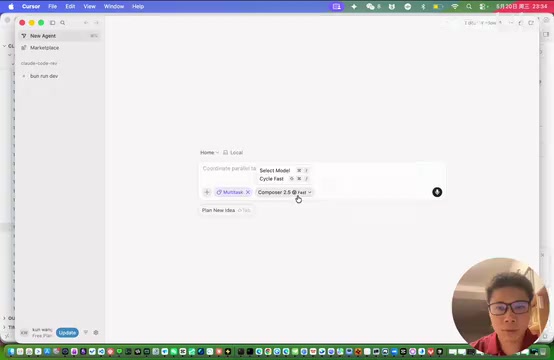
Cursor's Composer 2.5, fine-tuned on open-source Kimi K2, ranks top 3 on coding benchmarks via its data flywheel.
Cursor launched Composer 2.5 by reinforcement-training Moonshot AI's open-source Kimi K2 model, scoring 63.2 on SWE-bench to rank third — surpassing even Kimi's own K2.6. The secret lies in Cursor's data flywheel: massive real-world coding interaction data used for RLHF training. The article also covers Cursor's evolution into a full AI dev platform with Agent, Code Review, Cloud Execution, and CLI capabilities, plus pricing analysis and implications for the AI coding industry.
Core Event: Composer 2.5 Ranks Top 3 on Coding Benchmarks
Cursor recently launched its in-house model Composer 2.5, built through reinforcement training on top of Moonshot AI's open-source model Kimi K2. Moonshot AI was founded in 2023 by Yang Zhilin, a Tsinghua University alumnus, and is known for its long-context window technology. Kimi K2 uses a MoE (Mixture of Experts) architecture with trillion-level total parameters but only a fraction activated during inference, allowing the model to maintain strong capabilities while keeping inference costs under control. Being open-source means any organization can perform secondary training and commercial deployment on top of it — which is exactly what enabled Cursor to build Composer 2.5 on K2.
On coding benchmarks, Composer 2.5 scored 63.2, trailing only Opus 4 (64.8) and GPT 5.5, ranking third. The coding benchmark here primarily refers to the SWE-bench (Software Engineering Benchmark) evaluation suite, developed by a Princeton University team. It requires AI models to solve real issues from GitHub repositories — including understanding codebase context, locating problem files, writing fix patches, and passing test cases. Unlike traditional code generation benchmarks (such as HumanEval, which only tests function-level code completion), SWE-bench closely mirrors real software engineering scenarios, making it the gold standard for measuring AI coding ability. A score of 63.2 means the model can correctly solve approximately 63.2% of real software engineering problems — a level very close to the strongest closed-source models available today.
This result attracted widespread attention — even Elon Musk reposted the data. What's even more intriguing is that Kimi's own K2.6 version ranked only 13th on the same leaderboard, while Composer 2.5, trained on the open-source version, surged to third place. This contrast is worth pondering.
The Data Flywheel: How Cursor Trained an Open-Source Model to Outperform Its Creator
High-Quality Scenario Data Is the Key
The answer lies in data quality. As one of the earliest AI coding tools, Cursor has accumulated massive volumes of conversation data from users interacting with various models in real programming scenarios. This data, once refined, was used to perform RLHF (Reinforcement Learning from Human Feedback) training on the open-source Kimi K2 model, ultimately producing Composer 2.5.
RLHF is one of the core techniques for aligning and improving large language models today. The basic workflow is: first, collect human preference data on model outputs; then train a reward model to simulate human judgment; finally, use reinforcement learning algorithms (such as PPO or DPO) to optimize the language model so its outputs better match human expectations. In Cursor's case, users accept or reject code suggestions in the IDE every day, modify AI-generated code snippets, upvote results or request regeneration — these implicit feedback signals naturally constitute extremely high-quality RLHF training data. They come from real developers making real judgments in real projects, far more valuable than manually annotated preference data.
This reveals an important principle: In vertical domains, high-quality scenario data matters more than the base model itself. Cursor possesses real programming interaction data — an advantage that no general-purpose LLM company can easily match. While general-purpose LLM companies may have larger pre-training datasets and more compute power, they lack this kind of fine-grained feedback data from real coding workflows.
Implications for LLM Companies
This case points to a clear path for LLM companies:
- Acquire users for free first, accumulate data — Only when users are willing to use the product can data be collected. This explains why AI coding tools worldwide commonly adopt a Freemium model. The free tier's core purpose isn't charity — it's data collection.
- Use real-world scenario data for reinforcement training — This is more efficient than simply scaling up pre-training. The industry is reaching consensus: pre-training determines a model's capability ceiling, but post-training (including SFT supervised fine-tuning and RLHF) determines its actual performance on specific tasks.
- Build a vertical-domain data flywheel — More users → better data → stronger model → more users. Once this positive feedback loop is established, latecomers will find it extremely difficult to catch up, because data moats are the hardest of all moats to breach with capital and compute alone.

Cursor Product Landscape: From Coding IDE to Full-Stack AI Development Platform
Product Capabilities Far Beyond a Code Editor
Many users may not have noticed how fast Cursor's product has evolved. Today it's no longer just a code editor — it's a complete AI development platform:
- Agent: Autonomous programming capabilities similar to Claude Code and Devin. It can independently plan tasks, search codebases, write and execute code, run tests, and iteratively fix issues based on results — all without step-by-step human guidance.
- Code Review: Automated code quality checks that can automatically analyze code changes at the Pull Request stage, identifying potential bugs, performance issues, and violations of team coding standards.
- Cloud Execution: A cloud-based development environment similar to Codex and Claude Code, running code compilation, execution, and testing in cloud sandboxes to avoid dependency on and contamination of local environments.
- CLI Tool: Can be integrated into enterprise CI/CD pipelines to automatically execute AI-assisted code analysis and generation tasks in headless server environments.

The Strategic Significance of the CLI Tool
Cursor's CLI launch isn't simply about competing with Claude Code. The CLI's core value lies in enterprise pipeline integration. CI/CD (Continuous Integration/Continuous Deployment) is a core practice in modern software engineering, referring to the automated pipeline from code commit to production deployment. A typical flow includes: code commit → automated build → unit testing → code scanning → deployment to staging → integration testing → production release. In this pipeline, security scanning, compliance checks, format validation, and other steps at deployment time must all run automatically in unattended server environments — graphical IDE tools are completely unsuitable here. Only CLI tools can be invoked by scripts and embedded into automated workflows.
This is also an industry trend: CLI products like Claude Code are expanding toward the desktop (e.g., launching VS Code extensions), while desktop products like Cursor are moving back toward CLI. The two will eventually meet in the middle, forming a complete "IDE + CLI + Cloud" trinity development experience.
Cursor Pricing and Usage Recommendations
Pricing Overview
Cursor's current pricing plans:
- Basic: $20/month (usage-based billing with request limits)
- Auto: $200/month (higher quotas)

In practice, the $20/month basic plan typically hits rate limits within about a week. However, Cursor's billing is relatively flexible, supporting pay-as-you-go usage.
Value Analysis
For developers who need access to top-tier models like GPT 5.5 and Claude Opus 4, calling these models through AI coding tools like Cursor is far more reliable than purchasing API keys directly or using third-party proxy services. The reason is simple: these products need to maintain their market reputation and won't easily compromise on model quality. Additionally, as a large customer, Cursor has bulk purchasing agreements with model providers, obtaining API prices far lower than what individual developers would pay — and these cost advantages are passed on to users through the subscription model. More importantly, Cursor has implemented extensive engineering optimizations at the model invocation layer — including intelligent context trimming, cache reuse, and request batching — so the same token budget produces better coding assistance results.
Ecosystem and Extensibility
Cursor's official marketplace features a wide range of development-related plugins and tools, including third-party integrations like Figma and Snack. Even if you don't use Cursor, you can reference the tools in its ecosystem and integrate them into Claude Code or other development environments via the MCP protocol.
MCP (Model Context Protocol) is an open protocol standard introduced by Anthropic in late 2024, designed to establish a unified communication interface between AI models and external tools and data sources. Similar to how USB-C unified physical connectors, MCP unifies how AI applications invoke external capabilities — whether reading databases, calling APIs, manipulating file systems, or interacting with third-party services, everything goes through the same protocol. Through MCP, a plugin developed for Cursor can theoretically also be used by Claude Code, Windsurf, and other AI development tools, greatly reducing ecosystem fragmentation and giving developers more freedom in tool selection.
Conclusion: The Data Flywheel Is the Ultimate Moat in AI Coding
The success of Composer 2.5 proves two things:
- Chinese open-source models have reached a strong enough foundation — with vertical-domain reinforcement training, they can achieve world-class performance. This also validates the core value of the open-source ecosystem: open-sourcing a base model isn't the finish line, but the starting point. When a sufficiently powerful base model is open-sourced, developers and companies worldwide can build vertical applications on top of it, and the data and experience generated by these applications feed back into the entire ecosystem, forming an innovation network more powerful than any closed-source model.
- The data flywheel is the ultimate moat for AI products — whoever owns high-quality scenario data can train better models. This logic has been repeatedly validated in the internet era (e.g., Google Search, ByteDance's recommendation algorithm) and applies equally in the AI era — only the form of data has shifted from click behavior to human-AI interaction feedback.
For LLM companies and AI coding tools, this is a clear signal: reinforcement training based on real user data is one of the most effective paths to improving model capabilities. Rather than competing on compute power during pre-training, it's better to accumulate data at the application layer and let data drive model iteration. The competitive landscape is shifting from "who has more model parameters" to "who spins the data flywheel faster" — and this is precisely where markets with massive user bases have the greatest opportunity to build a lasting advantage.
Related articles
Claude Code Workflow in Action: 68 Sub-Agents Working Concurrently
Hands-on test of Claude Code's Workflow mode with 68 concurrent sub-agents. Covers setup, write-review separation, real concurrency results, and token costs.

OpenAI o3 Helps Boston Children's Hospital Tackle Rare Genetic Disease Diagnosis Challenges
OpenAI's o3 Deep Research model partners with Boston Children's Hospital to assist rare genetic disease diagnosis. Published in NEJM AI, this human-AI collaboration shortens diagnostic timelines and advances precision medicine.
What Is Cursor? A Complete Guide to the AI-Native Programming IDE's Core Features and Use Cases
An in-depth look at Cursor, the AI-native programming IDE, covering intelligent code generation, multi-model support, context awareness, and how it compares to traditional IDEs across six key dimensions.