Cursor Integrates with Jira: How an AI Coding Assistant Becomes an Autonomous Development Agent

Cursor integrates with Jira, enabling AI to autonomously process tickets and deliver merge-ready PRs.
Cursor has officially integrated with Atlassian Jira, allowing developers to assign work items or @Cursor in comments to trigger an AI agent that autonomously understands requirements, writes code, and submits merge-ready PRs. This marks a significant shift from AI-assisted coding to autonomous development agents, competing with GitHub Copilot's similar functionality but targeting the enterprise market where Jira dominates. While promising automation of low-complexity tasks, challenges remain around code security, context depth, and team trust.
From Editor to Project Management: Cursor Takes a Critical Step
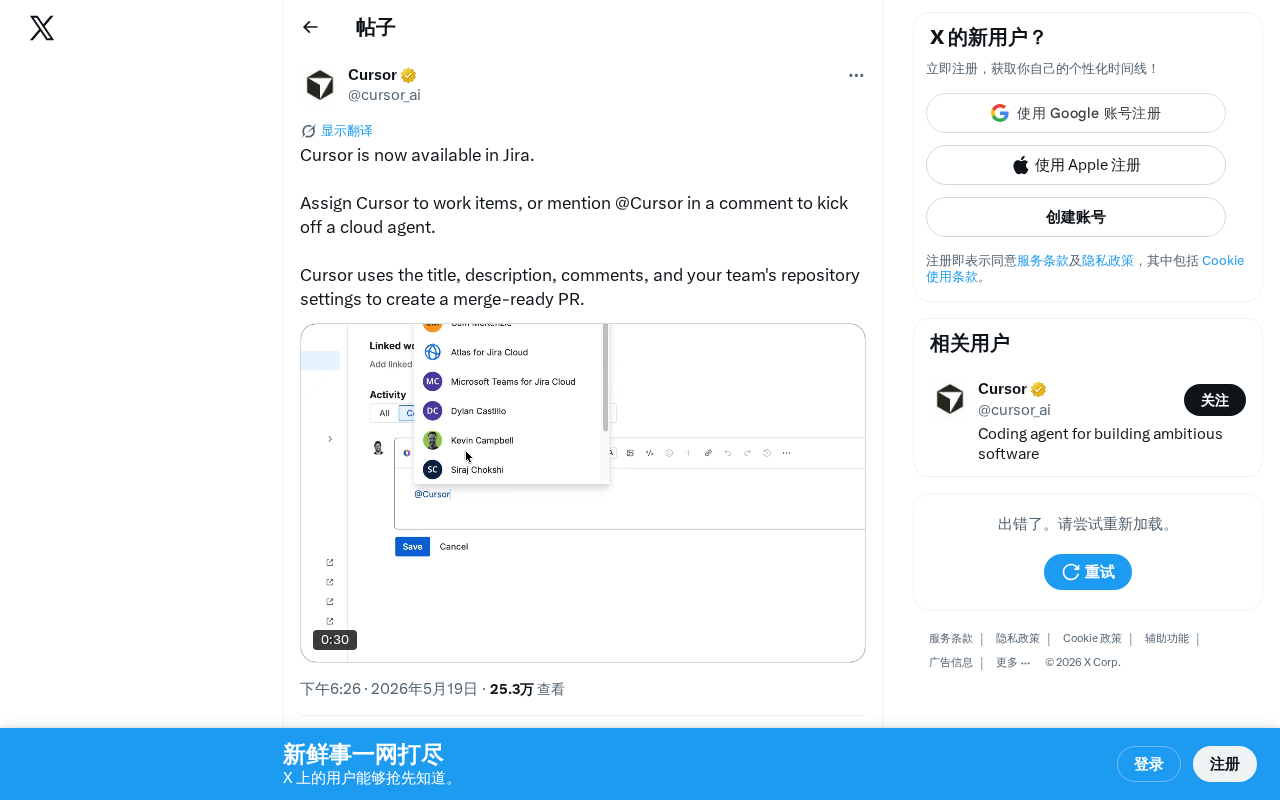
The Cursor team recently announced a major integration—Cursor has officially connected with the Atlassian Jira platform. This means developers can now assign work items directly to Cursor within Jira, or @Cursor in comments to launch a cloud-based AI agent that automatically handles the entire workflow from understanding requirements to submitting code.
Jira is Atlassian's flagship product and one of the most widely used project management and issue tracking platforms globally. According to industry data, Jira has long dominated the global agile project management tool market, adopted by over 250,000 companies ranging from startups to Fortune 500 enterprises. Jira's core strength lies in organizing the entire software development lifecycle—from requirement definition, task breakdown, and Sprint planning to bug tracking—within a unified workflow. It supports multiple agile methodologies including Scrum and Kanban, and deeply integrates with CI/CD pipelines, code repositories, and testing tools through its rich API and Marketplace ecosystem. Because Jira serves as the "central nervous system" in enterprise development workflows, Cursor's decision to integrate with it carries enormous strategic significance—it means the AI Agent can embed directly into the core nodes of enterprises' existing workflows, rather than requiring teams to change established habits.
This isn't merely a simple plugin integration—it's a landmark event in the evolution of AI coding tools from "assisted coding" to "autonomous task completion." Cursor is gradually transforming from an intelligent code editor into an AI development Agent capable of independently taking on development tasks.
What we call an AI development Agent is fundamentally different from traditional code completion tools. Traditional tools are passively responsive—developers type code, and the tool predicts the next line. An Agent, however, is goal-driven—it receives a high-level task description, then autonomously plans execution steps, decomposes subtasks, invokes tool chains, and iteratively validates results. This relies on the combination of large language model reasoning capabilities and external Tool Use mechanisms: the Agent needs to understand natural language requirements, map them to specific code changes, while operating development infrastructure like Git, file systems, and terminal commands. This paradigm shift from "human-driven with AI assistance" to "AI-driven with human review" represents the most profound transformation in the AI programming field today.
Cursor's Workflow in Jira: From Ticket to Merge-Ready PR
Two Trigger Methods
According to official documentation, using Cursor within Jira is highly intuitive:
- Direct Assignment: Assign Jira work items (such as Stories, Tasks, Bugs, etc.) directly to Cursor, and it will automatically begin processing
- Comment Trigger: @Cursor in the comment section of any Jira ticket to launch the cloud agent for handling specific requests
Intelligent Context Understanding
When processing tasks, Cursor leverages multi-dimensional contextual information: the ticket's title and description provide a requirements overview, comment discussions supplement details and constraints, and the team's code repository settings ensure generated code conforms to project standards and architectural style.
This ability to integrate multi-dimensional context is what distinguishes an AI Agent from simple automation scripts. Traditional automation tools can only process structured input commands, while Cursor needs to extract technical intent from unstructured natural language descriptions—understanding that "fix the intermittent timeout issue during user login" might involve database connection pool configuration, network timeout parameters, retry mechanisms, and multiple other technical dimensions. Simultaneously, it needs to "read" the existing codebase to understand the project's technology stack choices, code style conventions, module organization, and dependency graphs, ensuring that generated code isn't an isolated fragment but an organic component that seamlessly integrates with the existing system.
Ultimately, Cursor produces a "merge-ready" Pull Request—a code change request that can be directly merged. This means it doesn't just write code; it also handles branch creation, code commits, PR description writing, and a series of other engineering operations.
It's worth elaborating that generating a truly "merge-ready" PR is far more complex than simply writing code. In modern software engineering practice, a qualified PR requires: creating a feature branch from the main branch following the team's branch naming conventions (e.g., feature/JIRA-1234-fix-login-timeout), organizing code changes into logically clear commits with properly formatted commit messages, writing PR descriptions explaining the motivation and scope of changes, ensuring code passes automated tests and Lint checks in the CI pipeline, and potentially linking the corresponding Jira ticket for bidirectional traceability. For Cursor to automatically complete this entire chain means it's not just a code generator—it's an automated engineer that understands software engineering best practices.
Industry Trend: AI Agents Are Reshaping the Software Development Process
Evolution from Copilot to Autonomous Agent
Cursor's Jira integration reflects the evolutionary direction of the entire AI programming field. Over the past two years, AI coding tools have progressed through several stages:
- Code Completion Stage: Represented by GitHub Copilot, providing line-level or function-level code suggestions
- Conversational Programming Stage: Tools like Cursor and Windsurf support writing and modifying code through natural language dialogue
- Autonomous Agent Stage: AI can independently receive tasks, understand requirements, write code, and submit PRs
Cursor's Jira integration is a quintessential example of the third stage. As a notable detail, GitHub Copilot previously launched similar functionality—Copilot can be assigned GitHub Issues and automatically create PRs. Cursor's choice to integrate with Jira clearly targets the enterprise market, as Jira's market share in project management among medium and large enterprises far exceeds that of GitHub Issues.
The competitive strategy differences between these two are worth deeper analysis. GitHub Copilot leverages Microsoft and GitHub's ecosystem advantages, naturally forming a closed loop with GitHub Issues, GitHub Actions, and GitHub Codespaces—for teams already all-in on the GitHub ecosystem, Copilot's Agent functionality offers near-zero-friction adoption. But the reality is that many enterprises, especially medium and large organizations, often use combinations of different platforms for project management and code hosting: Jira + GitLab, Jira + Bitbucket, or even Jira + self-hosted Git services. Cursor's decision to first connect with Jira as the "greatest common denominator" is a classic platform decoupling strategy—not binding to a specific code hosting platform, but cutting in from the project management layer to cover a broader enterprise user base. This also reflects the broader trend of AI coding tools upgrading from "individual developer productivity tools" to "enterprise-level development infrastructure."
Practical Impact on Development Teams
This integration model may bring several significant changes:
- Automation of Low-Complexity Tasks: Simple bug fixes, copy changes, boilerplate code writing, and similar tasks can be handed directly to Cursor, with developers only needing to review the PR
- Seamless Connection Between Project Management and Code Implementation: After product managers create requirements in Jira, some tasks can be immediately picked up by AI, shortening the turnaround time from requirement to code
- Transformation of the Developer Role: Developers may spend more time on architecture design, code review, and complex problem-solving rather than repetitive coding
Implementation Challenges: Code Quality, Context Depth, and Team Trust
This feature still faces several challenges in practical deployment. First is code quality and security—whether auto-generated PRs truly meet the "merge-ready" standard requires extensive real-world validation. Second is the depth of context understanding—can AI accurately comprehend complex business logic and technical constraints based solely on Jira ticket information? Finally, there's the establishment of team trust—allowing AI to directly participate in the code submission process requires teams to make corresponding adjustments to workflows and permission management.
In enterprise scenarios, the complexity of these challenges is further amplified. Code security auditing is the primary concern: could AI-generated code introduce security vulnerabilities (such as SQL injection, XSS attacks, or hardcoded sensitive information)? Enterprises typically have strict code security scanning processes (such as SAST/DAST tools), and AI-generated code must pass through these same gates. Intellectual property issues cannot be ignored either—AI models may have been exposed to open-source code during training, and whether generated code snippets carry license compliance risks is particularly sensitive in regulated industries (finance, healthcare, defense). Additionally, permission management requires careful design: Cursor as an AI Agent needs write access to code repositories and permission to update Jira ticket statuses. How to ensure these permissions aren't abused, and how to set up approval gates (such as requiring AI PRs to be reviewed by at least one human developer before merging), are questions that enterprise IT governance teams need to seriously consider. Some teams may adopt a gradual approach—first letting AI handle test code or documentation tasks, then progressively expanding to production code after trust is established.
Regardless, Cursor's integration with Jira represents a clear signal: AI coding tools are upgrading from the developer's "copilot" to an "autonomous driving" mode capable of operating independently. This transformation has only just begun.
Key Takeaways
Related articles

Claude Code for Test Development in Practice: An AI Programming Workflow That Doubles Your Efficiency
A practical guide to Claude Code for test development: auto-generating test scripts, Plan Mode workflows, MCP + Playwright integration, and Subagent parallel tasks to build systematic AI-assisted workflows.

Hermes Agent Hands-On Review: An AI Efficiency Revolution for Indie Game Developers
Indie game developer reviews Hermes Agent vs OpenClaude: intelligent context compression, real-time Memory, remote control via Telegram, and practical use cases in game dev, social media, and email.
Vibe Coding Beginner's Guide: Tool Selection Across Three Categories with Practical Examples
A comprehensive guide to Vibe Coding's three tool categories: Agent frameworks, CLI Coding, and IDE tools, with practical examples including Snake game and data analysis workbench.