Cursor Releases Official SDK: Build Custom AI Agents with Python and TypeScript Based on Composer 2.5
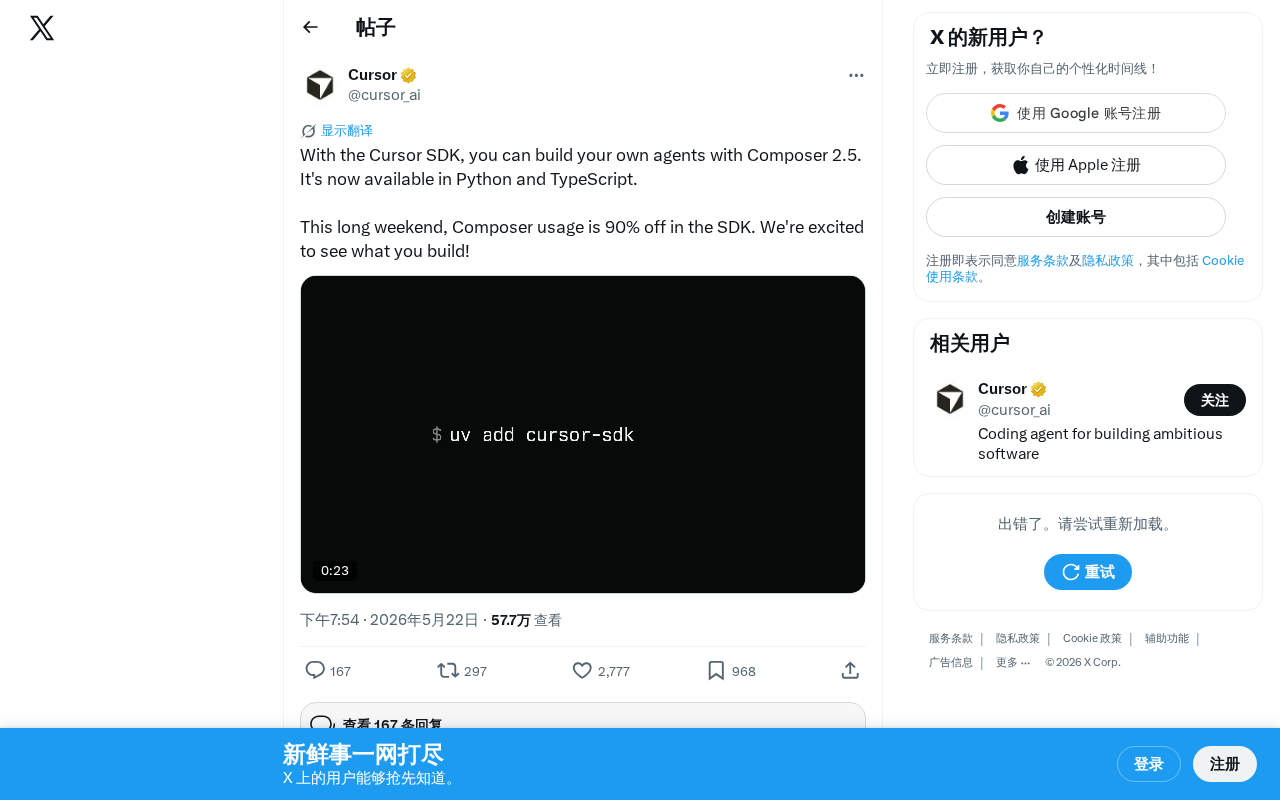
Cursor launches an official SDK enabling developers to build custom AI Agents powered by Composer 2.5.
Cursor has officially released its SDK supporting Python and TypeScript, allowing developers to build custom AI Agents based on Composer 2.5's reasoning and code generation capabilities. The SDK enables integration into external applications and workflows beyond the Cursor editor, with use cases ranging from automated code review to CI/CD repair agents. A limited-time 90% discount signals Cursor's push to build a developer ecosystem as it transitions from an AI editor to a full AI development platform.
Cursor SDK Officially Launches: Unlocking Composer 2.5's Agent Capabilities
The Cursor team recently announced the release of their official SDK, enabling developers to build their own AI Agents based on Composer 2.5. The SDK supports both Python and TypeScript, significantly lowering the barrier for developers to access Cursor's underlying capabilities.
Core SDK Capabilities: Powered by Composer 2.5
Composer is one of the most popular features in the Cursor editor, capable of understanding project context, executing multi-file edits, running terminal commands, and performing other complex operations. It's fundamentally different from traditional code completion tools — traditional completion tools (like early GitHub Copilot) primarily predict single or multi-line code based on cursor position context, while Composer uses an Agent architecture that can autonomously plan task steps, understand project structure across files, invoke terminal commands, and dynamically adjust subsequent actions based on execution results. This "plan-execute-feedback" loop is the core paradigm in today's AI Agent field. Composer 2.5, as the latest version, features significant optimizations in Chain of Thought depth and tool-calling reliability, making it more stable when handling complex multi-step programming tasks.
With this SDK, developers are no longer limited to using these capabilities within the Cursor editor — they can integrate them into their own applications, workflows, or automation pipelines. Specifically:
- Custom AI Agent Development: Build domain-specific intelligent assistants leveraging Composer 2.5's reasoning and code generation capabilities
- Dual Language Support for Python and TypeScript: Covers the vast majority of developers' tech stack preferences with minimal onboarding cost
- Flexible Integration: Can be embedded into existing projects and workflows without depending on the Cursor editor environment
Understanding the Technical Core of AI Agents
AI Agents represent the cutting edge of large language model applications, fundamentally different from simple Q&A-style AI. A complete AI Agent typically consists of four core components: a perception module (understanding user intent and environmental state), a planning module (decomposing complex tasks into executable steps), a tool-calling module (executing concrete actions like file operations, API calls, and terminal commands), and a memory module (maintaining task context and historical information). In programming scenarios, an Agent needs to understand the overall architecture of a codebase, identify dependencies between files, and anticipate the cascading effects of modifications — placing extremely high demands on the model's long-context comprehension and tool-use accuracy. The Cursor SDK encapsulates these complex capabilities into directly callable interfaces for developers, dramatically lowering the technical barrier to building programming Agents.
Limited-Time Offer: 90% Off SDK Usage Costs
To encourage developers to experiment and explore, the Cursor team launched a 90% discount promotion on SDK usage fees during the long weekend. This strategy is clearly aimed at rapidly building a developer ecosystem, allowing more people to experience the SDK's capabilities at minimal cost.
For developers looking to quickly prototype and validate AI Agent ideas, this is a window worth seizing.
Industry Insight: AI Coding Tools' Platform Transformation
This move signals that Cursor is transitioning from an AI code editor to an AI development platform. Opening up an SDK (Software Development Kit) is the classic path for tech companies evolving from product to platform — Stripe built a fintech ecosystem through its payment SDK, Twilio became a cloud communications platform through its communications SDK, and OpenAI let GPT capabilities permeate thousands of applications through its API/SDK. Cursor's core logic in releasing this SDK is similar: abstracting AI programming capabilities validated by a large user base into programmable interfaces, enabling third-party developers to build vertical applications on top of them. The key advantage of this model is that the platform doesn't need to cover every scenario itself — instead, it achieves exponential capability expansion through the creativity of ecosystem developers.
Unlike GitHub Copilot, which primarily focuses on in-editor code completion, Cursor's SDK opens up deeper Agent-building capabilities. This enables developers to create fully customized AI workflows, going far beyond code completion or chat conversations.
Competitive Landscape: From Code Completion to Platform Ecosystem Wars
The AI coding tools market is undergoing rapid differentiation. GitHub Copilot holds a leading market share position thanks to GitHub's developer base and Microsoft's enterprise channels, but its core capabilities remain centered on in-editor code completion and Chat. Google's Gemini Code Assist and Amazon's CodeWhisperer compete through differentiation within their respective cloud ecosystems. Among emerging players, Windsurf (formerly Codeium) is also exploring the Agent direction, while Devin positions itself directly as a fully autonomous AI software engineer. Cursor's strategy of opening its SDK is essentially a bid to define the "AI programming infrastructure layer" — if a large number of third-party Agents are built on top of the Cursor SDK, Cursor transforms from an editor into the operating system of AI programming.
What Can You Build with the Cursor SDK?
The directions developers can explore with the Cursor SDK are quite broad:
- Automated Code Review Agent: Automatically detect issues and provide modification suggestions during the PR process. These Agents can integrate with GitHub/GitLab Webhooks, automatically triggering on each Pull Request submission and leveraging Composer 2.5's project context understanding to analyze potential risks in code changes
- Project Scaffolding Generator: Automatically set up project structures based on requirement descriptions, including directory organization, dependency configuration, and base code templates — compressing hours of project initialization work into minutes
- Domain-Specific Programming Assistants: Customize AI assistants for scenarios like data analysis or DevOps. By pre-configuring domain knowledge and toolchain settings, these Agents can demonstrate expertise far exceeding general-purpose models within specific tech stacks
- CI/CD Intelligent Code Repair: Automatically locate and fix build errors in continuous integration pipelines. When a CI pipeline fails, the Agent can analyze error logs, locate problematic code, generate fix patches, and automatically submit them
- Multi-Step Task Orchestration Agent: Chain multiple operations to complete complex automation workflows, such as end-to-end development tasks like "read requirements document → generate database schema → create API endpoints → write unit tests"
As the AI Agent ecosystem rapidly evolves, the Cursor SDK launch provides developers with yet another powerful building foundation. Notably, competition among AI coding tools is shifting from "whose code completion is more accurate" to "whose platform ecosystem is richer" — and Cursor has clearly chosen the latter as its breakthrough strategy.
Related articles

Claude Code for Test Development in Practice: An AI Programming Workflow That Doubles Your Efficiency
A practical guide to Claude Code for test development: auto-generating test scripts, Plan Mode workflows, MCP + Playwright integration, and Subagent parallel tasks to build systematic AI-assisted workflows.

Hermes Agent Hands-On Review: An AI Efficiency Revolution for Indie Game Developers
Indie game developer reviews Hermes Agent vs OpenClaude: intelligent context compression, real-time Memory, remote control via Telegram, and practical use cases in game dev, social media, and email.
Vibe Coding Beginner's Guide: Tool Selection Across Three Categories with Practical Examples
A comprehensive guide to Vibe Coding's three tool categories: Agent frameworks, CLI Coding, and IDE tools, with practical examples including Snake game and data analysis workbench.