datasette-fixtures: Create a Datasette Test Database with a Single Command

datasette-fixtures enables one-command test database creation for Datasette plugin developers.
The datasette-fixtures plugin (v0.1a0) leverages Datasette 1.0a30's new `populate_fixture_database()` API to let plugin developers create standardized test databases with a single `uvx` command — no pre-installation required. This small but significant tool addresses a long-standing pain point in the Datasette plugin ecosystem by providing ready-made test data covering various data types and edge cases, lowering the barrier for plugin testing and prototype validation.
The Datasette ecosystem has gained another handy little tool — the datasette-fixtures plugin has released version 0.1a0. While small in scope, this plugin addresses a long-standing pain point for plugin developers: how to quickly create and use Datasette's standard test database.
Datasette is an open-source data exploration and publishing tool developed by Django co-creator Simon Willison. Its core philosophy is to transform SQLite database files directly into interactive Web APIs and browsable interfaces — no backend code required. Since its initial release in 2017, Datasette has grown a rich ecosystem of over a hundred plugins spanning data visualization, geospatial display, full-text search, authentication, and more. It's precisely this vast plugin ecosystem that makes standardized testing infrastructure so urgently needed.
Starting from Datasette 1.0a30
Datasette's latest 1.0a30 release introduced a seemingly minor but significant feature:
Added a documented
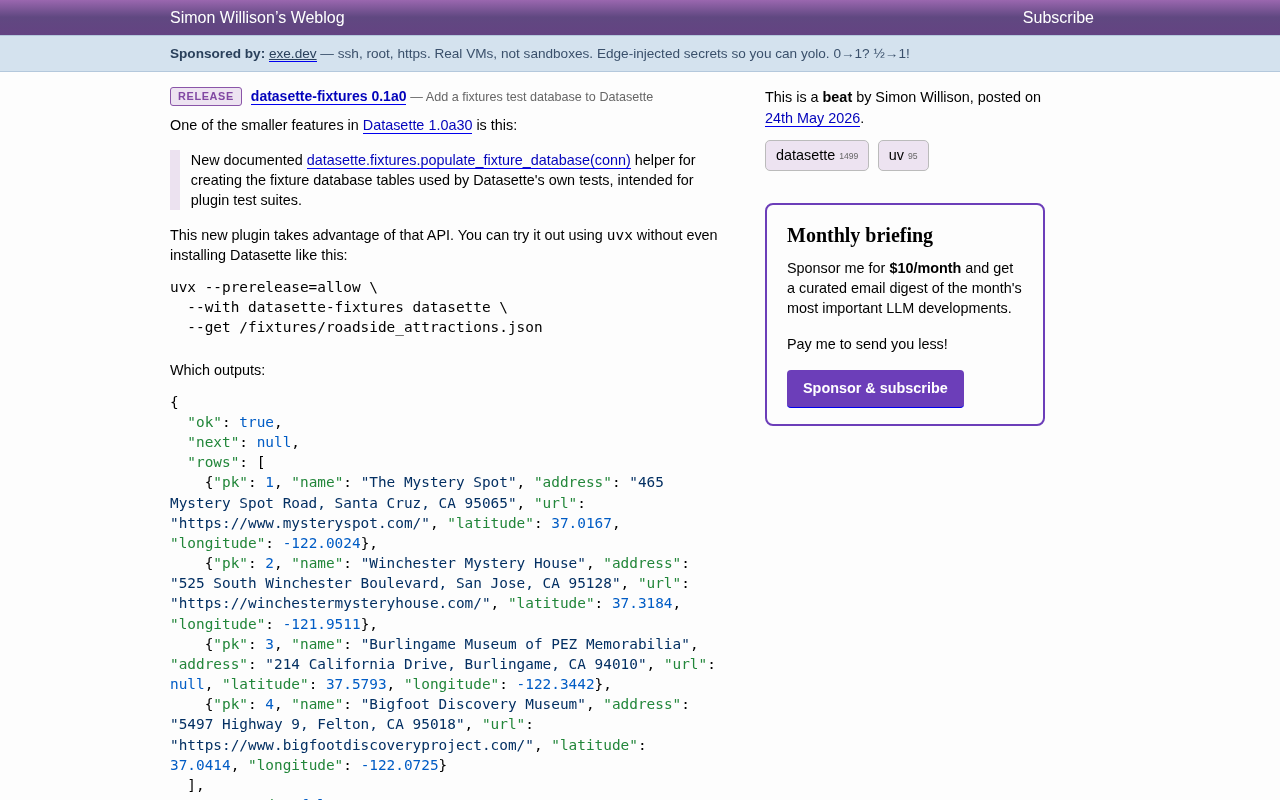
datasette.fixtures.populate_fixture_database(conn)helper function for creating the fixture database tables used by Datasette's own tests, designed for use in plugin test suites.
In software engineering, a "fixture" refers to a predefined set of data prepared for testing purposes. The concept originates from manufacturing, where a "fixture" holds a workpiece in a known position for precise machining. In software testing, fixtures provide a known, repeatable data state that makes test results deterministic and reproducible. Major frameworks like Django and pytest all have mature fixture mechanisms, but Datasette previously lacked standardized fixture support for plugin developers.
In short, Datasette has made its internal test database creation logic "public" as an official API for plugin developers to call. The datasette-fixtures plugin is the first practical application built on this new API.
Zero-Install Experience: The Magic of uvx
The most impressive aspect of this plugin is how it's used. Thanks to uvx (part of the uv toolchain) in the Python ecosystem, you don't even need to pre-install Datasette to run it and retrieve test data:
uvx --prerelease=allow \
  --with datasette-fixtures datasette \
  --get /fixtures/roadside_attractions.json
uv is an ultra-fast Python package manager and project management tool developed by Astral (the same company behind the Python linter Ruff). Written in Rust, it installs packages 10–100x faster than traditional pip. uvx is the command-line tool runner in the uv toolchain, similar to npx in the Node.js ecosystem — it runs Python CLI tools in isolated temporary virtual environments that are discarded after use, keeping your system environment clean. Since its release in 2024, uv has quickly become one of the fastest-growing infrastructure tools in the Python community.
This command does several things:
uvxruns the tool in a temporary virtual environment — no global installation needed--prerelease=allowpermits pre-release versions (since Datasette 1.0 is still in alpha)--with datasette-fixturesinjects the fixtures plugin as an additional dependency--getissues a GET request directly and outputs the result
Running this returns a structured JSON response containing test data from the roadside_attractions table — a few California roadside attractions with names, addresses, URLs, and latitude/longitude coordinates.
What This Means for Plugin Developers
Standardized Testing Infrastructure
Previously, Datasette plugin developers who wanted to write tests had to manually create test databases and table schemas. This was not only repetitive work, but the inconsistent test data formats across plugins made it difficult to establish unified testing standards.
Datasette's plugin architecture is built on Python's pluggy framework (originally developed for pytest's plugin system), using a series of hook functions to enable extensions. Plugins can intervene in request handling, page rendering, permission checks, SQL execution, and virtually every other stage. Datasette itself is an ASGI (Asynchronous Server Gateway Interface) application, meaning it natively supports asynchronous processing, and plugins can leverage Python's async/await syntax for efficient I/O operations. This flexible and powerful plugin architecture, in turn, demands more rigorous testing — plugins need to verify their behavior in near-real data environments.
With the populate_fixture_database() API and the datasette-fixtures plugin, developers can now directly reuse Datasette's official test datasets. These datasets are carefully designed to cover various data types and edge cases (such as null values in url fields), making them ideal for plugin functionality validation.
Rapid Prototype Validation
For developers who want to quickly verify a Datasette feature or plugin behavior, a single uvx command can spin up a Datasette instance with a complete test dataset, dramatically lowering the barrier to experimentation. This "use it and move on" experience is becoming increasingly popular in the developer tools space.
Reflections on the Technical Ecosystem
The release of this small plugin reflects several noteworthy trends:
Maturing Toolchains: uvx makes distributing and using Python tools as convenient as npx is for Node.js. Zero installation, temporary environments, one-off execution — this pattern is changing how developers interact with tools. It's worth noting that npx, shipped with npm 5.2 in 2017, has profoundly changed tool usage habits in the JavaScript community, spawning numerous "use it and move on" tools like create-react-app and degit. The Python community long lacked a similar convenience mechanism, and uvx is filling that gap.
API-First Design Philosophy: By elevating internal testing tools to a public API, Datasette demonstrates its commitment to the plugin ecosystem. A healthy plugin ecosystem needs more than just extension points — it needs supporting test infrastructure. This approach isn't uncommon in mature open-source projects — WordPress provides WP_UnitTestCase, VS Code offers @vscode/test-electron — they all recognize that lowering the testing barrier for plugin developers raises the quality of the entire ecosystem.
Small, Focused Tool Philosophy: datasette-fixtures has an extremely narrow function — it just creates a test database. But it's precisely this Unix philosophy of "do one thing well" that gives it a critical connecting role in the overall toolchain.
The Long Road to Datasette 1.0: Datasette's transition from 0.x to 1.0 has been ongoing for years and is still in alpha (1.0a30 means the 30th alpha pre-release). In Semantic Versioning (SemVer), a 1.0 release represents a stability commitment for the public API — once released, non-breaking changes can only be reflected through minor version increments. Simon Willison's cautious approach to 1.0 reflects his desire to thoroughly validate design decisions before locking down the API. Tools like datasette-fixtures are precisely part of the ecosystem infrastructure being built in preparation for the official 1.0 release.
Summary
Although datasette-fixtures 0.1a0 is just an alpha release, it signals the Datasette ecosystem's march toward maturity. As Datasette 1.0 stable approaches, this kind of developer-experience-focused infrastructure will become increasingly important. For developers currently building or planning to build Datasette plugins, now is the time to pay attention to these new tools.
Related articles

Claude Code for Test Development in Practice: An AI Programming Workflow That Doubles Your Efficiency
A practical guide to Claude Code for test development: auto-generating test scripts, Plan Mode workflows, MCP + Playwright integration, and Subagent parallel tasks to build systematic AI-assisted workflows.

Hermes Agent Hands-On Review: An AI Efficiency Revolution for Indie Game Developers
Indie game developer reviews Hermes Agent vs OpenClaude: intelligent context compression, real-time Memory, remote control via Telegram, and practical use cases in game dev, social media, and email.
Vibe Coding Beginner's Guide: Tool Selection Across Three Categories with Practical Examples
A comprehensive guide to Vibe Coding's three tool categories: Agent frameworks, CLI Coding, and IDE tools, with practical examples including Snake game and data analysis workbench.