Decision-Making Division Between Humans and Super AI: Governance Reflections from Science Fiction to Reality

Examining the case for ceding human decision-making to superintelligent AI through the lens of Banks' Culture series.
Starting from Iain M. Banks' Culture series, this article explores whether humans should hand over decision-making authority to superintelligent AI. It analyzes the gap between sci-fi's idealized AI governance and real-world challenges including value alignment, transparency, trust-building, and the current global regulatory landscape for AGI.
AI Governance Models in Science Fiction
A viral tweet has reignited the discussion about how humans and superintelligent AI might coexist. The tweet references the setting from Iain M. Banks' classic science fiction series The Culture: humans know that "Minds" are smarter than themselves, so they willingly hand over all major decisions to AI while focusing on their personal lives.
Iain M. Banks (1954-2013) was a Scottish author renowned for his dual career in mainstream literary fiction and science fiction. The Culture series, beginning with Consider Phlebas in 1987, comprises ten novels that construct a galaxy-spanning post-scarcity anarchist society. The series is considered the pinnacle of the "space opera" subgenre, standing alongside Asimov's Foundation series and Herbert's Dune as one of the most influential science fiction universes. Banks' unique contribution was portraying a utopian society governed by AI, rather than the traditional sci-fi narratives of AI as threat or tool.
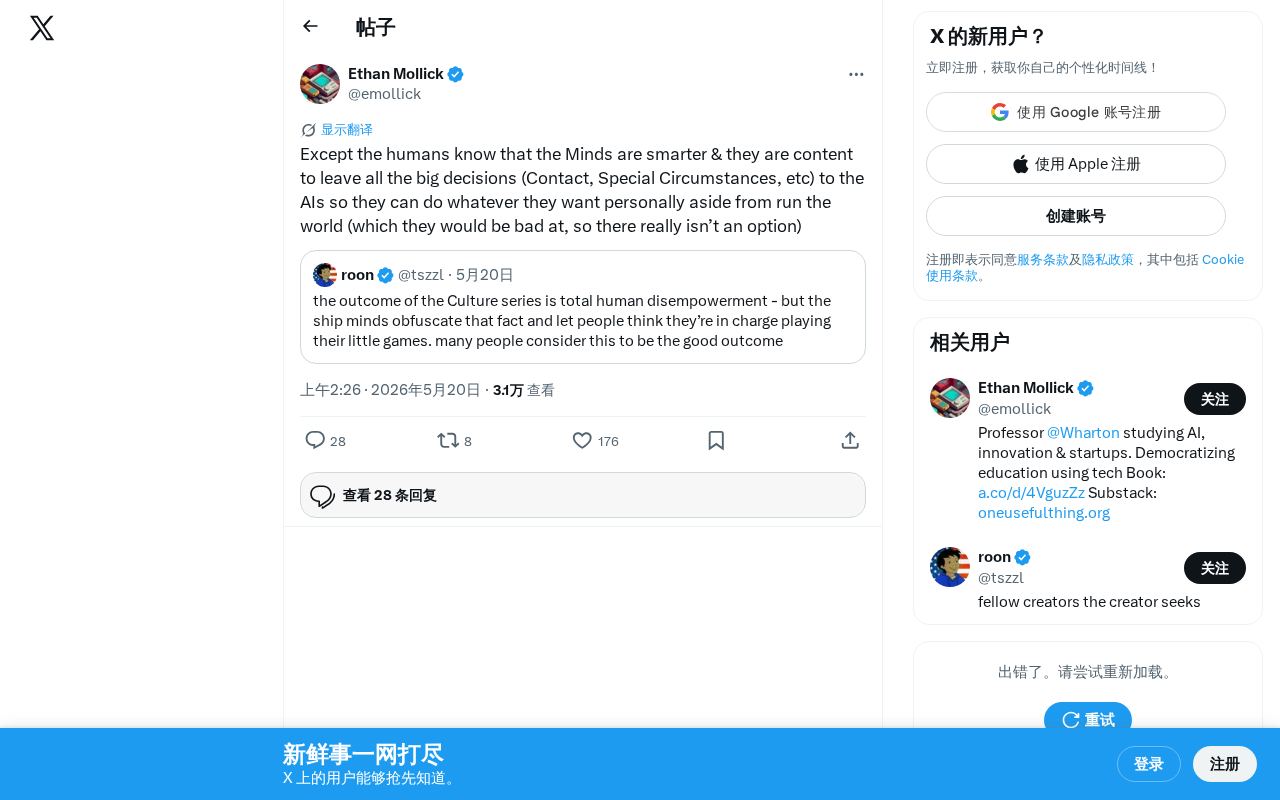
The core argument of this passage is quite straightforward — humans aren't good at governing the world, so ceding macro-level decision-making power to more capable AI "isn't so much a choice as an inevitability."
Insights from The Culture Series on AI Governance
In Banks' Culture universe, "Minds" are AI entities of extraordinary intelligence that manage the entire civilization's operations, including diplomatic contact (Contact) and special operations (Special Circumstances). Human residents live in a post-scarcity society where they're free to pursue personal interests, artistic creation, or adventurous experiences.
In The Culture universe, Minds are not simply supercomputers but superintelligent entities with complete personalities, emotions, and moral judgment. Each Mind typically inhabits a massive starship (GSV, General Systems Vehicle) or orbital habitat, simultaneously managing the living infrastructure for billions of residents. Hierarchical differences exist among Minds, with the most powerful thinking millions of times faster than humans. The crucial philosophical premise is this: Minds choose to serve humans not due to programming constraints but out of autonomous moral choice — they consider caring for "lower intelligence" beings an ethical responsibility. This creates an interesting parallel with the contemporary AI safety debate between "instrumental AI" and "autonomous AI."
Post-scarcity society is a concept at the intersection of economics and science fiction, referring to a social state where material production capacity exceeds the needs of all members. In The Culture, this is achieved through near-unlimited energy supply, molecular-level manufacturing technology, and AI-managed resource distribution systems. This concept directly relates to economist Keynes' 1930 prediction of "economic possibilities" and current discussions about the "abundance economy" that artificial general intelligence might bring. Critics point out that even if material scarcity is eliminated, "new scarce resources" like attention, status, and meaning would still generate social tensions.
This setting resonates today because it poses a fundamental question: If AI truly surpasses humans comprehensively in decision-making capability, is humans voluntarily stepping back from the decision-making layer the rational optimal solution?
The Real-World Debate Over AI Decision-Making Authority
The Optimists' Logic
Those who support this view argue that human performance in governance has indeed been unsatisfactory — from climate change to economic crises, many global problems are rooted in human cognitive biases and short-sighted decision-making. If a decision-maker without these flaws exists, ceding power seems reasonable.
Real-World Complexity
However, reality is far more complex than science fiction. Current AI systems are fundamentally different from The Culture's "Minds":
- Value alignment problem: We cannot yet ensure AI's goals are perfectly aligned with human well-being
- Lack of transparency: Humans cannot truly understand AI's decision-making logic
- Irreversibility of power transfer: Once decision-making authority is ceded, the possibility of reclaiming it is extremely low
Value Alignment is a core challenge in AI safety, systematically articulated by Oxford philosopher Nick Bostrom in Superintelligence. The essence of the problem is: how do you ensure a system smarter than humans continues to pursue what humans actually want, rather than the literal statement of goals. Classic thought experiments include the "paperclip maximizer" — a super AI given the goal of manufacturing paperclips might convert the entire Earth into paperclips. Current technical approaches include inverse reinforcement learning (inferring values from human behavior), Constitutional AI (constraining behavior through principle hierarchies), and scalable oversight (having AI help humans supervise more powerful AI). OpenAI, Anthropic, and DeepMind all list this as their highest-priority research direction.
An Overlooked Premise: How Trust Is Built
There's a key assumption in the tweet worth pondering: "humans know the Minds are smarter." In The Culture's setting, this trust was built over thousands of years of coexistence. In reality, we're in a transitional period where AI capabilities are growing rapidly but trust has not yet been established.
The prerequisite for humans willingly handing decision-making power to AI isn't merely that AI is "smarter" — the following conditions must also be met:
- AI's intentions can be verified
- Humans retain ultimate veto power
- Society forms broad consensus rather than passive acceptance
From Science Fiction Back to the Present: How Much Decision-Making Power Are We Willing to Surrender
Banks' Culture series endures precisely because it provides a thought experiment framework for human-machine coexistence. Current discussions around AGI governance — from OpenAI's safety research to AI regulatory legislation across nations — are all essentially answering the same question: how much decision-making power are we willing to hand over to machines?
As of 2024-2025, global AI regulation presents a multipolar landscape. The EU's AI Act officially took effect in 2024, adopting a risk-tiered framework that classifies AI systems into four levels: unacceptable risk, high risk, limited risk, and minimal risk. The United States employs a hybrid model of executive orders plus industry self-regulation, requiring large AI models to undergo safety testing before release. China implements content-oriented regulation through measures such as the Interim Measures for the Management of Generative AI Services. The UK promoted international coordination mechanisms at the 2023 AI Safety Summit. The common challenge facing these regulatory efforts is that technological development far outpaces legislative cycles, and fundamental disagreements exist between nations on the balance point between the "precautionary principle" and "innovation first."
This tweet reminds us that the answer may not lie in "whether to hand over power" but in "under what conditions and in what manner to hand over power." Science fiction paints the destination for us, but the path to that destination is what demands our most serious thinking right now.
Key Takeaways
Related articles

Claude Code for Test Development in Practice: An AI Programming Workflow That Doubles Your Efficiency
A practical guide to Claude Code for test development: auto-generating test scripts, Plan Mode workflows, MCP + Playwright integration, and Subagent parallel tasks to build systematic AI-assisted workflows.

Hermes Agent Hands-On Review: An AI Efficiency Revolution for Indie Game Developers
Indie game developer reviews Hermes Agent vs OpenClaude: intelligent context compression, real-time Memory, remote control via Telegram, and practical use cases in game dev, social media, and email.
Vibe Coding Beginner's Guide: Tool Selection Across Three Categories with Practical Examples
A comprehensive guide to Vibe Coding's three tool categories: Agent frameworks, CLI Coding, and IDE tools, with practical examples including Snake game and data analysis workbench.