Deep Agents: Enterprise-Grade Agent Engineering and Deep Research Implementation Guide

Deep Agents framework systematically solves enterprise AI Agent pain points, enabling production-grade Deep Research applications.
Enterprise AI Agent development faces critical pain points including tool sprawl, context pollution, cost explosion, and security risks. LangChain's Deep Agents framework, built on LangGraph, systematically addresses these challenges. Its core application, Deep Research, employs an Agentic RAG paradigm of "plan-search-reflect-search again" to achieve autonomous task decomposition, multi-round deep search, and structured report generation. Enterprises should leverage this framework for customized private deployment to meet business adaptability and data compliance requirements.
Introduction: Ten Pain Points of Agent Development
In enterprise-grade AI Agent development, developers commonly face a series of challenging problems. Based on real-world project experience, these pain points can be summarized into ten core areas, with the two most severe being tool sprawl and context pollution.
The Technical Root Cause of Tool Sprawl
An AI Agent is an AI system capable of perceiving its environment, autonomously planning, and executing actions. Unlike traditional single-turn Q&A LLMs, Agents possess the cyclical ability of "think-act-observe" (known in academia as the ReAct paradigm). Tool Calling (Function Calling) is one of the core capabilities of an Agent, allowing the LLM to dynamically invoke external APIs, database queries, code execution, and other tools during the reasoning process.
Tool sprawl refers to the fact that in enterprise scenarios, Agents typically need to call not just one or two tools, but a large collection of tools. When the number of tools scales from single digits to dozens or even hundreds, the model must semantically match user intent with tool descriptions with high precision. This places extremely high demands on embedding quality, tool description standardization, and parameter extraction accuracy. In such cases, the Agent may fail to invoke the correct tool precisely, or may be unable to accurately extract key parameters (arguments) from the user's query when calling tools, causing the entire workflow to fail.
The Essence of Context Pollution
The "Context Window" of a large language model refers to the maximum number of tokens the model can process in a single inference pass. GPT-4o supports 128K tokens, and Claude 3.5 supports 200K tokens. In multi-turn conversations or long-chain Agent tasks, historical messages, tool call records, and intermediate results continuously accumulate and fill the context window.
Context pollution arises precisely from this — irrelevant historical information interferes with the current decision-making process, causing a significant decline in Agent output quality. Its technical essence is the "Lost in the Middle" phenomenon: when irrelevant information occupies a large portion of the context, the model's attention mechanism is disrupted, with significantly reduced attention to information in the middle positions of the window, leading to decision bias or forgetting of key information. Effective context management strategies include sliding windows, summary compression, and selective memory.
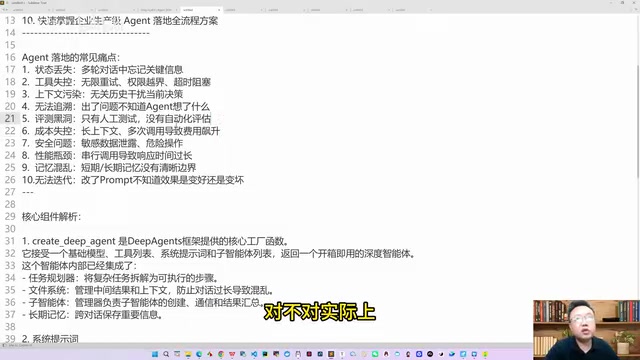
Beyond these, there are several other issues that cannot be ignored:
- Cost explosion: Especially when using autonomously planning Agents for long-chain tasks, token consumption is staggering. Taking GPT-4o as an example, input tokens cost approximately $2.5/million and output tokens approximately $10/million. A single execution of a complex research task may consume tens of thousands or even hundreds of thousands of tokens, and costs scale rapidly in high-concurrency enterprise scenarios
- Security risks: Sensitive data leakage and dangerous operation risks, such as accidentally deleting files or modifying passwords when executing automated operations through shell commands
- Performance bottlenecks: Response latency and throughput limitations affecting user experience
- State loss: Difficulties in state management across multi-turn interactions
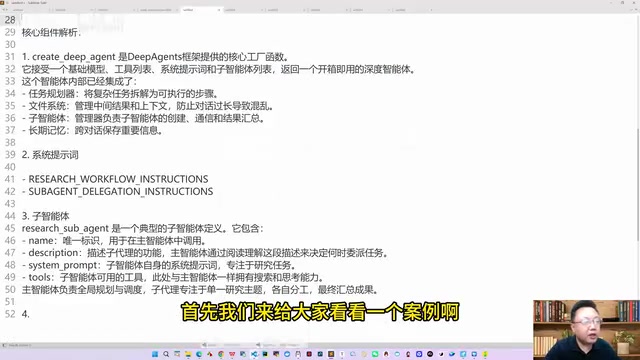
If these problems are solved manually one by one, the engineering effort is enormous and it's easy to fix one issue while breaking another. It is against this backdrop that LangChain, starting from V1, shifted its core focus toward Agent positioning and launched the Deep Agents framework, aiming to systematically address the above pain points.
LangChain's Framework Evolution
LangChain is one of the most widely used LLM application development frameworks, founded by Harrison Chase in October 2022. Its early versions (V0.x) used Chain (sequential calling) as the core abstraction, helping developers quickly string together LLM calls, prompt templates, and tools. However, as Agent application complexity increased, the limitations of the Chain pattern became apparent: lack of dynamic planning capability, weak state management, and insufficient production-grade reliability. To address this, LangChain introduced LangGraph as the underlying graph computation engine, supporting stateful, cyclical Agent workflows, and built the Deep Agents framework on top of it for enterprise production environments — marking a strategic transformation from "prototyping tool" to "production-grade Agent engineering platform."
What is Deep Research?
Deep Research is a core application scenario of Deep Agents and one of the most in-demand capabilities in enterprises today. It has widespread applications in government agencies, public institutions, state-owned enterprises, and consulting firms.
Definition of Deep Research
Deep Research is an intelligent agent search technology driven by large language models (LLMs), built on the search capabilities of AI Agents. Unlike traditional keyword search or simple Q&A ChatBots, the core philosophy of Deep Research is to act like a human researcher — autonomously planning, conducting multi-round searches, and deeply integrating information on complex topics to ultimately generate a structured professional report.
From a technical architecture perspective, Deep Research is an advanced evolution of RAG (Retrieval-Augmented Generation). Traditional RAG follows a static "single retrieval + single generation" process, while Deep Research adopts a dynamic iterative paradigm of "plan-search-reflect-search again," referred to in academia as Agentic RAG or Iterative RAG. Its core innovation lies in introducing a "Reflection" mechanism: after each round of search, the Agent evaluates the sufficiency and credibility of the information, determining whether supplementary searches are needed, whether to adjust the search strategy, or whether to dive deeper into a particular sub-direction — thereby handling open-ended complex problems.
Its application scenarios are extensive:
- Market research: Industry analysis, competitive research, market trend forecasting
- Academic research: Paper draft generation, literature review compilation
- Financial analysis: Investment research reports, industry financial analysis
- Consulting reports: Corporate strategy analysis, policy research
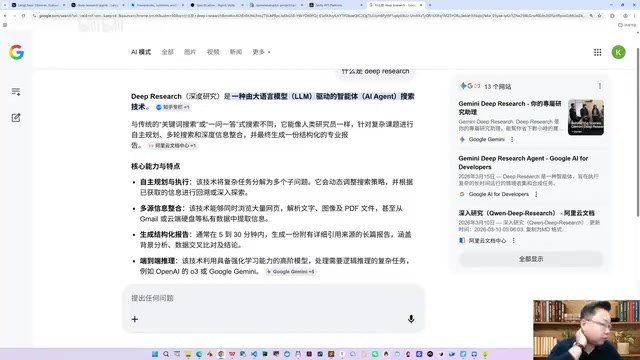
Three Core Capabilities of Deep Research
Autonomous Planning and Execution
When a user presents a complex request, such as "write a market research report on the new energy vehicle market" or "create a paper framework based on a specific topic," Deep Research automatically decomposes the complex task into multiple sub-questions and dynamically adjusts the search strategy. The key to this capability lies in "Research" — it's not a simple one-time search, but a multi-round iterative deep exploration. After each round of search, the system evaluates the completeness of acquired information through the reflection mechanism and determines the next direction of exploration.
Multi-Source Information Integration
The system retrieves information from multiple different data sources, including web pages, PDF documents, images, and more, then uniformly integrates this heterogeneous information. This step simulates the process of a human researcher collecting materials from multiple channels when working on a project.
Structured Report Generation
Finally, leveraging the LLM's comprehension and generation capabilities, the integrated information is output as a structured professional report. The entire process employs end-to-end reasoning to ensure logical coherence and professionalism in the report. Notably, OpenAI's Deep Research uses the o3 model specifically optimized for search reasoning under the hood, demonstrating the critical role of strong reasoning capabilities for this type of task.
General Products vs. Custom Development: How Should Enterprises Choose?
There are currently multiple Deep Research products on the market, including OpenAI's Deep Research, Google Gemini's Deep Research, and Qwen Deep Research from Alibaba's Tongyi Qianwen.
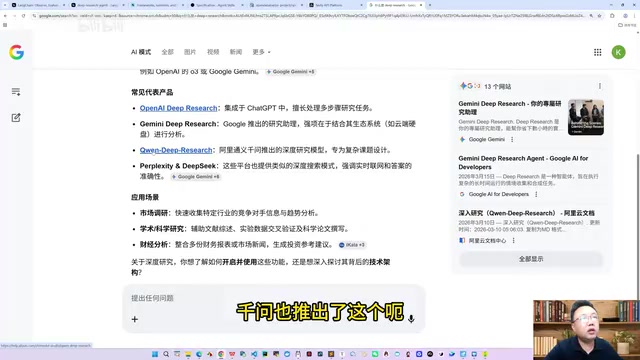
However, these products share a common characteristic — they are all general-purpose products. For enterprises, while general products can assist work to some extent, whether they can achieve satisfactory results often remains questionable.
Why Do Enterprises Need Customized Deep Research?
Enterprise requirements typically have strong industry-specific and business-specific characteristics. For example:
- The financial industry needs to connect to specific data sources and comply with regulatory requirements
- Consulting firms need report templates that align with their own methodologies
- Research institutions need to connect to internal knowledge bases and proprietary data
Beyond business adaptability, data security and compliance are the deeper drivers for enterprises choosing customized solutions. Heavily regulated industries such as finance, healthcare, and government have strict restrictions on data cross-border transfer, and sending sensitive business data to OpenAI or Google's cloud APIs poses compliance risks. Custom development allows enterprises to choose privately deployed open-source models (such as Qwen, DeepSeek, LLaMA series), keeping the entire inference pipeline within the enterprise intranet environment. Additionally, custom development enables integration with internal enterprise knowledge bases (intranet documents, proprietary databases), integration with existing enterprise identity authentication and permission management systems, and customization of report templates and output formats according to industry standards — all of which are core values that general SaaS products cannot provide.
Core Implementation Process of Deep Research
In summary, the implementation of Deep Research involves three key steps:
- Complex task decomposition: Breaking down the user's complex requirements into an executable sequence of sub-tasks, with each sub-task corresponding to a clear search or analysis objective. This step draws on research in the Task Planning domain, transforming open-ended problems into structured execution plans through hierarchical decomposition
- Web search and information collection: Conducting multi-round deep information retrieval and organization through internet search engines and various data sources. The reflection mechanism after each round of search determines whether further iteration is needed, continuing until information is sufficient
- Structured report generation: Leveraging the LLM's comprehension and generation capabilities to integrate collected information into a logically clear, structurally complete professional report
These three steps are interconnected, forming a complete automated research workflow. With the support of the Deep Agents framework, developers can flexibly customize and extend upon this foundation to meet the specific needs of different enterprise scenarios. In terms of cost control, the framework typically also integrates optimization strategies such as model routing (using smaller models for simple sub-tasks) and semantic caching (avoiding redundant queries), helping enterprises strike a balance between effectiveness and cost.
Summary and Outlook
The emergence of Deep Agents marks a critical transition in AI Agent development from "functional" to "production-ready." It systematically addresses enterprise-grade pain points such as tool sprawl, context pollution, cost explosion, and security risks, providing engineering best practices for production-grade Agent deployment.
For enterprises, mastering the core concepts and practical methods of Deep Agents not only enables rapid construction of high-value applications like Deep Research, but also lays a solid technical foundation for more complex Agent systems in the future. As AI Agents move from concept to large-scale deployment, Deep Agents is undoubtedly a key technology that every AI engineer should understand in depth.
Key Takeaways
- Enterprise-grade Agent development faces ten core pain points including tool sprawl, context pollution, cost explosion, and security risks. Their technical root causes lie in the semantic matching challenge of large-scale tool sets and the "Lost in the Middle" phenomenon in context windows
- LangChain V1 introduced the Deep Agents framework (based on the LangGraph graph computation engine) to systematically address engineering challenges in production-grade Agent deployment
- Deep Research is the core application scenario of Deep Agents, essentially an advanced evolution of RAG — achieving autonomous planning, multi-round search, and deep information integration through the "plan-search-reflect-search again" Agentic RAG paradigm, ultimately generating professional reports
- General-purpose Deep Research products struggle to meet enterprise customization needs. Enterprises need industry-specific private deployment based on the framework, driven by both business adaptability and data compliance considerations
- The Deep Research core process includes three key steps: complex task decomposition, web search and collection, and structured report generation, with the ability to integrate cost optimization strategies such as model routing and semantic caching
Related articles
 Tutorials
Cursor + Codex Dual-IDE Collaboration: A Practical Methodology for Open-Source Project Customization
A complete methodology for open-source project customization based on real-world experience, detailing the Cursor+Codex dual-IDE workflow, seven-stage process, MVP validation, and AI source code reading techniques.
 Tutorials
Cursor Multi-Agent in Practice: Building a Full-Stack Next.js Blog in 50 Minutes
Build a full-stack blog in 50 minutes using Cursor IDE's multi-Agent mode with Next.js, Clerk auth, and Supabase. Learn the 4-phase AI Agent workflow and key integration pitfalls.
 Tutorials
Building an AI Software Factory from Scratch: A Cursor Engineer's Hands-On Experience with Multi-Agent Collaboration
Cursor engineer Eric shares practical insights on building an AI software factory: automation levels, guardrail design, parallel Agent management, and scaling to 1000+ Agents for 24/7 development.