Deep Dive into a Cursor Discount Renewal Plugin: Is 65%-Off Pay-Per-Use Legit?
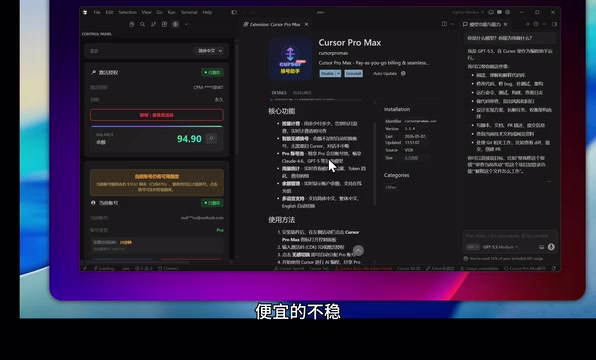
A technical teardown of a 65%-off Cursor plugin, weighing its pay-per-use model against compliance and security risks.
This article provides a deep technical analysis of a third-party plugin that claims to offer Cursor Pro at 65% off through account pool scheduling and pay-per-use billing. We examine its architecture — including dynamic account routing and token-based metering — while objectively assessing compliance gray zones, code data security concerns, sustainability of bulk procurement, and single-operator risks. Practical recommendations are provided for developers across different usage frequencies.
Where Does the 'Cost Anxiety' Around AI Coding Tools Come From?
As one of the most popular AI coding tools today, Cursor has become an everyday essential for a large number of developers thanks to its excellent code completion, logic refactoring, and project generation capabilities. Cursor is a deeply customized AI-native code editor built on the VS Code open-source architecture, developed by Anysphere. Unlike plugin-based AI coding assistants such as GitHub Copilot, Cursor embeds AI capabilities directly into the editor core, supporting cross-file context awareness, natural language instruction-driven code generation and refactoring, and semantic understanding at the entire codebase level. Under the hood, it calls multiple large language models including Claude and GPT-4o, and uses a proprietary context retrieval engine (similar to a RAG architecture) to inject project code snippets as prompt context, enabling high-quality code completion and logical reasoning.
However, the Pro membership subscription at $20/month does present a real pain point for developers with irregular usage patterns — paying for a full month when you don't use it enough feels like a waste.
This exact demand gap has spawned a wave of third-party low-cost Cursor service tools. Recently, a Cursor plugin promoted on Bilibili claiming "65% off renewal, pay-per-use billing, and balances that never expire" has attracted significant attention. This article will provide a deep technical teardown of its architectural logic while objectively analyzing the potential risks behind such services.
Common Failure Modes of Low-Cost Cursor Tools on the Market
The video creator first outlined the typical problems with current low-cost Cursor tools on the market — an analysis that genuinely hits on real pain points many developers have experienced:
Problem 1: Sudden mid-use failures. Everything works for a day or two after registration, then model calls fail, error popups appear, and development work is forced to halt.
Problem 2: Account bans. Ongoing projects are abruptly interrupted, code can't be saved in time, and work progress is severely delayed.
Problem 3: Platform disappearance. The operator suddenly goes silent, and topped-up balances become unrecoverable.
The creator attributes these problems to two underlying violation patterns: first, tampering with client-side frontend code — modifying Cursor's local files to bypass payment verification, which triggers instant bans once detected by official real-time monitoring; second, third-party wrapper API proxying — using unofficial interfaces to impersonate Cursor services, resulting in degraded model capabilities, high latency, and poor stability.
Client Integrity Verification Mechanism Explained
Cursor's client integrity verification is a common anti-tampering mechanism in SaaS software, similar in principle to anti-cheat systems in the gaming industry. During startup and runtime, the client periodically sends verification hashes to the server to confirm that local files haven't been modified. Once it detects that frontend code, configuration files, or network requests have been hijacked or tampered with, the server immediately flags the device fingerprint and triggers a ban. This mechanism typically combines device ID, IP fingerprinting, behavioral pattern analysis, and other multi-dimensional signals, making simple file modifications or proxy hijacking increasingly difficult to evade. Cursor's team has indeed been continuously strengthening these verification capabilities, and the survival space for bulk trial accounts and shared accounts has been significantly compressed.
The Plugin's Claimed Core Technical Architecture
"Clean Scheduling" Mode: No Client Tampering
Unlike other tools on the market, this plugin claims to use a "no client tampering" technical approach:
- No modifications to any Cursor client frontend code whatsoever
- No tampering with verification parameters, no script injection, no hijacking of official requests
- Only intelligent scheduling and allocation of account resources in the background
- The user's Cursor client remains in its original, legitimate state
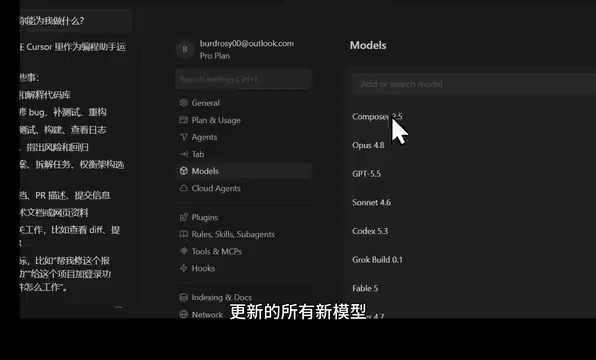
The creator emphasizes that all official Cursor models (including Claude, GPT, etc.) are natively supported, and when the official client updates, there's no need to wait for compatibility patches — it syncs seamlessly.
Account Source: Bulk-Purchased Official Pro Accounts
Regarding the account source, the creator explicitly states: the platform's account pool contains no trial accounts, shared accounts, or black-market refurbished accounts — all are bulk-purchased official dedicated Pro accounts and enterprise-tier accounts. Their permissions, model calling capabilities, concurrency limits, context length, and other specifications are identical to those of individually purchased premium memberships.
The price advantage comes from "economies of scale through large-volume, long-term procurement," pushing the per-account usage cost down to levels individual users simply can't achieve.
Technical Principles of the Account Scheduling System
The so-called "account scheduling system" is essentially a resource pooling management platform, with an architecture similar to resource orchestration systems in cloud computing. The platform maintains a pool of Pro accounts and uses scheduling algorithms to dynamically route user requests to accounts with sufficient remaining quota for API calls. Technically, this model needs to solve problems including session state management, context continuity, concurrency control, and quota balancing. Notably, users' code context needs to be forwarded through the scheduling layer to the actual executing account, meaning the scheduling platform does technically come into contact with users' code data along the technical chain — a point that's crucial for the data security risk discussion that follows.
Cursor 65%-Off Pay-Per-Use Billing Model Explained
Rate Structure: Flat 65% Off with No Hidden Fees
The plugin's billing rules are quite straightforward: a flat rate of 35% of official pricing. For every $1 of token resources consumed at official rates, only $0.35 is deducted from your balance.

The creator specifically emphasizes several "no's": no processing fee tricks, no tiered price increases, no hidden service fees, and no mandatory bundled plans.
Technical Background on Token Billing
Tokens are the basic unit of measurement for text processing in large language models. For English text, one token corresponds to roughly 4 characters or 0.75 words; in Chinese text, one character is typically encoded as 1-2 tokens. In AI coding scenarios, each code completion or conversation request consumes input tokens (the user's code context and instructions) and output tokens (the model-generated code), with the two typically priced differently — output tokens generally cost 3-5x more per unit than input tokens. Cursor Pro's monthly subscription model essentially bundles a certain quota of token calls into a fixed monthly fee, while pay-per-use billing settles directly based on actual token consumption. Understanding this mechanism helps developers evaluate their real usage costs.
Dynamic Scheduling and Balances That Never Expire
This is the plugin's biggest claimed differentiator — completely abandoning the monthly subscription model:
- The system monitors all accounts' quota usage and idle status around the clock
- No code written, no model called = no charges incurred
- Idle account quotas are automatically reclaimed, released, and redistributed to other active users
- Balances don't expire, don't get zeroed out, and don't reset at month's end
If this mechanism truly operates as described, it would indeed be more economical than a fixed monthly subscription for developers with irregular usage patterns.
Billing Transparency: Precise to Three Decimal Places
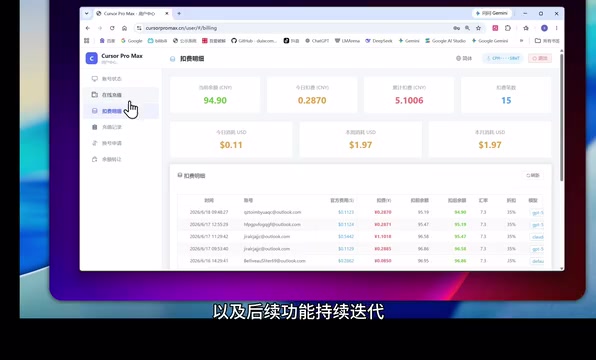
Each user's dashboard records every model call, token consumption, and billing detail, precise to three decimal places, including tokens consumed, USD conversion, CNY conversion, remaining balance, call timestamp, and model used.
A Sober Analysis: Four Risks You Can't Ignore
Despite the plugin demonstrating relatively high technical transparency in its marketing, the following risks still warrant careful consideration by developers:
The Compliance Gray Zone
No matter how "clean" the technical implementation is, distributing official Pro accounts to multiple users through a scheduling system is fundamentally a form of account sharing. Virtually all major SaaS products' Terms of Service explicitly prohibit account sharing, resale, or transferring subscription benefits to third parties in any form. This isn't just about protecting the business model — it also involves the legal delineation of data security responsibilities. When accounts are shared, the service provider cannot accurately track the identity of data accessors, which may constitute a compliance risk under data protection regulations like GDPR. Cursor's team has the right to unilaterally terminate service without refund upon discovering violations, meaning developers relying on such third-party services face the risk of losing tool access at any time. Even if current enforcement hasn't been triggered, the risk of future policy changes always exists.
Questionable Sustainability of "Bulk Official Account Procurement"
A 65% discount means the platform's actual procurement cost needs to be below 35% of the official retail price. Enterprise bulk purchases can indeed yield discounts, but whether such a large discount margin is sustainable long-term depends on whether Cursor tightens its channel policies. In the SaaS industry, when vendors discover large-scale account resale, they typically respond by adjusting enterprise pricing strategies, increasing usage audits, and limiting concurrent devices per account. Once procurement costs rise, the platform must either raise prices or compress margins until operations become unsustainable.
Code Data Security Cannot Be Overlooked
Using Cursor through a third-party scheduling system means your code context and project information pass through the third-party platform's scheduling pipeline to some degree. Since the scheduling system needs to forward users' code context to Pro accounts in the pool for model calls, these code snippets may be recorded by the scheduling platform's logging systems during transmission and processing. For projects involving trade secrets or sensitive code, this point demands extra caution. Even if the platform promises not to store user data, without third-party security audits, developers have no way to verify the truthfulness of that promise.
Stability Risks of a Solo-Operator Model
The creator openly acknowledges that "all development, operations, and customer service are handled solely by themselves." This single-person operation model may face challenges in service stability and response speed as the user base grows. From an operations perspective, a platform involving account pool management, dynamic scheduling, billing systems, and user management carries non-trivial technical complexity. Single points of failure, handling traffic spikes, security incident response — all require sustained human investment, and a one-person team is inherently limited in its risk resilience.
Cursor Usage Strategy Recommendations for Different Developer Profiles
For different types of developers, a differentiated strategy is recommended:
- High-frequency power users (4+ hours daily): Subscribe directly to Cursor's official Pro membership — stability and compliance are best guaranteed, and the cost-effectiveness is actually the highest. At $20/month, developers using it 4+ hours daily pay less than $0.25 per hour, far below the value of the efficiency gains AI provides.
- Medium-frequency users (3-4 days per week): Consider the official membership, or test the waters with a small amount on a third-party tool before deciding. Also keep an eye on whether Cursor will introduce more flexible billing plans.
- Low-frequency, sporadic users: Pay-per-use billing is indeed more economical, but be sure to limit your top-up amounts and prioritize small-amount testing. Also consider using Cursor's free tier combined with other free AI coding tools (such as Codeium, Supermaven, etc.) as alternatives.
Regardless of which option you choose, the core principle is: never make large deposits on any third-party platform, never process sensitive code through unofficial channels, and always maintain local code backups.
Conclusion: A Clear-Headed Balance Between Saving Money and Staying Safe
This low-cost Cursor renewal plugin is indeed more transparent and professional in its technical narrative than most similar tools on the market, and its "no client tampering + official account scheduling + pay-per-use billing" design has a certain logic to it. However, developers still need to make a clear-headed tradeoff between "saving money" and "compliance and security" when making their choice.
From a broader perspective, the AI coding tools market is in a period of rapid growth, with competition among Cursor, GitHub Copilot, Windsurf, and other products intensifying. This competition will ultimately drive diversification in pricing models — pay-per-use billing, team sharing, student discounts, and other flexible plans will likely become standard official offerings. Until then, developers need to make rational choices within the current pricing framework.
The core value of AI coding tools lies in boosting efficiency, not in repeatedly stumbling over tool selection — and that point is perhaps more important than any discount.
Related articles

A Giant Shot: An AI Screenshot Tool with Built-in MCP That Lets AI Directly Control Your Computer
A Giant Shot is a desktop screenshot tool with a built-in MCP Server, offering 11 annotation tools, smart OCR, AI chat, and desktop automation for Cursor and Claude Desktop.

Three Essential Claude Code Configuration Techniques: A Practical Guide to CLAUDE.md, Memory & MCP
Master three Claude Code configuration techniques: use CLAUDE.md for project rules, Memory for auto-learning preferences, and MCP for connecting GitHub and external tools.

Token Doomsday: The Industry Truth Behind AI Coding's Spiraling Costs
GitHub Copilot shifts from flat-rate to per-token billing, sending dev costs from $29/mo to $1,000+. Uber burns its annual AI budget in months. A deep dive into Token Doomsday.