Deep Dive into Six AI Development Tools: Loop Recipe Library, Vercel Agent Framework, and More
Six AI dev tools analyzed: Loop recipes, Vercel Agent framework, Pyker, Arrow, DBX, and NVIDIA Skill Spectre.
This roundup examines six AI development tools shaping the engineering landscape: Loop Library for repeatable AI workflows with checkpoints and stop conditions, Vercel's file-system-first Agent framework, Pyker's AI-native project management treating Agents as team members, Arrow's cryptographic P2P connectivity, DBX's lightweight multi-database client, and NVIDIA's Skill Spectre for Agent security analysis revealing that 26.1% of Skills contain vulnerabilities.
This week's tech roundup focuses on the latest developments in AI engineering and developer tooling ecosystems, covering the Loop workflow recipe library, Vercel's open-source Agent framework, AI-native project management platform Pyker, P2P connectivity tool Arrow, lightweight database client DBX, and NVIDIA's Agent security analysis tool Skill Spectre. These tools are advancing AI Agent reliability, developer experience, and security governance from different angles.
Loop Library: Making AI Automation Repeatable and Predictable
The concept of Loops has been gaining momentum in AI engineering circles. Loop Library is a collection of AI Loop workflow recipes covering engineering, operations, content, design, and evaluation scenarios.
In AI Agent engineering, a Loop refers to a working pattern where an Agent repeatedly executes a "perceive-decide-act-evaluate" closed loop. Unlike traditional single API calls, Loops allow Agents to iteratively converge toward a goal across multiple rounds. However, unconstrained Loops easily lead to "Agent drift" — where an Agent deviates from its original objective during extended runs, producing unpredictable behavior.
The core concept isn't complicated: every Loop has built-in Checkpoints and Stop Conditions, making automated workflows repeatable and outcomes predictable. Checkpoints essentially borrow from the snapshot mechanism in distributed systems, saving state at critical nodes to enable backtracking and recovery. Stop Conditions are analogous to termination criteria in control theory, preventing Agents from falling into infinite loops or performing actions beyond their authorized scope. The combination of these two concepts represents the core design pattern in current Agent reliability engineering.
This may seem simple, but it directly addresses the pain point of current Agent engineering — everyone is pursuing long-running autonomous Agents, but the real challenge is making them run reliably and know when to stop.
Take engineering Loops as an example: the recipe library provides templates for testing, documentation, performance optimization, code coverage, and more. The "ticket-to-PR" Loop design is particularly elegant — it requires the Agent to first reproduce the issue in a minimal environment, only attempting fixes after failure, with escalation triggers to prevent the Agent from making irreversible decisions on its own.
This approach of "bounded automation" is more pragmatic than blindly pursuing Agent autonomy, and deserves attention.
Vercel Agent Framework: File-System-First Developer Experience
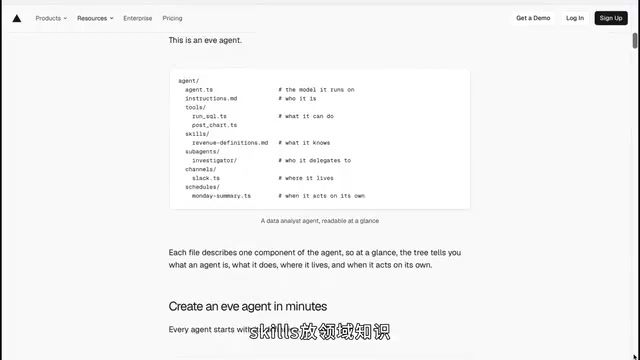
Vercel has released an open-source Agent framework with the goal of making Agent development feel like building with Next.js. Its core design philosophy is file-system first — an Agent is a directory, and where you place files determines functionality.
File-system First is a framework design paradigm originally popularized by Next.js in the frontend world — using file and directory naming conventions to automatically generate routes, eliminating vast amounts of boilerplate configuration code. This "Convention over Configuration" philosophy originated from Ruby on Rails, with the core advantage of reducing cognitive load: developers simply place files according to the agreed directory structure, and the framework automatically infers their functional roles.
Specifically, the directory structure is highly intuitive:
- agent.ts configures the model
- instructions.md contains system prompts
- tools/ directory holds tool capabilities
- skills/ stores domain knowledge
- channels/ defines deployment channels like Slack or Discord
- schedules/ configures scheduled triggers
The framework includes built-in persistent execution with checkpoint resumption, code sandboxing, human approval steps, tool execution via MCP protocol, and comes with OpenTelemetry observability and an evaluation framework.
MCP (Model Context Protocol) mentioned here is an open protocol released by Anthropic in late 2024, designed to standardize interactions between AI models and external tools and data sources. Before MCP, every Agent framework had its own tool-calling interface, leading to severe ecosystem fragmentation. MCP defines a unified request-response format, permission declarations, and context-passing mechanisms, allowing the same tool plugin to be reused across different Agent frameworks. It's becoming the de facto standard for Agent tool interoperability.
OpenTelemetry (OTel) is an open-source observability framework under the Cloud Native Computing Foundation (CNCF), providing unified APIs for collecting distributed traces, metrics, and logs. Integrating it into an Agent framework means developers can trace the latency of every LLM call, token consumption, tool execution chains, and error propagation paths. This is crucial for debugging complex multi-step Agent workflows — an Agent system without observability is like a black box where you know the inputs and outputs but can't understand what happened in between.
That said, the Agent framework space is already a red ocean — LangChain, Mastra, and various cloud vendors are all competing. Vercel's differentiator is bringing its expertise in developer experience and deployment integration to the table, though this also means deep coupling with the Vercel platform. Whether it can become a cross-vendor de facto standard remains to be seen based on community adoption. The bundled observability and evaluation capabilities are a direction worth watching.
Pyker: Treating AI Agents as Full Members of Agile Teams
Pyker is a free, open-source AI-native project management platform with a fairly radical approach: treating AI Agents as full members of agile teams, on a shared human-AI kanban board where AI can proactively pick up tasks, update statuses, and collaborate with humans in real time.
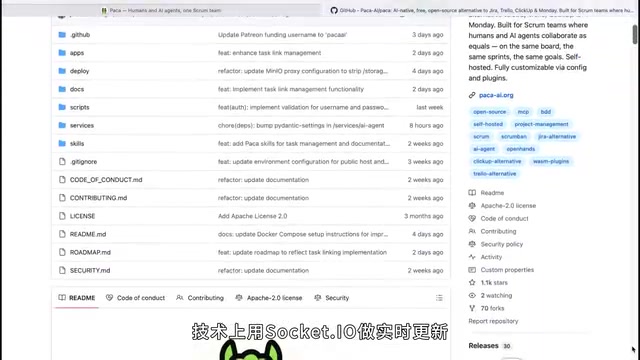
It includes a built-in MCP Server that can connect to Agents like Claude. The MCP Server is the server-side component implementing the Model Context Protocol, responsible for registering, discovering, and dispatching tool capabilities, allowing Pyker's project management features to be exposed as standardized tool interfaces to any MCP-compatible Agent. All changes come with before/after diffs and one-click rollback, and it supports planning work through natural language in project chats. Technically, it uses Sockets for real-time updates, runs plugins in a sandbox environment, supports self-hosting via Docker Compose, and is open-sourced under the Apache license.
Traditional tools like Jira and ClickUp are all stuffing AI into their products, but mostly treat AI as an "add-on assistant." Pyker takes the opposite approach — treating Agents as first-class citizens at the data model level — a product philosophy more aligned with the future of Agent collaboration. Of course, the design that integrates sandboxing and code changes together might become a drawback in complex scenarios; real-world viability depends on its actual problem-solving capability.
Arrow: Cryptographic Public Keys Replace IP Addresses for P2P Connections
Arrow is an open-source peer-to-peer connectivity toolkit whose standout feature is using cryptographic public keys instead of IP addresses to establish connections, enabling direct device-to-device communication.
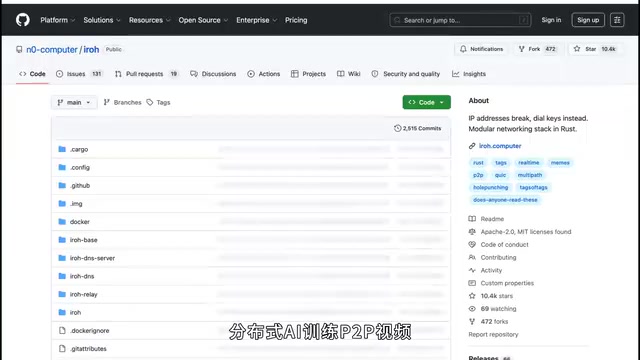
To understand Arrow's value, you need to know the core challenges of P2P connectivity. NAT (Network Address Translation) is one of the most ubiquitous technologies in internet infrastructure — it allows multiple devices to share a single public IP address, but is also the biggest obstacle to P2P connections. Two devices both behind NAT cannot directly find each other. Traditional NAT traversal techniques include STUN (discovering your external address via a public server), TURN (relaying traffic through an intermediary server), and ICE (combining multiple strategies to select the optimal path). Arrow's approach of "replacing IP addresses with cryptographic public keys" essentially introduces cryptographic identity at the network layer — devices no longer address each other through volatile IP addresses but through persistent public key identities. This aligns with the design philosophy of modern network protocols like libp2p and WireGuard.
It can punch through NAT and firewalls to establish direct connections, falling back to stateless relays when direct connection fails, minimizing cloud infrastructure dependencies. The same API supports multiple operating systems, with transport methods covering WiFi, cellular, Bluetooth, and more. Typical use cases include cross-cloud distributed AI training, P2P video, IoT device communication, and file transfer.
Written in Rust, Arrow can run on MCU-level devices, positioning it as more low-level and versatile than typical WebRTC solutions — suitable for teams that need to control their own connectivity layer. However, deployment still requires developers to understand the complexities of P2P networking.
DBX: A Lightweight Unified Client for 50+ Databases
DBX is a lightweight open-source database client that consolidates management of 50+ databases into a single application, eliminating the need to switch between various specialized tools.
Supported engines include MySQL, PostgreSQL, Redis, MongoDB, ClickHouse, Snowflake, BigQuery, and other mainstream and niche databases. Features include connection management, SQL editing, ER diagrams, schema comparison, column lineage analysis, and cross-engine data import/export. Technically, it uses native Rust drivers without JDBC dependency, keeping the installation package at approximately 15MB.
Notably, DBX's choice of native Rust drivers over JDBC (Java Database Connectivity standard interface) means it doesn't require a JVM runtime environment — the key reason the installation package stays at 15MB. Traditional database clients like DBeaver rely on the JDBC ecosystem; while they support a wide range of databases, they need to bundle a complete Java runtime, resulting in installation packages of hundreds of MB.
DBX's selling point is "comprehensive yet lightweight," though its depth of support for any single database may not match vertical tools. It's better suited for full-stack developers who prioritize breadth.
Skill Spectre: NVIDIA's Open-Source Agent Security Gatekeeper
The last tool may be the most sobering of this roundup. Skill Spectre is NVIDIA's open-source security analysis tool specifically designed to detect security issues in Agent Skills (skill plugins).
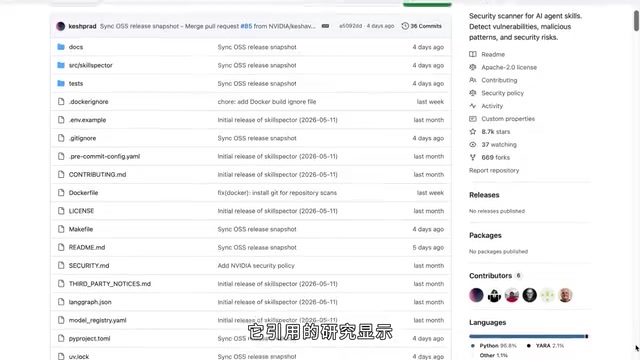
The research data it cites is alarming: 26.1% of Skills contain vulnerabilities, and 5.2% are suspected of having malicious intent — and these plugins are often implicitly trusted and directly executed. The security problem with Agent Skills is essentially an extension of software supply chain security into the AI era. Traditional supply chain attacks (such as the 2020 SolarWinds incident and the 2021 Log4Shell vulnerability) have already proven that third-party dependencies are the weakest link in the security chain. The risk with Agent Skills is even more severe: traditional npm packages or Python libraries execute deterministic code, while Agent Skills often contain natural language instructions (system prompts) that can be carefully crafted to carry out prompt injection attacks — causing an Agent to silently exfiltrate sensitive data or perform unauthorized operations while appearing to execute tasks normally.
The tool employs a multi-stage detection pipeline:
- Fast static analysis: Uses regex and AST (Abstract Syntax Tree) for behavioral analysis — AST is a technique that parses source code into a tree structure, enabling understanding of code's syntactic structure rather than merely matching text patterns, thus more accurately identifying dangerous function calls, data flows, and permission requests
- Semantic evaluation (optional): Uses an LLM for intent assessment, going beyond the capabilities of traditional static analysis by leveraging large language models to understand the semantic intent of code and prompts, identifying patterns that are syntactically valid but semantically suspicious
- CVE lookup: Connects to the OSV (Open Source Vulnerabilities) database for real-time vulnerability checks — OSV is a vulnerability database maintained by Google that aggregates known vulnerability information across multiple ecosystems
It covers 16 major categories with 64 vulnerability patterns including prompt injection, data exfiltration, privilege escalation, and supply chain poisoning. It accepts Git repositories, URLs, ZIP files, or directories as input, outputs to terminal, JSON, or SARIF reports, and provides a risk score from 0-100.
SARIF (Static Analysis Results Interchange Format) is a JSON format defined by the OASIS standards organization specifically for representing static analysis tool outputs. Mainstream CI/CD platforms like GitHub and Azure DevOps natively support SARIF format, displaying security scan results directly in Pull Request code review interfaces. Skill Spectre's SARIF output support means it can seamlessly integrate into existing DevSecOps pipelines — automatically triggering security scans on every Agent Skill code change and presenting discovered vulnerabilities as part of code review.
The Agent Skill and MCP ecosystem is expanding rapidly, but security governance is nearly nonexistent. A third-party Skill may receive far more permissions than you'd imagine, and Skill Spectre can be conveniently integrated into existing CI security pipelines. However, it has limitations: it can only perform static analysis and cannot parse runtime behavior, encrypted code, or non-English content.
Summary
This week's six tools outline several key trends in AI engineering:
- Reliability first: Loop Library emphasizes bounded automation, more pragmatic than blindly pursuing Agent autonomy
- Developer experience competition intensifies: Vercel enters the Agent framework space — crowded but directionally clear
- Deepening human-AI collaboration: Pyker elevates Agents from "assistants" to "team members" — a forward-thinking philosophy
- Infrastructure goes deeper: Arrow and DBX provide lighter, more versatile foundational capabilities in networking and data management respectively
- Security governance is urgent: A quarter of Agent Skills contain vulnerabilities — the security toolchain desperately needs to catch up
From a broader perspective, these tools collectively reflect that AI engineering is transitioning from the "just make it work" prototype stage to a production stage with strict requirements for reliability, observability, security, and developer experience. This closely mirrors the path cloud-native technology took from experimentation to maturity a decade ago — first an explosion of foundational capabilities, then systematic completion of the engineering toolchain.
Most of these tools are open-source and available. Developers are encouraged to selectively try them based on their specific needs.
Related articles
Sakana AI Launches RSI Lab: The Path to Recursive Self-Improvement Where AI Builds AI
Sakana AI launches RSI Lab for recursive self-improvement, letting AI autonomously improve its own architecture. Explore their four-stage roadmap and key breakthroughs.

The Clotilda: Underwater Archaeological Discovery of America's Last Slave Ship
The Clotilda, America's last slave ship, was discovered by underwater archaeologists in Alabama nearly 160 years after sinking. Learn about the search, key evidence, and other slave trade shipwreck discoveries.
Sakana AI in Practice: Reshaping Banking Lending Operations with AI Agents — Technology and Strategy
Deep dive into how Sakana AI applies AI Agents to banking lending operations, covering end-to-end support from information gathering to approval document generation, plus technical challenges and human-AI collaboration design.