Deep Dive into the 198-Page Codex Chinese Manual: A Complete Guide from Beginner to Advanced
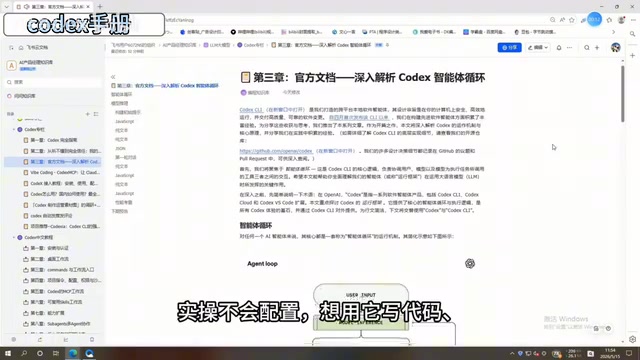
A comprehensive breakdown of ByteDance's 198-page Codex manual covering beginner to advanced AI programming workflows.
This article dissects a 198-page Codex Chinese usage manual compiled internally at ByteDance, covering four progressive modules: installation and authentication, Commands instruction systems, MCP workflows with reusable Skills templates, and advanced multi-Agent collaboration with background task scheduling. The manual provides a complete learning path for leveraging OpenAI's Codex as an autonomous software engineering assistant.
Why You Need a Systematic Codex Learning Guide
As one of the most powerful AI programming assistants available today, OpenAI's Codex is attracting increasing attention from developers and productivity enthusiasts alike. Codex was originally fine-tuned from GPT-3, specifically optimized for code generation tasks, with training data encompassing billions of lines of public code from GitHub. In 2025, OpenAI launched a completely new Codex cloud-based software engineering agent that runs in a cloud sandbox environment, capable of handling multiple tasks in parallel—including writing functional code, fixing bugs, answering codebase-related questions, and creating Pull Requests. Unlike earlier versions, the new Codex is powered by the codex-1 model, which has been trained through reinforcement learning to strictly follow instructions, write code in established styles, and execute test validations. This marks the evolution of AI programming assistants from simple code completion to a new era of autonomous software engineering.
However, the reality is that most people's learning journey looks like this: struggling through English documentation, piecing together scattered tutorials online, unable to understand the principles as beginners, and unable to configure things in practice—wanting to use it for coding and productivity but never quite getting the hang of it.
Recently, a 198-page Codex Chinese usage manual compiled by senior engineers at ByteDance has sparked heated discussion in the community. This manual is specifically designed for beginners and intermediate learners, covering the complete Codex usage pipeline from basic installation to advanced multi-Agent collaboration. Today, we'll do a deep dive into the core content of this manual to see whether it's truly worth your time.
Core Architecture of the Manual: Four Modules Building Progressively
Layer 1: Installation, Authentication, and Desktop Workflow Basics
For users starting from zero, the biggest barrier often isn't the complexity of Codex itself—it's the environment configuration step that drives away a large number of people. The first section of this manual starts directly with installation and authentication, covering basic desktop workflow operations to ensure readers can get Codex up and running in the shortest possible time.
This "get it running first, understand later" teaching approach is highly pragmatic. Many technical documents prefer to explain a mountain of theory first, causing readers to lose patience before they even start hands-on work. This manual instead lets users see results first, then circle back to understand the why—a typical characteristic of internal training materials at major tech companies. In educational theory, this approach is called "Experiential Learning," proposed by educational theorist David Kolb. It emphasizes building learning motivation through concrete experience before gradually diving into abstract concepts, achieving learning retention rates far higher than the traditional "theory first, practice later" model.
Layer 2: Complete Breakdown of Commands and Project Configuration
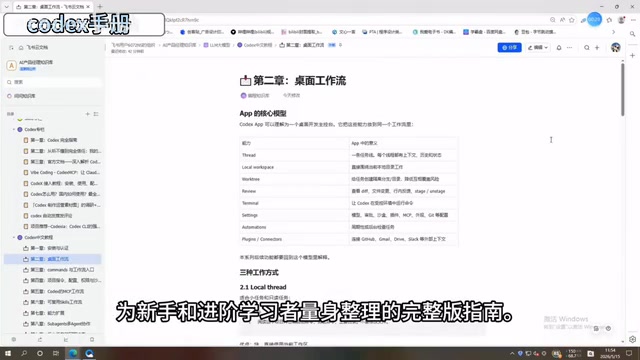
After mastering basic operations, the manual moves into its second core module—the Commands instruction system and project configuration. This section is essentially the "central nervous system" of Codex usage, determining how much control you can exert over the tool.
Your mastery of the instruction system directly impacts usage efficiency. The gap between a proficient Codex user and a beginner often isn't about who understands programming better, but about who is better at "giving instructions." This "giving instructions" is essentially the practice of Prompt Engineering—how to describe requirements in precise, structured natural language so the AI model produces outputs that best match expectations. Research shows that optimized prompts can improve AI code generation accuracy by 30%-50%. The manual's comprehensive breakdown of the instruction system means readers can systematically build their own instruction knowledge base rather than relying on scattered experience.
Layer 3: MCP Workflows and Skills Templates
This is one of the most practically valuable sections of the manual. MCP (Model Context Protocol) workflows represent the core protocol of current AI programming tools—understanding it means understanding the underlying operational logic of Codex.

MCP (Model Context Protocol) is an open standard protocol introduced by Anthropic in late 2024, designed to establish a unified communication interface between AI models and external data sources and tools. Think of MCP as the "USB-C port" of the AI world—it defines a standardized connection method that enables AI models to seamlessly access file systems, databases, API services, development tools, and other external resources. In Codex usage scenarios, MCP workflows allow users to inject context information such as code repositories, project documentation, and testing frameworks into the AI model through a standard protocol, enabling it to generate more precise code with full understanding of the project background. MCP uses a client-server architecture, supports both local and remote connection modes, and has been widely integrated into mainstream AI programming tools including Cursor, VS Code, and Windsurf.
Even more noteworthy is the concept of reusable Skills templates. The manual teaches users to encapsulate common operations into "one-click efficiency packages"—essentially teaching you to build your own AI workflow automation system. The Skills template concept is fundamentally an extension of the "Infrastructure as Code" philosophy into the AI workflow domain. In traditional DevOps practices, engineers template server deployment and environment configuration through configuration files; in AI programming scenarios, Skills templates encapsulate commonly used AI interaction patterns—including prompts, context configurations, output format requirements, and post-processing logic—into reusable standardized units.
For example, if you frequently need to perform code reviews, formatting, or test case generation, you can completely template these operations for one-click invocation later. Users can define these high-frequency operations as Skills, enabling team-level efficiency replication and transforming tacit experience into explicit knowledge assets.
The value of this approach far exceeds Codex itself. It cultivates a mindset of "abstracting repetitive labor into reusable processes"—a universal skill applicable to any AI tool. This parallels the "Template Method Pattern" in software design—defining the algorithm skeleton while deferring specific steps to subclass implementations, maintaining process consistency while allowing flexible customization.
Advanced Techniques: Multi-Agent Collaboration and Background Task Scheduling
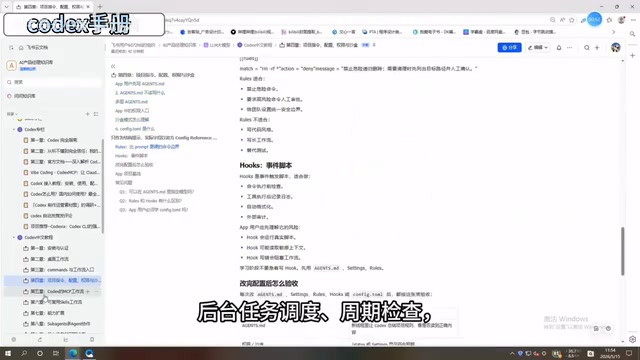
The final major module of the manual enters advanced territory: Subagents multi-Agent collaboration, background task scheduling, periodic checks, and result joint merging.
The Practical Significance of Multi-Agent Collaboration
Multi-Agent collaboration is not a gimmick concept. Multi-Agent Collaboration is a cutting-edge paradigm in current AI system design, with its core philosophy rooted in distributed computing and microservices architecture—decomposing a complex task into multiple specialized subtasks, each handled by different AI Agents, with results ultimately integrated through coordination mechanisms.
In Codex's Subagents system, the main Agent (Orchestrator) handles task decomposition and scheduling, while sub-Agents each execute specific work in independent sandbox environments. In real software development scenarios, a complex task often needs to be broken down into multiple subtasks for parallel processing: one Agent handles code generation, another handles test validation, another handles documentation, and finally the results are merged. This working model can significantly improve processing efficiency for complex projects.
The advantages of this architecture are threefold: First, each Agent can have an independent context window, avoiding the context overflow problem that occurs when a single Agent handles complex tasks—even the most advanced large language models have limited context windows, and a single Agent processing an oversized codebase can easily "forget" critical information. Second, multiple Agents can execute in parallel, dramatically reducing overall processing time. Third, specialized division of labor allows each Agent to maximize performance in its area of expertise. This model is highly consistent with the "divide and conquer" strategy in software engineering and the pipeline philosophy in DevOps.
Background Task Scheduling and Periodic Checks
Background task scheduling means you can have Codex continuously run specific tasks in the background—such as periodically checking code quality, automatically running test suites, and monitoring project dependency updates. This is no longer simply "AI helping you write code"—it's AI serving as your continuous integration assistant.
The implementation of background task scheduling in Codex essentially combines the automation philosophy of traditional CI/CD (Continuous Integration/Continuous Deployment) pipelines with AI capabilities. Traditional CI/CD tools like Jenkins and GitHub Actions automatically execute build, test, and deployment processes through predefined scripts after code commits. Codex's background task scheduling goes further—it not only executes preset automation scripts but also leverages AI's understanding and reasoning capabilities for intelligent code quality analysis, potential bug detection, and dependency security auditing.
Periodic checks and result joint merging further complete this automation loop. The periodic check mechanism is similar to Cron Job scheduled task scheduling but incorporates AI judgment capabilities—for example, it can not only detect that a dependency package has a new version but also assess upgrade compatibility risks and automatically generate migration plans. You can set check frequencies to have outputs from multiple Agents undergo unified verification and integration at the final stage, ensuring output quality. Result joint merging draws from Git's merge strategies, using conflict detection and intelligent resolution mechanisms to integrate parallel outputs from multiple Agents into a consistent final output.
Who Is This Codex Chinese Manual For?
Looking at the content structure, this manual covers a remarkably broad target audience:
- Complete programming beginners: Starting from installation and configuration, with hand-held guidance into the basics—no prerequisite knowledge required
- Working programmers: Advanced content like MCP workflows and multi-Agent collaboration can be directly applied to daily development, especially suitable for teams exploring AI-Assisted Development
- Productivity enthusiasts: The approaches to Skills templates and background task scheduling apply to any scenario where you want to leverage AI for efficiency gains—whether content creation, data analysis, or project management
- Students: A systematic learning path that's many times more efficient than scattered online searches, while also helping build a holistic understanding of modern software engineering practices
Summary and Reflections
The greatest value of this 198-page Codex Chinese manual lies not only in its systematic integration of knowledge scattered across various sources, but more importantly in how it embodies the methodology accumulated within major tech companies for using AI tools. From basic operations to advanced collaboration, from individual skills to workflow automation, it presents a complete growth path for AI programming capabilities.
Of course, any manual is just a starting point. True skill improvement still requires extensive hands-on practice. But having a clearly structured, immediately actionable guide as a reference can at least help you avoid many detours and spend your time on truly valuable practice.
In an era where AI tools iterate so rapidly, rather than passively waiting for scattered information to come to you, it's better to proactively build a systematic learning framework. It's worth noting that AI programming tools are rapidly evolving from "assisted coding" to "autonomous engineering"—from GitHub Copilot's line-level completion, to Cursor's project-level understanding, to Codex's multi-Agent autonomous collaboration, each leap redefines the collaboration boundary between developers and AI. Mastering a systematic methodology for using AI tools, rather than merely learning to operate any single tool—this is perhaps the greatest insight this manual offers us.
Related articles
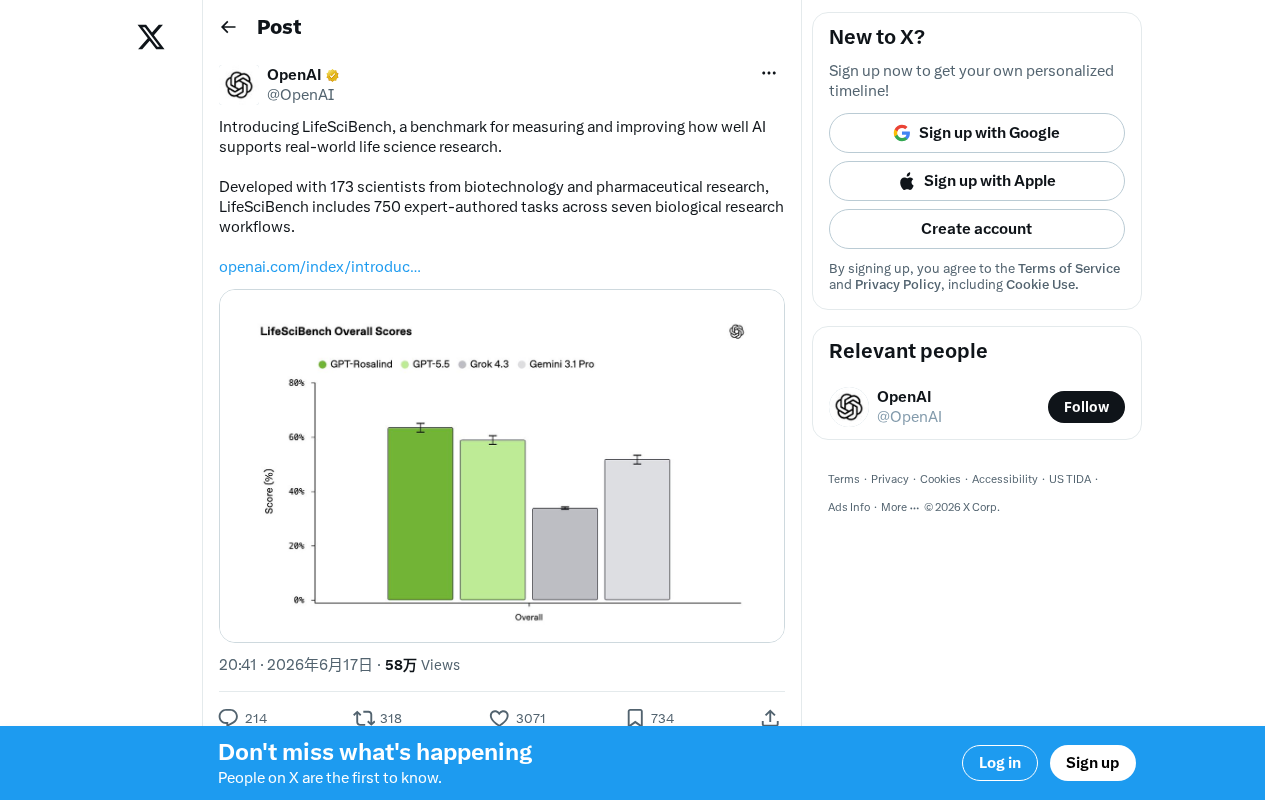
LifeSciBench: A Life Science AI Benchmark Built by 173 Scientists
LifeSciBench is a life science AI benchmark developed by 173 biotech and pharma scientists, featuring 750 expert tasks across seven research workflows.

OpenAI o3 Diagnoses Rare Childhood Diseases: A Deep Dive into the NEJM AI Study
OpenAI and Boston Children's Hospital published research in NEJM AI showing how the o3 Deep Research model helps clinicians diagnose previously unresolved rare childhood diseases.
GPT-5.4 Powers a Drug Chemistry Projec…
GPT-5.4 Powers a Drug Chemistry Project: A Complete Closed Loop from Literature Review to Experimental Validation
GPT-5.4 teams with Maria AI and automated labs to complete a full drug chemistry closed loop—from literature review and hypothesis generation to experimental validation.