DeepMind TacticAI Lands at Palmeiras: AI Predicts Match Dynamics 8 Seconds in Advance
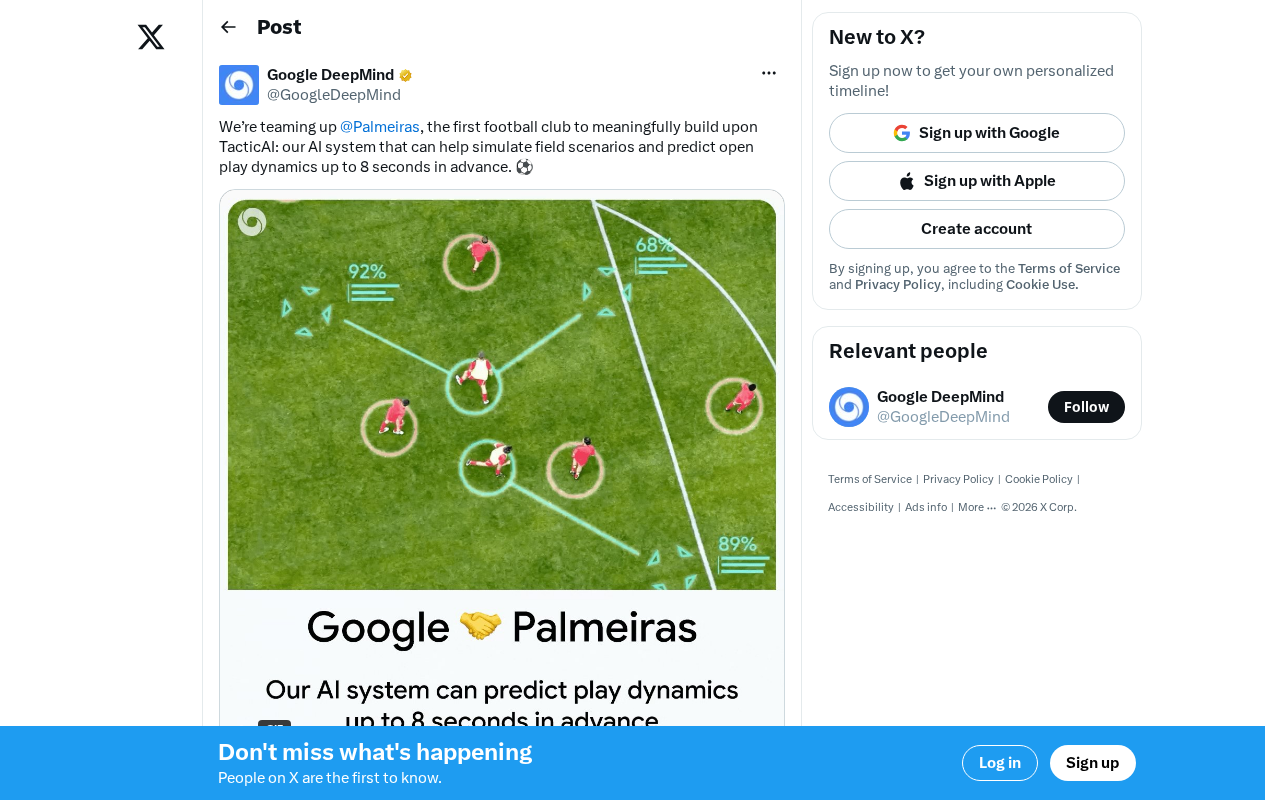
DeepMind's TacticAI becomes the first AI tactical system deployed at a professional football club.
Google DeepMind has partnered with Brazilian club Palmeiras to deploy TacticAI, the first AI tactical analysis system used in professional football. Built on graph neural networks, TacticAI has evolved from corner kick analysis to predicting open-play dynamics up to 8 seconds in advance, offering coaches real-time tactical support for pre-match planning, in-game decisions, and post-match analysis.
DeepMind Partners with Palmeiras
Google DeepMind recently announced a partnership with Brazilian football powerhouse Palmeiras, making them the first football club in the world to officially deploy the TacticAI system in real-world operations. This marks a milestone in the application of AI technology in competitive sports.
TacticAI is an AI tactical analysis system developed by DeepMind. Its core capability lies in simulating on-pitch match scenarios and predicting open-play dynamics up to 8 seconds in advance. This means coaching staff can leverage AI to develop more precise tactical plans before matches and receive real-time decision support during games.
TacticAI's Technical Architecture and Core Capabilities
From Corner Kick Analysis to Full-Scenario Dynamic Prediction
TacticAI didn't appear out of nowhere. As early as the beginning of 2024, DeepMind published a research paper on TacticAI in Nature Communications, where the system primarily focused on tactical analysis of corner kick scenarios. The system uses Graph Neural Networks (GNN) to model player positions, movement trajectories, and tactical coordination, enabling it to predict corner kick receivers, analyze defensive vulnerabilities, and generate alternative tactical plans.
Graph Neural Networks are a class of deep learning models specifically designed to process graph-structured data. Unlike traditional neural networks that handle regular grid data (such as images), GNNs can learn and reason over complex topological structures composed of nodes and edges. In football scenarios, each player is modeled as a node in the graph, with attributes including position, velocity, and orientation; spatial distances between players, adversarial relationships, and coordination patterns are encoded as edge features. Through message-passing mechanisms, GNNs allow each node to aggregate information from its neighboring nodes, thereby capturing the collaborative and adversarial patterns that are crucial in team sports. This modeling approach is naturally suited for football and other multi-agent interaction scenarios, since player behavior is highly dependent on the positions and actions of teammates and opponents.
Now, TacticAI's capabilities have expanded from set pieces to dynamic prediction of open play — a qualitative leap. Set pieces (such as corner kicks, free kicks, and penalties) are special scenarios in football where play restarts from a fixed position after a stoppage, with players in clearly defined initial positions and relatively fixed, enumerable tactical routines. Open play, on the other hand, refers to the continuous dynamic process during normal match flow, accounting for approximately 85%-90% of a match's duration. During open play, 22 players move freely on the pitch simultaneously, with each person's decisions influenced by teammates, opponents, ball position, and the overall match situation — forming a high-dimensional, highly nonlinear dynamic system. From a computational perspective, the state space for set-piece scenarios is relatively limited, while the state space for open play grows exponentially, placing extremely high demands on the model's generalization ability and real-time inference speed.
Being able to predict match dynamics 8 seconds in advance means the system must process massive amounts of data — real-time positions, velocities, accelerations of all 22 players, and the ball's trajectory — and deliver reliable predictions in an extremely short time. Data collection relies on the increasingly mature tracking technology infrastructure in modern football. Currently, mainstream player tracking technologies in professional football include optical tracking systems (such as Hawk-Eye and ChyronHego) and GPS/LPS-based wearable devices. Optical tracking systems use multiple high-speed cameras deployed around the pitch to capture player and ball positions at 25-50 frames per second, with centimeter-level accuracy. After processing, this raw tracking data generates rich spatiotemporal features for each player, including 2D or 3D coordinate sequences, velocity, acceleration, and body orientation. Additionally, event data (such as passes, shots, and tackles) is typically collected by specialized data companies (such as Opta and StatsBomb) through manual annotation or semi-automated methods. TacticAI's 8-second prediction capability is built precisely on this foundation of high-density, high-precision spatiotemporal data.
Practical Value of the 8-Second Prediction Window
In football, 8 seconds may seem brief, but it's enough to change the course of an attack. A fast counter-attack from the defensive third to the attacking third typically takes only 5-10 seconds, and the decision window for a key pass is often less than 2 seconds. The 8-second prediction capability provides coaching staff with multi-dimensional tactical support:
- Pre-match tactical simulation: Simulating the effectiveness of different attacking and defensive schemes based on the opponent's tactical characteristics
- Post-match deep analysis: Analyzing tactical execution at critical moments and identifying areas for improvement
- Training session optimization: Designing more targeted training content based on predictive models
DeepMind's Sports AI Research Trajectory
It's worth noting that DeepMind has deep roots in AI research for sports. Their most well-known achievement is AlphaGo's defeat of the world champion in Go, but the team's exploration in sports analytics has been equally systematic and thorough. In 2021, DeepMind collaborated with Liverpool Football Club to analyze corner kick tactics using AI — research that later evolved into the prototype for TacticAI. DeepMind's core advantage lies in its deep technical expertise in reinforcement learning, multi-agent systems, and temporal prediction — precisely the key capabilities needed for sports tactical analysis. From AlphaGo to AlphaStar (the StarCraft AI) to TacticAI, DeepMind has consistently explored how AI can make optimal decisions in complex multi-agent competitive environments. The football pitch is simply a natural real-world extension of this research direction.
Why Did Palmeiras Become the First Partner Club?
Palmeiras (Sociedade Esportiva Palmeiras), founded in 1914, is one of Brazil's most successful football clubs, boasting 12 Brasileirão titles and 3 Copa Libertadores championships. In recent years, under the leadership of president Leila Pereira, the club has made significant investments in data analytics and technology adoption. As a dominant force in South American football, Palmeiras' decision to embrace AI technology reflects the importance top-tier sports organizations place on data-driven decision-making.
While Brazilian football is renowned for its technical flair, it has long lagged behind Europe's top leagues in data-driven decision-making. Palmeiras' partnership with DeepMind is not only a major step in the club's own digital transformation but could also drive a technology adoption upgrade across South American football as a whole. Notably, the match tempo and style of Brazilian leagues differ significantly from European leagues — the Brasileirão's pitch conditions, climate factors, and tactical preferences all have their own unique characteristics, providing a valuable opportunity to validate TacticAI's adaptability across different football cultures.
You may not have noticed, but DeepMind specifically emphasized in its announcement that Palmeiras is "the first football club to meaningfully build on TacticAI." The phrase "meaningfully build" implies this is not merely a branding partnership or proof of concept, but rather a genuine integration of the AI system into the club's daily training and tactical decision-making processes.
The Future of AI Sports Analytics
The significance of this partnership extends far beyond football itself. It represents a crucial step in AI's journey from the laboratory to real competitive environments. Previously, AI applications in sports were mainly limited to statistical data and simple performance analysis, but the scenario simulation and dynamic prediction capabilities demonstrated by TacticAI elevate AI's role from "post-hoc analyst" to "real-time tactical advisor."
As this partnership progresses, it's foreseeable that more top football clubs will follow suit in adopting similar AI systems. AI-driven tactical analysis could become standard equipment in professional football, much like VAR (Video Assistant Referee) technology, profoundly changing the face of the sport. VAR was first officially used in a FIFA event at the 2018 Russia World Cup and has since been gradually rolled out across major leagues worldwide. VAR's adoption was far from smooth — from initial controversy to becoming standard in professional football, it went through an adaptation period of about 5-6 years, facing issues of cost, fairness, and technical standardization along the way. The adoption of AI tactical analysis systems may follow a similar path: first proving their value at top clubs and events, then gradually penetrating to broader levels as the technology matures and costs decrease.
However, potential fairness concerns also deserve attention — if only financially powerful clubs can afford top-tier AI systems, could this further widen the gap between strong and weak teams? Unlike VAR, AI tactical systems directly influence competitive outcomes rather than merely assisting referee decisions, making fairness concerns potentially more sensitive. Currently, the deployment cost of VAR systems is approximately several hundred thousand dollars per season, which already poses a significant burden for lower-tier leagues, while the development and maintenance costs of top-tier AI tactical analysis systems could be even higher. This is an issue worth careful consideration as AI technology becomes more widespread in sports.
Key Takeaways
Related articles
Codex CLI vs. Desktop App: Choosing the Right Dev Mode by Task Type
In-depth comparison of Codex CLI vs. desktop app capabilities, analyzing the best choice for large projects, multi-file refactoring, quick bug fixes, and more.
Trae CN Download & Installation Guide: A Beginner's Guide to AI-Powered Coding
Complete guide to downloading and installing Trae CN, covering Windows & macOS setup, first-time configuration, Builder & Chat modes, and third-party AI model integration for beginners.
UE5 + Claude Code Hands-On: A Free Plugin Combo for an AI Game Development Workflow
A detailed breakdown of a free UE5 + Claude Code plugin workflow, covering setup of Unreal Claude and Vibe UE, prompt techniques, and building an endless runner game from scratch.