DeepSeek Forms Harness Team: AI Coding Competition Enters the Second Half
DeepSeek builds a Harness team to challenge Claude Code, shifting AI competition to engineering deployment.
DeepSeek has officially formed a dedicated Harness team to build a self-developed Code Harness rivaling Anthropic's Claude Code. The article breaks down the four-layer closed-loop architecture essential for industrial-grade AI coding agents, DeepSeek's three key advantages — a 40x cost edge, top engineering talent, and an exclusive full-pipeline data flywheel — and argues that AI competition has fundamentally shifted from model benchmarks to engineering deployment capabilities.
An Underestimated Industry Milestone
DeepSeek has officially assembled a dedicated Harness team, with the core objective of going head-to-head with Anthropic's Claude Code to build a fully homegrown DeepSeek Code Harness. DeepSeek senior researcher Chen Deli personally confirmed that the team was formed to fill a critical ecosystem gap — DeepSeek's model capabilities are top-tier, but it has always lacked a deployable, controllable, and iterable engineering shell.
Many dismiss this as merely a domestic alternative to Claude Code — just another ordinary AI coding tool not worth paying attention to. But that assessment reveals a fundamental misunderstanding of the core competitive logic in today's AI industry. The strategic value of Harness may far exceed that of a single model version upgrade.
What Exactly Is Harness? It's Not a Code Completion Tool
First, a widespread misconception needs correcting: Harness is not a simple code completion tool, nor is it a reskinned Claude Code. Harness is an orchestration and constraint control system for engineering.
The term "Harness" originates from "Test Harness" in software engineering, initially used in automated testing to describe infrastructure that controls test execution, collects results, and manages test environments. In the AI Agent context, the meaning of Harness has been significantly expanded — it's not just a testing framework, but a complete engineering control layer for constraining, validating, orchestrating, and managing closed-loop feedback on large model outputs. Anthropic's Claude Code is the industry's recognized benchmark implementation, wrapping model capabilities in a complete engineering shell that evolves the model from "can chat" to "can work." The core philosophy behind this concept is: the raw output of large models inherently carries uncertainty and hallucination risks, and must be "tamed" through engineering methods into predictable, reproducible, and auditable productivity tools.
Think of a large model as a supercharged engine with off-the-charts horsepower, responsible for divergent thinking and code generation. Harness is the steering wheel, brakes, and dashboard — its core function is convergence, validation, and error correction, transforming model capabilities from "can generate" to "can reliably deliver."
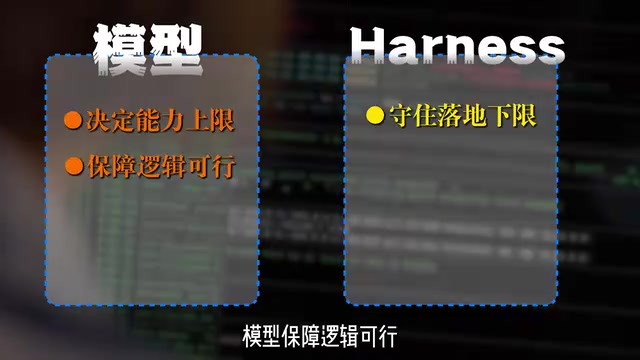
This is DeepSeek's core logic formula: Model + Harness = Real Agent. The model determines the capability ceiling; Harness guards the deployment floor. The model ensures logical feasibility; Harness enables stable, low-cost, long-term iterative deployment in enterprise projects.
The Four-Layer Closed-Loop Architecture of Industrial-Grade Code Harness
The community-developed DeepSeek TUI, leveraging the model's powerful coding capabilities, already delivers an experience close to Claude Code, with its ecosystem growing rapidly. However, there is a fundamental gap between community wrappers and official self-developed solutions — the four complete closed-loop layers essential for industrial-grade Code Harness represent a core shortcoming that third-party tools cannot bridge.
Layer 1: Fine-Grained Context Management
This is the foundation for stable Agent operation. Through precise file selection, compression of ineffective conversations, and global source code review, it addresses the root causes of logic drift, reckless refactoring, and increasingly chaotic modifications in AI development. The quality of context management directly determines the stability of Agent output.
To understand the technical difficulty of this layer, you need to grasp the inherent limitations of large model context windows. Although context windows keep expanding — from GPT-3's 4K to today's 128K or even million-token capacities — "being able to fit it in" and "being able to effectively utilize it" are two different things. Research shows that large models suffer from a severe "Lost in the Middle" problem: when context is too long, the model's attention to information in the middle positions drops significantly, causing critical information to be overlooked. In real engineering scenarios, a mid-sized project might contain hundreds of files and tens of thousands of lines of code, far exceeding any model's effective processing capacity. Therefore, the core technologies of fine-grained context management include: intelligent file selection (loading only code files relevant to the current task), conversation history compression (condensing lengthy multi-turn dialogues into key decision summaries), and global code graph construction (using AST abstract syntax trees and dependency graphs to help the model understand the full project picture rather than reading file by file). These technologies directly determine whether an Agent performs "precision surgery" or "blind modifications" in complex projects.
Layer 2: Standardized Tool Orchestration and Permission Control
File read/write, command execution, MCP calls, user authorization — the key to engineering deployment isn't the number of tools, but the controllability of boundaries and permissions. The industry consensus is clear: an Agent with unchecked permissions is far more dangerous than one that can't use tools at all.
The MCP (Model Context Protocol) mentioned here is an open standard protocol released by Anthropic in late 2024, designed to establish a unified interaction interface between large models and external tools and data sources. Before MCP, every AI tool needed custom adapters for different external services, leading to severe ecosystem fragmentation. MCP's design philosophy is similar to what the USB protocol is for hardware devices — providing a standardized "port" that allows any tool provider to connect to AI systems in a unified format. In the Code Harness context, tool orchestration involves not just which tools to call, but more critically, permission control: which files can be read/written, which commands can be executed, and whether human confirmation is required. This is especially important in enterprise environments, where a runaway Agent might execute destructive commands like rm -rf or leak sensitive code to external services.
Layer 3: Fully Automated Verification Closed Loop
Ordinary demos end when the code is written, but enterprise development is the exact opposite — writing the code is just the beginning. A true Code Harness automatically runs test cases, performs Lint checks and type detection, feeds error logs back to the model, autonomously iterates on fixes or pauses the task for human intervention, forming a complete self-verification chain.
Layer 4: Sustainable Session Asset Accumulation
Real engineering projects cannot be completed in a single Prompt round — they are accompanied throughout by interruptions, rollbacks, and iterative reviews. Harness supports session resumption, version rollback, and fault self-recovery, serving as the core backbone for long-term development of complex engineering projects.
Once you understand these four architectural layers, it becomes clear why all leading AI companies build their own proprietary Code Harness — Kimi, Qwen, and Tencent all do the same. The industry's unchanging truth: a native model paired with a native engineering shell is the optimal deployment solution.
DeepSeek's Three Trump Cards: Why It Can Compete Head-On with Claude Code
Claude Code already occupies a mature market. What gives DeepSeek the confidence to make a strong entry? It actually holds three severely underestimated trump cards.
Trump Card 1: Crushing Cost Advantage
DeepSeek V4, combined with its proprietary caching technology, costs only $0.0145 per million tokens on cache hits, while comparable Claude models cost $0.50 — a nearly 40x cost difference. Claude's high costs make frequent iterative testing impractical, and enterprise commercial use easily leads to bill explosions. DeepSeek, on the other hand, can run multi-round automated verification without cost pressure — high-density iteration is the decisive advantage for enterprise deployment.
To understand the strategic significance of this cost difference, you need to know how AI Agents actually work. Unlike humans who write code in one pass, AI Agents use a "generate-verify-fix" iterative loop: after each code generation, tests need to be run, errors analyzed, and fix plans regenerated. A moderately complex feature development might require 5-15 iterations, each consuming tens of thousands of tokens. By this calculation, an enterprise team's daily Agent usage could reach hundreds of millions of tokens. Under Claude's pricing (Sonnet model output token price of $15 per million tokens), monthly costs could reach tens of thousands of dollars. DeepSeek V4, through its innovative Multi-head Latent Attention (MLA) architecture and FP8 mixed-precision training, dramatically reduces inference costs. Combined with its KV Cache hit mechanism, the marginal cost of high-frequency repeated requests is pushed to extremely low levels. This 40x cost gap means: DeepSeek can "brute force" multi-round automated verification and regression testing, while Claude users must carefully budget every single call.
Trump Card 2: Top Engineering Talent Filling the Gap
Cui Tianyi, a star quantitative engineer formerly at Jane Street, has joined DeepSeek to lead Harness team R&D full-time. The stringent requirements of quantitative systems for low latency, high stability, and high-precision decision-making are highly aligned with AI Agent underlying architecture, directly addressing the long-standing weakness of domestic large models — "strong models, weak engineering."
Trump Card 3: Exclusive Full-Pipeline Data Closed Loop
This is the most insurmountable core moat. In the traditional third-party wrapper model, local logs, error reports, and tool anomaly data cannot be fed back to the model, preventing the model from self-iterating. DeepSeek's self-developed Model+Harness system connects the full-pipeline data closed loop, where all real engineering data flows back to supplement training, making the model stronger with use.
The strategic value of a full-pipeline data closed loop can be understood through the concept of a "Data Flywheel." This concept was first validated by Tesla's autonomous driving team: edge case data generated by vehicles on real roads (such as rare traffic scenarios) is sent back to training centers to improve the model, and the improved model is then deployed back to vehicles to collect higher-quality data, forming a positive cycle. In AI coding, this flywheel works the same way: when users work with Harness on real projects, they generate vast amounts of valuable engineering data — including specific scenarios where the model made mistakes, diff records of human corrections, parsing paths for complex dependencies, and edge-case usage of various frameworks and languages. Third-party wrapper tools, lacking control over the model training pipeline, can only let this data sit idle in local logs. A self-developed system, however, can clean and anonymize this data before feeding it back into the training process, creating a reinforcement loop of "usage → data → training → stronger model → more usage." This is precisely why Anthropic insists on self-developing Claude Code rather than relying on third-party IDE plugins.

This also explains why the marginal returns of pure conversational model training have bottomed out — conventional Q&A scenarios have been fully covered, leaving little room for breakthroughs. The complex engineering scenarios that Harness addresses, however, generate large volumes of niche, extreme cases and complete execution chain data — the core fuel for large model iterative upgrades.
The AI Competition Landscape Has Fundamentally Shifted
It's clear that the AI industry's competitive landscape has undergone a fundamental transformation:
- The past: The industry competed on parameters, benchmarks, and inference speed
- The future: The core competition is about application closed loops and engineering deployment capabilities
Whoever captures user workflows, controls real engineering data, and builds self-iterating closed loops will hold the initiative in the industry. DeepSeek's formation of a Harness team gives a domestic company, for the first time, the capability to compete with Anthropic in the complete "model + engineering shell" closed-loop domain.
For domestic developers, this means completely breaking free from the high prices, rate limits, and instability of overseas tools. A homegrown, self-reliant AI engineering solution has officially broken the overseas monopoly.
Where Does This Leave Ordinary Developers?
The future AI industry will phase out entry-level practitioners who can only call APIs and run simple demos. What commands premium salaries is professionals who master Harness logic, are skilled in tool orchestration, and can independently deliver engineering projects — specialized AI engineers.
The key for ordinary people to ride this wave isn't accumulating model buzzwords, but building complete engineering pipeline skills:
- Use RAG to solve knowledge supply — RAG (Retrieval-Augmented Generation) is the mainstream technical approach for addressing large models' "knowledge cutoff" and "hallucination" problems. Its core principle is to retrieve the most relevant document fragments from an external knowledge base before the model generates an answer, injecting them as context into the Prompt so the model reasons based on real data rather than memory. In Code Harness scenarios, RAG requires building vector indexes over entire code repositories, supporting semantic-level code search, and updating indexes in real-time to reflect the latest code changes.
- Use MCP protocol for action execution
- Use evaluation systems for result acceptance
- Crystallize unstable model capabilities into standardized, deployable business processes
The industry trend is now crystal clear: the model is just the foundation; mastering it is the core. Compute is no longer scarce; the engineering closed loop is the real moat. The dividends of AI's second half don't belong to those who merely apply models — they belong to hands-on developers who can harness models to deliver business value and build complete engineering systems.
Key Takeaways
Related articles
Loop Engineering from Beginner to Expert: A Complete Guide to Agent Loop Development
A deep dive into Loop Engineering covering Agent Loop workflows, code implementation (While loops and Graph patterns), and how it differs from Prompt Engineering.

Coze Workflow Development Tutorial: A Complete Guide to Building AI Apps with Zero Code
Complete guide to Coze workflow development covering Agent building, node orchestration, plugin systems, API integration, and a Coze vs Dify comparison.
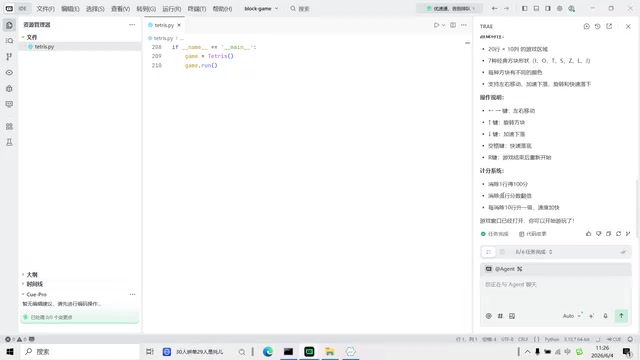
Building Tetris with Zero Coding Using Trae: A Complete AI Programming Walkthrough
A complete walkthrough of building Tetris from scratch using Trae AI IDE with zero coding, covering 4 rounds of iterative AI dialogue, bug fixes, and practical tips for AI-assisted programming.