Loop Engineering from Beginner to Expert: A Complete Guide to Agent Loop Development
A comprehensive guide to Loop Engineering: designing and optimizing Agent loop mechanisms.
Loop Engineering is a methodology for systematically designing Agent loop mechanisms. This article covers the differences between Agents and large models, the Agent Loop workflow (based on the ReAct paradigm), code implementations from While loops to Graph patterns (LangGraph), and how Loop Engineering relates to Prompt and Harness Engineering. It also explores future trends like multi-agent systems and human-in-the-loop design.
What Is Loop Engineering?
Loop Engineering is a methodology for systematically designing and engineering the loop mechanisms of intelligent agents (Agents). While the name may sound novel, its core ideas have long been prevalent in AI development practice.
For those already working in large model development, you've likely encountered this Loop-based development pattern in your work — you just didn't realize it had a formal name. Today, we'll start from the foundational concepts of Agent Loop to help you build a complete cognitive framework.
Agent Loop: The Core Concept of Agent Loops
The Essential Difference Between Agents and Large Models
To understand Loop Engineering, you first need to grasp the difference between an Agent and a regular large language model.
The concept of an "agent" didn't originate in the era of large models. As early as the 1990s, AI researchers proposed the BDI (Belief-Desire-Intention) architecture, defining agents as autonomous entities with beliefs (perception of the world), desires (goals), and intentions (action plans). The LLM Agents we discuss today are essentially modern implementations of the BDI architecture powered by large language models as the "brain" — the model's reasoning capabilities serve as the engine for belief updating and intention generation, while tool invocation is the concrete execution of intentions.
The core differences between the two are reflected in three aspects:
-
Autonomous Tool Invocation: A large model can reason about which tool to call, but requires a human to manually execute it; an Agent can autonomously invoke tools and decide the next step based on the results. The "tool invocation" here technically relies on the Function Calling mechanism — OpenAI pioneered this capability in June 2023, allowing models to output function call requests in structured JSON format, including function names and parameters. Anthropic, Google, and other providers soon followed suit. Function Calling is the critical bridge connecting a large model's "thinking" with "acting" — without it, autonomous tool invocation by Agents would be impossible.
-
Iterative Decision-Making: After calling a tool and obtaining information, an Agent autonomously reasons — should it continue calling other tools for more information, or is it ready to provide a final answer to the user? This "think-act-think-act" loop is the essence of the Agent Loop.
-
Context Memory Management: Agents have the ability to automatically manage context memory, whereas large models can also manage memory but require manual human intervention. It's worth noting that current large models generally have context window limitations (ranging from a few thousand to millions of tokens), meaning that during long-running loops, Agents must intelligently manage which information stays in context and which needs to be compressed or discarded. These memory management strategies — including sliding windows, summary compression, and vector database-backed external memory — are themselves key design considerations in Loop Engineering.
The Agent Loop Workflow
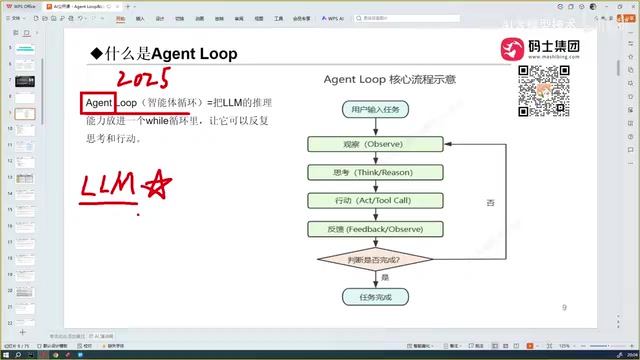
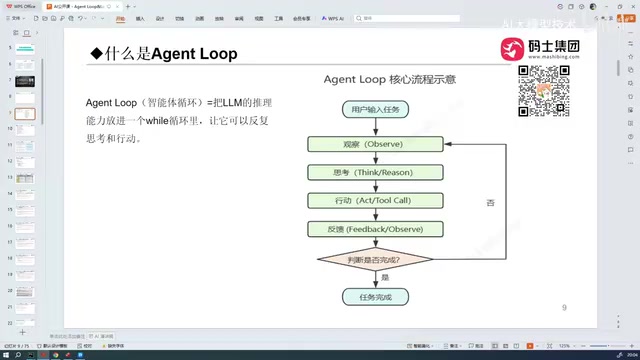
A standard Agent Loop workflow is as follows:
- User Input: Receive the user's question or instruction
- Observe and Think: The large model observes the input, determining whether to answer directly or invoke a tool
- Execute Action: If a tool is needed, call the tool and obtain results; if a direct answer is possible, generate the response
- Termination Check: Check whether the user's needs have been met — if so, end the loop; otherwise, return to step two and continue
This process is essentially a While loop — continuously thinking, acting, thinking again, and acting again until the goal is achieved.
This alternating "thinking-acting" pattern has a well-known name in academia: ReAct (Reasoning + Acting). In 2022, a joint paper by Princeton University and Google Brain first systematically proposed this paradigm, demonstrating that having large models alternate between reasoning (generating chains of thought) and acting (calling external tools) can significantly improve the quality of complex task completion. ReAct can be considered the most classic theoretical foundation of the Agent Loop.
From a broader AI history perspective, the Agent Loop concept shares the same lineage as classical AI planning algorithms (such as the STRIPS planner proposed in 1971) — both follow the closed loop of "perceive environment → formulate plan → execute action → observe results → adjust plan." The difference is that classical planning relied on manually defined symbolic rules, while modern Agent Loops replace the rule engine with the emergent capabilities of large models.
In engineering practice, termination condition design is one of the most error-prone aspects of Agent Loops. If termination conditions are poorly designed, an Agent may fall into an infinite loop (continuously calling tools without converging on an answer) or terminate prematurely (providing an answer with insufficient information). Common termination strategies include: setting a maximum loop count, token budget caps, timeout mechanisms, and letting the model autonomously judge whether the task is complete. The selection and tuning of these strategies is one of the core tasks of Loop Engineering.
Code Implementation of Agent Loops
Early Implementation: The While Loop Pattern
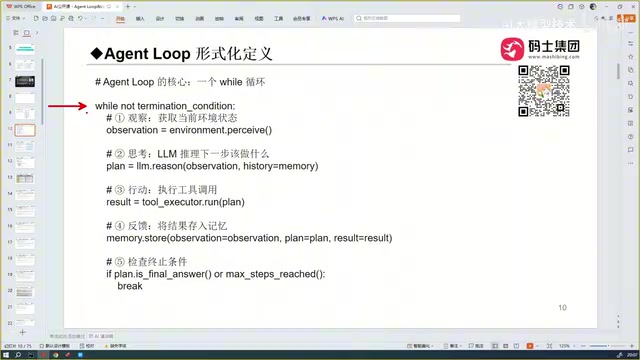
In early agent frameworks, the implementation of Agent Loops was very straightforward — just a While loop. Taking early versions of LangChain as an example, the pseudocode for its core logic looked roughly like this:
while True:
    # Step 1: Observe the user's question and current environment state
    observation = get_current_state(user_input, context)

    # Step 2: Think about the next action (call a tool or reply directly)
    action = llm.think(observation, memory)

    # Step 3: Execute the action
    if action.type == "tool_call":
        result = execute_tool(action.tool, action.params)
        memory.add(result)

    # Step 4: Check termination condition
    if action.type == "final_answer":
        return action.response  # End the loop and return the result
LangChain is an open-source framework created by Harrison Chase in late 2022. Its original design philosophy was to chain large models together with various tools and data sources through "Chains." Its early AgentExecutor component was a typical implementation of the While loop pattern described above — it received user input, repeatedly called the LLM for decision-making within the loop, executed tool calls, and continued until the LLM returned a final answer.
The advantages of the While loop pattern are simplicity and clear logic, but it exposed numerous issues in production environments: crude error handling (a single failed tool call could crash the entire loop), lack of fine-grained flow control (difficulty inserting human review nodes mid-loop), difficult state rollback (inability to conveniently return to a previous decision point for re-execution), and weak multi-Agent collaboration support (no unified mechanism for message passing and coordination between multiple Agents). These pain points directly drove the architectural evolution toward the Graph pattern.
Modern Implementation: The Graph Pattern
Current versions of LangChain no longer use simple While loops to implement Agent Loops — instead, they adopt a Graph-based approach. This evolution reflects the trend in agent development from linear loops toward more complex process orchestration.
Specifically, the LangChain team launched LangGraph as a sub-project in 2024, dedicated to building graph-based Agent applications. In LangGraph, every decision point, tool call, and conditional check in an Agent is modeled as a node in the graph, and the transition relationships between nodes are represented by edges. Unlike the directed acyclic graphs (DAGs) common in traditional workflow engines, LangGraph supports cyclic graphs — this is precisely what Agent Loops inherently require, because "looping" itself means there are back edges in the graph (edges pointing from subsequent nodes back to preceding nodes).
This graph-based design philosophy shares similarities with State Machines and workflow engines (such as Temporal and Airflow) in software engineering, but is specifically optimized for the characteristics of LLM Agents: each node can carry complete conversation state, and edge transition conditions can be dynamically determined by the LLM rather than hard-coded in advance.
The advantages of the Graph pattern include:
- Support for more complex branching logic: Different processing paths can be taken based on different tool return results, and even parallel branches are supported
- More flexible multi-Agent collaboration: Multiple Agents can serve as different subgraphs within the graph, communicating and coordinating through clearly defined interfaces
- Easier flow visualization and debugging: Graph structures are naturally suited for visual display, allowing developers to intuitively see the Agent's decision paths and current state
- More granular state management: Each node has clearly defined input/output states, supporting state persistence, checkpoints, and rollback
Beyond LangGraph, frameworks like Microsoft's AutoGen and CrewAI are also exploring different Agent orchestration patterns, but the core idea is the same: elevating Agent Loops from simple program control flow to a configurable, observable, and debuggable engineering architecture.
The Relationship Between Loop Engineering and Prompt Engineering
Many people ask: what exactly is the difference between Loop Engineering and Prompt Engineering?
From a developmental perspective, AI engineering has gone through several stages:
-
Prompt Engineering: The core skill after ChatGPT's explosive popularity, focused on how to write good prompts to guide model output. Its key techniques include Few-shot Learning, Chain-of-Thought, role assignment, output format constraints, and more. Prompt Engineering addresses the quality of "single interactions" — how to get the model to give the best possible answer in a single call.
-
Harness Engineering: Focused on how to integrate large models with external systems to build complete application pipelines. Typical products of this stage include RAG (Retrieval-Augmented Generation) pipelines, multi-step Chain orchestration, API gateway integration, and more. Harness Engineering addresses the "system integration" problem — how to make large models part of enterprise-grade application architectures rather than isolated chat boxes.
-
Loop Engineering: Focused on the design and optimization of agent loop mechanisms, addressing Agent controllability. Building on the previous two, it further focuses on engineering quality within the loop process — including: loop count control and budget management (preventing runaway token consumption), observability of each loop iteration (being able to trace what decisions the Agent made at each step and why), error recovery and retry strategies (how to gracefully degrade when a tool call fails), and human-in-the-loop node design (introducing human review at critical decision points).
Loop Engineering is more of a systematic summary and methodological elevation of existing development practices. The core problem it solves is "how to make Agents complete complex tasks more efficiently and controllably." In essence, Prompt Engineering is the foundation of Loop Engineering (every LLM call within each loop iteration needs good prompts), while Harness Engineering is its support structure (tool calls within the loop depend on good system integration). The three are progressively layered and interdependent.
Practical Implications for Developers
Learning Paths for Developers with Different Backgrounds
For developers with different backgrounds, here are some recommendations:
- AI Development Beginners: Start by understanding the basic concepts of Agents, then learn Loop design patterns. It's recommended to begin with the core ideas of the ReAct paper, then get hands-on by implementing a simple tool-calling Agent using LangChain or a similar framework to experience the Agent Loop in action.
- Engineers with Existing AI Development Experience: Review your current Agent implementations to see if you've already been doing Loop Engineering without realizing it. Focus on whether your Agent has infinite loop risks, whether token consumption is controllable, and whether each decision round has traceable logs.
- Architects and Technical Leaders: Pay attention to Loop Engineering's impact on system architecture design, especially regarding observability, error handling, and resource control. In production environments, each iteration of an Agent Loop means at least one LLM API call (with associated latency and cost), so loop count control directly affects system response time and operational costs.
Future Trends
Loop Engineering is more of an incremental engineering capability improvement than a disruptive technological revolution. Mastering its core idea — how to design, optimize, and control the loop process of intelligent agents — will become a fundamental skill for AI application developers.
Several cutting-edge directions closely related to Loop Engineering are worth watching:
- Multi-Agent Systems: When multiple Agents need to collaborate on complex tasks, each Agent has its own internal Loop, and there are higher-level coordination Loops between Agents. How to design these "Loops within Loops" (nested loops) is a current hotspot in both research and engineering practice.
- Human-in-the-Loop: In high-risk decision scenarios (such as financial trading and medical diagnosis assistance), Agents cannot run fully autonomously — human review and confirmation must be introduced at critical nodes. How to elegantly insert human intervention nodes within the Loop without disrupting the overall flow continuity is an important challenge that Loop Engineering needs to address.
- Adaptive Loop Strategies: Future Agents may dynamically adjust loop strategies based on task complexity — answering simple questions in a single round, automatically enabling multi-round deep reasoning for complex questions, and even dynamically switching between different reasoning models during execution to balance cost and quality.
Summary
The essence of Loop Engineering is the engineering-oriented, systematic design and management of an Agent's "think-act" loop mechanism. Once you understand the basic principles of Agent Loops, the concept of Loop Engineering becomes crystal clear. It's not some brand-new black technology — rather, it's the distillation and naming of best practices that emerged as AI engineering matured to a certain stage.
Key Takeaways
Related articles
Anjney Midha: The Rise from Singapore to Helm of a16z's AI Investment Empire
Deep dive into Anjney Midha, the key figure behind a16z's AMP fund, covering investments in Anthropic, Mistral, and Black Forest Labs, and his Outputmaxxing philosophy.
Pi: A Lightweight AI Coding Agent Framework — Setup & Hands-On Guide
A deep dive into Pi, a minimalist AI coding Agent framework covering multi-model support, extensions, skill loading, and hands-on custom extension building with model mixing strategies.

Why the Mayor of Los Angeles Has No Real Power: A City Designed to Be the Anti-New York
Why does LA's mayor seem powerless during crises like wildfires? It's not about competence — it's a century-old system designed to prevent corruption by radically decentralizing power.