Enterprise AI Agent Four-Layer Architecture Design and PDCA Continuous Optimization Practical Guide
Enterprise AI Agent Four-Layer Archite…
Four-layer architecture design and PDCA continuous optimization methodology for enterprise AI Agents
This article systematically explains how to build enterprise AI Agents, proposing a four-layer architecture comprising User, Gateway, Agent Service, and Capability layers, while introducing the PDCA cycle to drive continuous optimization. For quality assurance, it combines manual evaluation with LLM-as-Judge automated evaluation in a dual-track mechanism. The article emphasizes that Agent development is a continuous evolution process requiring Multi-Agent collaboration and advanced workflow extensions to handle complex enterprise scenarios.
Introduction
In the process of deploying enterprise-level AI Agents, architecture design and continuous optimization are two core challenges. An enterprise AI Agent is an autonomous decision-making system built on Large Language Models (LLMs), capable of perceiving environments, planning tasks, invoking tools, and executing multi-step operations. Unlike traditional Q&A chatbots, Agents possess the ReAct loop capability of "think-act-observe," dynamically adjusting strategies to accomplish complex goals. The core challenges in deploying enterprise Agents include: the complexity of multi-system integration, stability requirements in production environments, and engineering management for continuous iteration.
A complete enterprise Agent system requires not only a clear layered architecture to support complex business interactions, but also a scientific evaluation and iteration methodology to ensure continuous performance improvement. This article starts from the four-layer architecture of enterprise Agents and dives deep into how to build, evaluate, and optimize a production-grade Agent system.
The Four-Layer Architecture of Enterprise Agents
A complete enterprise Agent system can be clearly divided into four layers: User Layer, Network Layer (Gateway Layer), Agent Service Layer, and Capability Layer. Each layer has its own responsibilities, together forming the complete interaction loop of an enterprise Agent.
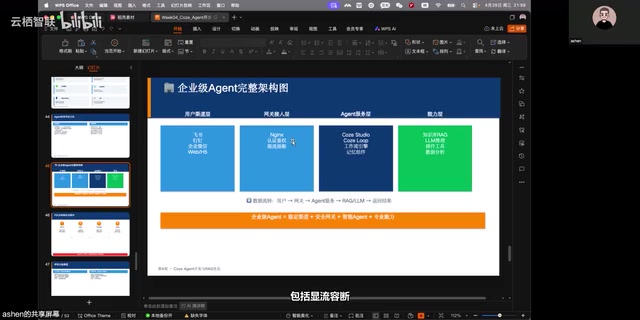
User Layer: Unified Entry Point for Multi-Channel Access
The User Layer is the interface where the Agent directly interacts with end users. In enterprise scenarios, users may access Agent services through various channels such as browsers, WeChat, Feishu, DingTalk, and more. The core responsibility of the User Layer is to provide a consistent interaction experience—regardless of which channel users enter from, they receive unified service quality.
Network Layer (Gateway Layer): Gatekeeper for Security and Traffic
The API Gateway is a core infrastructure component in microservice architectures, and is particularly critical in enterprise Agent scenarios. The Gateway Layer sits between the User Layer and the Service Layer, playing a vital middleware role. This layer typically includes the following key capabilities:
- Nginx service or API Gateway: Responsible for request routing and forwarding
- Authentication and authorization: Ensuring only legitimate users can access Agent services
- Rate limiting and circuit breaking: Protecting backend service stability under high concurrency, preventing system overload
Among these, Rate Limiting uses token bucket or sliding window algorithms to control request rates, preventing LLM inference services from crashing due to traffic spikes; Circuit Breaker borrows from the electrical fuse principle—when downstream service error rates exceed a threshold, requests are automatically cut off to avoid cascading failures. These two mechanisms together ensure the service resilience of Agents in high-concurrency enterprise scenarios. The design quality of the Gateway Layer directly determines the security and availability of the entire system, making it an indispensable component in enterprise deployments.
Agent Service Layer: The Core Brain of the Agent
The Agent Service Layer is the core of the entire architecture, responsible for the Agent's core logic processing. This layer primarily contains three major modules:
- Workflow Engine: Orchestrates and schedules processing nodes, supporting complex flows such as conditional branches, loops, and parallel execution
- Base Components: Including context management, session memory, prompt templates, and other infrastructure
- Orchestration Logic: Determines when to invoke which capability and how to combine outputs from multiple capabilities
Capability Layer: The Agent's Toolbox
The Capability Layer provides the various concrete capability resources that the Agent needs to actually execute tasks, including:
- Knowledge Base Retrieval: Based on RAG (Retrieval-Augmented Generation) technology, retrieving relevant information from enterprise knowledge bases. The core RAG process has three steps: first, enterprise documents are chunked and converted into vectors via Embedding models, then stored in a vector database; when a user asks a question, the query is similarly vectorized and similarity search is performed to recall the most relevant document fragments; finally, the retrieved results are injected as context into the LLM's Prompt to generate the final answer. RAG effectively addresses LLM knowledge cutoff dates and hallucination issues, serving as a core technical pillar of the enterprise Agent's Capability Layer.
- LLM Inference: Invoking LLMs for natural language understanding, generation, and reasoning
- Plugin Invocation: Connecting to external APIs or internal systems to execute specific business operations
- Data Analysis: Querying, aggregating, and visualizing structured data
The organic combination of these four layers constitutes the complete interaction system of an enterprise Agent from access to execution.
PDCA-Based Continuous Optimization Methodology
The PDCA cycle (Deming Cycle) originated in the quality management field in the 1950s and was popularized by statistician W. Edwards Deming for manufacturing quality control. Introducing it into AI Agent iteration management essentially combines agile software engineering principles with the unique characteristics of AI systems: AI system quality cannot be fully predicted during the development phase and must rely on real user data to drive optimization. Building an enterprise Agent is not a one-shot effort—it requires a scientific iteration methodology to drive continuous optimization. Here we recommend adopting the classic PDCA cycle (Plan-Do-Check-Act) to manage the Agent optimization process.
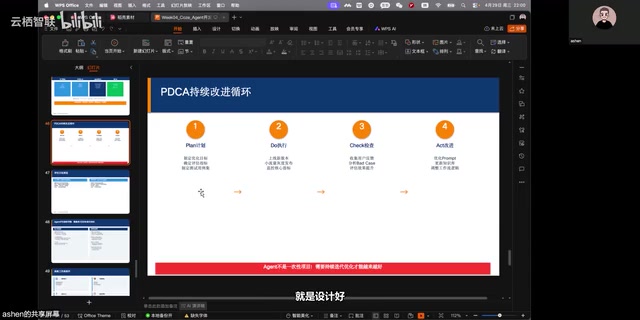
Plan: Define Objectives and Evaluation Metrics
At the beginning of the optimization phase, the following key tasks need to be completed:
- Set optimization objectives: Clearly define the core problem to be solved in this iteration, such as improving answer accuracy for a specific category of questions
- Determine evaluation metrics: Establish an evaluation system across multiple dimensions including accuracy, completeness, format clarity, knowledge base retrieval correctness, exception handling capability, and multi-turn dialogue context memory
- Prepare test sets: Design test cases covering various scenarios early on, including normal scenarios and edge cases
Do: Small Steps, Fast Iterations, Canary Validation
The core principle of the execution phase is small versions, small traffic. Canary Release is a standard practice in internet engineering for reducing deployment risks. In Agent scenarios, it typically involves gradually increasing traffic by user percentage (e.g., 5%→20%→100%) while performing A/B comparisons of key metrics between new and old versions. For AI systems, canary releases are particularly important because LLM outputs are probabilistic—certain edge cases only surface under real traffic. Don't try to ship all optimizations at once; instead, validate effects within a small scope first through canary releases to reduce risk.
Check: Data-Driven Performance Evaluation
The check phase requires collecting actual feedback from real users, with a focus on:
- Analyzing poorly performing cases to identify system weaknesses
- Evaluating whether metrics have met expected targets
- Identifying newly emerging problem patterns
Act: Targeted Optimization and Iteration
Based on findings from the check phase, perform targeted optimization actions:
- Optimize prompts: Adjust System Prompts and Few-shot examples
- Update knowledge bases: Supplement missing knowledge and correct erroneous content
- Adjust workflows: Optimize node orchestration logic and exception handling branches
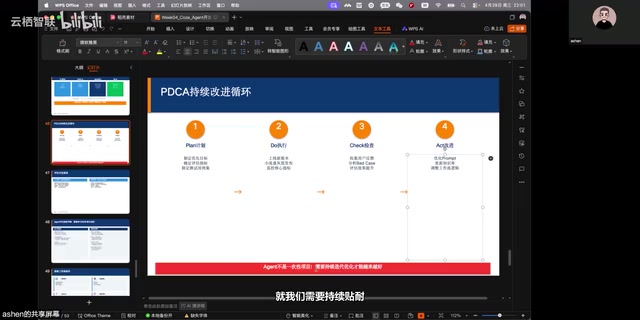
Key Insight: An Agent Is Not a One-Time Project
A critical insight deserves special emphasis here: An Agent is not a one-time engineering project. In actual use, a single Agent often cannot solve all problems. We need to continuously iterate, and even replicate independent Agents based on existing ones, or create multiple sub-Agents under a main Agent for parallel processing. Multi-Agent Systems are an important architectural pattern for handling complex enterprise scenarios: the main Agent (Orchestrator) is responsible for task decomposition and scheduling, while sub-Agents each focus on specific domains or task types, collaborating through message passing to accomplish complex goals. This architecture borrows the "single responsibility" principle from microservices—each sub-Agent has a more focused context window, resulting in higher reasoning quality, while supporting parallel execution to improve overall throughput. Typical implementation frameworks include AutoGen, CrewAI, and LangGraph. As long as you keep optimizing, results will continue to improve.
Agent Evaluation System
Enterprise Agent evaluation currently falls into two main approaches: manual evaluation and automated evaluation. Each has its pros and cons, and they typically need to be combined for optimal results.
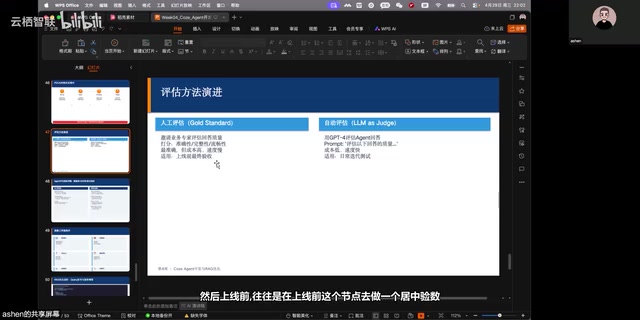
Manual Evaluation: Professional and Reliable but Costly
Manual evaluation is typically performed by business expert teams, scoring the Agent's answer quality across the following dimensions:
- Accuracy: Whether the answer content is correct
- Completeness: Whether all key information points of the question are covered
- Fluency: Whether the expression is natural and the format is clear
Manual evaluation is usually scheduled before launch as a final acceptance checkpoint, serving as the last line of defense for quality assurance. Its advantage lies in reliable evaluation results, but the downside is the need to coordinate business experts across multiple departments, making it costly and slow.
Automated Evaluation: Efficient, Low-Cost, and Sustainable
Automated evaluation uses large models to assess Agent answer quality, known in the industry as the LLM-as-Judge paradigm. The core approach involves designing structured evaluation Prompts that require a stronger model (or an equivalent model with carefully designed evaluation Prompts) to score Agent outputs across dimensions such as accuracy, relevance, and completeness, while providing reasoning. Research shows that evaluation results from strong models like GPT-4 achieve over 80% agreement with human experts.
The advantages of automated evaluation include:
- Fast: Can complete evaluation of large numbers of test cases in a short time
- Low cost: Does not require business experts' time
- Sustainable: Can be integrated into CI/CD pipelines for automated regression testing
Regarding evaluation metrics, Precision measures how many of the answers provided by the Agent are correct (avoiding misinformation), while Recall measures how many of all the key information points that should be covered are actually addressed by the Agent (avoiding omissions). The F1 score serves as the harmonic mean of both, providing a comprehensive measure. In knowledge base Q&A scenarios, specialized frameworks like RAGAS can also be introduced for more fine-grained evaluation across dimensions such as answer faithfulness and context relevance.
Advanced Workflow Extension Capabilities
Beyond basic workflows, enterprise-level Agents also need to support advanced workflow features to handle complex business scenarios:
- Special message notifications: Sending notifications to relevant personnel when specific conditions are triggered
- Exception handling branches: Gracefully degrading or taking alternative paths when a node execution fails
- Scheduled task processing: Supporting periodically executed automation tasks
Although these advanced features are built on top of the basic workflow framework, they are key capabilities that take enterprise Agents from "functional" to "excellent."
Summary
Building an enterprise-level Agent system requires systematic thinking across three dimensions: architecture design, continuous optimization, and quality evaluation:
- Four-layer architecture (User Layer, Gateway Layer, Agent Service Layer, Capability Layer) provides a clear system skeleton
- PDCA cycle provides a scientific iterative optimization methodology
- Dual-track evaluation system combining manual and automated approaches provides reliable means for quality assurance
Most importantly, recognize that Agent development is a continuously evolving process—only through constant iterative optimization can Agents truly become productivity tools for the enterprise.
Key Takeaways
- Enterprise Agent systems are divided into four layers—User Layer, Gateway Layer, Agent Service Layer, and Capability Layer—that work together to form a complete interaction system
- The PDCA cycle (Plan-Do-Check-Act) methodology drives continuous optimization and iteration of Agents
- Agent evaluation is divided into manual and automated approaches: manual evaluation suits pre-launch acceptance, while automated evaluation (LLM-as-Judge) suits daily regression testing
- An Agent is not a one-time project; complex business scenarios require Multi-Agent collaboration architectures and sub-Agent expansion
- Advanced workflows must support enterprise-grade features such as exception handling branches, special message notifications, and scheduled tasks
Related articles
 Tutorials
Cursor + Codex Dual-IDE Collaboration: A Practical Methodology for Open-Source Project Customization
A complete methodology for open-source project customization based on real-world experience, detailing the Cursor+Codex dual-IDE workflow, seven-stage process, MVP validation, and AI source code reading techniques.
 Tutorials
Cursor Multi-Agent in Practice: Building a Full-Stack Next.js Blog in 50 Minutes
Build a full-stack blog in 50 minutes using Cursor IDE's multi-Agent mode with Next.js, Clerk auth, and Supabase. Learn the 4-phase AI Agent workflow and key integration pitfalls.
 Tutorials
Building an AI Software Factory from Scratch: A Cursor Engineer's Hands-On Experience with Multi-Agent Collaboration
Cursor engineer Eric shares practical insights on building an AI software factory: automation levels, guardrail design, parallel Agent management, and scaling to 1000+ Agents for 24/7 development.