Figma + Cursor + UniApp in Practice: Building a Complete APP with Zero Manual Coding

Building a complete APP with zero manual coding, validating the feasibility of AI-powered Vibe Coding
This article presents a zero-manual-coding AI development case study that uses Figma for prototyping, Cursor as the AI programming tool, and UniApp + UniCloud as the tech stack to build a complete online learning platform with both a user-facing APP and backend management system. The project validates the Vibe Coding concept, with systematic prompt engineering as the core competitive advantage, though developers still need product design, architectural thinking, and debugging capabilities.
Project Overview: Validating the Feasibility of Zero-Code Full APP Development
This is a complete AI-powered development case study demonstrating how to go from product design to app launch without writing any code manually. The project uses Figma for prototype design, Cursor as the AI programming tool, and UniApp + UniCloud as the technical framework, ultimately delivering a complete product that includes both a user-facing APP and a backend management system.
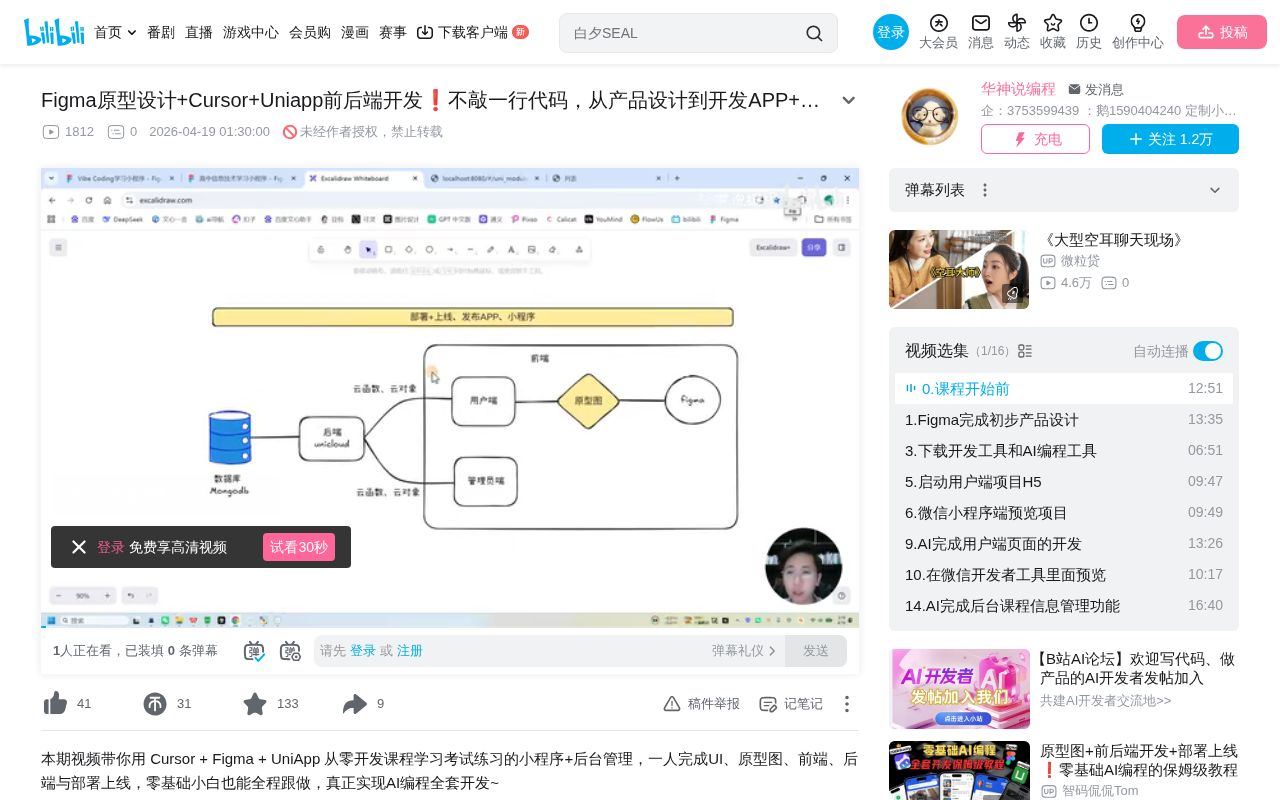
The core value of this project lies in validating the feasibility of "Vibe Coding." Vibe Coding is a programming paradigm concept proposed by OpenAI co-founder Andrej Karpathy in early 2025. The core idea is that developers describe their intent in natural language and rely entirely on AI to generate and maintain code — developers themselves don't even need to read or understand every code detail. This concept marks a paradigm shift in software development from "humans write code, machines execute" to "humans define intent, AI implements details." Unlike traditional low-code/no-code platforms, Vibe Coding doesn't rely on preset templates or drag-and-drop components. Instead, it uses large language models to understand complex business logic and generate production-grade code, with theoretically no functional ceiling. Through carefully designed prompts, AI handles all coding work while developers focus solely on product design and logic planning.
Technical Architecture and Toolchain Selection
Design Layer: Figma Prototyping
The first step was completing the full UI prototype in Figma, covering multiple pages including course introduction, chapter directory, exam interface, and community feed. Figma generated two design versions to choose from, and the better-performing version was selected as the development baseline.
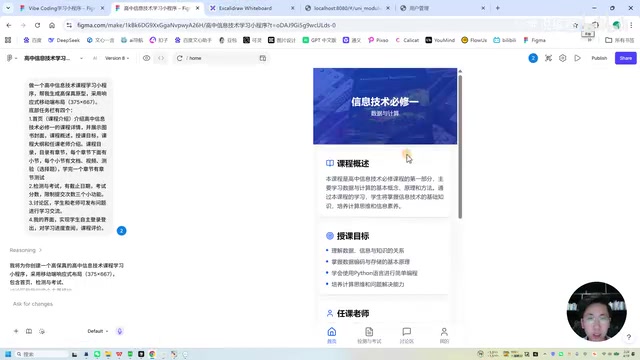
This step is crucial: the quality of the prototype directly determines the quality of AI programming output. Clear, well-structured design mockups help AI understand page structure and interaction logic more accurately, reducing the cost of subsequent iterations.
Development Layer: Cursor AI Programming
Cursor was used as the primary programming tool. Cursor is an AI-native code editor deeply rebuilt on VS Code, developed by Anysphere. Its core capability is deeply integrating large language models (supporting Claude, GPT-4, and other models) into the coding workflow. Unlike plugin-based solutions like GitHub Copilot, Cursor supports multi-file context understanding, codebase-level Q&A and modifications, and accepting images (such as design mockup screenshots) directly as input to generate corresponding code. In the competitive landscape of AI programming tools, Cursor competes with Claude Code (command-line tool), CodeBuddy (Tencent Cloud), Trae (ByteDance), and others, but its core differentiation lies in context window management and multi-file collaborative editing capabilities. The project doesn't restrict specific tool choices — CodeBuddy, CodeX, Claude Code, Trae, and others can equally handle the job. The core development workflow is as follows:
- Input Figma prototypes into the AI programming tool
- AI converts design mockups into UniApp Vue code
- Develop cloud objects (backend logic)
- Design database structure
- Develop the backend management system
Backend Layer: UniCloud + MongoDB
The backend uses UniCloud Serverless architecture with MongoDB as the database.
MongoDB is a document-oriented NoSQL database that stores data in JSON-like BSON format, naturally suited for storing flexibly structured business data (such as course chapters, user feeds, etc.). Compared to relational databases, MongoDB doesn't require frequent Schema changes in rapid iteration scenarios, making it highly compatible with agile development and AI-assisted development rhythms. Serverless architecture is a cloud computing deployment model where developers only need to upload function code while the cloud platform handles elastic scaling, load balancing, and operations, charging based on actual invocations — reducing infrastructure costs to near zero during early product validation phases.
UniApp is a cross-platform application development framework based on Vue.js, developed by DCloud. It compiles a single codebase to iOS, Android, WeChat/Alipay/Baidu Mini Programs, H5, and other platforms. UniCloud is the companion Serverless cloud service built on Alibaba Cloud and Tencent Cloud infrastructure, providing cloud functions, cloud database, cloud storage, and other capabilities. This technology selection offers three clear advantages:
- Zero operations: No need to purchase and deploy servers separately
- Integrated development: Frontend and backend developed in the same project, reducing integration complexity
- Multi-platform publishing: One codebase simultaneously covers iOS, Android, WeChat Mini Program, Alipay Mini Program, and H5
Feature Module Breakdown
User-Facing Core Features
The user-facing side implements a complete online learning platform with the following core modules:
Course Learning System: Supports three learning modes — document reading, video playback, and section quizzes. Each chapter contains multiple sections, and each section is equipped with independent quiz questions.
Exam System: Supports setting exam name, duration, number of questions, total score, and other parameters. After students complete an exam, it automatically grades and records exam history. An answer card feature allows students to review their responses.
Community Feed: A module similar to WeChat Moments, supporting image-text posts, likes, comments, and other social interactions.
User System: Integrates both WeChat authorization login and username/password login, supporting common features like profile editing and avatar changes.
Backend Management System
The backend management system covers CRUD operations for all business data:
- Course Management: Modify course name, description, cover image, learning objectives, instructor information, etc.
- Chapter Management: Add and edit chapters, set chapter test questions (question stem, options, correct answers)
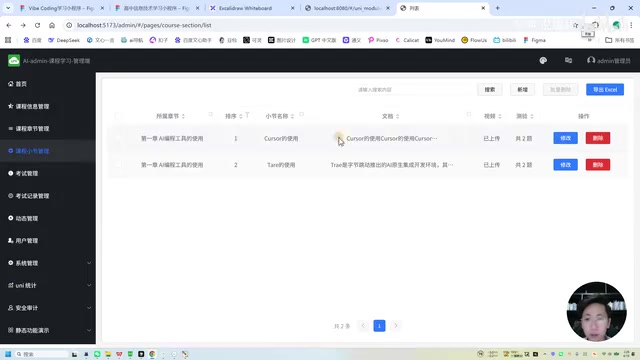
- Section Management: Manage documents, videos, and quiz content for each section
- Exam Management: Publish exams, set question scores, maintain question banks
- Feed Management: Review community content published by users
- User Management: View and manage all registered user information
All data is dynamically fetched — changes made in the backend are reflected in real-time on the frontend. This means the same system can flexibly host English courses, math courses, or any type of online course.
Development Workflow and Prompt Engineering
Six Steps from Design to Launch
The entire development follows a clear workflow, with each step having a corresponding prompt strategy:
- Prototype Design: Complete UI design for all pages in Figma
- Page Replication: AI converts prototypes into UniApp Vue code
- Backend Development: Guide AI through prompts to develop cloud objects and database
- Data Integration: Implement dynamic frontend-backend data interaction
- Admin Panel Development: AI develops the administrator web application
- Deployment & Launch: Package as APP or Mini Program and publish
Prompt Engineering Is the Core Competitive Advantage
The core of this project isn't any specific tool, but rather a systematic prompt engineering methodology. Prompt Engineering refers to the systematic design and optimization of natural language instructions given to large language models to achieve more accurate and stable outputs. In AI programming scenarios, high-quality prompts typically include several key elements: clear role definition (e.g., "You are a UniApp development expert"), well-defined task boundaries, specific technical constraints (framework version, code style), and expected output format. Research shows that structured prompts can improve the usability rate of AI code output by over 40% compared to casual descriptions.
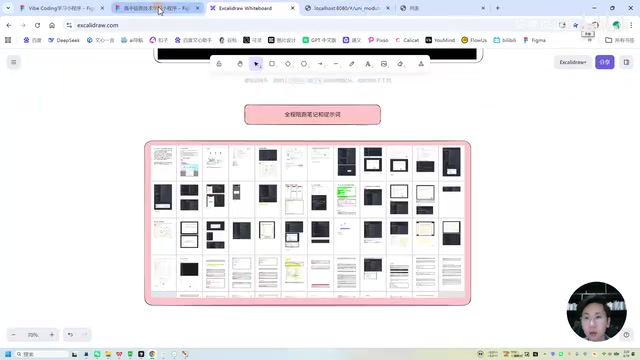
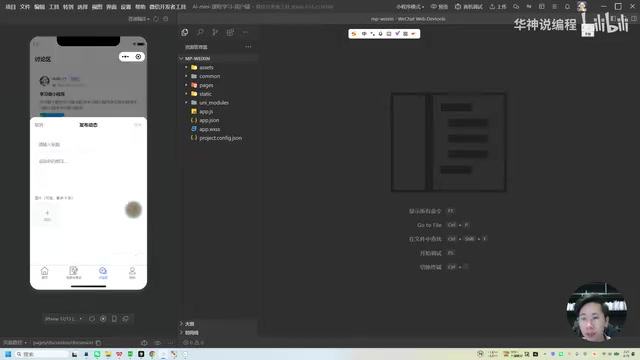
The project comes with complete prompt documentation and course notes, recording every step of the process through text and screenshots. The long-term value of this methodology is that as AI tools rapidly iterate, prompt engineering is evolving from a "trick" into a transferable core engineering capability whose value doesn't depend on any specific model or tool version. Once you master how to precisely describe requirements, decompose tasks, and guide AI output, you can quickly adapt to any new tool.
Practical Value and Required Capabilities
This case study demonstrates the maturity that AI programming has already achieved in real projects. A complete product containing a user-facing app, admin panel, database, and multi-platform adaptation, developed with zero manual coding — this was almost unimaginable two years ago.
However, it's important to recognize clearly that "zero code" does not mean "zero barrier." Developers still need the following capabilities:
- Product design ability: Clearly knowing what to build and being able to define complete functional requirements
- Architectural thinking: Understanding basic concepts like frontend-backend separation and database design
- Prompt engineering ability: Being able to precisely describe requirements and guide AI to produce high-quality code
- Debugging and correction ability: Knowing how to identify and fix problems when AI output doesn't meet expectations
The UniApp + UniCloud technology selection is equally noteworthy. One codebase covering iOS, Android, WeChat Mini Program, H5, and other platforms dramatically reduces the complexity of multi-platform development. Combined with the efficiency advantages of AI programming, this creates a multiplier effect that enables individual developers to deliver products that previously required team collaboration.
Key Takeaways
- The project achieved zero-code development across the entire workflow from Figma prototyping to APP launch, covering user-facing app, backend management, and multi-platform packaging
- The tech stack uses UniApp + UniCloud + MongoDB, enabling one codebase to publish to iOS, Android, WeChat Mini Program, and other platforms
- The core methodology is systematic prompt engineering, not dependent on any specific AI tool — Cursor, CodeBuddy, Claude Code, and others all work
- Feature completeness is high, including course learning, video playback, chapter quizzes, exam system, community feed, and user management
- Zero code doesn't mean zero barrier — product design, architectural thinking, and prompt engineering capabilities are still required
Related articles
 Tutorials
Cursor + Codex Dual-IDE Collaboration: A Practical Methodology for Open-Source Project Customization
A complete methodology for open-source project customization based on real-world experience, detailing the Cursor+Codex dual-IDE workflow, seven-stage process, MVP validation, and AI source code reading techniques.
 Tutorials
Cursor Multi-Agent in Practice: Building a Full-Stack Next.js Blog in 50 Minutes
Build a full-stack blog in 50 minutes using Cursor IDE's multi-Agent mode with Next.js, Clerk auth, and Supabase. Learn the 4-phase AI Agent workflow and key integration pitfalls.
 Tutorials
Building an AI Software Factory from Scratch: A Cursor Engineer's Hands-On Experience with Multi-Agent Collaboration
Cursor engineer Eric shares practical insights on building an AI software factory: automation levels, guardrail design, parallel Agent management, and scaling to 1000+ Agents for 24/7 development.