Firebase A/B Testing Upgrade: Real-Time Service and Custom Signal Conditions Explained
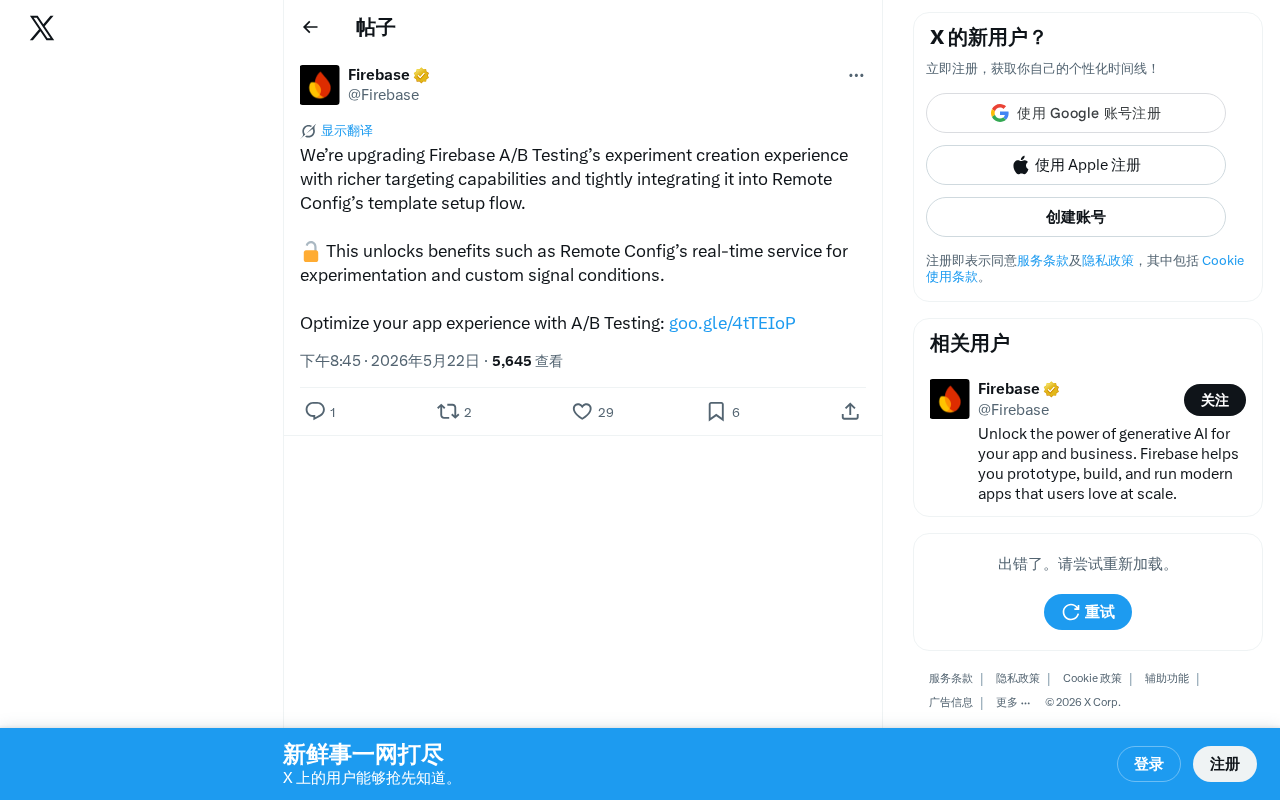
Firebase A/B Testing upgrades with real-time config delivery and custom signal targeting.
Google Firebase has upgraded A/B Testing with two major enhancements: Remote Config real-time service integration that reduces experiment variant propagation from hours to seconds, and custom signal conditions that enable precise user targeting. The update also streamlines workflows by unifying experiment creation within the Remote Config template setup, reflecting Firebase's broader trend toward deep inter-service integration.
Firebase A/B Testing Gets a Major Upgrade
The Google Firebase team recently announced a significant upgrade to the experiment creation experience in Firebase A/B Testing. The update centers on two key areas: richer targeting capabilities and deeper integration with the Remote Config template setup workflow. This means developers will have more granular user segmentation and a smoother workflow when running app experiments.
Firebase A/B Testing is an experimentation framework provided by the Google Firebase platform that allows developers to randomly assign users to different experiment groups (control and treatment), then make product decisions by comparing performance data across variants. Its core concept is rooted in Randomized Controlled Trials (RCTs) from statistics, widely used in the internet industry to validate feature effectiveness before launch. Firebase A/B Testing is deeply integrated with Google Analytics for Firebase, automatically tracking key metrics such as retention rate, revenue, and crash rate, and using Bayesian statistical models to determine whether experiment results are statistically significant.
Key Upgrade Highlights
Remote Config Real-Time Service Powers Experiments
One of the most notable changes in this upgrade is the introduction of Remote Config's real-time service capability into the A/B Testing experiment workflow.
Firebase Remote Config is a cloud-based configuration service that allows developers to dynamically modify app behavior and appearance without publishing an app update. It works by having developers set key-value pair parameters in the Firebase console, which the client SDK fetches from the cloud at runtime and applies to the app logic. In the traditional model, clients retrieve the latest configuration through a polling mechanism with a default cache time of 12 hours. The Real-time Service, however, leverages Firebase Cloud Messaging (FCM) push channels — when a server-side configuration changes, it immediately sends a signal to all online clients, triggering them to proactively fetch the latest configuration. This reduces configuration propagation delay from hours to seconds.
Previously, Firebase A/B Testing configuration changes had to wait for clients to actively fetch updates before taking effect, resulting in noticeable delays. This upgrade brings Remote Config's real-time service capability directly into the experiment workflow, dramatically shortening the time it takes for experiment variants to go live.
This is especially important for scenarios that require rapid iteration and immediate observation of user feedback. Developers can launch experiments faster, switch variants more quickly, and collect valid data within shorter time windows.
Custom Signal Condition Targeting
Another key upgrade is support for Custom Signal Conditions. Remote Config previously supported conditional configuration based on user properties, device type, geographic location, and other dimensions. Now, these rich targeting capabilities are directly integrated into the A/B Testing experiment creation workflow.
From a technical perspective, the early version of Remote Config's condition system supported dimensions including: platform (iOS/Android/Web), app version, OS version, device language, country/region, user percentage, and Firebase user properties. Custom signals allow developers to set arbitrary key-value pairs as signals in client-side code. These signals are reported to the Remote Config server and can serve as the basis for condition evaluation. This mechanism essentially exposes client-side runtime state to the server-side decision engine, greatly expanding the flexibility of condition targeting.
Developers can use custom signals to precisely define target user groups for experiments, such as:
- Segmenting users based on behavioral characteristics
- Triggering experiments based on in-app custom events
- Building complex targeting rules by combining multi-dimensional conditions
This makes experiment design more flexible, enabling hypothesis validation for specific user groups and improving experiment precision and effectiveness.
Practical Implications for Developers
Simplified Workflow
Tightly integrating A/B Testing into the Remote Config template setup workflow means developers no longer need to switch back and forth between two separate console interfaces. Experiment creation, configuration, and management can all be completed within a unified workflow, reducing operational complexity and minimizing the chance of errors.
More Scientific Product Decisions
A/B Testing is a core tool for data-driven product decisions. In the tech industry, large-scale adoption of A/B Testing began in the early 2000s at Google and Amazon. Today, virtually all leading internet companies have established mature experimentation platforms — Netflix runs hundreds of A/B experiments per year, and Microsoft's Experimentation Platform (ExP) processes tens of thousands of parallel experiments daily. For small and medium-sized development teams, building an in-house experimentation platform is extremely costly, requiring solutions for traffic allocation, statistical significance calculation, interaction effects between experiments, Simpson's paradox, and other complex issues. The value of Firebase A/B Testing lies in encapsulating these complexities into an out-of-the-box service, enabling resource-constrained teams to practice data-driven product iteration methodologies.
This upgrade allows developers to run experiments at lower cost and higher precision. Whether testing user acceptance of new features, optimizing payment conversion flows, or validating the impact of UI redesigns, the upgraded Firebase A/B Testing provides more reliable data support.
How to Get Started
For developers already using Firebase, this upgrade is incremental — you can experience the new experiment creation workflow directly through the Firebase console. Google also provides detailed documentation guides to help developers quickly get up to speed with the new features.
Interestingly, this upgrade reflects Firebase's broader trend toward feature convergence — the boundaries between individual services are becoming increasingly blurred, replaced by a more unified and seamless development experience. Since Google acquired Firebase in 2014, it has evolved from an initial real-time database service into a comprehensive mobile development platform encompassing over 20 services, including Authentication, Cloud Firestore, Cloud Functions, Crashlytics, Performance Monitoring, and more. In recent years, Firebase's product strategy has clearly shifted toward deep inter-service integration: Crashlytics and Performance Monitoring data can be directly linked to Analytics events, Cloud Functions can be automatically triggered by Firestore data changes, and this A/B Testing and Remote Config fusion is the latest manifestation of this trend. This trend toward unified BaaS (Backend as a Service) platforms also reflects the broader cloud services industry's evolution from point tools to integrated platforms.
For mobile app development teams, staying informed about and leveraging these new capabilities will help maintain a competitive edge in the fiercely competitive app market.
Key Takeaways
Related articles

Claude Code for Test Development in Practice: An AI Programming Workflow That Doubles Your Efficiency
A practical guide to Claude Code for test development: auto-generating test scripts, Plan Mode workflows, MCP + Playwright integration, and Subagent parallel tasks to build systematic AI-assisted workflows.

Hermes Agent Hands-On Review: An AI Efficiency Revolution for Indie Game Developers
Indie game developer reviews Hermes Agent vs OpenClaude: intelligent context compression, real-time Memory, remote control via Telegram, and practical use cases in game dev, social media, and email.
Vibe Coding Beginner's Guide: Tool Selection Across Three Categories with Practical Examples
A comprehensive guide to Vibe Coding's three tool categories: Agent frameworks, CLI Coding, and IDE tools, with practical examples including Snake game and data analysis workbench.