Firebase Agent Skills Explained: An All-in-One AI Agent Development Solution
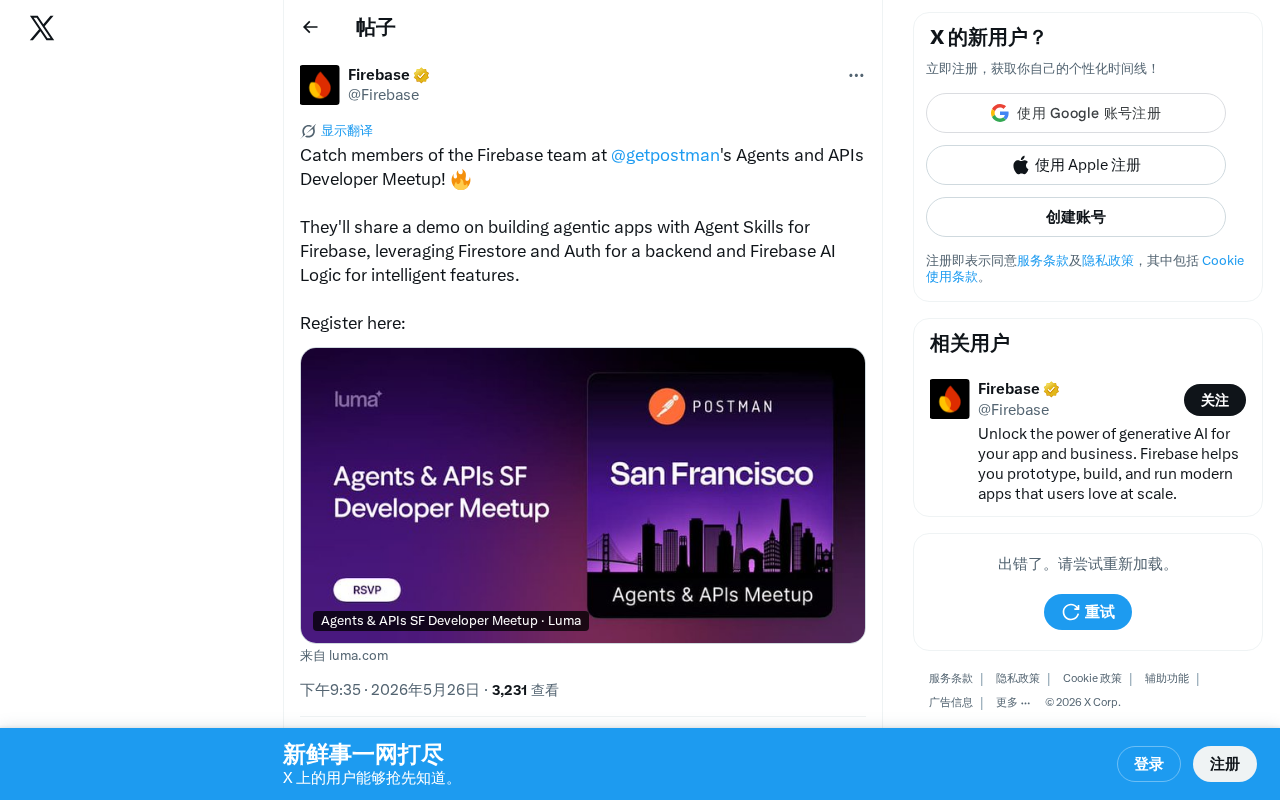
Firebase Agent Skills offers an all-in-one toolkit for building AI agent apps with Firestore, Auth, and AI Logic.
Google's Firebase has launched Agent Skills, a comprehensive toolkit for AI agent development comprising three core components: Firestore for data persistence and memory management, Firebase Auth for secure delegated authorization, and Firebase AI Logic for intelligent decision-making. This positions Firebase as a PaaS-level infrastructure solution that complements orchestration frameworks like LangChain and CrewAI, lowering the barrier for full-stack developers to build agentic applications.
Firebase Enters the AI Agent Development Arena
The Google Firebase team recently announced that it will showcase its latest AI agent development capabilities at the "Agents and APIs Developer Meetup" hosted by Postman. The core highlight of this event is Agent Skills for Firebase — a toolkit designed to help developers rapidly build agentic applications.
This move signals that Firebase is accelerating its transformation from a traditional Backend-as-a-Service (BaaS) platform into an AI-native application development platform. Since its founding in 2011, Firebase has provided mobile and web developers with infrastructure services such as real-time databases, hosting, and authentication — eliminating the need to build and maintain their own servers. After being acquired by Google in 2014, Firebase gradually integrated Google Cloud capabilities, growing to serve over 3 million applications. This pivot toward an AI-native platform represents a strategic move by Google to bring Gemini model capabilities to the broader developer community through the Firebase channel, and a direct response to competitors like OpenAI and Microsoft who are aggressively building out their AI development tooling.
Core Technical Architecture of Agent Skills
Based on officially disclosed information, the Agent Skills for Firebase tech stack comprises three core components, covering three critical areas: data management, security authentication, and intelligent reasoning.
Before diving into each component, it's worth clarifying the technical definition of an AI Agent: an AI Agent is a software system capable of perceiving its environment, making autonomous decisions, and taking actions to achieve specific goals. Unlike traditional chatbots, Agents possess three core capabilities: Tool Use, Planning, and Memory. A typical Agent workflow looks like this: receive user instructions → decompose into subtasks → call external APIs or tools for execution → adjust strategy based on feedback → return final results. This autonomy enables Agents to complete complex tasks such as booking flights, data analysis, and code generation — rather than merely engaging in text-based conversation.
Firestore: The Agent's Data Backend and Memory Hub
Firestore is Firebase's NoSQL document database, serving as the data persistence and state management layer in agentic applications. For AI Agents, memory management and context storage are key challenges, and Firestore's real-time synchronization and flexible document structure are naturally suited to this scenario.
From a technical architecture perspective, Firestore organizes data in a hierarchical structure of Collections and Documents, supporting real-time listeners and offline synchronization. In AI Agent scenarios, Firestore can not only store structured conversation histories and task states but may also leverage Vector Embedding capabilities for semantic retrieval. Google added vector search capabilities to Firestore in 2024, meaning Agents can retrieve historical memories based on semantic similarity rather than relying solely on keyword matching — enabling more intelligent context understanding and long-term memory management.
Developers can use Firestore to store the following critical data required for agent operation:
- Conversation history: Preserving multi-turn interaction context to support long-term memory
- User preferences: Personalizing agent behavior
- Task state: Tracking execution progress of multi-step tasks
Firebase Auth: The Security Gatekeeper for AI Agent Applications
AI Agent applications often need to perform actions on behalf of users, which places higher demands on identity authentication and permission management. Firebase Auth ensures that agents have proper authorization when accessing user data and calling external APIs.
This is particularly critical in enterprise-grade Agent applications — without reliable authentication mechanisms, an agent's autonomous operations pose serious security risks. AI Agent security authentication faces unique challenges: traditional authentication involves human users operating directly, but in Agent scenarios there's a "delegated authorization" problem — the Agent needs to act on behalf of the user, but how should its permission boundaries be defined? This involves delegated token mechanisms in OAuth 2.0, implementation of the principle of least privilege, and operation audit trails. The industry has yet to establish a unified Agent authentication standard; Anthropic's Model Context Protocol (MCP) and Google's Agent2Agent (A2A) protocol are both attempting to address this issue. Firebase Auth's value in this scenario lies in providing mature identity verification infrastructure upon which developers can build Agent-specific permission control logic.
Firebase Auth offers multiple authentication methods (OAuth, email/password, phone number, etc.) that can flexibly adapt to different business scenarios.
Firebase AI Logic: The Core Engine Driving Intelligent Decision-Making
Firebase AI Logic is the most noteworthy part of the entire solution. It injects intelligent decision-making capabilities into applications, enabling developers to build apps with the following abilities without building an AI inference pipeline from scratch:
- Understanding natural language input
- Autonomously planning execution paths
- Completing complex multi-step tasks
This dramatically lowers the technical barrier to building agentic applications, allowing more full-stack developers to participate in AI Agent development.
Why Firebase Agent Skills Deserves Attention
The Infrastructure Battle for AI Agent Development Is Heating Up
The AI Agent development space is currently in a phase of rapid infrastructure maturation. Frameworks like LangChain and CrewAI have addressed orchestration-layer challenges, but at the backend infrastructure level, developers still face significant integration work.
Specifically, LangChain is currently the most popular LLM application development framework, providing abstraction layers such as Chains, Agents, and memory management to help developers connect large language models with external data sources and tools. CrewAI focuses on multi-Agent collaboration scenarios, allowing developers to define multiple Agents with different roles and objectives that work together to accomplish complex tasks. These frameworks solve the "orchestration" problem — how to organize an Agent's thinking and action workflows — but they don't provide backend infrastructure like databases, authentication, or deployment. Firebase Agent Skills is positioned to fill exactly this gap, providing infrastructure support beneath the orchestration layer.
Firebase's entry into this space means Google is pushing Agent development capabilities down to the PaaS layer, attempting to offer an all-in-one solution. Pushing Agent development capabilities down to the PaaS (Platform as a Service) layer is a common trend among cloud service providers. Microsoft Azure has launched its AI Agent Service, AWS offers managed Agent building capabilities through Bedrock Agents, and Vercel's AI SDK provides Agent integration solutions for frontend developers. Firebase's differentiating advantage lies in its massive mobile and web developer community and deep integration with Google's Gemini models. The essence of this infrastructure battle is competing for the entry point to AI application developers — whoever can help developers build usable Agent applications the fastest will lock in this emerging market.
This aligns with the trend of Postman hosting an "Agents and APIs" themed event — API management platforms are also actively embracing the Agent ecosystem. When AI Agents need to interact with the external world, APIs are their hands and feet, and Postman and Firebase support Agent development from two dimensions: API management and backend services, respectively.
Practical Implications for Existing Firebase Developers
For developers already using the Firebase ecosystem, the launch of Agent Skills means they can quickly experiment with AI Agent functionality on a familiar tech stack without introducing entirely new infrastructure. This incremental approach to AI capability integration offers more practical value compared to building an Agent system from scratch, and is easier to validate within existing projects.
Summary
The launch of Firebase Agent Skills reflects a clear industry trend: AI Agent development is transitioning from experimental projects to production-grade engineering, with mainstream cloud platforms integrating Agent capabilities into their existing product lines. For developers, choosing the right infrastructure will directly impact the development efficiency and maintainability of Agent applications. With its massive developer base and mature backend service ecosystem, Firebase is well-positioned to claim an important role in the AI agent development space.
Key Takeaways
Related articles

Claude Code for Test Development in Practice: An AI Programming Workflow That Doubles Your Efficiency
A practical guide to Claude Code for test development: auto-generating test scripts, Plan Mode workflows, MCP + Playwright integration, and Subagent parallel tasks to build systematic AI-assisted workflows.

Hermes Agent Hands-On Review: An AI Efficiency Revolution for Indie Game Developers
Indie game developer reviews Hermes Agent vs OpenClaude: intelligent context compression, real-time Memory, remote control via Telegram, and practical use cases in game dev, social media, and email.

Vibe Coding Beginner's Guide: Tool Selection Across Three Categories with Practical Examples
A comprehensive guide to Vibe Coding's three tool categories: Agent frameworks, CLI Coding, and IDE tools, with practical examples including Snake game and data analysis workbench.