Firebase AI Logic in Practice: Using Gemini to Automatically Break Down Tasks into Actionable Subtasks
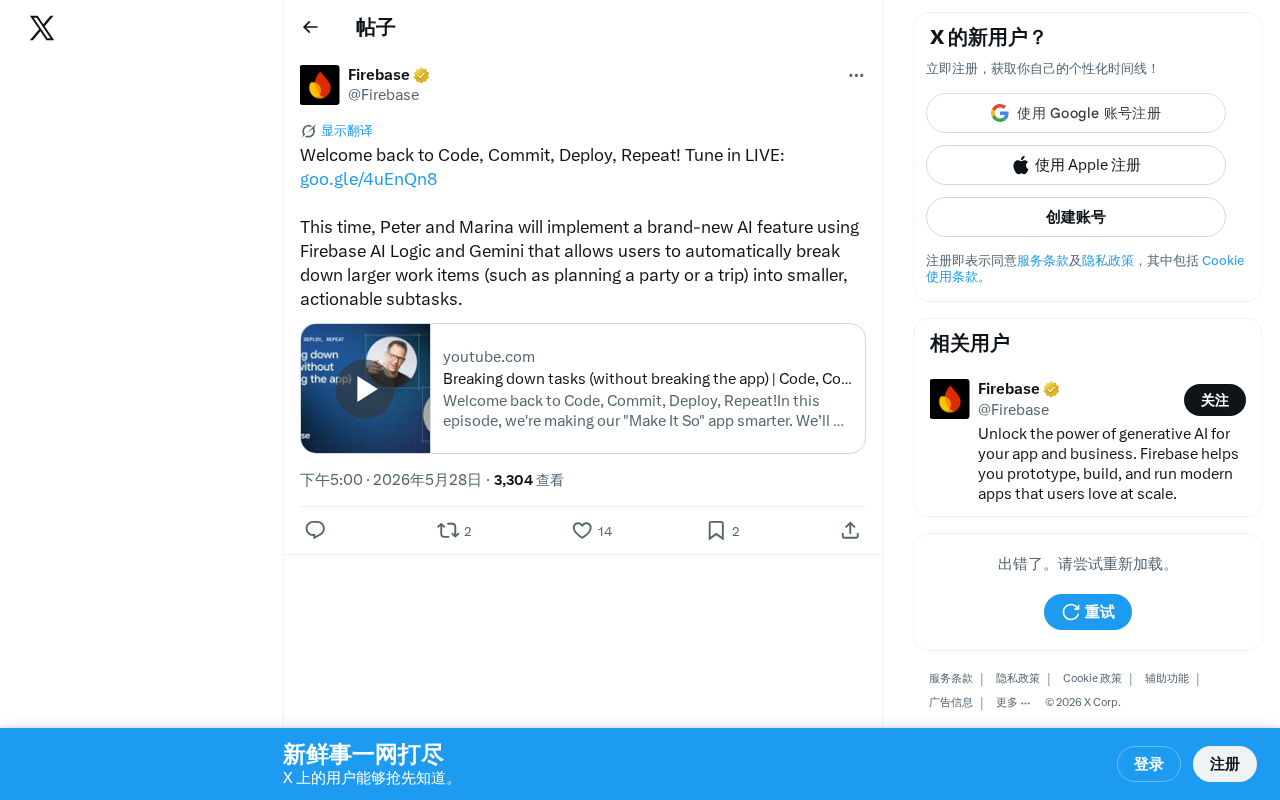
Use Firebase AI Logic and Gemini to auto-decompose tasks into actionable subtasks in real time.
This article walks through a practical demonstration of integrating Firebase AI Logic with Google's Gemini model to automatically break down large tasks into actionable subtasks. It covers the technical implementation — from structured prompt design and JSON output parsing to Firestore real-time sync — and shares key insights on prompt engineering, graceful degradation, and incremental AI integration strategies for full-stack developers.
Overview
In the "Code, Commit, Deploy, Repeat" livestream, Google Developer Advocates Peter and Marina demonstrated a practical AI feature — using Firebase AI Logic and the Gemini model to automatically break down large work items (such as planning a party or a trip) into smaller, actionable subtasks. This demonstration provided a complete walkthrough of how to seamlessly integrate generative AI capabilities into an existing application.
What Is Firebase AI Logic
Firebase AI Logic is an AI integration module introduced by Google within the Firebase platform, enabling developers to more easily call large language models like Gemini from their applications. Unlike calling REST APIs directly, Firebase AI Logic provides a higher level of abstraction with specific advantages including:
- Simplified model invocation: Interact with Gemini directly through the Firebase SDK without manually managing API keys and request formats
- Deep integration with the Firebase ecosystem: Seamlessly collaborate with Firestore, Cloud Functions, and other services to easily implement data storage, triggers, and other backend logic
- From prototype to production in one step: The entire workflow from proof of concept to deployment stays within the Firebase ecosystem
Within Google's AI service landscape, developers previously had two main ways to call large models: one was using the Gemini API provided by Google AI Studio, suitable for rapid prototyping; the other was through Google Cloud's Vertex AI platform, suitable for enterprise-grade production deployments but with higher configuration complexity. Firebase AI Logic fills the middle ground — under the hood, it actually connects to Vertex AI's model serving capabilities, but encapsulates the complexity of authentication, quota management, security rules, and other infrastructure layers within the Firebase SDK. This means developers don't need to manually configure service accounts in the Google Cloud console, set up IAM permissions, or manage API quotas. Firebase Security Rules automatically protect AI call endpoints against unauthorized access and abuse. For teams already building applications with Firebase, adding AI capabilities feels as natural as adopting a new Firebase service.
This design lowers the barrier to integrating AI features, allowing full-stack developers to focus their energy on product logic rather than infrastructure setup.
Core Feature: Automatically Breaking Down Large Tasks into Subtasks
Use Case Description
The core feature demonstrated is a high-frequency productivity scenario — automatic task decomposition. Users input a large work item, and the system leverages Gemini's reasoning capabilities to automatically break it down into specific, actionable subtasks.
Here are a few examples:
- Input "Plan a birthday party" → Automatically generates subtasks: set the date and venue, create a guest list, purchase decorations, order a cake, arrange the activity schedule, etc.
- Input "Plan a trip to Japan" → Automatically generates subtasks: apply for a visa, book flights, plan the itinerary, reserve hotels, exchange currency, etc.
This feature works thanks to two core capabilities of the Gemini model: Chain-of-Thought Reasoning and Hierarchical Planning. Traditional natural language processing approaches to task decomposition typically rely on predefined templates or rule engines — for example, having a fixed set of subtask templates for "travel planning." This approach lacks flexibility and can't handle open-ended task descriptions. As a large language model, Gemini can leverage world knowledge learned from massive training data to understand the inherent logical structure of a task, infer the sequence of steps needed to complete it, and dynamically adjust the output based on specific context. For instance, for the same "plan a party" task, if the user adds "on a limited budget" or "outdoor venue," the model can adjust the content and priority of subtasks accordingly. This understanding-based rather than template-based decomposition approach is a typical application pattern for generative AI in productivity tools.
The value of this feature lies in embedding AI's language understanding and planning capabilities directly into task management tools, helping users overcome the "where do I even start" problem when facing complex tasks.
Technical Implementation Approach
Based on the livestream demonstration, the technical path for implementing automatic task decomposition involves the following key steps:
- Frontend interaction layer: Users enter a high-level task description in the application interface
- Firebase AI Logic invocation: The backend sends a structured prompt to Gemini through the Firebase AI Logic module, requesting the model to decompose the task into a subtask list
- Structured output parsing: The subtask list returned by Gemini is parsed and written to Firestore as structured data
- Real-time synchronized display: Leveraging Firestore's real-time listener capabilities, the subtask list is instantly rendered on the user interface
Among these, structured output is a critical technical component for integrating AI capabilities into applications and deserves deeper understanding. The native output of large language models is free-form natural language text, but applications need parseable structured data (such as JSON objects). If the model returns a prose-style description, the application needs additional parsing logic to extract information, which is both unreliable and adds complexity. Gemini provides JSON Mode (also known as structured output mode), where developers can specify the output format as application/json via the responseMimeType parameter during API calls, and can even define the expected JSON Schema through the responseSchema parameter. This constrains the model to generate content within the specified data structure, ensuring the output can be directly parsed by the program. For example, in the task decomposition scenario, you can define a Schema requiring the model to return an array of objects containing title, description, and priority fields, eliminating the fragile steps of regex matching or text parsing.
In the data persistence and real-time synchronization phase, Firestore's real-time listener mechanism plays a crucial role. Firestore is a NoSQL cloud database provided by Firebase, and one of its core features is support for clients to subscribe to document or collection change events via the onSnapshot method. When the backend writes AI-generated subtasks to Firestore, all clients subscribed to that data path receive update notifications within milliseconds — no polling or manual refresh required. This push mechanism based on WebSocket long connections enables AI-generated results to appear "as soon as they're written," giving users a smooth, real-time experience. In multi-device scenarios (for example, a user triggers task decomposition on their phone and views the results on their computer), this real-time sync capability is especially important. Additionally, Firestore provides offline persistence support — even if the network is interrupted, locally cached data remains available and automatically syncs when connectivity is restored.
The entire workflow was demonstrated end-to-end from coding to deployment, rather than remaining at the conceptual level.
Practical Takeaways for Developers
Prompt Engineering Determines Feature Quality
The effectiveness of task decomposition is highly dependent on prompt design. A good prompt needs to clearly tell the Gemini model: the output format (e.g., a JSON array), the granularity requirements for subtasks, whether sorting or priority labeling is needed, and so on. The user experience of AI features largely depends on the level of refinement in prompt engineering.
In the specific context of task decomposition, there are several prompt engineering techniques worth noting. First is Role Prompting: by setting the model as a "professional project manager" or "task planning expert" in the System Instruction, you can guide the model to output more professional and well-organized subtasks. Second is Few-shot examples: providing 1-2 task decomposition examples (input-output pairs) in the prompt can significantly improve the model's understanding of the expected output format and granularity. For instance, first show a complete example of "organize a team-building activity" decomposed into 5-7 subtasks, then have the model process the user's actual input. Third is constraint design: explicitly limiting the subtask count range (e.g., "generate 5 to 10 subtasks"), the description length for each subtask, whether to include time estimates, etc., to prevent the model from producing overly vague or overly granular results. Finally, negative instructions are equally important — telling the model "do not generate duplicate subtasks" or "do not include content unrelated to the main task" can effectively reduce low-quality output. The combined application of these techniques directly determines the usability of AI features in real user scenarios.
Incremental AI Integration Strategy
This case demonstrates an integration approach worth emulating — rather than building an AI-native application from scratch, incrementally adding AI capabilities to an existing application. An existing task management tool only needs an "AI Decompose" button to significantly enhance the user experience. This approach is low-risk, delivers quick results, and is suitable for most development teams to try.
From a software engineering perspective, incremental AI integration follows an important principle: treating AI as a feature enhancement layer rather than an architectural foundation layer. This means that when AI calls fail (model timeout, abnormal response format, quota exhaustion, etc.), the application's core functionality remains unaffected — users can still manually create and manage subtasks. This "graceful degradation" design philosophy avoids tying the entire application's availability to the stability of an external AI service. In actual engineering practice, this typically manifests as: AI features having independent error handling logic, call results having local caching mechanisms, and the user interface providing the ability to manually edit AI output. This strategy also reduces the team's technical risk — not everyone needs to be proficient in AI engineering; only a few people need to be responsible for prompt design and AI module maintenance.
Firebase's Unique Advantages as an AI Application Backend
For small-to-medium teams and independent developers, Firebase provides a one-stop solution from authentication and database to AI invocation. You can quickly build applications with AI capabilities without setting up your own servers or managing model deployments. As Firebase AI Logic continues to mature, this advantage will become even more pronounced.
Summary
The automatic task decomposition feature showcased in this livestream may seem simple on the surface, but it demonstrates a complete paradigm for AI feature integration: starting from user needs, connecting to Gemini's reasoning capabilities through Firebase AI Logic, leveraging the Firebase ecosystem for data persistence and real-time synchronization, and ultimately delivering a smooth user experience.
For developers exploring how to incorporate AI into their products, this is a highly valuable reference case — choosing the right integration approach matters more than pursuing technical complexity.
Related articles

Claude Code for Test Development in Practice: An AI Programming Workflow That Doubles Your Efficiency
A practical guide to Claude Code for test development: auto-generating test scripts, Plan Mode workflows, MCP + Playwright integration, and Subagent parallel tasks to build systematic AI-assisted workflows.

Hermes Agent Hands-On Review: An AI Efficiency Revolution for Indie Game Developers
Indie game developer reviews Hermes Agent vs OpenClaude: intelligent context compression, real-time Memory, remote control via Telegram, and practical use cases in game dev, social media, and email.
Vibe Coding Beginner's Guide: Tool Selection Across Three Categories with Practical Examples
A comprehensive guide to Vibe Coding's three tool categories: Agent frameworks, CLI Coding, and IDE tools, with practical examples including Snake game and data analysis workbench.