Firebase AI Logic Update: Expanded Model Support and Enhanced Output Integrity Explained
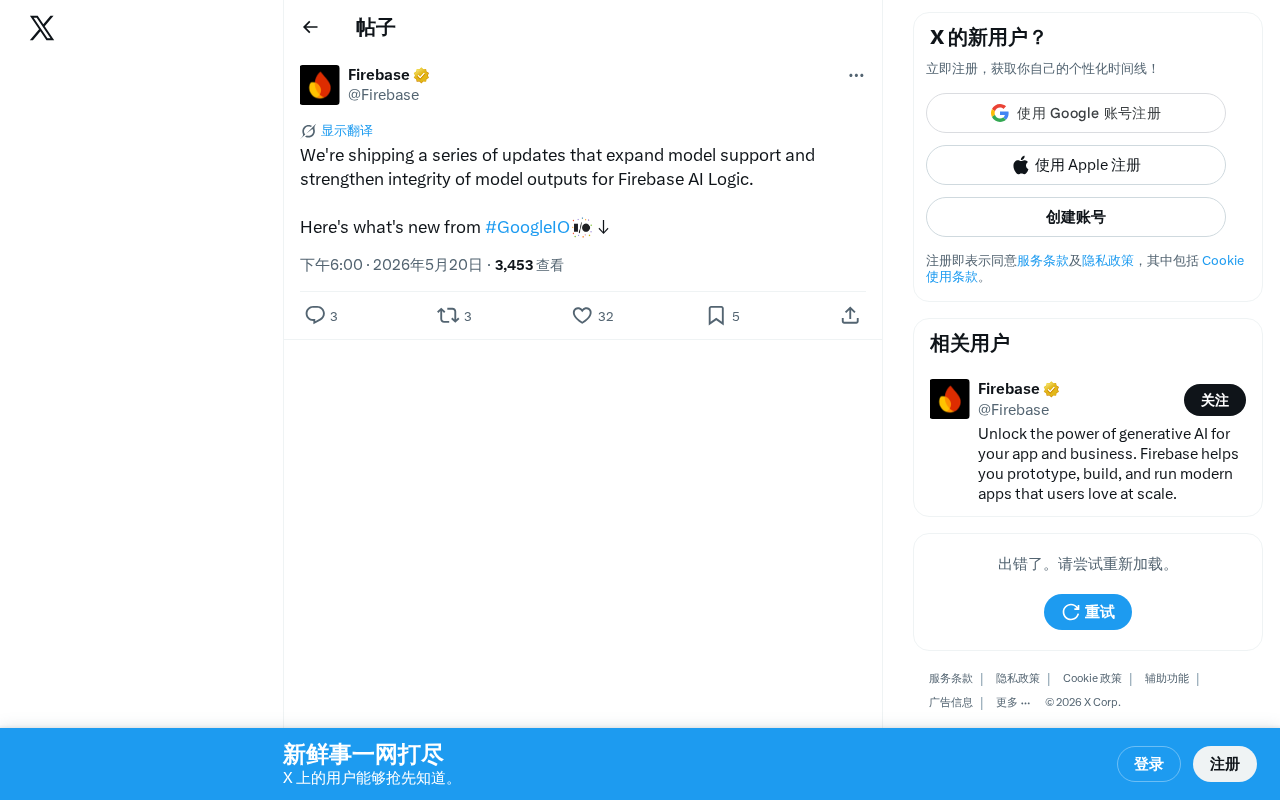
Firebase AI Logic expands model support and enhances output integrity for more reliable AI integration.
At Google I/O, Firebase AI Logic received major updates focusing on two core areas: expanded AI model support for greater flexibility and enhanced output integrity for production-reliable applications. These improvements lower AI integration complexity for developers, enable seamless model switching, and strengthen content safety, structured output, and consistency — positioning Firebase as a key channel for Google's AI capabilities.
Overview
At Google I/O, the Firebase team announced a series of important updates to Firebase AI Logic. These updates focus on two core directions: expanding model support and enhancing the integrity of model outputs, providing developers with more powerful and reliable AI integration capabilities.
What Is Firebase AI Logic?
The Bridge Between AI Models and Applications
Firebase AI Logic is a module within Google's Firebase platform dedicated to AI capability integration. It allows developers to directly invoke and manage AI models within the Firebase ecosystem. With Firebase AI Logic, developers can embed intelligent features into mobile and web applications without building AI infrastructure from scratch.
Firebase itself is a Backend-as-a-Service (BaaS) platform launched by Google. Since its acquisition by Google in 2014, it has evolved into a comprehensive backend solution covering authentication, real-time databases, cloud storage, hosting, push notifications, and more. The core philosophy of BaaS is to abstract backend infrastructure into directly callable cloud services, enabling frontend and mobile developers to build complete applications without managing servers. Millions of apps worldwide rely on Firebase as their core infrastructure, which means Firebase AI Logic naturally has a massive potential user base. Architecturally, Firebase AI Logic sits between the application layer and the model layer, acting as middleware — it encapsulates the underlying complexities of API management, request routing, authentication, and rate limiting for model calls, while leveraging Firebase's existing security rule system (such as Firebase App Check) to protect AI endpoints from abuse. Firebase App Check is an app attestation mechanism that uses device-level attestation (such as Android's Play Integrity API, iOS's App Attest, and reCAPTCHA Enterprise for web) to verify that requests genuinely come from the developer's legitimate app rather than from malicious scripts or emulators. This is especially critical for protecting AI API endpoints that are billed per call.
Compared to developers calling model providers' APIs directly, accessing AI capabilities through a middleware layer like Firebase AI Logic offers several significant advantages: API keys are never exposed in client-side code (avoiding the risk of key leakage through mobile app decompilation), call quotas and billing for multiple models can be managed centrally, and the underlying model can be swapped without modifying client-side code. This architectural pattern, known in the industry as an "AI Gateway" or "AI Proxy," has become one of the best practices for enterprise-grade AI application deployment.
The core value of this tool lies in lowering the barrier to AI application development while maintaining enterprise-grade security and reliability. For development teams already using Firebase as their backend service, AI Logic provides a seamless path to integrating AI capabilities.
Two Core Directions of This Update
Expanding Model Support
The first major focus of this update is expanding model support. Firebase AI Logic will be compatible with a wider range of AI models, giving developers greater flexibility in choosing their underlying models. With Google's continued investment in the Gemini model family and the thriving open-source model ecosystem, expanding model support is an inevitable response to industry trends.
Gemini is a family of multimodal large language models developed by Google DeepMind, ranging from the lightweight Gemini Nano (designed for on-device inference with a smaller parameter count, capable of running directly on mobile chipsets) to the high-performance Gemini Ultra. Among them, Gemini Pro is positioned for general-purpose cloud inference, while Gemini Flash emphasizes low latency and high throughput, making it ideal for real-time interactive scenarios with stringent response time requirements. "Multimodal" means these models can not only process text but also understand and generate images, audio, video, and other data types, enabling developers to build intelligent applications far beyond the scope of traditional chatbots. Meanwhile, the open-source model space experienced explosive growth in 2024–2025 — Meta's Llama series, Mistral AI's models, and numerous community fine-tuned versions offer developers a rich set of choices. Different models have distinct advantages in inference speed, context window length, and domain-specific performance (such as code generation, multilingual processing, and visual understanding). The context window refers to the maximum number of tokens a model can process in a single inference, directly determining how much conversation history the model can "remember" or how long a document it can analyze at once — Gemini 1.5 Pro's context window has reached 1 million tokens, far exceeding many competing models, which provides a significant advantage in scenarios like long document analysis and large codebase comprehension.
Firebase AI Logic's expansion of model support essentially embraces the industry paradigm of "models as components" — developers are no longer locked into a single vendor's model but can flexibly choose AI models much like selecting a database engine. The rise of this paradigm is closely tied to the "vendor neutrality" trend in the AI industry: as model capabilities iterate rapidly, today's best-performing model may be surpassed by a new one within months, making switching flexibility an important architectural design principle. The popularity of open-source frameworks like LangChain and LiteLLM also validates this trend — they all aim to provide unified model invocation interfaces that decouple application code from specific models.
The direct benefits of broader model support include:
- Developers can choose the most suitable model for specific scenarios (e.g., lightweight models for latency-sensitive scenarios, large-parameter models for quality-critical scenarios)
- Reduced dependency risk on a single model — when a model experiences service outages or performance degradation, developers can quickly switch
- Support for rapid switching and comparative testing between different models, facilitating A/B experiments to optimize effectiveness and cost
Enhancing Output Integrity
The second core direction is enhancing the integrity of model outputs. In real-world AI application deployments, the reliability and consistency of model outputs have always been a key challenge for developers. "Output integrity" typically encompasses several dimensions:
- Content safety: Ensuring generated content meets safety standards and filtering harmful outputs
- Structured output: Guaranteeing that the data format returned by the model meets expectations for application parsing
- Consistency assurance: Reducing cases where the model produces drastically different outputs for similar inputs
From a technical implementation perspective, ensuring output integrity involves engineering challenges at multiple levels. Content safety typically relies on "AI Guardrails" — a detection and filtering system that runs before and after model inference to identify and block outputs involving violence, discrimination, privacy leaks, and other issues. AI Guardrails can be implemented in various ways: some use rule-based keyword filtering, others use specially trained classification models for real-time output evaluation, and still others combine both in a hybrid approach. Google's own Safety Settings API provides multi-level filtering controls for hate speech, dangerous content, sexually suggestive content, and harassment content, allowing developers to adjust filtering strictness based on their application scenario. Open-source projects like NVIDIA's NeMo Guardrails and Guardrails AI are also driving standardization in this area.
Structured output involves technologies such as JSON Schema constraints and Function Calling, ensuring that model-returned content can be reliably parsed by downstream programs rather than being free-form text. JSON Schema constraints mean predefining the output data structure (including field names, data types, required fields, etc.) when calling the model, guiding the model to generate responses according to that structure. Function Calling goes a step further — it allows the model to identify user intent during inference and "call" predefined functions, returning structured function call parameters that the application then uses to execute actual operations (such as querying databases or calling external APIs). This capability is one of the foundational technologies for building AI Agents, evolving large language models from "text generators" into "intelligent assistants capable of taking action."
Consistency assurance may involve temperature parameter control, seed value fixing, and output validation with retry mechanisms. The temperature parameter is a key hyperparameter controlling the randomness of model output: at temperature 0, the model always selects the highest-probability token, producing the most deterministic and predictable output; higher temperatures make the model more inclined to explore lower-probability tokens, resulting in more creative but less controllable output. The seed value is the initial value of the random number generator — fixing the seed can produce nearly identical outputs for the same input, which is crucial for testing and debugging scenarios that require reproducible results. Output validation and retry mechanisms serve as a fallback strategy at the application level — when the model returns output that doesn't meet expected format or content requirements, the system automatically re-requests until it receives a qualifying response or reaches the maximum retry count.
In production environments, a single malformed model output can break an entire application workflow. Output integrity is therefore the critical dividing line between AI applications that are "demo-ready" and those that are "production-reliable." According to industry research, a significant proportion of AI application failures in production stem from the unpredictability of model outputs rather than insufficient model capabilities.
This improvement is particularly important for AI applications in production environments. When AI features directly face end users, output unpredictability can lead to degraded user experience or even security risks.
Practical Impact on Developers
Reducing AI Integration Complexity
The continuous iteration of Firebase AI Logic reflects Google's strategic positioning at the AI infrastructure level. By packaging complex model management, safety filtering, and output control into out-of-the-box services, Google is shifting the focus of AI development from "how to call models" to "how to design better user experiences."
For small and medium-sized development teams, the value of such platform-level tools is especially pronounced — they no longer need to invest significant resources in solving engineering problems around model deployment and output quality control, and can instead focus on business logic and product innovation. By some estimates, building and maintaining a complete AI application backend (including model serving, safety filtering, rate limiting, monitoring and alerting, log auditing, etc.) could require several dedicated engineers working for months. Firebase AI Logic packages these capabilities into a service accessible with just a few lines of SDK calls, dramatically compressing the time from idea to launch.
Deep Integration with Google's AI Ecosystem
As an update announced at Google I/O, the Firebase AI Logic upgrade is closely tied to Google's broader AI strategy. Combined with the continued evolution of the Gemini model family, Firebase is becoming one of the key channels through which Google's AI capabilities reach developers.
Google's AI strategy presents a clear layered architecture: at the bottom layer is the compute infrastructure provided through Google Cloud and TPU/GPU clusters, where TPU (Tensor Processing Unit) is Google's custom-designed AI chip, now in its sixth generation (Trillium), offering unique cost-performance advantages for large model training and inference; the middle layer is the Vertex AI platform, providing enterprise users with a full suite of tools for model training, deployment, evaluation, monitoring, and management, supporting complete workflows from custom model training to Model Garden (a one-stop shop for selecting from hundreds of pre-trained models); and Firebase AI Logic is positioned at the layer closest to application developers, focused on simplifying the AI feature integration experience. This layered strategy enables Google to simultaneously serve developer groups with different levels of technical depth — from machine learning engineers who need fine-grained control over model training workflows to full-stack developers who simply need to call APIs to implement intelligent features.
Additionally, Google I/O 2025 simultaneously announced several enhancements to the Gemini API (including longer context windows and stronger multimodal capabilities), updates to AI Studio (providing a more intuitive model debugging and prompt engineering interface), and expanded on-device AI capabilities for Android (enabling offline intelligent features through Gemini Nano and ML Kit). The Firebase AI Logic upgrade is a key piece of this overall AI offensive targeting mobile and web developers. Its relationship with Vertex AI is similar to the relationship between Firebase and Google Cloud — the former provides a simplified developer experience while the latter offers complete enterprise-grade control capabilities, both sharing underlying infrastructure but serving different user needs.
Summary
Based on the announced directions, Google is systematically addressing two major pain points in AI application development through this Firebase AI Logic update: flexibility in model selection and controllability of output quality. As AI accelerates from the experimental phase into production deployment, infrastructure-level improvements like these will become a critical force driving the large-scale adoption of AI applications.
Key Takeaways
Related articles

Claude Code for Test Development in Practice: An AI Programming Workflow That Doubles Your Efficiency
A practical guide to Claude Code for test development: auto-generating test scripts, Plan Mode workflows, MCP + Playwright integration, and Subagent parallel tasks to build systematic AI-assisted workflows.

Hermes Agent Hands-On Review: An AI Efficiency Revolution for Indie Game Developers
Indie game developer reviews Hermes Agent vs OpenClaude: intelligent context compression, real-time Memory, remote control via Telegram, and practical use cases in game dev, social media, and email.

Vibe Coding Beginner's Guide: Tool Selection Across Three Categories with Practical Examples
A comprehensive guide to Vibe Coding's three tool categories: Agent frameworks, CLI Coding, and IDE tools, with practical examples including Snake game and data analysis workbench.