Firebase Integrates with AI Studio: Four Core Capabilities for Production-Grade Agent Applications
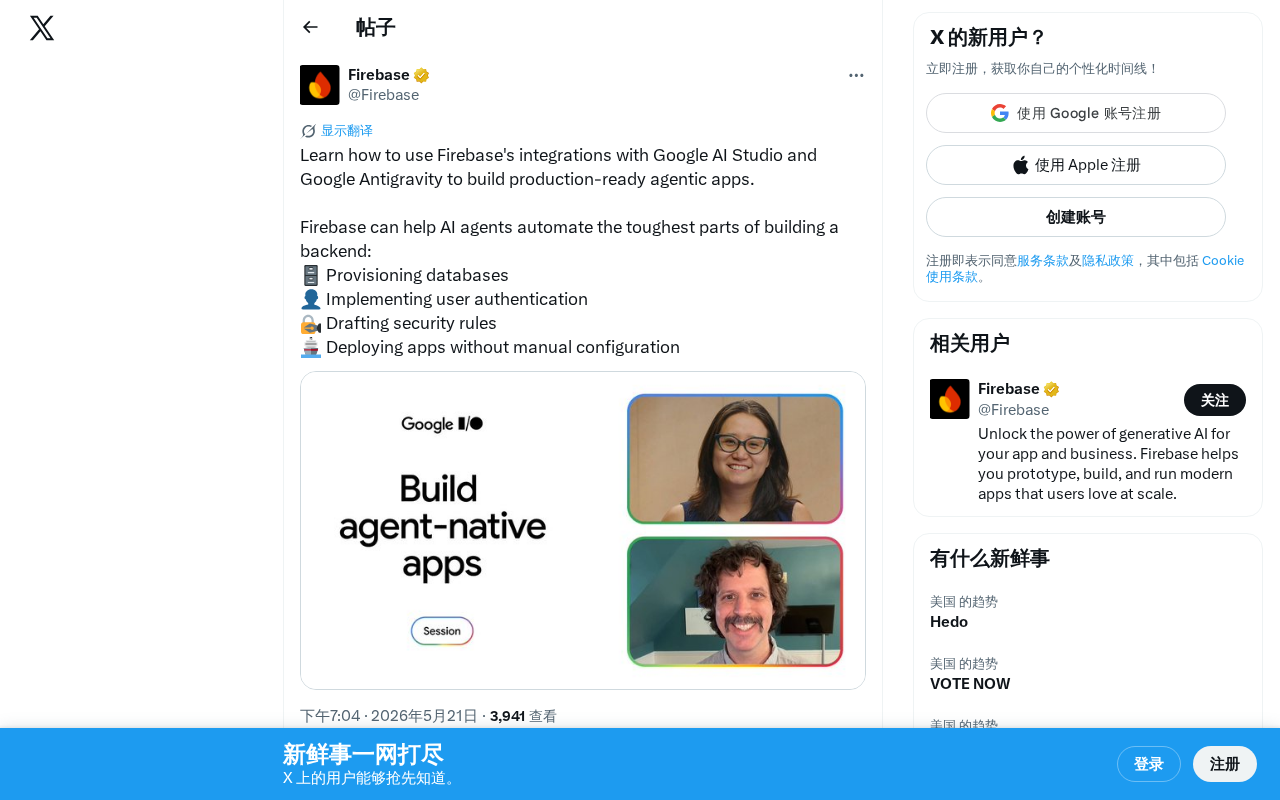
Firebase integrates with AI Studio to automate backend setup for production-ready AI agent applications.
Google Firebase has announced deep integration with AI Studio and Antigravity, enabling AI agents to automate four critical backend tasks: database configuration, user authentication, security rules drafting, and zero-configuration deployment. Built on the ReAct framework and Function Calling mechanisms, this integration dramatically reduces the engineering gap between AI app prototypes and production, positioning Firebase as an AI-native development platform.
Overview
Google Firebase recently announced a deep integration with Google AI Studio and Google Antigravity, aimed at helping developers rapidly build production-ready agentic applications. This integration enables AI agents to automate the most tedious aspects of backend development, dramatically lowering the barrier from prototype to production deployment.
Firebase is a mobile and web application development platform that Google acquired in 2014 and has continued to develop. It offers a comprehensive Backend-as-a-Service (BaaS) suite including Realtime Database, Cloud Firestore, Cloud Functions, Hosting, Authentication, and more. As of 2024, Firebase is used by over 3 million active applications, serving a broad user base from indie developers to large enterprises. This deep integration with AI capabilities marks the platform's evolution from a "developer tool" to an "AI-native development platform."
Google AI Studio is Google's AI model development and debugging environment where developers can test Gemini-series models, design prompts, adjust model parameters, and quickly obtain API keys. Google Antigravity is Google's agent development framework that allows developers to define AI agent behavior logic, tool-calling capabilities, and multi-step reasoning workflows, enabling AI to not only generate text but also perform real actions like calling APIs and modifying databases. The combination of all three creates a complete AI application development loop.
Four Core Capabilities of AI Agent-Automated Backend Development
Agentic applications represent a core paradigm shift in the AI field during 2024–2025. Unlike traditional "input-output" style AI calls, agents possess the ability to autonomously plan, use tools, maintain memory, and execute multi-step workflows. A typical agent can receive a high-level goal (such as "build a backend for my e-commerce app"), then autonomously decompose tasks, select tools, execute operations, and verify results.
The technical foundations of this paradigm include the ReAct (Reasoning + Acting) framework, Function Calling mechanisms, and contextual memory management. The ReAct framework was jointly proposed by Google Research and Princeton University in 2022. Its core idea is to have large language models alternate between reasoning and acting—at each step, the model first generates a thought process (Thought), then decides on an action to execute (Action), and continues reasoning based on the observation result (Observation). Unlike the pure reasoning approach of Chain-of-Thought, ReAct enables models to interact with external environments to obtain real-time information and execute operations. The Function Calling mechanism was first commercialized by OpenAI in June 2023 and subsequently adopted widely by models like Google Gemini. It allows models to output structured function call requests during response generation, which are executed by the application layer and the results returned to the model, forming a complete perception-decision-execution loop. Firebase's update applies this agentic capability to the automated setup of backend infrastructure.
Automated Database Configuration
Firebase's AI integration allows agents to automatically handle database configuration and initialization. Developers no longer need to manually create collections, define field structures, or configure indexes—the AI agent can automatically plan and deploy database schemas based on application requirements. This is especially valuable for fast-iterating projects, reducing data layer setup time from hours to minutes.
Within the Firebase ecosystem, database configuration involves multiple layers including Cloud Firestore collection and document structure design, composite index creation, and sharding strategy selection. Traditionally, developers need to manually design data models based on query patterns—for example, whether denormalization is needed to optimize read performance, or how to design subcollections to control security rule granularity.
Firestore's NoSQL document model is fundamentally different from traditional relational databases. In relational databases, developers use normalization to eliminate data redundancy and combine data through JOIN operations during queries. However, Firestore doesn't support cross-collection JOINs, meaning developers must consider read patterns at write time. If a page needs to display both user information and their order list, developers may need to redundantly store the username in order documents or organize data using subcollections. While this denormalized design improves read performance (a single query retrieves all needed data), it increases write complexity and data consistency maintenance costs. More critically, Firestore's billing model charges per document read/write—a poorly designed data model could cause a simple list page to trigger hundreds of document reads, leading to skyrocketing costs.
By analyzing the application's functional requirements and expected query patterns, AI agents can automatically generate optimal data architecture plans, avoiding common design mistakes made by novice developers.
User Authentication Implementation
Firebase Authentication is already a widely used identity verification solution in the industry, and now AI agents can automatically implement complete user authentication workflows. Common patterns including email/password login, third-party OAuth integration, and multi-factor authentication can all be automatically selected and configured by the agent based on application scenarios, reducing repetitive work for developers in the security authentication domain.
OAuth 2.0 is the de facto standard protocol for internet identity verification, allowing users to log into applications using third-party accounts like Google, Apple, or GitHub without exposing their passwords to the application. Multi-factor authentication (MFA) requires users to provide a second verification factor beyond their password (such as SMS codes, TOTP time-based tokens, or hardware security keys), significantly enhancing account security.
Correctly implementing these authentication flows requires handling complex details such as token refresh, session management, PKCE (Proof Key for Code Exchange) flows, and cross-origin cookie policies. PKCE (pronounced "pixy") is a security extension for OAuth 2.0, originally designed for mobile apps and single-page applications (SPAs), and is now the recommended practice for all OAuth clients. In the traditional OAuth authorization code flow, the client uses a client_secret to exchange for an access token, but mobile and frontend applications cannot securely store secrets. PKCE works by generating a random code_verifier during the authorization request and sending its hash (the code_challenge). During token exchange, the original code_verifier is provided for server verification, preventing replay attacks if the authorization code is intercepted. This mechanism eliminates the need for clients to store long-term keys, significantly improving security for public clients.
Behind a seemingly simple "Sign in with Google" button lies over a dozen steps involving redirect flows, ID Token verification, and user information synchronization. This is precisely where AI automation can save enormous amounts of time—compressing days of integration work into minutes.
Security Rules Drafting
Firebase Security Rules are a critical layer for protecting data security, but writing correct security rules has always been a pain point for developers. Rules that are too permissive create security vulnerabilities, while overly restrictive rules impair functionality. AI agents can now automatically draft security rules based on data models and business logic, providing developers with a reasonable starting point for human review and fine-tuning.
Firebase Security Rules use a declarative language to define data access permissions, executed directly on Google's servers without going through an application server. The unique aspect of this architecture is that even if client-side code is reverse-engineered or tampered with, the security rules remain effective—attackers cannot bypass rules to access data directly. Rules can provide fine-grained control based on user identity (request.auth), request data content (request.resource.data), existing data state (resource.data), and other conditions. For example, allow write: if request.resource.data.price is number && request.resource.data.price > 0 ensures the price field must be a positive number. Rule evaluation is atomic—each data access request is evaluated independently, eliminating permission leakage risks caused by caching.
However, the complexity of rules lies in their combinatorial effects—a seemingly reasonable rule may produce unexpected permission leaks under specific edge conditions. Google's own security team has repeatedly noted that misconfigured security rules are one of the most common sources of security vulnerabilities in Firebase applications. The value of AI agents here is not just generating rule code, but providing a verified security baseline based on best practice patterns. Developers can then make business-specific adjustments on top of this foundation, rather than starting from scratch with a blank rules file.
Zero-Configuration Deployment
The final key capability is automated deployment. Traditional Firebase deployment requires configuring firebase.json, setting up hosting rules, managing environment variables, and other steps. Through AI integration, the entire deployment process can be completed without manual configuration, truly delivering a one-click experience from code to production.
Practical Implications for Developers
Lowering the Full-Stack Development Barrier
The core value of this integrated solution is enabling frontend developers or AI application developers to build without needing deep knowledge of backend infrastructure details. Google AI Studio provides model invocation and prompt engineering capabilities, while Firebase handles all backend infrastructure. The two are connected through agents, forming a complete "AI-native" development workflow.
Accelerating the Path from Prototype to Production
One of the reasons many AI applications stall at the demo stage is the enormous engineering gap between prototype and production-grade application. Data persistence, user management, security protection, scalable deployment—these "boring but necessary" tasks consume vast amounts of time. Firebase's update directly targets this pain point, allowing developers to focus their energy on core business logic rather than infrastructure setup.
Industry Trend Observations
This development reflects a clear trend among cloud service providers: deeply embedding AI capabilities into the development toolchain, rather than merely offering API endpoints. Google is building a closed-loop ecosystem—from AI Studio's model capabilities, to Antigravity's agent framework, to Firebase's Backend-as-a-Service (BaaS)—enabling developers to manage the entire lifecycle of AI applications within the Google ecosystem.
The Backend-as-a-Service (BaaS) market is undergoing an AI-driven transformation. Beyond Google Firebase, platforms like Supabase (an open-source Firebase alternative built on PostgreSQL), AWS Amplify, and Vercel are also actively integrating AI capabilities. Supabase, as an open-source alternative, provides relational database capabilities based on PostgreSQL, and its Row Level Security (RLS) mechanism allows fine-grained access control at the database level, making it more approachable for developers familiar with SQL. AWS Amplify leverages Amazon Bedrock to offer multi-model AI integration capabilities. Vercel provides low-latency AI application deployment through its AI SDK and Edge Functions.
The core of this competition is no longer just infrastructure stability and performance, but who can deliver a smarter developer experience. Google's differentiating advantage lies in owning the complete AI technology stack from underlying TPU chips to top-level application frameworks, enabling tighter vertical integration—from TPU v5e chip inference optimization, to Vertex AI model serving, to Firebase's application layer. Model inference, agent orchestration, and backend execution all happen within the same cloud platform, reducing cross-platform integration friction. This full-stack control from silicon to software is a structural advantage that purely software-level competitors find difficult to replicate.
For teams exploring AI application development, this solution is worth watching. It represents a new paradigm of "AI-assisted development of AI applications," where backend complexity is further abstracted and automated, allowing developers to focus more on product logic and user experience.
Key Takeaways
- Firebase's deep integration with Google AI Studio and Antigravity creates a complete AI application development loop from model invocation to backend deployment
- AI agents can automatically handle four core backend tasks: database configuration, user authentication, security rules, and deployment
- Agentic applications are built on the ReAct framework and Function Calling mechanisms, enabling autonomous planning and multi-step execution
- The BaaS market is undergoing an AI-driven transformation, with Google leveraging vertical integration from TPU to application layer for differentiated advantage
- This solution significantly lowers the engineering barrier for taking AI applications from prototype to production, letting developers focus on core business logic
Related articles

Claude Code for Test Development in Practice: An AI Programming Workflow That Doubles Your Efficiency
A practical guide to Claude Code for test development: auto-generating test scripts, Plan Mode workflows, MCP + Playwright integration, and Subagent parallel tasks to build systematic AI-assisted workflows.

Hermes Agent Hands-On Review: An AI Efficiency Revolution for Indie Game Developers
Indie game developer reviews Hermes Agent vs OpenClaude: intelligent context compression, real-time Memory, remote control via Telegram, and practical use cases in game dev, social media, and email.

Vibe Coding Beginner's Guide: Tool Selection Across Three Categories with Practical Examples
A comprehensive guide to Vibe Coding's three tool categories: Agent frameworks, CLI Coding, and IDE tools, with practical examples including Snake game and data analysis workbench.