Firebase's Major Upgrade: Real-Time SQL Sync, On-Device AI Inference, and Agent Skills
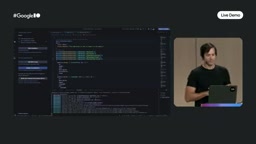
Firebase gets real-time SQL sync, on-device AI inference, and deep AI Studio integration at I/O 2025.
At Google I/O 2025, Firebase announced sweeping updates including SQL Connect with real-time sync for relational databases, AI Logic supporting on-device and hybrid inference, Firestore Enterprise with native full-text search, deep Google AI Studio integration, Agent Skills across all platforms, and phone number verification reaching GA — positioning Firebase as the go-to infrastructure for the AI era.
At Google I/O 2025, the Firebase team unveiled a series of major updates spanning databases, AI integration, authentication, and developer tools. From the all-new SQL Connect real-time sync capability, to AI Logic with on-device inference support, to deep integration with Google AI Studio, Firebase is fully embracing the application development paradigm of the AI era.
Firebase SQL Connect: A Complete Evolution for Relational Databases
Last year's Data Connect has officially been upgraded to Firebase SQL Connect this year — and it's not just a rebrand, but a qualitative leap in functionality. SQL Connect retains the core strengths of Data Connect — serverless secure access to Cloud SQL and strongly-typed auto-generated SDKs — while adding four key new capabilities.
For context, Firebase Data Connect was originally launched in 2024 to address the long-standing lack of relational database support in the Firebase ecosystem. Traditional Firebase centered around Firestore (a NoSQL document database) and Realtime Database, but many enterprise applications require complex relational queries, transactional consistency, and SQL standard support. Cloud SQL is Google Cloud's fully managed relational database service supporting PostgreSQL, MySQL, and SQL Server, but securely accessing Cloud SQL directly from the client previously required substantial backend code. SQL Connect uses GraphQL schemas to define data models and auto-generates strongly-typed SDKs, allowing frontend developers to work with relational databases as easily as they would with Firestore.
Real-time Sync
This is the most exciting update. Developers can now subscribe to queries using the subscribe method instead of the traditional executeQuery. Query results are cached on the server side, and whenever data changes, the frontend automatically receives a signal and refreshes the UI.
From a technical implementation perspective, real-time sync is a hallmark feature of Firebase Realtime Database and Firestore, but it's significantly harder to achieve with relational databases. Traditional relational databases use a request-response model and lack native change-push capabilities. SQL Connect's real-time sync works through a server-side caching layer — the system maintains snapshots of query results on the server, uses Change Data Capture (CDC) mechanisms to detect data changes, and then pushes incremental updates to clients via WebSocket or similar persistent connection protocols.
Even more powerful is the refresh directive — you can declare that a specific query should automatically refresh when a particular mutation occurs. This is essentially a declarative cache invalidation strategy, freeing developers from manually managing cache consistency. The demo showcased an "Emoji Exchange" app where when one user purchases an emoji, another user's interface updates the price change in real time, with no manual refresh needed.
Native SQL Support and Custom Resolvers
You can now write queries and mutations directly using full SQL syntax, including access to all PostgreSQL extensions. The demo showcased a geolocation search scenario using the PostGIS extension — displaying emoji trade locations on a map based on latitude and longitude.
PostGIS is one of PostgreSQL's most well-known extensions, adding full Geographic Information System (GIS) support to the database. It allows storing geographic objects (points, lines, polygons) in the database and provides spatial indexes along with hundreds of spatial analysis functions such as distance calculations, area containment checks, and route planning. PostGIS is widely used in mapping services, logistics systems, and location-based social applications. SQL Connect's support for PostgreSQL extensions means developers can leverage these powerful geospatial computation capabilities directly in frontend queries without implementing complex spatial algorithms at the application layer.
Custom Resolvers break down data source boundaries. Through Cloud Functions, you can fetch data from both SQL databases and BigQuery in a single query. This means you can seamlessly combine real-time transaction data with pre-computed analytics metrics, or even call any third-party API.
Offline Caching
Offline caching ensures applications remain responsive in no-network or weak-network environments, which is especially important for mobile apps.
Firestore Enterprise: Major NoSQL Enhancements
For NoSQL scenarios, Firestore Enterprise has also received heavyweight updates. Firestore Enterprise is an enhanced version designed for large enterprises and high-load scenarios, offering higher SLA guarantees, larger storage and throughput limits, and enterprise-grade security compliance features. While standard Firestore is powerful, it has always had limitations in complex queries — for example, no support for JOIN operations, and full-text search requiring third-party services like Algolia or Elasticsearch. The core capabilities in this update essentially bring some of the query expressiveness of relational databases into a NoSQL database, made possible by a refactoring of Firestore's underlying pipeline query engine.
Specific updates include:
- DML (Data Manipulation Language): Simplifies batch data modification operations — for example, a single pipeline query can delete all user-generated content when a user deactivates their account
- Subqueries: Support for combining multiple documents and filters within a single query, unlocking complex query scenarios
- GeoSearch: Native support for geographic field searches, including latitude/longitude and distance calculations
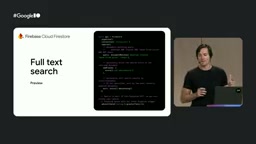
- Full Text Search: This long-awaited community feature is now natively supported in Firestore Enterprise, including exact word matching, phrase search, and semantic matching — no more need for third-party extensions
Firebase AI Logic: AI Capabilities from Cloud to Device
Secure Client-Side AI Integration
Firebase AI Logic lets developers add generative AI features to their apps without server-side configuration. It supports multiple languages including Java, Kotlin, Swift, and Flutter, and provides multi-layered security protection:
- Silver Prompt Templates: Prevent prompts from being exposed on the client side
- One-time Tokens: Prevent malicious replay attacks
- Template-only Mode: Only executes server-stored prompts
- Authentication-restricted Mode: Only allows calls carrying valid Firebase Auth tokens
On-Device and Hybrid Inference
Firebase AI Logic now supports on-device and hybrid inference, covering iOS, Chrome (GA), and Android (with Gemma 4 support). Developers need only a few lines of code to configure their app to prioritize the on-device model and automatically fall back to the cloud when necessary.
On-device inference means running AI models directly on the user's device rather than sending data to the cloud for processing. This brings three core advantages: privacy protection (sensitive data never leaves the device), low latency (no network round-trip time), and cost savings (no cloud API quota consumption). Gemma 4 is Google's lightweight open-source model series, optimized for edge devices and capable of running efficiently in resource-constrained environments like phones and browsers. The core idea behind hybrid inference is intelligent routing based on task complexity — simple tasks are handled by the local model, while complex tasks are automatically escalated to cloud-based Gemini models. Developers call a unified API without needing to worry about the underlying routing logic.
The demo showcased a receipt scanning app — since receipt formats are relatively standardized, the on-device model can handle recognition, saving valuable cloud token quota.
New Model and Feature Support
- Support for the latest Gemini 3 GA models
- Google Maps geographic data grounding
- Image generation controls (aspect ratio, dimensions)
- Finish reasons exposed
Developer Tools and Integration Ecosystem
Deep Integration Between Firebase and Google AI Studio
Firebase is now natively integrated into Google AI Studio. The Anti-gravity agent can automatically identify an app's Firebase service needs based on prompts — without explicitly mentioning databases or authentication in the prompt, the agent proactively suggests enabling Firestore and Firebase Auth and writes security rules.
Upcoming features include: creating real Android apps, adding AI features through AI Logic, and using App Check by default to protect all AI Logic calls. Firebase App Check is an app attestation service that uses device-level attestation (such as Apple's App Attest, Google's Play Integrity, or Web's reCAPTCHA Enterprise) to verify that requests genuinely come from legitimate apps rather than scripts or tampered versions. In AI scenarios, App Check is especially important — without it, attackers can extract API keys and make massive AI API calls, resulting in enormous bills. Making App Check the default protection layer for AI Logic calls means every AI request undergoes device legitimacy verification.
Firebase Agent Skills
Firebase Agent Skills now supports all four major platforms — Android, iOS, Web, and Flutter — and has expanded support for Crash Analytics and Remote Config. Whether you're using Android Studio, another IDE, or command-line tools, you can easily access these agent skills.
Dart Support for Cloud Functions
For Flutter developers, experimental Dart support for Cloud Functions means no more language switching between frontend and backend code, truly enabling full-stack Dart development.
Application Design Center (ADC) Integration
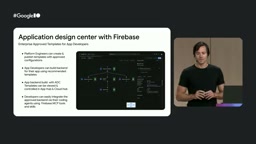
For enterprise customers, Firebase has introduced integration with Application Design Center, providing a unified resource deployment and management model that allows managing Firebase services like App Check, Firestore, and Authentication alongside other cloud infrastructure.
Phone Number Verification Reaches GA
Firebase Phone Number Verification (FPNV) has officially reached GA status. Compared to traditional SMS verification, FPNV doesn't send text messages (eliminating phishing attack risks), works with any internet connection, and obtains numbers directly from carriers — with over 10 carriers currently onboarded. The new SIM-free testing mode significantly reduces friction during development and testing.
Traditional SMS verification (OTP) has multiple security vulnerabilities: SIM swap attacks (where attackers convince carriers to transfer a number to a new SIM card), SMS interception (through SS7 protocol vulnerabilities), and phishing sites that trick users into entering verification codes. Additionally, SMS verification costs scale linearly with user volume, ranging from $0.01 to $0.05 per message. FPNV uses carrier-level SIM-bound verification, communicating directly with carriers through the mobile network's data channel to verify whether the SIM card in the current device corresponds to the claimed phone number. The entire process requires no user interaction, making it both more secure and more cost-effective.
Summary
Firebase's updates at I/O 2025 send a clear signal: whether it's human developers or AI agents writing code, Firebase aims to be the best infrastructure from client to cloud. SQL Connect's real-time capabilities breathe new life into relational databases, AI Logic's on-device inference makes AI features more economical and efficient, and deep integration with various development tools ensures developers can seamlessly use all of Firebase's capabilities within any workflow.
Related articles

In-Depth Guide to the Codex Chinese Manual: A Complete Walkthrough from Beginner to Advanced
In-depth breakdown of ByteDance's 198-page Codex Chinese manual covering installation, Commands, MCP workflows, Skills templates, and multi-Agent collaboration.

Codex Infinite Canvas Workflow: A New Approach to Precise AI Image Editing
A detailed guide on combining Codex with online canvas tools for precise AI image editing. A four-step workflow—generate, deploy canvas, annotate visually, regenerate—solves imprecise text-only editing.

From Vibe Coding to AI-Engineered Programming: A Practical Guide to Three Levels of Mastery
A deep dive into three levels of AI programming: Vibe Coding for rapid prototyping, Plan Mode for structured development, and AI-engineered programming for enterprise-grade projects with SDD and Claude Code SuperPower.