Fired 6 Times, He Achieved 95% Profit Margins with Digital Products — Here's How

Fired 6 times, Marc Lou built digital products achieving 95% profit margins as a solo indie developer.
After being fired 6 times, indie developer Marc Lou pivoted to building digital products and now earns over $1.5M annually with profit margins reaching 80-95%. This article breaks down his SaaS business model, user-driven development approach, AI-powered marketing tactics, pricing psychology, and the digital nomad lifestyle that makes it all possible.
From Getting Fired to Becoming a Millionaire: An Indie Developer's Comeback Story
"I got fired everywhere, so I started my own business." That's a line indie developer Marc Lou keeps repeating. This Frenchman now sits in a tropical paradise in New Zealand, running multiple digital products with annual revenue exceeding 1.5 million SGD and profit margins as high as 80%.
His story wasn't smooth sailing — after being fired 6 times, he chose a completely different path: building digital products as an indie developer. An indie hacker is someone who builds, operates, and profits from internet products independently or with a tiny team, without relying on venture capital or large organizations. The concept gained widespread recognition after Courtland Allen created IndieHackers.com in 2017. Unlike the traditional Silicon Valley startup model that pursues exponential growth and IPO exits, indie hackers prioritize sustainable profitability and work-life balance.
Marc's experience reveals a profound business truth: To earn $1 million in profit, a digital product only needs $1.2 million in revenue, while a restaurant needs $20 million.
How Digital Products Achieve a Stunning 95% Profit Margin
Marc showed his profit and loss statement in the video: total revenue of approximately 1.5 million SGD, profit of about 1.2 million SGD, yielding a profit margin of roughly 80%. Some of his smaller products even hit 95% margins.
This ultra-high profitability stems from the fundamental characteristics of the SaaS (Software as a Service) business model. SaaS delivers software over the internet, with users paying monthly or annual subscriptions rather than making one-time purchases. Its core advantage lies in recurring revenue (MRR/ARR) — predictable, stable cash flow every month or year. More critically, once a SaaS product is built, the marginal cost is nearly zero — the difference in server costs between serving one user and ten thousand users is minimal. This is the fundamental reason profit margins can reach 80%-95%.
Specifically:
- An email product earns $15,000/year with monthly operating costs of just $2-3
- A small SaaS product earns $2,000/month with operating costs under $10/month
- Even a product with "poop" in its name earns a few hundred dollars per month with zero maintenance costs

Digital Products vs. Traditional Restaurants: How Big Is the Profit Margin Gap?
Marc recalled his experience as a waiter in 2016: earning $10/hour, working 10 hours a day for just $100, while generating about $2,000 in revenue for the restaurant. A restaurant selling about $10,000 worth of food daily brings in roughly $3.6 million annually, but after deducting ingredients, rent, and labor, the profit margin is only about 5%.
Low profit margins in the food service industry are a global phenomenon. According to the National Restaurant Association, the average profit margin for U.S. restaurants ranges from 3%-9%, and about 60% of new restaurants close within their first year. High fixed costs (rent, equipment depreciation), variable costs (food waste, labor), and intense local competition make food service one of the hardest industries to profit in.
This means:
- Digital products: $1.2M revenue → $1M profit
- Restaurant: $20M revenue → $1M profit
Both end up with the same annual profit, but the investment required is worlds apart. Digital products don't need rent, employees, or worrying about someone cutting their finger while slicing meat — the product runs automatically 24/7.
Daily Operations of an Indie Developer: User Feedback-Driven Product Iteration
Marc demonstrated his update workflow for his product DataFast. He collects user feedback and prioritizes developing the most-requested features:
- Revenue categorization: Splitting revenue into "new revenue" and "recurring revenue," distinguished by different shades of orange
- Flexible KPI settings: Users can choose whether to include renewal revenue in key performance indicators
- Refund visualization: Marking refunded payments in gray and automatically excluding them from revenue statistics
- User journey tracking: Viewing the path between a user's first visit and final purchase

This user feedback-driven product iteration approach is known as "User-Driven Development" in product management. Unlike large companies that rely on product manager teams for market research and requirements analysis, indie developers typically communicate directly with users, collecting needs through feature voting boards (tools like Canny, Nolt, etc.), prioritizing them, and iterating quickly. The advantage is an extremely short feedback loop — from a user requesting a feature to it going live might take only a few days, whereas large companies might need months.
Using AI to Create Marketing Ads: One Ad Creative in 45 Minutes
Marc shared a practical marketing technique: he saw a French person promoting a restaurant on Instagram, found the format simple and effective, and copied the model:
- Extract the script format from the Instagram ad
- Use AI to rewrite the copy, adapting it for his own product (CodeFast programming course)
- Have his wife help film the video
- Use Submagic to add dynamic subtitles and thumbnails
- Have a friend with ad experience handle Facebook/Instagram targeting
The Meta advertising system (formerly Facebook Ads Manager) involved here is one of the world's largest social media advertising platforms, allowing advertisers to target users based on demographics, interests, behaviors, and custom audiences. Advertisers set daily budgets and bidding strategies, and the system determines ad placement through real-time bidding (RTB). For indie developers, social media ads are an important user acquisition channel, but they require continuous testing of different creative assets, audience targeting, and landing page combinations to optimize return on ad spend (ROAS).
The entire process took just 45 minutes. His core advice: If you see an effective ad, it means someone spent significant money validating it — just copy the format and rewrite the copy with AI. This strategy is known as the "Swipe File" method in marketing — collecting market-validated ad creatives as an inspiration library, then adapting them for your own product rather than creating from scratch.
Digital Product Pricing Strategy: Why Higher Prices Actually Work Better
Marc referenced a study on the placebo effect: in a Parkinson's disease treatment experiment, the more patients paid for medication, the better their treatment outcomes.

This study was published in the journal Neurology in 2015. Researchers found that patients told their medication cost $1,500 showed significantly greater improvement in motor function than those told it cost $100 — even though both groups received saline injections. This phenomenon is called the "Price-Quality Heuristic" in behavioral economics — consumers tend to equate higher prices with higher quality.
He believes this directly relates to digital product pricing: a common mistake indie developers make is pricing their products too cheaply. While it's genuinely difficult to start charging people online, accurate pricing is crucial — price itself is a signal of product value. Low pricing not only compresses profit margins but also causes users to underestimate the product's actual value. In the digital product space, this means reasonably high pricing can not only boost profits but also increase users' perceived value and engagement — users who pay more tend to use the product more seriously, achieving better results and creating a positive feedback loop.
Why Now Is the Best Time Ever to Build Digital Products
Marc repeatedly emphasizes: There has never been a better time in history to build digital products. Reasons include:
- AI can help you brainstorm marketing ideas
- AI can help you write code
- AI can help you build products
- Operating costs are extremely low with near-zero marginal costs
- No employees, rent, or inventory needed
- Products run automatically 24/7 without continuous time investment
Marc's mention of AI-assisted programming reflects the explosive growth of AI coding tools in 2023-2024. AI programming assistants like GitHub Copilot, Cursor, and Claude can generate code from natural language descriptions, debug errors, and explain code logic. This has dramatically lowered the barrier to software development — full-stack web applications that previously required years of programming experience can now potentially be built in weeks by people with basic logical thinking skills using AI tools. According to GitHub, developers using Copilot code 55% faster, and for non-professional developers, the improvement may be even more significant.
He also released a free 3-hour tutorial video teaching people to learn programming from scratch with AI and build SaaS products, covering internet fundamentals, APIs (Application Programming Interfaces — standard protocols for communication between different software systems), frontend and backend (frontend refers to the interface users see and interact with; backend refers to server-side programs that handle data and business logic), landing pages (the first page users arrive at after clicking an ad, typically designed for conversion), databases, and all other necessary knowledge.
The Indie Developer's Life Philosophy
Beyond business, Marc also showcased his attitude toward life as a digital nomad:
- Traveling and working with his wife in New Zealand
- Daily CrossFit training ("Exercise is the second-best legal drug on this planet after sleep")
- Handling legal matters like company succession to ensure his wife can gain company ownership under any circumstances
- Reading extensively, with a "either it's amazing or it's not worth it" filtering approach to books
The rise of the digital nomad lifestyle is one of the most significant work trends in recent years. According to MBO Partners, the global digital nomad population exceeded 35 million in 2023. This lifestyle has been enabled by the maturation of remote collaboration tools (like Slack, Notion), improvements in global internet infrastructure, and the dramatic increase in corporate acceptance of remote work following the COVID-19 pandemic. Many countries including Portugal, Thailand, and Colombia have introduced dedicated digital nomad visas to attract this demographic, and indie developers — whose income comes entirely from online sources with no geographic restrictions — are naturally suited to this lifestyle.
He cites a perspective from The Hope Effect: if you shape the self-identity you believe in, you'll act accordingly — even if you're not that person yet. This perfectly echoes his journey from being fired 6 times to becoming a millionaire. This concept is known in psychology as the "Self-Fulfilling Prophecy" or "identity-driven behavior" theory — when someone defines themselves as an "entrepreneur" rather than a "fired employee," their decision-making patterns, risk tolerance, and drive all shift accordingly.
For every developer considering a career transition, Marc's story sends a clear signal: Rather than working for others and getting fired, build your own digital assets. Low cost, high profit, time freedom — that's the core appeal of digital product entrepreneurship.
Key Takeaways
Related articles

AI Large Model Learning Roadmap Breakdown: Three Stages from Application Development to Model Fine-Tuning
Deep breakdown of a popular AI large model learning roadmap covering LangChain, RAG, Agent, and LoRA fine-tuning across three stages, with analysis of its strengths and limitations for career changers.

AI Agent Development: A Complete 6-Week Systematic Learning Roadmap
A 6-week systematic learning roadmap for AI Agent development, covering core architecture, ReAct principles, multi-agent collaboration, RAG integration, and deployment.
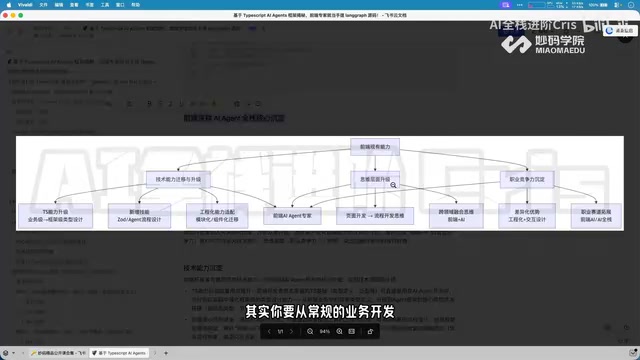
Four Core Advantages Frontend Developers Have When Transitioning to AI Agent Development
Frontend developers have key advantages for AI Agent development: TypeScript ecosystem fit, low-barrier full-stack bridging, and state management isomorphism. Learn the transition path here.