Firestore Enterprise Edition Released: Native Full-Text Search and Subquery Features Explained

Firestore Enterprise adds native full-text search, subqueries, and pipeline operations to eliminate third-party dependencies.
Google has released Firestore Enterprise Edition featuring three major capabilities: native full-text search (eliminating the need for Algolia/Elasticsearch), JOIN subqueries for cross-collection data association, and pipeline operations for server-side data processing. These additions blur the line between NoSQL and relational databases, significantly expanding Firestore's enterprise use cases while simplifying architecture for existing Firebase users.
Firestore Enterprise: A Major Upgrade
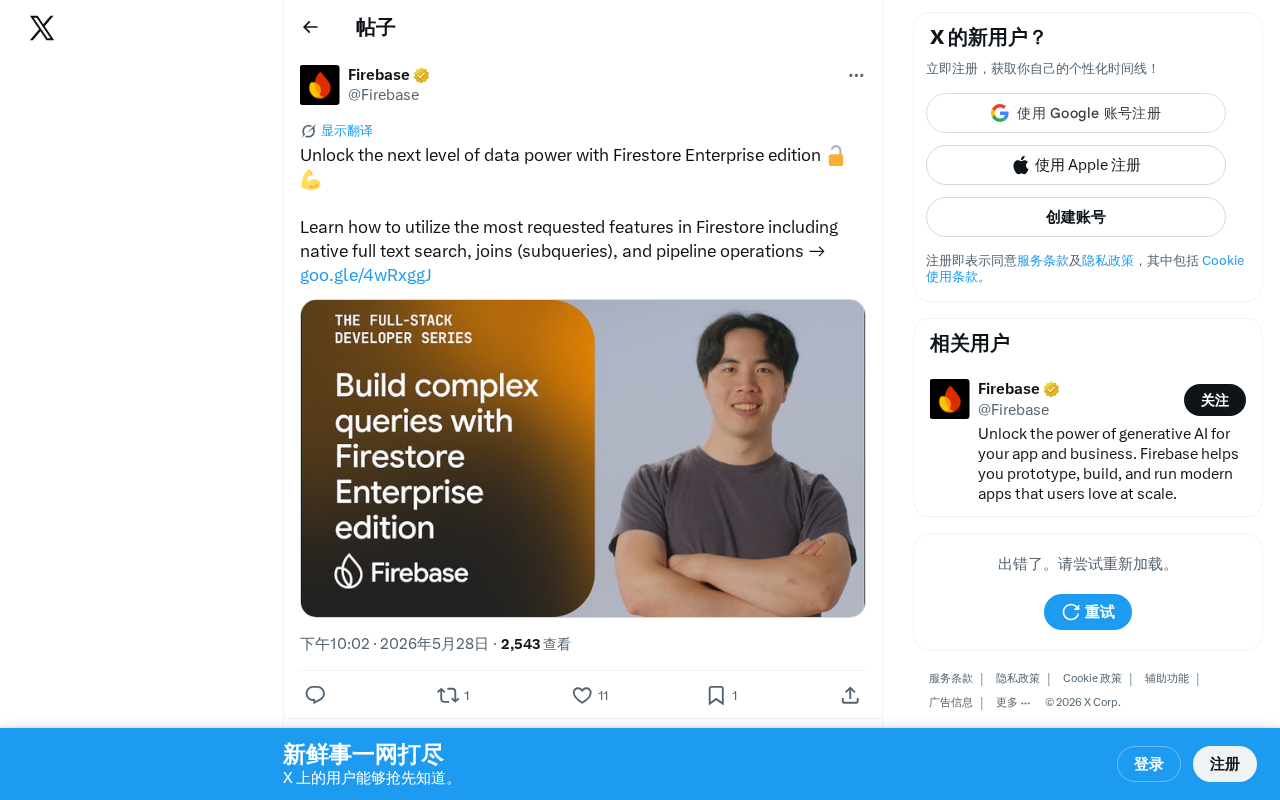
Google has officially launched Firestore Enterprise Edition, delivering several core features that developers have long been waiting for. This update directly addresses the community's most requested capabilities—native full-text search, JOIN queries (subqueries), and Pipeline Operations—marking a significant leap for Firestore from a lightweight NoSQL database to an enterprise-grade data platform.
Firestore is a cloud-native NoSQL document database launched by Google in 2017 as one of the core components of the Firebase platform. It uses a Document-Collection data model where each document is stored in JSON-like key-value pairs, with native support for hierarchical nested structures. Firestore's core strengths lie in real-time data synchronization, offline support, and automatic scaling, making it widely popular in mobile and web application development. However, NoSQL databases by design philosophy sacrifice many mature query capabilities found in relational databases in exchange for horizontal scalability and flexible schemas—a long-standing pain point criticized by the community. This Enterprise edition release systematically addresses these shortcomings.
Three Core Features Explained
Native Full-Text Search: Say Goodbye to Third-Party Search Services
For a long time, Firestore users who needed full-text search had no choice but to rely on third-party services like Algolia or Elasticsearch, which not only increased architectural complexity but also introduced additional costs and data synchronization issues. Firestore Enterprise Edition includes built-in native full-text search capabilities, allowing developers to execute complex text queries directly within Firestore without introducing external search engines.
To understand the value of this feature, you need to understand the core technology behind full-text search—the Inverted Index. An inverted index maps each term in a document to a list of documents containing that term, enabling efficient text retrieval. The two commonly used alternatives each had their pain points: Algolia is known for its instant search experience and simple API, but charges per search request, with costs growing significantly at scale; Elasticsearch is built on Apache Lucene and is powerful but operationally complex. When using these services, developers needed to sync Firestore data to the search engine in real-time through middleware like Cloud Functions, which not only introduced data consistency risks (sync delays could cause search results to be inconsistent with actual data) but also added failure points and debugging difficulty.
Now, all these problems are solved. For building content management systems, e-commerce search, knowledge bases, and similar use cases, developers can complete data storage and search within the same database, maintaining data consistency while reducing operational costs and dramatically lowering architectural complexity.
JOIN Queries and Subqueries: Cross-Collection Data Association Is No Longer a Challenge
A classic pain point of NoSQL databases is the lack of JOIN operations found in relational databases. In relational databases (such as PostgreSQL, MySQL), JOIN is one of the most fundamental operations, allowing dynamic association of data across multiple tables through foreign keys at query time. But in NoSQL database design philosophy, data is typically organized through denormalization—redundantly storing related data within the same document to avoid cross-collection queries. While this approach improves read performance, it introduces data redundancy and update consistency challenges. For example, in an e-commerce application, if user information is embedded in order documents, when a user changes their address, the address in all historical orders needs to be updated synchronously.
Previously in Firestore, developers had to simulate JOIN effects through multiple queries and client-side data assembly, which was not only code-complex but also difficult to guarantee performance. This pattern creates severe N+1 query problems at scale—after fetching N primary records, N additional sub-queries are needed, causing latency to grow linearly and network overhead to balloon dramatically.
Firestore Enterprise introduces subquery support, making cross-collection data association queries possible. This means developers can retrieve related data in a single query, dramatically reducing network round trips and improving application response times. For enterprise applications with complex data models, the value of this feature is obvious.
Pipeline Operations: Significantly Enhanced Server-Side Data Processing
Pipeline operations bring more powerful data processing capabilities to Firestore. Similar to MongoDB's Aggregation Pipeline, developers can perform data transformation, filtering, and aggregation operations directly at the database level, rather than pulling large amounts of raw data to the client for processing.
MongoDB's aggregation pipeline is the benchmark implementation of server-side data processing in NoSQL databases, allowing developers to chain multiple data processing stages (such as filtering, grouping, projection, sorting, and association) into a processing pipeline where data passes through each stage sequentially for transformation. This design borrows from the Unix pipe concept, where each stage's output serves as the next stage's input. Firestore's introduction of pipeline operations means developers no longer need to pull all raw data to the client for aggregate calculations—for example, calculating total sales by category over a time period previously might have required downloading tens of thousands of order records to the client for grouping and summing, but now this can be done directly on the server, returning only the final aggregated results, potentially reducing data transfer from several MB to just a few KB.
This server-side data processing pattern not only significantly reduces data transfer volume but also leverages server-side computing resources to accelerate complex queries, making it particularly suitable for data analytics, report generation, and similar scenarios.
Impact on the Developer Ecosystem
Lowering the Technology Selection Barrier
This Firestore Enterprise upgrade essentially blurs the boundaries between NoSQL and relational databases. In the past, many teams would turn to other solutions during technology selection because Firestore lacked full-text search and JOIN capabilities. Now that these barriers have been removed, Firestore's applicable scenarios will expand significantly.
For teams already deeply invested in the Firebase ecosystem, upgrading to the Enterprise edition can avoid introducing additional databases or search services, maintaining technology stack simplicity.
Clearer Enterprise Positioning
The naming alone reveals that Google is pushing Firestore toward the enterprise market. The addition of these features enables Firestore to support more complex business logic and larger-scale data processing needs, aligning with Google Cloud's overall enterprise strategy.
It's worth noting that Google Cloud currently has an extensive database product matrix: Cloud Spanner provides globally distributed relational database capabilities suitable for financial-grade transaction processing; Cloud SQL offers managed MySQL, PostgreSQL, and SQL Server instances; Bigtable targets large-scale analytical workloads; and AlloyDB is Google's high-performance PostgreSQL-compatible database. The Firestore Enterprise upgrade makes its positioning within this matrix more distinctive—it fills the niche of "developer-friendly + real-time sync + enterprise-grade query capabilities," creating more direct competition with AWS's DynamoDB and MongoDB Atlas.
Summary and Outlook
The release of Firestore Enterprise Edition is an important strategic move by Google in the database space. By filling in the three critical puzzle pieces of full-text search, JOIN queries, and pipeline operations, Firestore is evolving from a "good enough NoSQL database" into a "fully-featured enterprise data platform."
For development teams currently evaluating database solutions, Firestore Enterprise is worth reconsidering. For existing Firestore users, this upgrade may mean the opportunity to streamline technical architecture and remove dependencies on third-party services—an optimization opportunity worth paying attention to.
Key Takeaways
Related articles

Claude Code for Test Development in Practice: An AI Programming Workflow That Doubles Your Efficiency
A practical guide to Claude Code for test development: auto-generating test scripts, Plan Mode workflows, MCP + Playwright integration, and Subagent parallel tasks to build systematic AI-assisted workflows.

Hermes Agent Hands-On Review: An AI Efficiency Revolution for Indie Game Developers
Indie game developer reviews Hermes Agent vs OpenClaude: intelligent context compression, real-time Memory, remote control via Telegram, and practical use cases in game dev, social media, and email.

Vibe Coding Beginner's Guide: Tool Selection Across Three Categories with Practical Examples
A comprehensive guide to Vibe Coding's three tool categories: Agent frameworks, CLI Coding, and IDE tools, with practical examples including Snake game and data analysis workbench.