Franz Founder's 10-Year Startup Lesson: The Logic Behind Disbanding a 5-Person Team to Return to Solo Development
Franz founder disbanded his 5-person team to ship faster solo with AI after 10 years of bootstrapping.
The founder of messaging aggregation app Franz shares his decade-long entrepreneurial journey: rejecting VC funding, experimenting with user donations, scaling to a 5-person team, then making the counterintuitive decision to let everyone go and return to solo development. The story illustrates how team expansion created financial anxiety and design-by-committee slowdowns, and how AI tools now enable individual developers to match or exceed small team output.
A Counterintuitive Startup Story
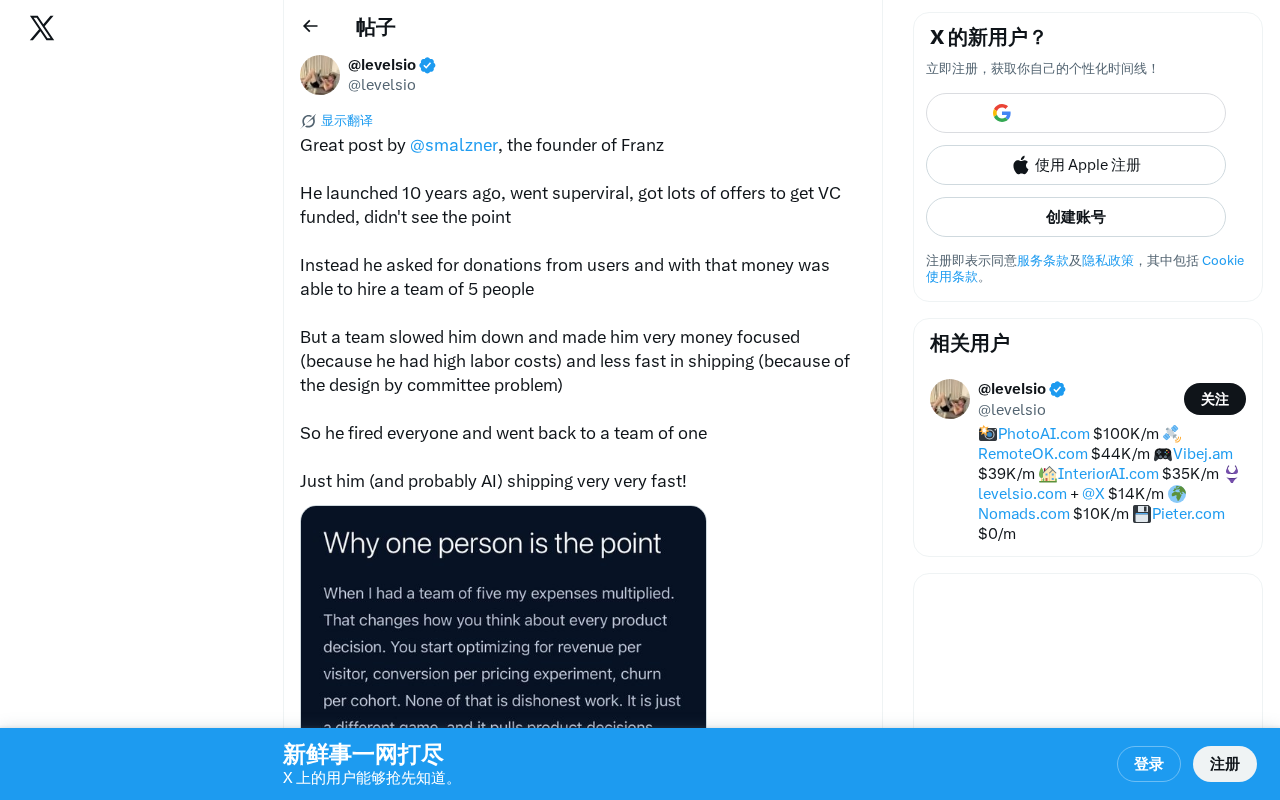
Recently, @smalzner, the founder of messaging aggregation app Franz, shared an incredibly insightful decision from his decade-long entrepreneurial journey—disbanding his entire team and returning to solo development. The story sparked widespread discussion on Twitter because it challenges the mainstream startup narrative of "raise funding → expand → scale."
From Viral Product to Rejecting VC Funding
Franz is a desktop application that consolidates multiple messaging services (WhatsApp, Slack, Telegram, etc.) into a single interface. It was born during the explosive growth of instant messaging apps in the 2010s—a time when users routinely juggled over a dozen communication platforms daily, and the fragmented desktop experience was a significant pain point. Franz uses the Electron framework (a cross-platform desktop application development framework based on Chromium and Node.js), embedding each service as a WebView within a unified window—essentially a well-designed multi-tab browser container. Competitors like Rambox, Station, and Ferdi (an open-source fork of Franz) later emerged in this space, confirming real demand but also indicating relatively limited technical moats, with product differentiation relying more on user experience and iteration speed.
Ten years ago, the product went superviral shortly after launch, and venture capital firms came knocking in droves.
However, the founder made a decision that would seem "unthinkable" in Silicon Valley—he rejected all VC funding. He believed accepting venture capital made no sense; the product already had a user base and didn't need external capital to drive growth.
This judgment required enormous courage at the time. The essence of venture capital is trading equity for the capital needed to fuel hypergrowth, but the costs extend far beyond equity dilution. The VC business model demands that portfolio companies deliver 10x+ returns within 5-7 years, meaning that once you accept funding, you're locked onto a track of "exponential growth or death." For a utility product like Franz, the natural market ceiling (TAM, Total Addressable Market) may not support the return multiples VCs expect. Additionally, VCs typically require board seats, liquidation preferences, anti-dilution clauses, and other terms that can severely restrict a founder's decision-making freedom when the company underperforms expectations. Basecamp founder DHH, Mailchimp founder Ben Chestnut, and others have publicly championed the bootstrapping path of not raising funding, proving its viability.
After all, "take the money and run" is most founders' instinctive reaction when their product goes viral.
The User Donation Model Experiment and the Hidden Costs of Team Expansion
Instead of VC funding, he chose a more modest path—asking users for donations. The user donation model (also known as "voluntary payment" or "Pay What You Want") has a long history in open-source and independent software. Wikipedia, VLC Player, Blender, and other projects all rely on this model. The core challenge is the "free rider problem"—most users will choose not to pay, with typically only 1-5% of active users donating voluntarily, meaning the product needs an enormous user base to generate meaningful revenue.
This user-funded revenue allowed him to build a 5-person team. However, team expansion brought two problems he never anticipated:
Problem One: Financial Anxiety Eroding Product Thinking
A 5-person payroll meant high fixed monthly expenses. This forced the founder to devote significant energy to "how to make more money" rather than "how to build a better product." When labor costs become the number one source of stress, product decisions get hijacked by financial needs. Franz later introduced a subscription model (Franz Professional), suggesting that the revenue uncertainty of a pure donation model was indeed unsustainable for team operations. This forced transition from donations to subscriptions is observable across many indie developer projects—it's typically not driven by product strategy but forced by survival pressure.
Problem Two: Design by Committee Slowing Iteration Speed
"Design by committee" is a classic trap in software development—when every decision requires multi-person discussion and consensus, iteration speed drops dramatically. What one person could decide in 5 minutes might require 3 meetings with 5 people.
The theoretical roots of this problem trace back to the core insight Fred Brooks presented in his 1975 classic The Mythical Man-Month: adding people to a late software project only makes it later. Brooks's Law reveals that communication costs in software development grow as n(n-1)/2—a combinatorial explosion. A 5-person team has 10 communication channels; a 1-person team has zero. Furthermore, Conway's Law states that an organization's communication structure inevitably maps onto the architecture of the systems it produces—the more complex the team, the more bloated the product architecture tends to become. For consumer products that demand unified aesthetics and extreme simplicity, a single decision-maker often maintains stronger product consistency.
The team didn't make him faster—it became the bottleneck.
Returning to Solo Development: The Rise of Individual Developers in the AI Era
Ultimately, he made his second counterintuitive decision—he let everyone go and returned to solo development.
With AI tools maturing rapidly, this decision makes far more sense today than it would have a decade ago. Between 2024-2025, the AI development tool ecosystem has formed a complete one-person company tech stack: at the code level, GitHub Copilot, Cursor, Claude, and other AI coding assistants can boost coding efficiency 2-5x; at the design level, Midjourney, Figma AI, v0.dev, and similar tools enable rapid prototyping; at the operations level, Vercel, Railway, and other platforms enable one-click deployment; for customer support, AI chatbots handle user inquiries; for marketing, AI copywriting tools assist with content creation.
As the tweet implies, "just him (and probably AI) shipping very very fast"—he and AI form the new "team," delivering product at breakneck speed. Pieter Levels (founder of Nomad List and RemoteOK) is the benchmark figure for this trend, solo-operating multiple products generating millions of dollars in annual revenue. By observation, over 85% of the indie hacker community was using AI tools in 2024, with the average number of projects managed per person growing 3x compared to 2022.
Core Takeaways for Indie Developers and Founders
This story reveals several thought-provoking insights:
1. Scale does not equal efficiency. More people don't necessarily mean faster output, especially for creative software products where communication costs can devour all marginal gains. Amazon founder Bezos's "two-pizza rule" (teams should be no larger than what two pizzas can feed) is already a compromise for large teams—for many independent software products, the optimal team size might just be one person.
2. VC is not the only path. User payment/donation models may grow more slowly, but they preserve the founder's complete control over product direction. This self-sustaining approach, known as "bootstrapping," lets founders build sustainable businesses at their own pace rather than being forced to chase valuation targets for the next funding round.
3. AI is redefining what "team" means. One person + AI may be more efficient, more flexible, and lower cost than a 5-person team. This isn't a rejection of human collaboration but a re-examination of "what types of work require human collaboration"—when AI can handle vast amounts of execution-level work, human value shifts more toward strategic judgment and creative direction.
4. Entrepreneurship is a reversible experiment. If expansion doesn't work, contract. No decision is irreversible. Acknowledging mistakes and adjusting quickly is itself a capability. The "pivot" concept from lean startup methodology applies equally to organizational form—team structure itself should be a subject of continuous experimentation and optimization.
Franz's story is a perfect footnote for the "company of one" philosophy in the AI era. Paul Jarvis argued in his book Company of One that growth shouldn't be the default option but rather a deliberate, well-considered choice. When tools are powerful enough, small and beautiful is no longer a compromise—it's a strategic choice.
Related articles

Claude Code for Test Development in Practice: An AI Programming Workflow That Doubles Your Efficiency
A practical guide to Claude Code for test development: auto-generating test scripts, Plan Mode workflows, MCP + Playwright integration, and Subagent parallel tasks to build systematic AI-assisted workflows.
Hermes Agent Hands-On Review: An AI Efficiency Revolution for Indie Game Developers
Indie game developer reviews Hermes Agent vs OpenClaude: intelligent context compression, real-time Memory, remote control via Telegram, and practical use cases in game dev, social media, and email.
Vibe Coding Beginner's Guide: Tool Selection Across Three Categories with Practical Examples
A comprehensive guide to Vibe Coding's three tool categories: Agent frameworks, CLI Coding, and IDE tools, with practical examples including Snake game and data analysis workbench.