Gemini Notebooks Arrives in Europe: Feature Breakdown and Usage Guide
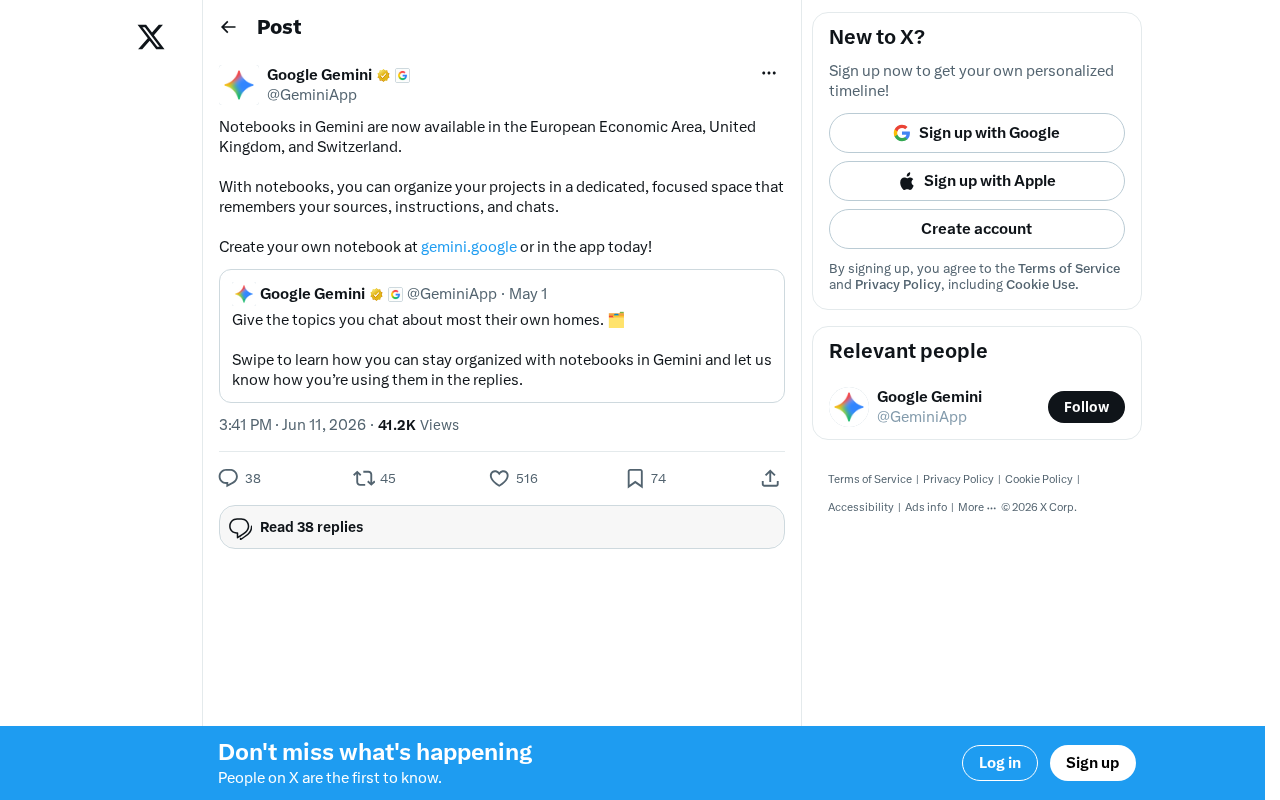
Gemini Notebooks launches in Europe, bringing persistent AI project workspaces to EEA, UK, and Swiss users.
Google has expanded Gemini Notebooks to the European Economic Area, the United Kingdom, and Switzerland. Unlike standard Gemini conversations, Notebooks offers a persistent workspace with source memory, saved instructions, and centralized chat management — functioning as a structured knowledge management tool rather than a simple Q&A interface. The European rollout signals Google's completion of GDPR and regional compliance requirements as it competes with ChatGPT, Claude, and Copilot in the global AI assistant market.
Overview
Google recently announced that the Notebooks feature in Gemini is now available to users in the European Economic Area (EEA), the United Kingdom, and Switzerland. This expansion marks another significant step in Google's global rollout of its AI assistant capabilities.
What Are Gemini Notebooks
A Focused Project Management Space
Gemini Notebooks is a feature module designed specifically for project organization. Unlike traditional conversational AI interactions, Notebooks provides a dedicated, focused workspace where users can systematically manage their AI-assisted workflows.
Its core features include:
- Source Memory: Notebooks remembers the materials and references users upload or cite, eliminating the need to re-provide context with every conversation
- Persistent Instructions: User-defined instructions and preferences are saved within the notebook, ensuring consistency in AI responses
- Conversation Management: All related chat histories are centralized within the same notebook space, making it easy to review and continue previous work
From a technical perspective, the "source memory" feature in Notebooks relates to a critical concept in large language models (LLMs) — the context window. Traditional conversational AI models have a token limit for each interaction, and earlier information that falls outside the window gets "forgotten." Notebooks overcomes this single-conversation context limitation by persistently storing user-uploaded materials and historical instructions, then automatically injecting relevant context into each conversation. This design is similar in concept to Retrieval-Augmented Generation (RAG) architecture — first retrieving relevant content from the user's knowledge base, then feeding it into the model as part of the prompt. This ensures the AI's responses are always grounded in the user's specific materials rather than relying solely on the model's pre-trained knowledge.
How Notebooks Differs from Regular Gemini Conversations
Regular Gemini conversations are better suited for one-off Q&A scenarios, while Notebooks is designed for complex projects that require ongoing iteration. For example, users can create a dedicated notebook for a research topic, organizing papers, data, and analysis instructions together to form a complete knowledge work environment.
This evolution from conversational AI to structured knowledge management reflects a fundamental shift in user needs. Early AI assistants (such as the first-generation ChatGPT) were essentially stateless conversation systems — each conversation was independent, with no cross-session memory. As users began applying AI to complex tasks like academic writing, code development, and market analysis, the single-conversation model could no longer keep up. This gave rise to the concept of the "AI workspace": an environment that can persistently save context, organize multiple source materials, and support iterative workflows. This trend aligns closely with the "Second Brain" personal knowledge management philosophy — AI is no longer just a tool for answering questions but an extension of the user's thinking and an external knowledge store. Products like Notion AI and Mem.ai are also moving in a similar direction.
The Significance of European Market Expansion
Balancing Compliance and Availability
The European market is known for its strict data protection regulations (such as GDPR), and AI products typically undergo lengthy compliance review cycles before entering the market. The fact that Gemini Notebooks now covers the EEA, the UK, and Switzerland indicates that Google has completed the necessary privacy and data processing compliance work.
Specifically, GDPR (General Data Protection Regulation) is the data protection regulation that the EU formally implemented in 2018, widely regarded as one of the world's strictest privacy legal frameworks. For AI products, GDPR compliance challenges are particularly complex: first, AI model training data may involve personal information of European citizens, requiring a clear legal basis; second, materials uploaded to Notebooks may contain sensitive data, and Google must ensure that the storage, processing, and transfer of this data comply with GDPR's data minimization and purpose limitation principles; additionally, GDPR grants users the "right to be forgotten," meaning users have the right to request deletion of their personal data, which places additional requirements on the data management architecture of AI systems. Since 2024, the EU has also been advancing the implementation of the AI Act, the world's first comprehensive AI regulation, further raising the bar for AI products entering the European market.
It's worth noting that the European Economic Area (EEA) consists of the 27 EU member states plus three non-EU countries — Iceland, Liechtenstein, and Norway — covering a total of 30 countries. The EEA was established to extend the EU's single market rules to these three non-member states, granting them the same rights in the free movement of goods, services, people, and capital as EU member states. Switzerland, despite being geographically central in Europe, is neither an EU member state nor an EEA member state; it maintains economic cooperation with the EU through a series of bilateral agreements. Google listed Switzerland separately in this rollout precisely because Switzerland operates under an independent legal framework from the EEA system, requiring separate compliance adaptation.
Shifting Competitive Landscape
In an increasingly competitive AI assistant market, regional feature availability has become an important differentiator. Competing products like OpenAI's ChatGPT and Anthropic's Claude are also actively expanding into global markets. Google's move helps solidify its position in the European AI market.
The current AI assistant market has developed into a multi-polar competitive landscape. OpenAI's ChatGPT holds a leading position thanks to its first-mover advantage and the GPT model series, with its Plus and Team subscription plans covering most global markets. Anthropic's Claude stands out for its safety focus and long-context processing capabilities, with its 200K token context window offering an edge in handling lengthy documents. Microsoft has built a unique competitive moat in the enterprise market by deeply integrating Copilot into the Office 365 ecosystem. Google's Gemini, leveraging its massive product ecosystem spanning Search, Gmail, Google Docs, and more, aims to differentiate through deep integration. The Notebooks feature is a prime example of this strategy — it's not just an AI conversation tool but a knowledge management platform embedded within the Google ecosystem.
How to Create and Use Gemini Notebooks
Users can create their own Notebook through two methods:
- Visit the Gemini web version (gemini.google.com)
- Use the Gemini mobile app
The creation process is simple and intuitive — users just need to navigate to the Notebooks section to start organizing their project space.
Looking Ahead
The European expansion of Gemini Notebooks reflects a broader trend: AI tools are evolving from simple Q&A assistants into structured knowledge management platforms. As users shift from occasional queries to deep collaboration with AI, features with contextual memory and project management capabilities will become increasingly important. For European users, this means they can now leverage Gemini for more complex, sustained AI-assisted workflows.
Key Takeaways
Related articles

AI Agent Systematic Learning Path: From Zero to Independent Development
A systematic AI Agent learning path covering core principles, Prompt engineering, RAG, multi-Agent collaboration, and hands-on projects for beginners.
Kimi K2.7 + Hermes Agent Real-World Test: Generate Complete Applications with a Single Sentence
Hands-on test of Kimi K2.7 integrated with Hermes Agent: generate complete 3D games and web OS apps from a single sentence, with benchmark data vs Claude 3.5.

Build a Personal Website with One Prompt Using Lovable: A Zero-Code Free Deployment Guide
Learn how to use Lovable AI to generate a professional personal website with one prompt and deploy it for free. Complete walkthrough from writing prompts to one-click publishing — no coding required.