Kimi K2.7 + Hermes Agent Real-World Test: Generate Complete Applications with a Single Sentence
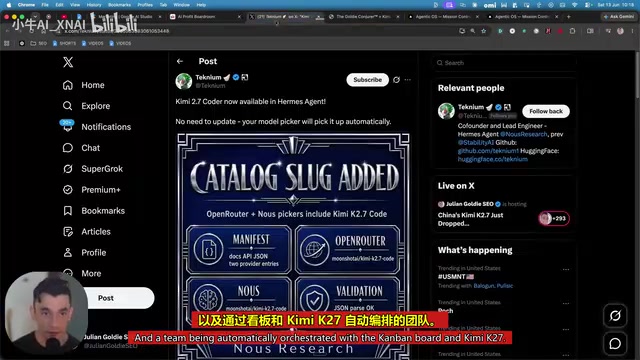
Kimi K2.7 + Hermes Agent enables non-programmers to build complete apps from natural language descriptions.
Moonshot AI's Kimi K2.7, a 300M-parameter MoE model with 256K context, has been integrated into the Hermes Agent system. Real-world demos show it generating 3D RPG games, web operating systems, and full videos in 19 minutes—all from simple text prompts. It outperforms Claude 3.5 in MCP tool-calling benchmarks (81.1% vs 76.4%) while using 30% fewer thinking tokens than its predecessor.
Kimi K2.7 + Hermes Agent: A New Combination for AI Programming
Moonshot AI's latest release, the Kimi K2.7 coding model, was quickly integrated into the Hermes Agent intelligent agent operating system. According to a hands-on demo by a Bilibili content creator, this combination can achieve a workflow where you "describe a requirement in one sentence, and it automatically generates a complete application and fixes bugs." The entire process requires no manual intervention—the AI team collaborates to complete everything from code writing to self-evaluation.
Kimi K2.7's core specifications are impressive: a 300-million-parameter Mixture of Experts (MoE) model with a 256K Token context window, purpose-built for long-text programming tasks. Mixture of Experts is a sparsely-activated neural network architecture—unlike traditional dense models that activate all parameters during every inference, MoE models contain multiple "expert" sub-networks and a routing mechanism that selects only a subset of experts to process each input while the rest remain dormant. This means that although the total parameter count is enormous, the actually activated parameters are far fewer, dramatically reducing computational costs while maintaining powerful capabilities. Google's Switch Transformer and Mistral's Mixtral both employ similar architectures.
The 256K Token context window means the model can process roughly the equivalent of a medium-length novel in a single conversation. For programming scenarios, this means the model can simultaneously "see" dozens of code files in a large project, understand their interdependencies, without needing to split the project into fragments for piecemeal processing. By comparison, early GPT-3.5 supported only 4K Tokens, and Claude 3.5 supports 200K Tokens.
More critically, K2.7 uses 30% fewer thinking Tokens than its predecessor K2.6, yet scores higher on coding benchmarks—doing more with less. In models with "chain-of-thought" capabilities, "thinking Tokens" refer to the Token consumption used for internal reasoning before delivering a final answer. While users may not see these Tokens, they consume computational resources and time, and count toward API billing. Using 30% fewer thinking Tokens means the model has learned to "think" more efficiently, reducing redundant reasoning steps, which directly translates to lower usage costs and faster response times.
Real-World Results: From 3D Games to Web Operating Systems
Generating a 3D RPG Game with a Single Sentence
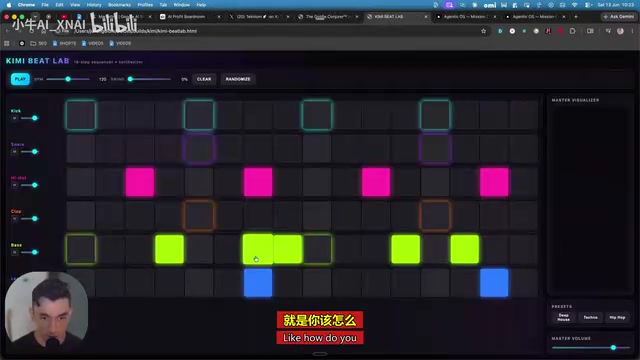
In the demo, the creator showcased multiple projects built with Kimi K2.7. The most impressive was an Elder Scrolls-style 3D RPG game where players can freely explore. This wasn't generated from a one-shot instruction—it was the result of the model continuously iterating and self-correcting during a long-horizon task.
Building a Complete Web Operating System
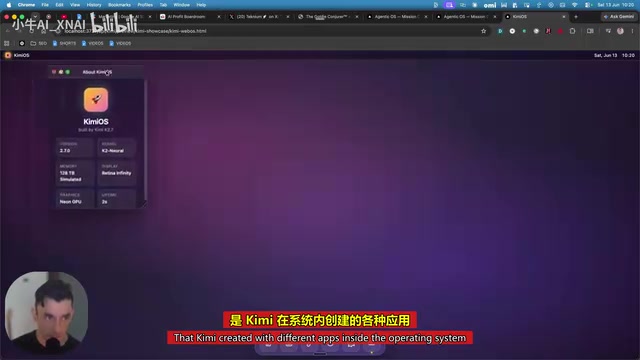
An even more striking case was a complete web-based operating system. Kimi K2.7 created multiple applications within the system: a notes app (data persists after closing and reopening), a calculator, a drawing tool, and a clock (with reasonably accurate time), all supporting simultaneous multi-app operation. This demonstrates the model's ability to handle complex, multi-module projects.
Completing a Full Video in 19 Minutes
The demo video itself was produced using the Kimi K2.7 + Hermes Agent team. The AI digital avatar was generated by Hermes and Heizhan, editing and design were handled by Kimi K2.7, and music and voiceover were completed through Kimi K2.7 paired with APIs. The entire team took only about 19 minutes to produce a fully edited video.
Breaking Down the Agent Team Collaboration Mechanism
Kanban-Driven Automatic Task Assignment
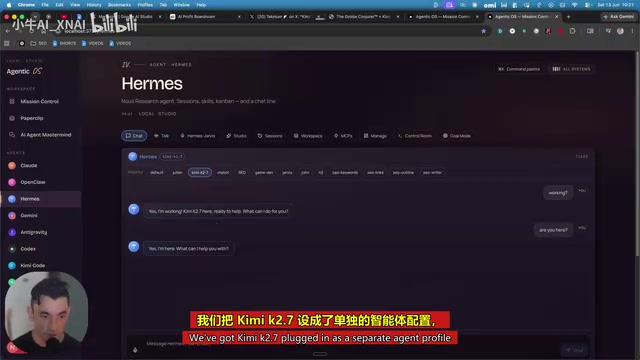
The core architecture of this system is: Kimi K2.7 serves as the "brain," while Hermes Agent acts as the "hands and feet" to execute operations. Here it's important to understand the fundamental difference between agents and traditional AI assistants: traditional AI assistants operate in a "question-and-answer" mode—the user asks, the model responds, and the interaction ends. Agents, however, possess autonomous planning, tool invocation, and continuous execution capabilities—they can decompose complex goals into subtasks, call external tools (such as browsers, code executors, file systems), observe execution results, adjust strategies based on feedback, and loop through this process until the goal is complete. Hermes Agent, as an "agent operating system," provides infrastructure for task scheduling, multi-agent collaboration, and tool registration, enabling Kimi K2.7 to truly "take action" rather than merely "talk."
Once tasks are placed on the kanban board, the system automatically categorizes and assigns them to different agents—a producer handles generating digital avatar videos, an editor handles cutting, and a "judge" agent reviews the output. Kanban originally came from the Toyota Production System and was later widely adopted in software development (tools like Trello, Jira, etc.). Its core concept is visualizing work as cards that flow between columns like "To Do - In Progress - Done." In the Hermes Agent system, the kanban board serves as the task scheduling center for multi-agent collaboration: subtasks enter the board as cards, and the system automatically assigns them based on each agent's capabilities, solving the critical problems of "who should do what" and "how to handle task dependencies" in multi-agent systems.
The judge mechanism is particularly interesting: it uses Kimi K2.7 to watch the generated video and score it, iterating from an initial score of 6 to 7, then 9, continuously fixing issues until the output meets standards. This self-evaluation and iteration loop is something traditional AI tools simply don't have.
Self-Correction Capability in Long-Horizon Tasks
When executing long-horizon tasks, Kimi K2.7 evaluates its own work and goes back to improve based on observed results. It doesn't simply execute instructions—it possesses a "reflect-correct" loop capability. This is crucial for complex project development—in software engineering, few projects get all the code right on the first try. The real development process is inherently a cycle of continuous debugging, fixing, and optimizing. Kimi K2.7's capability essentially simulates the human programmer's workflow of "write code - run - check errors - modify - run again."
Benchmark Data: Kimi K2.7 vs Claude 3.5
Major Improvements in Coding Benchmarks
Compared to its predecessor Kimi K1.6, K2.7 achieved significant improvements across multiple benchmarks:
- Kimi CodeBench programming test: 50.9 → 62.0
- Journalist score: 48.3 → 53.6
- Benchmark: 26.7 → 35.1
Leading MCP Tool-Calling Capability
In the MCP Mark Agent tool-calling benchmark, K2.7 scored 81.1%, leading Claude 3.5's 76.4%. MCP Atlas tool-calling capability improved from 69.4 to 76, and MCP Mark verification rose from 72.8 to 81.1.
MCP (Model Context Protocol) is an open standard protocol released by Anthropic in late 2024, designed to provide AI models with a unified interface for external tool invocation. Before MCP, each AI application needed custom integration code for every external tool, leading to ecosystem fragmentation. MCP is similar to a "USB port" for the AI world—it defines the standard process for how models discover, invoke, and receive results from external tools. K2.7 leading Claude 3.5 in MCP benchmarks means it can more accurately understand when to call which tool and how to pass parameters in agent scenarios, which is critical for building reliable automated workflows.
Practical Usage Experience: Strengths and Weaknesses
Strengths
- High cost-effectiveness: Compared to the high cost of Claude's API, Kimi K2.7 offers near-Claude-level coding capabilities at a more friendly price
- Flexible integration options: Supports subscription-based access to Hermes Agent without per-Token billing
- Strong long-context processing: The 256K Token window is suitable for complete development of large projects
- Autonomous iteration: Can run in the background autonomously, self-evaluate, and self-correct
Weaknesses
- Slow response speed: Even simple questions take about 7 seconds to respond, resulting in poor experience for real-time tasks like browser operations
- Lack of independent third-party evaluation: Currently mainly official benchmark data, with no independent third-party verification yet
What This Means for Non-Technical Users
The content creator specifically emphasized that he is not a programmer, yet through the Hermes Agent + Kimi K2.7 combination, non-technical users can complete complex development tasks. The agent operating system lowers the barrier to entry—you don't need to understand code, you just need to be able to describe your requirements.
This perhaps represents an important direction for AI programming tools: shifting from "helping programmers write code" to "enabling anyone to build applications through natural language." When models are powerful enough and agent frameworks are mature enough, the barrier to programming may truly disappear. This trend is aligned with the "no-code/low-code" movement, but is fundamentally more radical—no-code platforms still require users to understand logic flows and interface operations, while AI agent programming attempts to directly convert "intent" into "implementation," with all technical details in between handled autonomously by AI.
Key Takeaways
Related articles
Non-Technical Founders Built a $50K/Month SaaS Product Using AI Tools
Two non-coders built Shipper to $50K MRR in 6 months using AI tools. Learn their reverse-engineering, zero-free-tier, and viral growth playbook for indie developers.
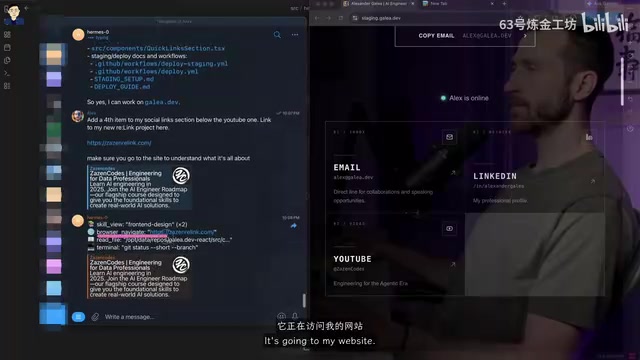
Hermes Agent Deployment Guide: Building a Mobile AI Coding Workflow with Telegram
Learn how to deploy Hermes Agent on a VPS with Telegram Bot integration for mobile AI coding. Covers Docker setup, GitHub integration, auto-deployment, and comparison with OpenClaw.
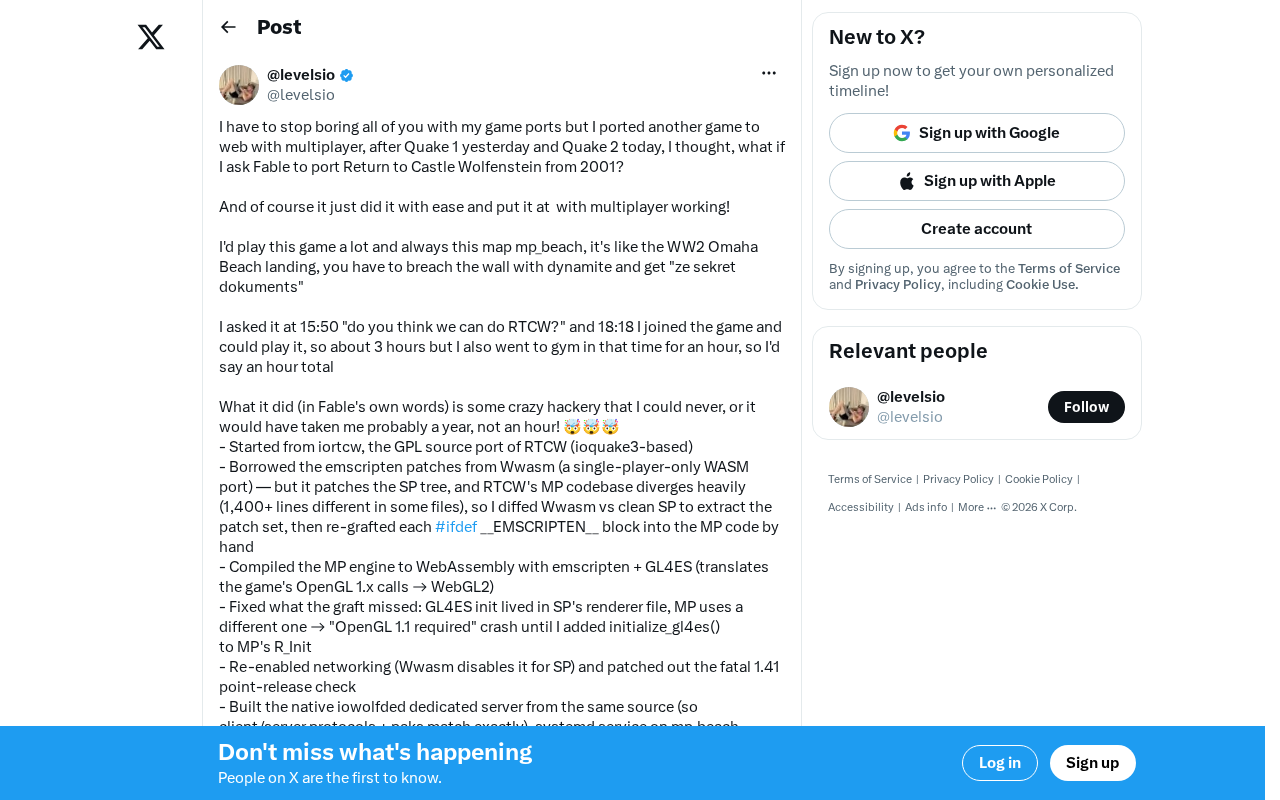
AI Tool Fable Ports Classic FPS to Browser in Two Hours — With Full Multiplayer
A developer used AI coding tool Fable to port Return to Castle Wolfenstein to the web browser in just two hours with full multiplayer, revealing AI's power in system-level engineering.