Generating a 3D Plants vs. Zombies Game from Pure Text Descriptions — Zero Code Written

A developer built a full 3D Plants vs. Zombies game using only natural language prompts and zero manual code.
A developer used the AI platform Codewisp to generate a complete 3D Plants vs. Zombies game entirely through natural language descriptions, without writing a single line of code. The game features multiple plant and zombie types, an 8-level campaign, sandbox mode, and polished 3D visuals — all refined through iterative AI conversation. The project highlights both the impressive speed of AI game generation and its current limitations in performance optimization.
A developer used nothing but natural language descriptions on an AI platform to generate a complete 3D version of Plants vs. Zombies from scratch — featuring multiple plant and zombie types, a level system, and a sandbox mode — all without manually writing a single line of code. This project not only showcases the astonishing capabilities of AI code generation but also offers a glimpse into the future of democratized game development.
Starting from a Single Sentence: How AI Generated a 3D Game
The creator of this project had previously remade a 2D version of Plants vs. Zombies using Scratch, with decent results. Scratch is a visual programming language developed by the MIT Media Lab, where users create programs by dragging and dropping block-based code — widely used in programming education and simple 2D game development. However, Scratch's rendering engine is built on HTML5 Canvas, which inherently lacks a 3D rendering pipeline — no depth buffer, perspective projection, or real-time lighting models. Achieving 3D effects in Scratch would require extremely complex mathematical simulations. This led the creator to wonder: could AI generate a complete 3D version instead?
The tool he used was Codewisp, an AI game platform he built himself. The platform's core concept is straightforward — describe the game you want in natural language, and AI automatically generates runnable code. This relies on Natural Language Programming technology: large language models (LLMs) trained on massive code repositories and natural language corpora learn to map human natural language intent into executable code. Codewisp adds a game-development-specific toolchain on top of the LLM — including 3D rendering engine integration, real-time preview, and an object reference system — enabling the model's generated code to compile and run instantly, presenting an interactive game on screen.
The creator opened a blank editor and typed a simple instruction: "make Plants vs. Zombies in 3D." Within seconds, an initial version appeared.
This initial version already had the game's basic framework: a start screen, a lawn where plants could be placed, sunflowers, peashooters, and zombies. Sunflowers produced sun, peashooters fired at zombies, wall-nuts blocked zombies, and snow peas could even slow them down. While the details were still rough — the house had a bizarrely shaped roof, and the peashooter looked like a green AirPod — as a one-shot AI generation, it was already quite impressive.
Iterative Refinement: Polishing Game Details Through Natural Language Conversation
After the initial version was generated, the creator set himself a challenge: no manual code modifications whatsoever — all adjustments would be made through natural language conversation.
Visual Enhancement
The platform provides an "object edit" button that lets you click on any object in the game and reference it in the chat box. The creator used this approach to progressively refine the game's visuals:
- Fixing orientation: Plants and zombies initially all faced downward. A simple "make the zombies face left" fixed the direction issue.
- Improving models: Typing "make the peashooter's nose longer" (he later realized it was actually the mouth) successfully reshaped it to look closer to the original design.
- Beautifying the scene: Telling the AI to "make the game as beautiful as possible, add lighting, shadows, and particle effects" ultimately produced a gorgeous scene with blue skies, white clouds, fences, flowers, and fluttering butterflies.
The 3D rendering techniques involved here are quite rich: geometric modeling defines objects' three-dimensional shapes, materials and textures determine surface appearance, lighting systems (including ambient light, directional light, and shadow mapping) create realism, and particle systems handle dynamic effects like fluttering butterflies. The fact that AI can generate these effects from simple natural language instructions shows that the underlying model has thoroughly mastered the API call patterns of Three.js or similar WebGL frameworks, capable of translating vague instructions like "make the game more beautiful" into specific rendering parameter configurations.
The final visual quality was quite good: detailed zombie models, refined lawn mowers, decorative trees and flowers — the overall look far exceeded expectations.
Gameplay Feature Iteration
Beyond visual optimization, the creator also progressively added numerous gameplay features through conversation:
- New plant types: Repeater, Chomper, Potato Mine
- New zombie types: Conehead Zombie (double health), Buckethead Zombie (triple health), with headgear falling off as health decreases
- Game mechanics: Progress bar, huge wave alerts, game over screen, multi-level system
- Camera controls: Drag-to-rotate and zoom support for close-up battle observation
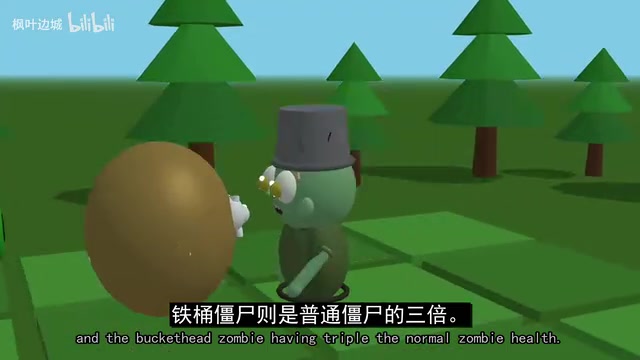
It's worth noting that AI-generated results weren't perfect every time. The Repeater looked "like something out of a horror game" on its first attempt, the Chomper resembled an onion, and a later version was described by the creator as "the most terrifying thing I've seen all year." But through continuous conversational iteration, all these issues were resolved. This "generate-evaluate-feedback-regenerate" loop is essentially a human-AI collaborative creation model, where humans provide aesthetic judgment and directional guidance while AI handles the concrete code implementation.
Actual Gameplay Experience: 8-Level Challenge and Sandbox Mode
The finished game includes a complete level system and sandbox mode. Based on the creator's actual playthrough, the game's strategic depth is remarkably close to the original:
Early levels are relatively simple — a basic sunflower + peashooter combo can handle them. Players collect sun, strategically place plants — the standard PvZ gameplay is fully represented.
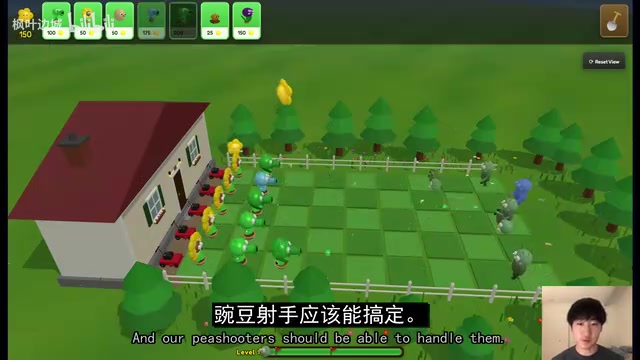
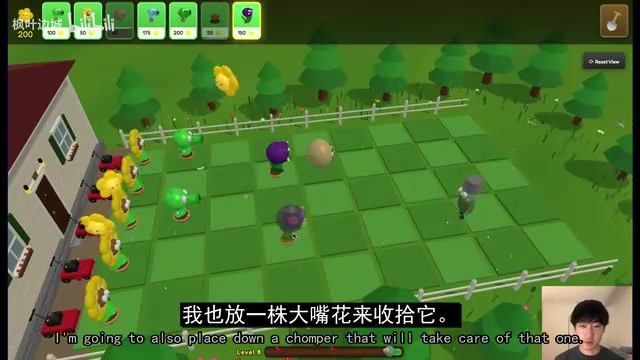
Later levels (such as Level 8) ramp up significantly in difficulty, with Buckethead Zombies appearing early, requiring comprehensive use of Potato Mines, Chompers, Wall-nuts, and other plants for defense. The creator demonstrated fairly complex tactics in Level 8: using Potato Mines for emergency Buckethead Zombie disposal, Wall-nuts to protect Chompers, and Snow Peas for slowdown combined with Repeaters for damage output.
Sandbox mode offers unlimited sun and free placement. The creator built an "ultimate defense line" — four rows of Repeaters, one row of Snow Peas, one row of Chompers, one row of Wall-nuts, and one row of Potato Mines — then repeatedly clicked the "Start Wave" button, summoning roughly 200 zombies simultaneously. While the game experienced noticeable lag (understandable for AI-generated code handling such an extreme scenario), it still managed to run.
Technical Insights: Capabilities and Limitations of AI Game Development
This project highlights several key characteristics of AI-assisted game development:
Astonishing generation speed: From a blank editor to a playable 3D game prototype in just seconds. Each subsequent iteration only requires typing a sentence and waiting a few seconds. The overall development efficiency far surpasses traditional approaches.
Interactive iteration experience: Codewisp's "object edit" feature lets users select objects directly in the game view for modification — this WYSIWYG interaction dramatically reduces the complexity of descriptions. Compared to traditional development where you constantly switch between a code editor and game preview, this "point and describe" approach directly on the running game is far more intuitive.
Human guidance still required: AI doesn't produce perfect results on the first try. Throughout the process, the creator sent numerous optimization instructions, relying on human aesthetic judgment and game design experience to guide the AI in the right direction. This suggests that current AI is better suited as a "super executor" rather than an "independent creator" — it can turn ideas into reality extremely quickly, but still needs humans to define "what good looks like."
Obvious performance limitations: From the demo, 200 zombies caused noticeable lag. The underlying reason is that AI-generated code typically prioritizes functional correctness over runtime efficiency. In traditional game development, handling large numbers of on-screen units requires a suite of specialized optimization techniques: Object Pooling to avoid frequent memory allocation and deallocation, Spatial Partitioning to accelerate collision detection, Instanced Rendering to merge multiple instances of the same model into a single draw call to reduce GPU overhead, and LOD (Level of Detail) to dynamically reduce polygon counts for distant objects. AI-generated code likely creates a complete 3D object and collision detection logic independently for each zombie, lacking these deep optimizations — so performance bottlenecks under extreme load are entirely expected.
Conclusion
From "describing a game in text" to "generating a playable 3D game," this project shows us a future that's rapidly approaching: AI is dramatically lowering the barrier to game development. This is actually the latest chapter in the long-running trend of game development democratization — from early template-based tools like RPG Maker and GameMaker, to the free-tier strategies of Unity and Unreal Engine, to creation platforms aimed at everyday users like Roblox Studio and Dreams. Each generation of tools has lowered the creative barrier. AI code generation represents the most radical stage of this trend: it skips learning programming languages and game engines entirely, converting creative ideas into runnable products via the shortest possible path.
While AI-generated games currently can't match the precision and performance of titles built with professional engines like Unity or Unreal — professional-grade games still require fine-tuned performance optimization, complete art asset pipelines, and complex game balance design, areas where AI still can't fully replace humans — as a rapid prototyping tool and creative validation method, these AI platforms have already demonstrated enormous practical value.
For people without programming experience but with creative ideas, "making games with words" is no longer a sci-fi concept — it's a reality unfolding right now.
Related articles
PilotDeck: A Local Console That Tames Multi-Task Agent Chaos
PilotDeck is an open-source local Agent console from a Tsinghua-affiliated team that solves multi-task chaos with workspace isolation, white-box memory management, and smart model routing.

Fusion Startup Funding Landscape: A Deep Dive into the $7.1 Billion Flow and Industry Dynamics
Global fusion startups have raised $7.1B, heavily concentrated in top players. A deep analysis of funding patterns, tech pathways, commercialization challenges, and the investment logic behind this ultimate energy bet.

Codex and Claude Code Dual-Engine: A Practical Guide to AI-Powered Engineering
A deep dive into AI engineering with Codex and Claude Code: Vibe Coding limitations, Chinese LLM rankings, Skill-driven development, and enterprise project practices.