Google AI Features Rolling Out Globally: Ultra Users Get First Access, When Will Free Users Follow?
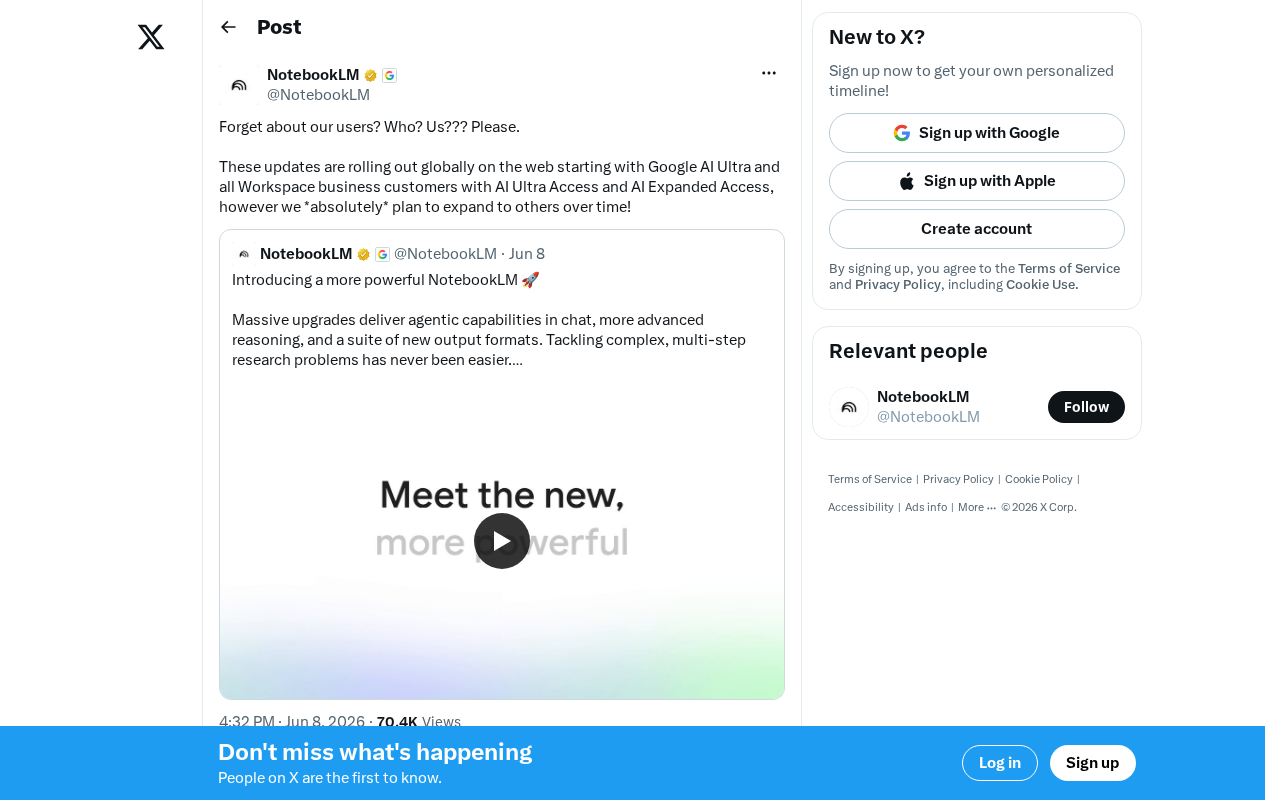
Google rolls out AI features globally, prioritizing Ultra subscribers and Workspace business customers.
Google has announced a global rollout of AI features for web users, with AI Ultra subscribers ($249.99/month) and Workspace business customers (AI Ultra Access and AI Expanded Access) receiving priority access. The company confirmed plans to expand to all users eventually, employing a staged rollout strategy common in AI deployments to manage compute demands and ensure service quality.
Google AI Update Begins Global Deployment
Recently, Google officially announced a major update on social media: its AI-related features are being gradually rolled out to web users worldwide. This update first benefits Google AI Ultra subscribers, as well as all Workspace business customers with AI Ultra Access and AI Expanded Access.
Coverage and Expansion Plans
First Wave of Users
Based on currently available information, the first group of users to receive the update includes:
- Google AI Ultra Subscribers: This is Google's premium AI subscription plan for individual users, priced at $249.99/month. It typically includes unlimited access to the most powerful AI models (such as Gemini 2.5 Pro/Ultra), 2TB of cloud storage, and comprehensive AI feature enhancements across the Google ecosystem. This pricing directly competes with OpenAI's ChatGPT Pro ($200/month), reflecting the fierce competition in the high-end AI subscription market.
- Workspace Business Customers (AI Ultra Access): Enterprise users who have purchased the highest tier of AI access, gaining full access to Google's most powerful Gemini models and enterprise-grade data processing capabilities.
- Workspace Business Customers (AI Expanded Access): Enterprise users with expanded AI access rights, providing core AI features but with certain usage limits.
Google Workspace is Google's enterprise-focused office collaboration suite, encompassing Gmail, Google Docs, Sheets, Meet, and other products. Since 2023, Google has been embedding AI features into Workspace (initially called Duet AI, later unified as Gemini for Workspace). AI Ultra Access and AI Expanded Access are two access tiers designed for different enterprise needs, requiring businesses to pay an additional per-user fee to unlock these AI-enhanced capabilities.
Commitment to Future Expansion
In the announcement, Google specifically emphasized that they "absolutely plan" to extend these updates to more user groups in the future. This statement appears to be a direct response to concerns from some users who questioned whether Google would limit new features exclusively to paying customers. The Google team responded with a slightly humorous tone: "Forget about our users? Who? Us??? Please."
Analysis and Interpretation
The Logic Behind Staged Rollout Strategy
The staged rollout strategy Google is employing is quite common in the tech industry, but it's particularly critical for large-scale AI service deployments. AI inference services have extremely high demands for GPU/TPU compute power — taking a Gemini Ultra-level model as an example, a single inference may require hundreds of TPU cores working in coordination, with each user request consuming substantial computational resources. Rolling out to premium paying users first allows precise control over concurrent request volume and server load, while also enabling rapid iteration and optimization through real-world usage feedback from high-value users (including metrics like latency, accuracy, and safety). This approach has been widely adopted by AI companies including OpenAI (which first opened GPT-4 to Plus users at launch) and Anthropic.
Infrastructure Challenges of Global Deployment
This "global deployment" involves complex infrastructure orchestration. Google operates over 35 data center regions worldwide, but AI inference workloads differ from traditional web services — they require data centers specifically equipped with AI accelerators like TPU v5 or Nvidia H100/B200. Data compliance requirements in different regions (such as the EU's GDPR) also add deployment complexity. This global web rollout indicates that Google has completed sufficient AI compute deployment in major service regions to guarantee acceptable response latency and service quality.
Practical Impact on Regular Users
For regular users, while they won't be able to experience the latest features immediately, Google's explicit commitment means these updates will eventually reach everyone. Based on historical precedent, Google typically takes weeks to months to gradually extend premium features downward — for example, Gemini 1.5 Pro was initially limited to paying users before being gradually opened to free users. Users with immediate needs may consider upgrading to the AI Ultra subscription plan for priority access.
Summary
Google's global rollout signals an acceleration in its AI productization efforts. From a business strategy perspective, prioritizing paying users is a sound operational decision — it ensures service quality while covering the high costs of AI inference through premium subscription revenue. The commitment to future expansion demonstrates attention to the broader user base and aligns with Google's established "paid first, free later" product promotion path. The specific feature details and timeline for free user access are worth continued monitoring.
Key Takeaways
Related articles

AI Large Model Learning Roadmap Breakdown: Three Stages from Application Development to Model Fine-Tuning
Deep breakdown of a popular AI large model learning roadmap covering LangChain, RAG, Agent, and LoRA fine-tuning across three stages, with analysis of its strengths and limitations for career changers.

AI Agent Development: A Complete 6-Week Systematic Learning Roadmap
A 6-week systematic learning roadmap for AI Agent development, covering core architecture, ReAct principles, multi-agent collaboration, RAG integration, and deployment.
Four Core Advantages Frontend Developers Have When Transitioning to AI Agent Development
Frontend developers have key advantages for AI Agent development: TypeScript ecosystem fit, low-barrier full-stack bridging, and state management isomorphism. Learn the transition path here.