Google Antigravity CLI Launch: Unified AI Development Platform and Gemini CLI Migration Guide

Google unifies its AI dev tools under Antigravity, migrating Gemini CLI users to a Go-based CLI with multi-agent support.
Google announced a strategic reorganization of its AI development tools, migrating Gemini CLI users to the new Antigravity CLI within a 30-day transition period. The platform includes four products—Antigravity 2.0, CLI, SDK, and IDE—offering unified developer experiences. The CLI is rebuilt in Go for better performance and features multi-agent orchestration and asynchronous workflows. Enterprise users retain existing Gemini CLI support while individual users must migrate.
Google Launches Unified AI Development Platform Antigravity: A Strategic Reorganization
Google recently announced a major platform consolidation plan—migrating Gemini CLI users to the new Antigravity CLI and building a unified AI development platform around "Google Antigravity." This move marks a strategic reorganization of Google's AI development tools, aimed at providing developers with a more consistent and efficient experience.
The industry backdrop for this consolidation is the increasingly fierce competition in the AI development tools market. Microsoft has secured a first-mover advantage with deep integration between GitHub Copilot and VS Code, Anthropic has launched the Claude Code command-line tool, and AI-native IDEs like Cursor and Windsurf are rapidly gaining ground. Google's AI development tools were previously scattered across multiple brands—Gemini API, Google AI Studio, Vertex AI, Gemini Code Assist, and more—with blurry product boundaries that often left users confused about which tool to use. This fragmentation not only impacted user experience but also dispersed engineering resources. By unifying under the Antigravity brand, Google can concentrate its efforts on building an end-to-end developer experience and establish clearer differentiation from competitors. Notably, the name "Antigravity" itself hints at Google's ambition—in Python, typing import antigravity opens an Easter egg webpage, and this naming choice is likely a nod to developer culture.
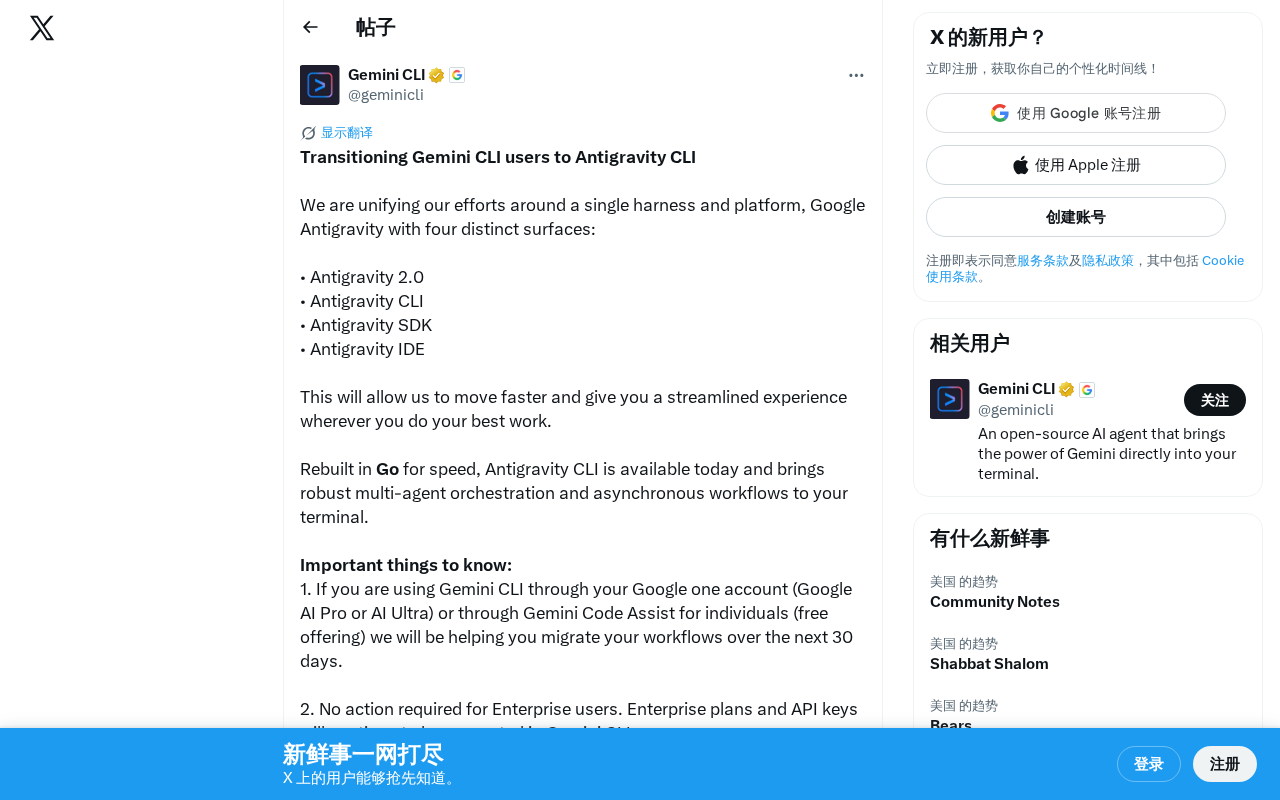
Antigravity's Four-Product Matrix: Covering All Development Scenarios
The new Google Antigravity platform includes four core product lines:
- Antigravity 2.0: An upgraded version of the main platform
- Antigravity CLI: A command-line tool for terminal users
- Antigravity SDK: A software development kit for developers
- Antigravity IDE: An integrated development environment
This four-in-one product layout means that regardless of where developers prefer to work—terminal, IDE, or through SDK integration—they can enjoy a unified and seamless experience. Google officially states that this consolidation "will allow us to move faster and deliver a streamlined experience in the work environments where you excel."
This all-scenario coverage strategy aligns closely with the current evolution of developer tools. Modern developer workflows often span multiple environments: writing code in an IDE, executing builds and deployments in the terminal, and integrating AI capabilities into automation pipelines through SDKs. Providing a unified underlying platform means that when developers switch between environments, AI context understanding, project configurations, and personal preference settings can sync seamlessly.
Antigravity CLI Technical Highlights: Performance Leap Through Go Language Rebuild
Antigravity CLI has been rebuilt from scratch in Go, a technical choice that delivers significant performance improvements.
Go (also known as Golang) was open-sourced by Google in 2009, originally designed by Robert Griesemer, Rob Pike, and Ken Thompson. Go's core advantage lies in its goroutine concurrency model—compared to traditional threads, goroutines have minimal memory overhead (starting at approximately 2KB stack space), making it easy to create hundreds of thousands of concurrent tasks. For CLI tools, Go's static compilation means the final artifact is a single binary file with no runtime dependencies, greatly simplifying distribution and installation. The previous Gemini CLI was built on Node.js, which offered high development efficiency but had inherent disadvantages in cold start speed and memory usage. Multiple successful cases in the industry have proven Go's advantages in the CLI domain, including Docker CLI, Kubernetes' kubectl, and GitHub CLI—all developed in Go.
Key features of the new CLI include:
- Multi-agent Orchestration: Supports multiple AI agents working collaboratively to handle complex development tasks
- Asynchronous Workflows: Allows developers to run non-blocking AI tasks in the terminal, improving productivity
- Speed Optimization: Overall response speed is dramatically improved thanks to Go's characteristics
Deep Dive into Multi-agent Orchestration
Multi-agent orchestration is an architectural pattern that decomposes complex tasks among multiple specialized AI agents working collaboratively. Unlike a single large model handling all tasks, each agent in a multi-agent system has a specific role and capability boundary—for example, one agent focuses on code generation, another handles code review, and a third writes test cases. These agents exchange information through predefined communication protocols, with an Orchestrator coordinating execution order and data flow.
The advantages of this architecture include: each agent can use different prompting strategies or even different models to achieve specialized division of labor; tasks can execute in parallel, significantly reducing total completion time; and the system offers better observability, allowing developers to trace each agent's decision-making process. Current similar implementations in the industry include Microsoft's AutoGen framework, CrewAI, and LangGraph.
Developers can dispatch multiple AI agents simultaneously in the terminal, handling code generation, testing, documentation writing, and other tasks separately, achieving a true AI-assisted development pipeline.
The Practical Value of Asynchronous Workflows
Asynchronous workflows allow developers to initiate an AI task and continue other work without waiting for it to complete. In traditional synchronous CLI interactions, users must wait for the AI response to finish before proceeding to the next step, which severely blocks development flow when handling large-scale code refactoring, project-wide test generation, and other time-consuming tasks. In asynchronous mode, tasks are submitted to a background execution queue, and the CLI tool notifies users of task completion status through event notifications or polling mechanisms.
This aligns with the design philosophy of modern CI/CD pipelines—developers can simultaneously launch multiple independent tasks (such as code generation, dependency analysis, and security scanning), with the system aggregating results after all tasks complete. This pattern is particularly well-suited for use with multi-agent orchestration, as different agents' tasks naturally lend themselves to parallel execution.
Gemini CLI Migration Plan: 30-Day Transition Period Explained
For existing Gemini CLI users, Google has established a clear migration path:
Individual Users (Migration Required)
Users accessing Gemini CLI through Google One accounts (Google AI Pro or AI Ultra), as well as users of the free personal version of Gemini Code Assist, will receive assistance from Google to complete workflow migration within the next 30 days.
Enterprise Users (No Action Required)
Enterprise plans and API keys will continue to be supported in Gemini CLI, and enterprise users need not take any action. This arrangement reflects Google's respect for enterprise customers' stability needs, avoiding the business disruption risks that large-scale migration could bring.
Google's different migration strategies for enterprise and individual users reflect a core principle of enterprise software services—backward compatibility and service continuity. Enterprise customers typically integrate AI tools deeply into CI/CD pipelines, code review processes, and automation scripts, and any sudden API changes or tool migrations could cause production environment disruptions. Google's commitment to continuing support for enterprise plans and API keys in Gemini CLI essentially maintains a Compatibility Layer, giving enterprise customers a longer evaluation and migration window. This strategy is very common in the cloud services industry—AWS typically maintains old SDK versions for years when launching new ones, and Google Cloud's own API version management follows a similar Gradual Deprecation principle.
Strategic Analysis: Google AI Development Tool Consolidation Trends
This consolidation reflects several important trends:
AI development tools are moving from fragmentation to unification. Previously, Google had multiple AI development tool brands that easily caused user confusion. Unifying under the Antigravity brand helps establish clearer product recognition.
CLI tools continue to rise in importance for AI development. As AI programming assistants become widespread, the terminal environment has become a crucial scenario for developer-AI interaction. Rewriting the CLI tool in Go demonstrates that Google views it as a strategic-level product rather than an ancillary tool. The terminal environment's advantage lies in its scriptable, automatable nature—developers can embed AI commands in shell scripts, Makefiles, or CI configurations to achieve programmatic invocation of AI capabilities, something graphical IDEs cannot fully replace.
Multi-agent architecture is becoming an industry standard. The evolution from single AI assistants to multi-agent collaboration represents the next direction for AI development tools. Since 2024, virtually all major AI development tool vendors have been moving toward multi-agent approaches, driven by the limitations of single models in handling complex, multi-step tasks—through task decomposition and specialized agents, systems can achieve higher accuracy and reliability on each subtask.
Developer Migration Recommendations and Response Strategies
For current Gemini CLI users, the following steps are recommended:
- Follow Google's official blog for detailed migration guides
- Gradually familiarize yourself with Antigravity CLI's new features during the 30-day transition period
- Evaluate the potential improvements that multi-agent orchestration and asynchronous workflows can bring to your existing development processes
- While enterprise users don't need to take immediate action, it's advisable to learn about the Antigravity platform in advance to prepare for potential future migration
- Check existing automation scripts and CI/CD configurations for Gemini CLI dependencies and plan replacement strategies in advance
During the migration process, developers should pay special attention to changes in configuration file formats, differences in authentication methods, and command syntax updates. Since Antigravity CLI is a complete rewrite in Go, its installation method may also change from npm global installation to direct binary download, which may require corresponding adjustments to team toolchain management.
Antigravity CLI is already available, and interested developers can immediately experience this brand-new AI terminal tool.
Key Takeaways
Related articles

Claude Code for Test Development in Practice: An AI Programming Workflow That Doubles Your Efficiency
A practical guide to Claude Code for test development: auto-generating test scripts, Plan Mode workflows, MCP + Playwright integration, and Subagent parallel tasks to build systematic AI-assisted workflows.

Hermes Agent Hands-On Review: An AI Efficiency Revolution for Indie Game Developers
Indie game developer reviews Hermes Agent vs OpenClaude: intelligent context compression, real-time Memory, remote control via Telegram, and practical use cases in game dev, social media, and email.
Vibe Coding Beginner's Guide: Tool Selection Across Three Categories with Practical Examples
A comprehensive guide to Vibe Coding's three tool categories: Agent frameworks, CLI Coding, and IDE tools, with practical examples including Snake game and data analysis workbench.