Google Gemini 3.5 Flash Released: A Generational Leap Focused on Agentic and Coding Capabilities
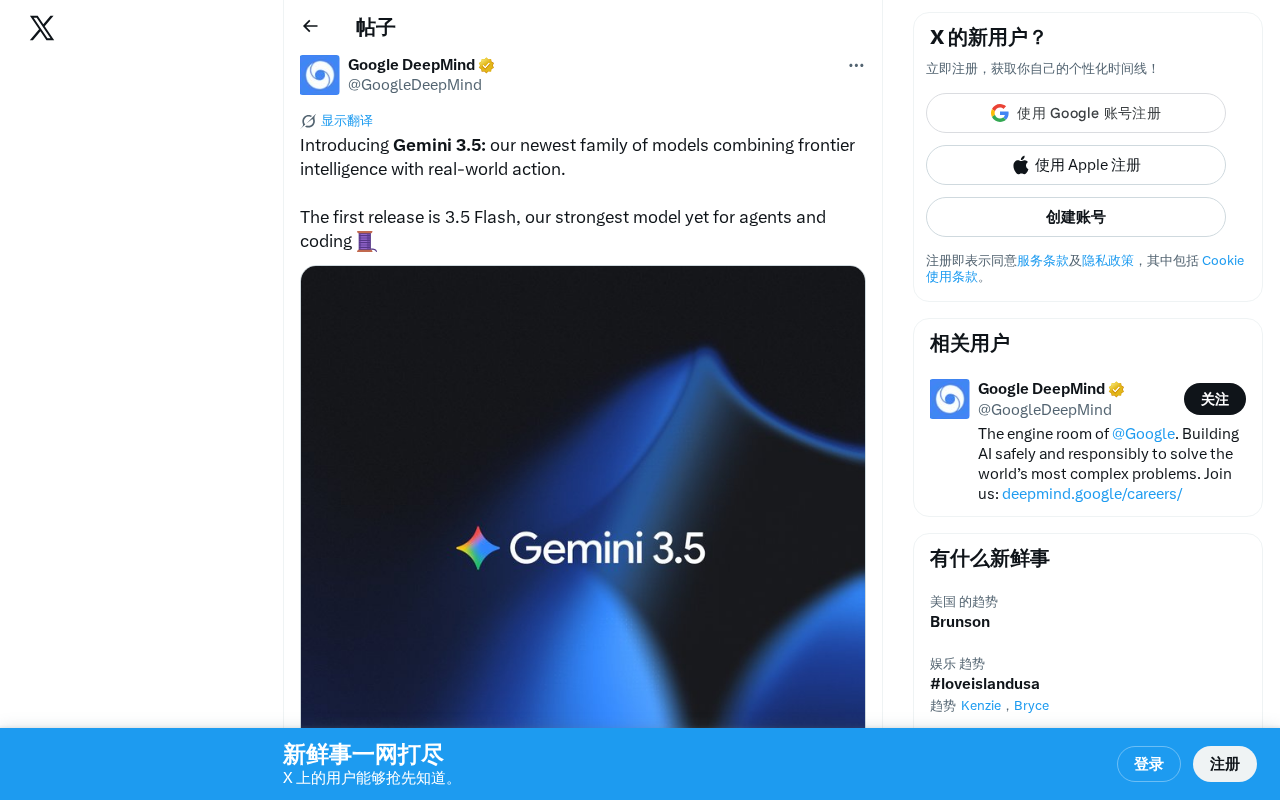
Google launches Gemini 3.5 Flash, skipping v3.0, with a focus on AI agents and coding excellence.
Google officially released Gemini 3.5 Flash, the first model in its new 3.5 series, skipping version 3.0 entirely to signal a generational leap. The model is positioned around two core capabilities: agentic real-world action and state-of-the-art coding performance. As the lightweight Flash tier, it targets developers needing high-volume, cost-effective API access, with Pro and Ultra variants expected to follow.
Gemini 3.5 Officially Unveiled
Google has officially released the new Gemini 3.5 series of models, positioned as a next-generation AI model family that "combines frontier intelligence with real-world action." The first version released is Gemini 3.5 Flash, which Google claims is currently the strongest model in the areas of AI agents and coding.
From 2.5 to 3.5: What the Version Number Jump Signifies
Here's an interesting detail: Google jumped directly from Gemini 2.5 to 3.5, skipping version 3.0 entirely. This kind of version number leap isn't unprecedented in the tech industry — Microsoft famously jumped from Windows 8 to Windows 10, partly to avoid code-level confusion with the legacy Windows 9x series and partly to signal a fresh start; Apple also skipped iPhone 9, leaping from 8 directly to X (10) to commemorate its tenth anniversary. Google's decision to skip 3.0 and go straight to 3.5 likely suggests that an internal 3.0-level technical iteration existed, but the final released version achieved significant improvements beyond that baseline, warranting a higher version number to reflect the exceeded expectations. Regardless of the reasoning, it sends a clear signal: this is not an incremental upgrade — it's a generational leap.
Google has chosen to define Gemini 3.5 as a new "family of models," implying that more variants will follow, potentially including Pro, Ultra, and other configurations. Leading with the Flash version continues Google's established strategy — releasing the lightweight, efficient version first to let developers get started quickly. In Google's model naming hierarchy, Flash represents the lightweight, fast, cost-effective tier, primarily targeting developers and enterprise users who need high-volume API calls. Compared to Pro and Ultra versions, Flash offers significant advantages in inference speed and API call costs while maintaining near-flagship performance on most common tasks. This tiered strategy is similar to product line segmentation in the chip industry — using different specifications to serve different use cases. By choosing Flash as the debut version of the 3.5 series, Google aims to rapidly capture the developer ecosystem and get more applications connected to the new model first.
Two Core Directions: Agents and Coding
Comprehensive Enhancement of Agentic Capabilities
Based on the official description, one of Gemini 3.5's core selling points is "real-world action" capability. This means the model goes beyond mere text generation and can better interact with external tools, APIs, and real environments.
To understand the importance of this capability, it helps to first understand the concept of AI Agents. Unlike traditional large language models that only engage in single-turn or multi-turn conversations, AI Agents possess the ability to autonomously plan, invoke tools, perceive their environment, and execute multi-step workflows. A typical Agent can receive a user's high-level goal (such as "book me a flight to Shanghai next week"), then autonomously decompose the task, call search engines, access booking APIs, handle exceptions, and ultimately complete the entire workflow. This transformation from "passive answering" to "proactive action" is widely regarded as the critical leap for AI evolving from a tool into an assistant. Achieving this requires the model to have strong instruction following, long-horizon planning, error recovery, and multimodal understanding capabilities — precisely the technical directions that Gemini 3.5 emphasizes.
In the current AI industry landscape, agents have become a focal point of competition among major players. OpenAI, Anthropic, Microsoft, and others are all aggressively pushing AI Agent deployment. Google's decision to position agentic capabilities as Gemini 3.5's primary feature clearly represents a continued investment in this competitive arena.
Significant Improvements in Coding Ability
Coding is the other heavily emphasized direction. Google claims Gemini 3.5 Flash is its "strongest coding model to date." Given that Gemini 2.5 Pro already performed impressively on multiple coding benchmarks, if 3.5 Flash can further improve upon that foundation, it will directly impact the underlying model choices for AI coding tools like Cursor and GitHub Copilot.
The mainstream benchmarks for measuring AI coding ability include HumanEval and SWE-bench. HumanEval, released by OpenAI, contains 164 hand-written programming problems that test a model's ability to generate correct code from function signatures and docstrings. SWE-bench is much closer to real software engineering scenarios — it extracts bug-fix tasks from real open-source projects on GitHub, requiring the model to understand the entire codebase context and generate correct patches. SWE-bench is significantly harder than HumanEval because it involves cross-file understanding, dependency analysis, and complex code reasoning, and is considered the gold standard for measuring whether AI can truly perform the work of a software engineer. If Gemini 3.5 Flash achieves breakthrough results on SWE-bench, it would carry substantial practical significance.
Competitive Landscape Analysis
The large model competition has entered a white-hot phase. From the second half of 2024 through 2025, the industry has entered an unprecedented period of dense releases. OpenAI launched its reasoning-focused o-series models (o1, o3, o4-mini) along with the more general-purpose GPT-4.1; Anthropic's Claude 4 Sonnet/Opus excels in long-context understanding and code generation; Meta is attempting to build an open ecosystem moat through open-sourcing Llama 4. The focus of this race has shifted from pure benchmark scores to real-world application capabilities — whoever can make AI truly complete complex real-world tasks will win the favor of developers and enterprise customers. Google's decision to launch Gemini 3.5 at this moment is clearly aimed at maintaining competitiveness in this arms race.
From a naming strategy perspective, the version number "3.5" is also quite deliberate — it evokes GPT-3.5, the milestone version that truly brought large language models to the masses. In November 2022, it was ChatGPT, built on GPT-3.5, that surpassed 100 million users within two months and completely ignited the global generative AI boom. Google may be hoping that Gemini 3.5 can become a similar turning point, especially in popularizing agentic applications.
Key Developments to Watch
Currently, Google has only released Gemini 3.5 Flash as a single version, and detailed technical parameters, benchmark results, and the complete model family roadmap have not been fully disclosed. The following aspects are worth monitoring:
- Performance benchmarks: Specific results on coding benchmarks like SWE-bench and HumanEval, as well as agent-related evaluations (such as WebArena, OSWorld, and other interactive evaluations that simulate real environments)
- API pricing: The Flash tier has always been known for cost-effectiveness, and the pricing strategy for 3.5 Flash will influence developer choices. For reference, Gemini 2.5 Flash was already priced significantly below comparable competitors — if 3.5 Flash can improve performance while maintaining or even lowering prices, it will be extremely competitive
- Pro/Ultra versions: Release timelines and capability boundaries for higher-tier versions, especially whether the Ultra version will achieve breakthroughs in frontier areas like scientific reasoning and multimodal understanding
- Integration with the Google ecosystem: Whether it will be deeply integrated into Android, Google Workspace, Google Cloud, and other products to form a complete closed loop from model to application
The release of Gemini 3.5 marks an important step for Google in the AI model race. The positioning shift from "frontier intelligence" to "real-world action" reflects the entire industry's transition from "model capability competition" to "practical application deployment." Behind this transition is the formation of an industry consensus: pure benchmark scores are no longer sufficient to demonstrate a model's actual value — true competitiveness lies in whether a model can help users complete complex end-to-end tasks. As for whether Gemini 3.5 can truly deliver on its promises, we'll need to wait for more technical details and real-world testing to verify.
Related articles

Claude Code for Test Development in Practice: An AI Programming Workflow That Doubles Your Efficiency
A practical guide to Claude Code for test development: auto-generating test scripts, Plan Mode workflows, MCP + Playwright integration, and Subagent parallel tasks to build systematic AI-assisted workflows.

Hermes Agent Hands-On Review: An AI Efficiency Revolution for Indie Game Developers
Indie game developer reviews Hermes Agent vs OpenClaude: intelligent context compression, real-time Memory, remote control via Telegram, and practical use cases in game dev, social media, and email.
Vibe Coding Beginner's Guide: Tool Selection Across Three Categories with Practical Examples
A comprehensive guide to Vibe Coding's three tool categories: Agent frameworks, CLI Coding, and IDE tools, with practical examples including Snake game and data analysis workbench.