Google Gemini for Science: A Detailed Look at the Experimental AI Toolkit Empowering Scientific Research
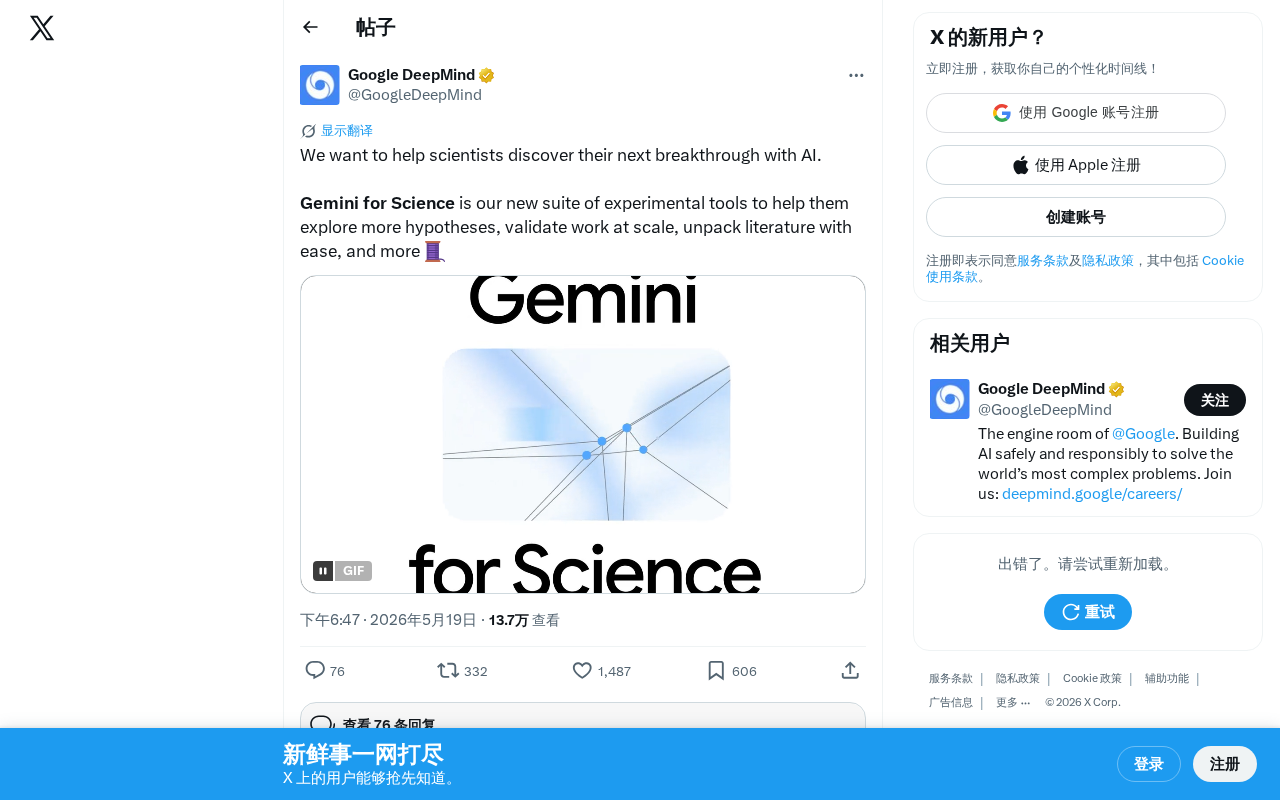
Google launches Gemini for Science, an experimental AI toolkit to accelerate scientific research workflows.
Google has released Gemini for Science, an experimental AI toolkit designed for scientific researchers. The suite covers key research stages including hypothesis exploration, large-scale validation of results, and efficient literature interpretation. Building on successes like AlphaFold, Google aims to democratize AI-powered research tools while acknowledging challenges around scientific rigor, over-reliance, and bias.
Overview
Google has officially released Gemini for Science, an experimental AI toolkit designed for scientific researchers, aimed at helping scientists leverage artificial intelligence to accelerate the pace of scientific discovery. From exploring hypotheses to validating research findings, from interpreting literature to large-scale data analysis, this toolkit covers multiple critical stages of the scientific research workflow.
Core Capabilities of Gemini for Science
Exploring More Research Hypotheses
The core of scientific research lies in proposing and validating hypotheses. In traditional research, scientists are often limited by time and energy, able to explore only a finite number of research directions. Gemini for Science leverages AI's powerful reasoning and generation capabilities to help scientists explore a broader hypothesis space, uncovering research paths that might otherwise be overlooked.
From a methodological perspective, scientific research has long followed the Hypothetico-Deductive Model, where researchers first propose hypotheses based on observations and existing theories, then design experiments for validation. However, this process is highly dependent on the researcher's personal knowledge base and intuitive judgment, with clear cognitive limitations—what psychology calls "Confirmation Bias," the tendency to seek evidence supporting existing beliefs. The advantage of Large Language Models (LLMs) in scientific hypothesis generation is their ability to simultaneously correlate massive amounts of cross-disciplinary knowledge, identifying variable relationships and causal chains that human researchers might overlook. The Gemini model, based on the Transformer architecture's attention mechanism, can perform multi-hop reasoning across a knowledge space of billions of parameters, thereby proposing non-intuitive yet logically consistent research hypotheses.
This means AI is no longer just a passive computational tool but becomes a scientist's "thinking partner," capable of proposing new research hypotheses and experimental directions based on existing knowledge.
Validating Research at Scale
Experimental validation is one of the most time-consuming aspects of research. Gemini for Science provides the ability to validate work at scale, which is particularly important for fields that need to process massive amounts of data, including:
- Genomics: Alignment and analysis of massive gene sequence data
- Climate Science: Cross-validation of multi-dimensional climate models
- Materials Science: Material property prediction and experimental data matching
Notably, the scientific community has faced a serious "Replication Crisis" in recent years. A 2016 survey by Nature showed that over 70% of researchers had tried and failed to reproduce others' experiments, and over 50% couldn't even reproduce their own results. This problem is particularly acute in biomedical, psychology, and social science fields. Causes include insufficient sample sizes, misuse of statistical methods, and selective reporting. AI's value in large-scale validation lies in its ability to systematically check for statistical flaws in experimental design, automate meta-analysis, and pre-screen viable approaches through in-silico experiments before actual experimentation, thereby improving the reliability of research outcomes at the source.
AI can help researchers quickly verify the consistency and reliability of experimental results, dramatically shortening the cycle from hypothesis to conclusion.
Efficiently Interpreting Academic Literature
The explosive growth of academic literature is a major challenge facing contemporary researchers. The number of academic papers published globally each year exceeds several million, making it impossible for researchers in any field to keep up with the latest developments. Gemini for Science's literature interpretation feature (unpack literature with ease) helps scientists quickly understand and synthesize large volumes of literature, extract key findings and methodologies, and more efficiently build their research foundation.
Specifically, in the biomedical field alone, the PubMed database indexes over 1.5 million new articles annually, and global academic output across all disciplines grows at approximately 4-5% per year. Even if a researcher reads 5 papers per day, they would only cover about 1,800 papers per year—just the tip of the iceberg in any active field. Gemini for Science likely employs a Retrieval-Augmented Generation (RAG) technical architecture: the system first locates relevant papers from massive literature databases through semantic retrieval, then uses large language models to perform deep understanding, summary generation, and knowledge synthesis of the retrieved content. Unlike traditional keyword-based search, this approach can understand the semantic essence of research questions, identify methodological similarities rather than mere terminology matches, and even discover implicit contradictions or complementary relationships between different papers.
Google's Strategic Positioning in AI for Science
Evolution from AlphaFold to Gemini for Science
Google has deep expertise in applying AI to scientific research. From DeepMind's AlphaFold solving the protein folding problem and winning the Nobel Prize, to now launching Gemini for Science for the broader research community, Google is systematically delivering AI capabilities across all stages of scientific research.
AlphaFold's achievement deserves deeper understanding of its milestone significance. The protein folding problem—predicting a protein's three-dimensional structure from its amino acid sequence—had puzzled biologists for over 50 years and was listed as one of the most important unsolved problems in biology. In 2020, AlphaFold2 solved this problem at CASP14 (Critical Assessment of protein Structure Prediction) with accuracy far surpassing other methods, reaching experimental-level prediction precision. In 2024, AlphaFold's primary developers Demis Hassabis and John Jumper received the Nobel Prize in Chemistry. Since then, Google DeepMind has continued expanding its scientific AI product line: AlphaFold3 further predicts complex structures of proteins with DNA, RNA, and small molecules; GNoME (Graph Networks for Materials Exploration) discovered 2.2 million new crystal structures, of which 380,000 are considered stable enough for experimental synthesis; and AlphaGeometry achieved International Mathematical Olympiad silver medal level in mathematical reasoning. Gemini for Science can be seen as a "horizontal integration" following this series of vertical breakthroughs—bringing general AI capabilities to broader research scenarios.
This evolutionary path clearly demonstrates Google's strategic intent: not only to achieve breakthroughs on individual scientific problems, but to build universal AI research infrastructure.
Product Positioning as Experimental Tools
Interestingly, Google positions Gemini for Science as "experimental tools," indicating the product is still in its early stages. Google hopes to iterate and refine these tools through close collaboration with the research community—an open development strategy that helps ensure the tools truly meet researchers' practical needs.
This product strategy is not uncommon in the tech industry, but carries special significance for research-oriented tools. Scientific research demands extremely high accuracy and reliability from its tools—a "hallucination" problem tolerable in consumer-grade applications could lead to wrong experimental directions and wasted resources in research settings. Through the "experimental" label, Google both manages user expectations and preserves room for rapid iteration. This strategy resembles Google's early approach of keeping Gmail in "Beta" status for an extended period, but with more cautious considerations behind it—the cost of errors in research tools is far higher than in communication tools.
Potential Impact on the Research Ecosystem
Lowering Barriers to Research
The introduction of AI tools has the potential to lower barriers to certain research activities, enabling resource-limited research teams to conduct large-scale data analysis and literature reviews, thereby promoting the democratization of scientific research.
Accelerating Interdisciplinary Convergence
When AI can help researchers quickly understand literature and methods from other fields, barriers to interdisciplinary research will be significantly reduced. This could catalyze more breakthrough discoveries at the intersection of disciplines.
Historically, many major scientific breakthroughs have originated from cross-disciplinary knowledge transfer: Schrödinger's introduction of quantum mechanics concepts into biology gave birth to molecular biology, Shannon's application of the thermodynamic concept of entropy to communication theory established information theory, and in recent years, deep learning itself is a product of the cross-fertilization of statistics, neuroscience, and computer science. However, the high degree of specialization in contemporary academia creates enormous "language barriers" for interdisciplinary collaboration—different disciplines use different terminology systems, methodological paradigms, and evaluation standards. For a computer scientist to understand an immunology paper, or a biologist to master topological data analysis methods, often requires months or even years of study. AI's potential as a "universal translation layer" lies in its ability to re-express core concepts and methods from one field in ways that researchers from another field can understand, dramatically reducing the time cost of cross-disciplinary knowledge acquisition.
Challenges and Risks to Consider
AI-assisted research also faces challenges that cannot be ignored:
- Scientific Rigor: How can we ensure AI-generated hypotheses withstand validation?
- Over-reliance Risk: Will researchers weaken their independent thinking capabilities as a result?
- Bias Issues: AI models may introduce systematic biases from training data
These issues require the research community to gradually explore solutions through practice.
Summary
The release of Gemini for Science marks Google's formal introduction of its most advanced AI model capabilities into the scientific research domain. As a toolkit covering core stages including hypothesis generation, experimental validation, and literature interpretation, it has the potential to significantly transform the methods and efficiency of research work. As the tools mature and the research community provides ongoing feedback, AI will play an increasingly critical role in future scientific breakthroughs.
Key Takeaways
Related articles

Claude Code for Test Development in Practice: An AI Programming Workflow That Doubles Your Efficiency
A practical guide to Claude Code for test development: auto-generating test scripts, Plan Mode workflows, MCP + Playwright integration, and Subagent parallel tasks to build systematic AI-assisted workflows.

Hermes Agent Hands-On Review: An AI Efficiency Revolution for Indie Game Developers
Indie game developer reviews Hermes Agent vs OpenClaude: intelligent context compression, real-time Memory, remote control via Telegram, and practical use cases in game dev, social media, and email.
Vibe Coding Beginner's Guide: Tool Selection Across Three Categories with Practical Examples
A comprehensive guide to Vibe Coding's three tool categories: Agent frameworks, CLI Coding, and IDE tools, with practical examples including Snake game and data analysis workbench.