Google Hybrid Inference Comes to iOS: A Complete Guide to On-Device AI Cross-Platform Deployment
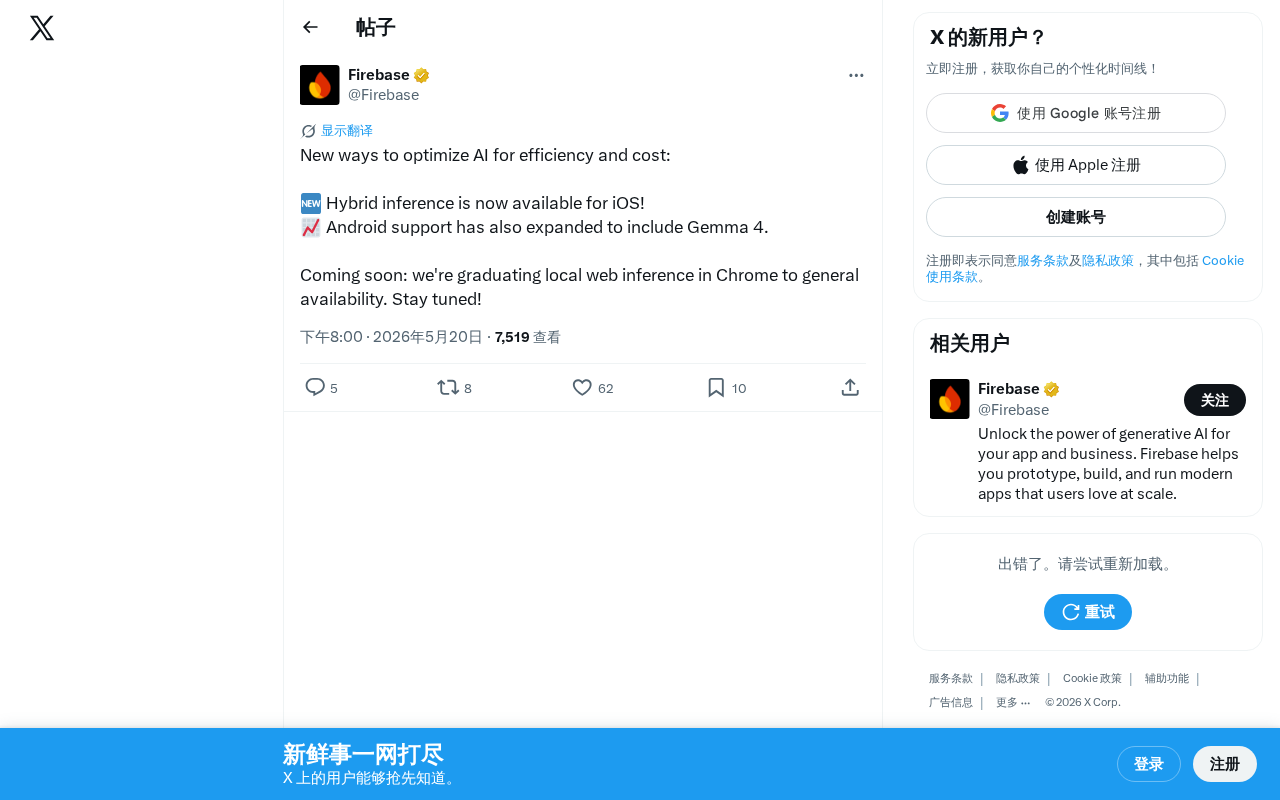
Google expands hybrid inference to iOS, Android (Gemma 4), and Chrome, enabling cross-platform on-device AI deployment.
Google announced major hybrid inference updates: iOS support, Gemma 4 on Android, and Chrome local Web inference approaching GA. This edge-cloud collaborative approach reduces latency, cuts costs by 40-70%, enhances privacy, and enables offline AI. With cross-platform coverage spanning 90%+ of global devices, developers can now build efficient AI apps that intelligently distribute computation between device and cloud.
Hybrid Inference: A New Path to AI Efficiency and Cost Optimization
Google recently announced a series of significant updates to Hybrid Inference, marking another notable expansion of on-device AI capabilities. Hybrid inference technology has officially landed on iOS, Android has expanded support for the Gemma 4 model, and Chrome's local Web inference feature is about to become generally available.
This series of moves clearly indicates that Google is pushing hard to migrate AI inference from the cloud to edge devices, seeking the optimal balance between efficiency and cost.
What Is Hybrid Inference? Core Concepts and Technical Advantages
Hybrid inference is a technical approach that intelligently distributes AI computation tasks between the cloud and local devices. Simply put, part of the model's inference work is completed on the user's phone or browser, while more complex computations are handled by the cloud.
From a technical implementation perspective, the underlying architecture of hybrid inference involves two core mechanisms: Model Partitioning and Task Routing. Model partitioning refers to splitting a complete neural network model into sub-modules that can run on different compute nodes—for example, placing shallow attention computations in a Transformer architecture on the device while delegating parameter-heavy deep inference to the cloud. Task routing is an intelligent scheduling system that determines the execution location of each inference request in real-time based on factors such as task complexity, network conditions, and device computing power. This architecture relies on efficient model quantization techniques (such as INT4/INT8 quantization) to compress models that are originally tens of GBs down to sizes that can run on mobile devices, while using Knowledge Distillation to ensure the compressed model maintains sufficient inference accuracy.
Model quantization refers to converting the weight parameters in a neural network from their original 32-bit floating-point (FP32) storage format to lower-precision data formats (such as 8-bit integer INT8 or 4-bit integer INT4). This process can reduce model size by 4-8x, improve inference speed by 2-4x, and significantly lower memory usage. Take a 7B parameter language model as an example: in FP32 format it requires approximately 28GB of storage space, but after INT4 quantization it only needs about 3.5GB, which can easily run within the memory of modern smartphones. Knowledge distillation is another model compression strategy that has a small model (student model) learn the output distribution of a large model (teacher model), enabling the small model to achieve comparable inference capabilities with far fewer parameters than the teacher model. The combination of these two techniques forms the technical foundation that makes on-device inference feasible.
This architecture delivers several core advantages:
- Reduced latency: Simple tasks are completed locally and instantly, without waiting for network round-trips
- Cost savings: Reduced cloud computing consumption means lower expenses for both developers and users
- Enhanced privacy: Some data never needs to leave the device, and sensitive information can be processed locally
- Offline availability: Basic AI functions can still run even with poor network connectivity
It's worth understanding the economic logic behind the cost advantages. The primary cost of current cloud-based AI inference comes from GPU compute rental. A single complex LLM inference call may consume milliseconds to seconds of GPU time, and at current A100/H100 GPU cloud pricing, inference costs for large-scale applications can reach hundreds of thousands of dollars per month. Hybrid inference significantly reduces cloud API call volume by offloading simple queries (such as text classification, keyword extraction, basic Q&A, and other lightweight tasks that account for 60%-80% of total requests) to device-side processing. Industry estimates suggest that a well-designed hybrid inference strategy can reduce total inference costs by 40%-70%, which represents a decisive economic advantage for consumer-facing applications with large user bases.
Specifically, taking NVIDIA H100 GPUs as an example, major cloud providers charge approximately $3-5 per hour on-demand. For an AI application with 10 million daily active users, if every user interaction requires cloud inference, assuming an average of 50ms GPU time per inference, daily GPU costs alone could exceed tens of thousands of dollars. If 70% of simple requests (such as auto-completion, sentiment analysis, simple classification, etc.) can be completed on-device, cloud costs would drop directly to 30% of the original amount. This fundamental change in cost structure makes many AI features that were previously unviable due to high inference costs economically feasible.
iOS Hybrid Inference Support: Completing the Cross-Platform Puzzle
The Strategic Significance of Cross-Platform Coverage
Previously, Google's hybrid inference capabilities were primarily concentrated in the Android ecosystem. The official landing on iOS means developers can now deploy hybrid inference applications to the vast majority of mobile users worldwide, no longer limited to a single platform.
For iOS developers, this opens a new door—they can leverage Google's AI models for local inference on Apple devices, building smarter applications with faster responses and smoother experiences. This was almost unimaginable before, as on-device inference was typically deeply tied to specific hardware ecosystems.
To understand the technical implications of this breakthrough, one needs to understand the hardware foundation of on-device inference. In recent years, NPU (Neural Processing Unit) performance in mobile chips has improved rapidly—Apple's Neural Engine, Qualcomm's Hexagon NPU, and Google's custom Tensor processors all provide dedicated hardware acceleration for on-device inference. Apple's Neural Engine was first introduced with the A11 Bionic chip, and the latest A17 Pro/M4 chips now deliver 35 trillion operations per second (35 TOPS), with hardware optimizations specifically targeting core neural network operations like matrix multiplication and convolution. However, what makes Google's hybrid inference solution unique is that it doesn't strongly depend on specific NPU hardware. Instead, it achieves cross-hardware compatibility through software abstraction layers (such as TensorFlow Lite, MediaPipe, and other frameworks). On iOS devices, Google's inference engine can leverage Apple's Core ML framework or directly call Metal GPU for accelerated computation. This software-level adaptation strategy enables the same hybrid inference solution to run efficiently across heterogeneous hardware environments, truly realizing the vision of "develop once, deploy everywhere."
This cross-platform strategy also has far-reaching commercial implications. iOS users dominate high-value markets globally (North America, Western Europe, Japan, etc.), where users have significantly higher willingness to pay and ARPU (Average Revenue Per User) compared to other regions. By extending hybrid inference capabilities to iOS, Google is effectively helping developers reach these high-value user segments while establishing its own AI infrastructure presence within Apple's walled garden.
Android Expands Support for Gemma 4 Model
Meanwhile, hybrid inference on Android has also received an important upgrade—new support for the Gemma 4 model. Gemma 4 is Google's latest generation of open-source lightweight models, offering stronger inference capabilities while maintaining a compact size. Bringing Gemma 4 to Android on-device inference means developers can run more powerful AI models on mobile devices to handle more complex tasks.
From a technical characteristics perspective, Gemma 4 belongs to Google's open-source Small Language Model (SLM) family, with a design philosophy of maximizing inference capability within limited parameter scales. Unlike GPT-4 or Gemini Ultra with hundreds of billions of parameters, the Gemma series typically operates at the billions-of-parameters level, achieving performance close to large models on specific tasks through careful training data curation and architecture optimization. Gemma 4 shows significant improvements over its predecessors in multimodal understanding, long-context processing, and instruction following, while further reducing memory usage and computational overhead during inference through more advanced quantization and pruning techniques. This makes it particularly suitable for running under the memory and compute constraints of mobile devices, making it an ideal candidate model for on-device inference.
The rise of Small Language Models (SLMs) is one of the most important technical trends in AI during 2024-2025. Research shows that model performance does not have a simple linear relationship with parameter count—through higher-quality training data, better model architectures (such as Mixture of Experts/MoE structures, Grouped Query Attention/GQA, etc.), and more refined training strategies (such as curriculum learning, RLHF alignment, etc.), small models can match or even surpass models with 10x more parameters on specific tasks. Google's Gemma series is a product of this philosophy. Gemma 4's open-source nature is also noteworthy—it allows developers to perform fine-tuning locally, customizing model behavior for specific vertical domains (such as medical Q&A, legal text analysis, customer service conversations, etc.). This flexibility is something that closed-source large model APIs cannot provide.
Chrome Local Web Inference Approaching General Availability
Google also previewed another noteworthy development: Chrome's local Web inference feature is about to graduate from experimental stage to General Availability (GA) status.
The significance of this feature should not be underestimated. It means Web application developers can invoke local AI inference capabilities through the browser alone, without relying on any native SDK. This will dramatically lower the development barrier for AI applications, and any webpage could potentially become a carrier for intelligent applications.
From a technical implementation perspective, Chrome's local Web inference is built on two major Web standards: WebGPU and WebAssembly (Wasm). WebGPU is the next-generation browser graphics and compute API that allows Web applications to directly access the device's GPU for general-purpose computing (GPGPU). Its performance far exceeds the previous WebGL approach, providing the necessary computational power for running neural network inference in the browser. WebAssembly provides near-native code execution efficiency, enabling complex model inference logic to run efficiently within the browser sandbox. Google's previously launched Prompt API and built-in AI features (such as integrating the Gemini Nano model directly into Chrome) were early explorations in this direction. When these capabilities reach GA stage, it means the API interfaces are stable, performance has been thoroughly optimized, and developers can confidently use them in production environments without worrying about interface changes or feature rollbacks.
A deeper understanding of WebGPU's technical breakthrough helps grasp the importance of this change. Traditional WebGL was designed based on OpenGL ES and is essentially a graphics rendering API. While it can perform some general-purpose computing through shaders, its programming model and memory management approach are not suited for compute-intensive tasks like neural network inference. WebGPU was redesigned from the ground up, drawing on design principles from modern graphics APIs like Vulkan, Metal, and Direct3D 12, providing primitives specifically designed for general-purpose computing such as Compute Shaders, Storage Buffers, and Compute Pipelines. Benchmarks show that WebGPU achieves 3-10x the performance of WebGL in matrix operations and other core AI operations, making it realistic to run language models with billions of parameters in the browser. Gemini Nano, as Google's model variant designed specifically for on-device use, has approximately 1.8B-3.25B parameters and requires only about 1-2GB of memory after INT4 quantization, running smoothly in browsers on mainstream PCs and high-end mobile devices.
Practical application scenarios include: an online document tool completing text summarization and grammar correction locally in the browser; an e-commerce website performing local image recognition without uploading images; an online education platform analyzing student input in real-time and providing personalized feedback—all these scenarios will become readily achievable as Chrome local inference becomes widespread. More importantly, the zero-installation nature of Web inference means users don't need to download any application—they can enjoy AI capabilities simply by opening a webpage, dramatically reducing the user acquisition cost for AI features.
Industry Trend: Edge-Cloud Collaborative Architecture Becomes Consensus
From a broader perspective, Google's updates reflect a clear trend across the entire AI industry: The era of pure cloud inference is passing, and hybrid edge-cloud collaborative architectures are becoming mainstream.
Apple has deployed its own AI capabilities on-device (Apple Intelligence achieves on-device inference through its custom chip's Neural Engine, routing complex tasks to Apple's Private Cloud Compute servers when needed). Qualcomm and MediaTek continue to strengthen NPU performance at the chip level (Qualcomm's latest Snapdragon 8 Elite series NPU delivers over 45 TOPS, sufficient to run language models with billions of parameters on-device). Google, however, has chosen a more universally applicable route—enabling AI capabilities to run across platforms and devices through a software-level hybrid inference solution.
Apple's Private Cloud Compute (PCC) approach deserves special attention as it represents a different design philosophy for edge-cloud collaboration. PCC's core principle is that even when cloud computing power is needed, user data privacy must be guaranteed—Apple claims PCC servers do not store user data, destroying it immediately after processing, with the entire system independently security-audited. This "privacy-first" cloud design forms an interesting contrast with Google's focus on "efficiency and cost optimization" in hybrid inference. At the chip level, the NPU computing power arms race is accelerating—Qualcomm Snapdragon 8 Elite at 45 TOPS, MediaTek Dimensity 9400 at 46 TOPS, Apple A18 Pro at 35 TOPS. These numbers mean that current flagship phones' AI computing power is approaching the level of data center GPUs from 2020. This democratization of hardware capability provides a solid physical foundation for on-device inference.
The advantage of this strategy lies in not depending on specific hardware, offering stronger scalability and compatibility. When hybrid inference simultaneously covers iOS, Android, and Chrome—three major platforms—Google has effectively built an almost ubiquitous on-device AI infrastructure. These three platforms collectively cover over 90% of global smart device users, meaning Google's hybrid inference solution has the potential to become the de facto industry standard.
From an industry ecosystem perspective, this layout has even deeper strategic considerations. As one of the world's largest cloud service providers (Google Cloud), Google's push to migrate inference to the edge may seem contradictory to its cloud business interests. In reality, however, this is a more sustainable business model design. As AI applications experience explosive growth, pure cloud inference will face severe GPU supply bottlenecks (global AI GPU production capacity remains tight). Hybrid inference effectively expands the total supply capacity of AI inference by leveraging the idle computing power of billions of edge devices. Google can concentrate its precious cloud GPU resources on training and complex inference tasks while maintaining developer ecosystem stickiness by providing hybrid inference frameworks and toolchains—this is a "retreat to advance" platform strategy.
Summary: Developers Should Start Planning for Hybrid Inference Now
For developers, now is the time to seriously consider hybrid inference architecture. With iOS support added, Gemma 4 landing on Android, and Chrome local inference approaching general availability, building efficient, low-cost, cross-platform AI applications is becoming more feasible than ever. Google is proving through action that the best AI doesn't always have to be in the cloud—sometimes the smartest approach is to let computation happen as close to the user as possible.
For developers looking to take immediate action, here are several recommended directions: First, evaluate which AI features in existing applications can be migrated to the device side (typically latency-sensitive tasks with moderate computational requirements). Second, familiarize yourself with Google's AI Edge SDK and related toolchains. Finally, build flexibility for edge-cloud switching into your architecture design, enabling applications to dynamically choose inference paths based on device capabilities and network conditions. Hybrid inference is not just a technology choice—it's a future-oriented architectural mindset. In an era where AI capabilities are everywhere, applications that can flexibly orchestrate computing resources will have a decisive competitive advantage.
Related articles

Claude Code for Test Development in Practice: An AI Programming Workflow That Doubles Your Efficiency
A practical guide to Claude Code for test development: auto-generating test scripts, Plan Mode workflows, MCP + Playwright integration, and Subagent parallel tasks to build systematic AI-assisted workflows.

Hermes Agent Hands-On Review: An AI Efficiency Revolution for Indie Game Developers
Indie game developer reviews Hermes Agent vs OpenClaude: intelligent context compression, real-time Memory, remote control via Telegram, and practical use cases in game dev, social media, and email.
Vibe Coding Beginner's Guide: Tool Selection Across Three Categories with Practical Examples
A comprehensive guide to Vibe Coding's three tool categories: Agent frameworks, CLI Coding, and IDE tools, with practical examples including Snake game and data analysis workbench.