GPT-Rosalind: A Deep Dive into OpenAI's First Frontier Model for Scientific Research
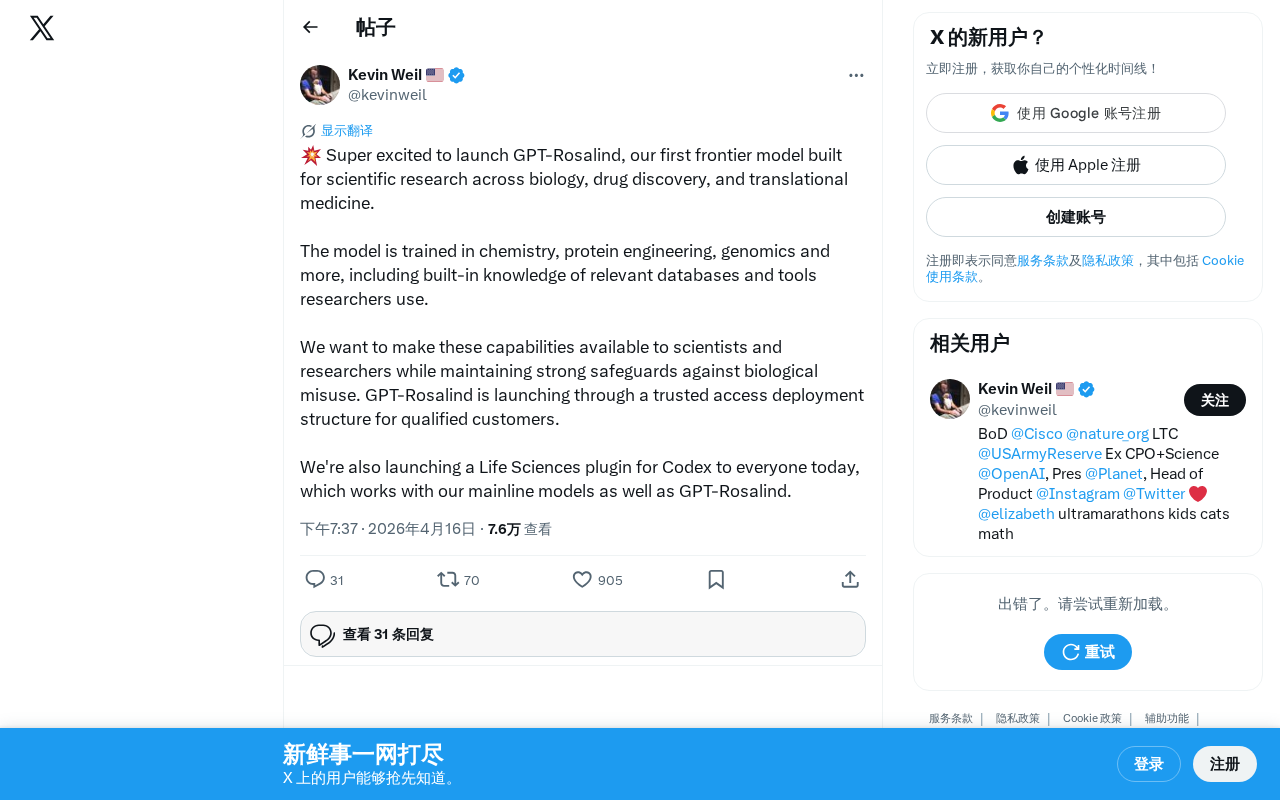
OpenAI launches GPT-Rosalind, its first specialized frontier model for life sciences research.
OpenAI has released GPT-Rosalind, a frontier AI model purpose-built for biology, drug discovery, and translational medicine. The model integrates chemistry, protein engineering, and genomics capabilities with a safety-first trusted access deployment. A companion Codex Life Sciences plugin is available to all users.
Overview
OpenAI has officially launched GPT-Rosalind, its first frontier AI model purpose-built for scientific research, spanning biology, drug discovery, and translational medicine. This marks a significant leap for large language models—moving from general-purpose intelligence toward specialized scientific domains.
The verticalization of large language models (LLMs) has been a major trend in AI over the past two years. Early GPT-series models employed general-purpose pretraining strategies, learning language patterns from massive internet text corpora. While this gave them broad knowledge coverage, they often produced "plausible-sounding but wrong" answers in specialized research contexts—incorrect molecular formulas, nonexistent protein structures, or fabricated literature citations. Vertical models address this through deep fine-tuning on high-quality domain-specific datasets (such as the PubMed literature database, UniProt protein database, and ChEMBL compound database), significantly improving professional accuracy. Google DeepMind's AlphaFold had already demonstrated AI's enormous potential in life sciences with its breakthrough in protein structure prediction. GPT-Rosalind represents OpenAI's formal entry into this space.
GPT-Rosalind's Capabilities: Deep Coverage Across the Life Sciences Pipeline
GPT-Rosalind's training encompasses multiple core research domains:
- Chemistry: Molecular structure analysis and compound property prediction
- Protein Engineering: Protein design and function prediction
- Genomics: Gene sequence analysis and variant interpretation
- Database and Tool Integration: Built-in knowledge of databases and tools commonly used by researchers
Behind these domains lies a complex computational biology toolchain. In chemistry, SMILES (Simplified Molecular Input Line Entry System) and molecular fingerprinting are foundational representation methods for AI to understand compound structures. In protein engineering, traditional methods rely on X-ray crystallography and cryo-electron microscopy to resolve 3D protein structures, while AI models can predict folding conformations directly from amino acid sequences. In genomics, researchers typically use specialized tools like BLAST for sequence alignment and GATK for variant calling. Integrating these disparate capabilities into a conversational AI model means researchers can describe their needs in natural language, and the model automatically selects the appropriate analytical pathway.
This means researchers no longer need to switch between multiple specialized tools—GPT-Rosalind itself understands scientific databases and analytical tools, directly leveraging that knowledge within conversations to support research decisions.
Deployment Strategy: A Safety-First Trusted Access Mechanism
One noteworthy detail: OpenAI has adopted a release strategy for GPT-Rosalind that differs significantly from its standard models. Given the dual-use risks inherent in biosciences, the model is not openly available to all users. Instead, it's delivered through a "trusted access deployment structure" to qualified clients.
Dual-use risk is a core concept in biosecurity, referring to technologies that can be used both to benefit humanity and to cause harm. This risk is particularly acute at the intersection of AI and biology. In 2023, multiple studies demonstrated that large language models could theoretically provide operational guidance for synthesizing dangerous pathogens to individuals lacking specialized expertise. Both the U.S. National Academies of Sciences and the White House Office of Science and Technology Policy have issued warning reports on this issue. OpenAI itself acknowledged in its 2024 safety evaluations that its models require stricter safeguards for biological threat-related queries. Consequently, GPT-Rosalind's trusted access mechanism isn't an OpenAI invention—it aligns with the logic behind the U.S. government's "Select Agent" regulatory framework for certain biological research.
This decision reflects the AI industry's balancing act between frontier capabilities and safety guardrails. AI tools for biology and drug discovery, if misused, could pose serious biosecurity risks. OpenAI has chosen to make these capabilities available to vetted scientists and researchers while maintaining robust safety protections.
Companion Tools: Codex Life Sciences Plugin Available to All Users
In contrast to GPT-Rosalind's restricted release, OpenAI simultaneously launched a Life Sciences plugin for Codex, available to all users. Key features include:
- Broad Compatibility: Works with both OpenAI's mainline models and GPT-Rosalind
- Open Access: No special credentials required
- Programming Support: Provides coding and data analysis assistance for life sciences through the Codex platform
This tiered release strategy is quite clever—core model capabilities are deployed under controlled access, while auxiliary tools are broadly available. This satisfies the research community's foundational needs while maintaining a cautious stance toward high-risk capabilities.
Industry Significance and Future Outlook
The launch of GPT-Rosalind carries multiple layers of industry significance:
First, this is OpenAI's first explicit release of a frontier model for a vertical domain, signaling a product strategy shift from "one model serves all scenarios" to "specialized models serve specialized fields."
Second, the model is named after Rosalind Franklin—the scientist whose work was pivotal to discovering DNA's double helix structure—reflecting OpenAI's tribute to and positioning within life sciences research. Franklin (1920–1958) was a British physical chemist and X-ray crystallographer whose DNA X-ray diffraction photograph "Photo 51" provided the critical evidence for deciphering the double helix structure. However, James Watson and Francis Crick used her photograph without her consent and received the Nobel Prize in 1962, while Franklin, who died of ovarian cancer in 1958, could not share in the honor. Her story is widely regarded as a quintessential case of a female scientist's contributions being overlooked. OpenAI naming its first life sciences model after her serves as both a belated tribute to her scientific contributions and a signal of the model's ambition to reveal the fundamental structures of life science.
Third, the trusted access deployment model may become the standard paradigm for releasing high-risk AI capabilities in the future, establishing a reference framework for safe deployment across the industry.
As AI plays an increasingly important role in scientific research, GPT-Rosalind represents a new trend: AI is no longer merely a general-purpose assistant but is becoming a deep collaborative partner in specific research domains. In the future, we can expect to see more specialized frontier models emerging for fields like physics, materials science, and climate research.
Key Takeaways
Related articles

Claude Code for Test Development in Practice: An AI Programming Workflow That Doubles Your Efficiency
A practical guide to Claude Code for test development: auto-generating test scripts, Plan Mode workflows, MCP + Playwright integration, and Subagent parallel tasks to build systematic AI-assisted workflows.

Hermes Agent Hands-On Review: An AI Efficiency Revolution for Indie Game Developers
Indie game developer reviews Hermes Agent vs OpenClaude: intelligent context compression, real-time Memory, remote control via Telegram, and practical use cases in game dev, social media, and email.
Vibe Coding Beginner's Guide: Tool Selection Across Three Categories with Practical Examples
A comprehensive guide to Vibe Coding's three tool categories: Agent frameworks, CLI Coding, and IDE tools, with practical examples including Snake game and data analysis workbench.