Hands-On with Google's AI Research Tools: Expanding from Biological to Social Sciences
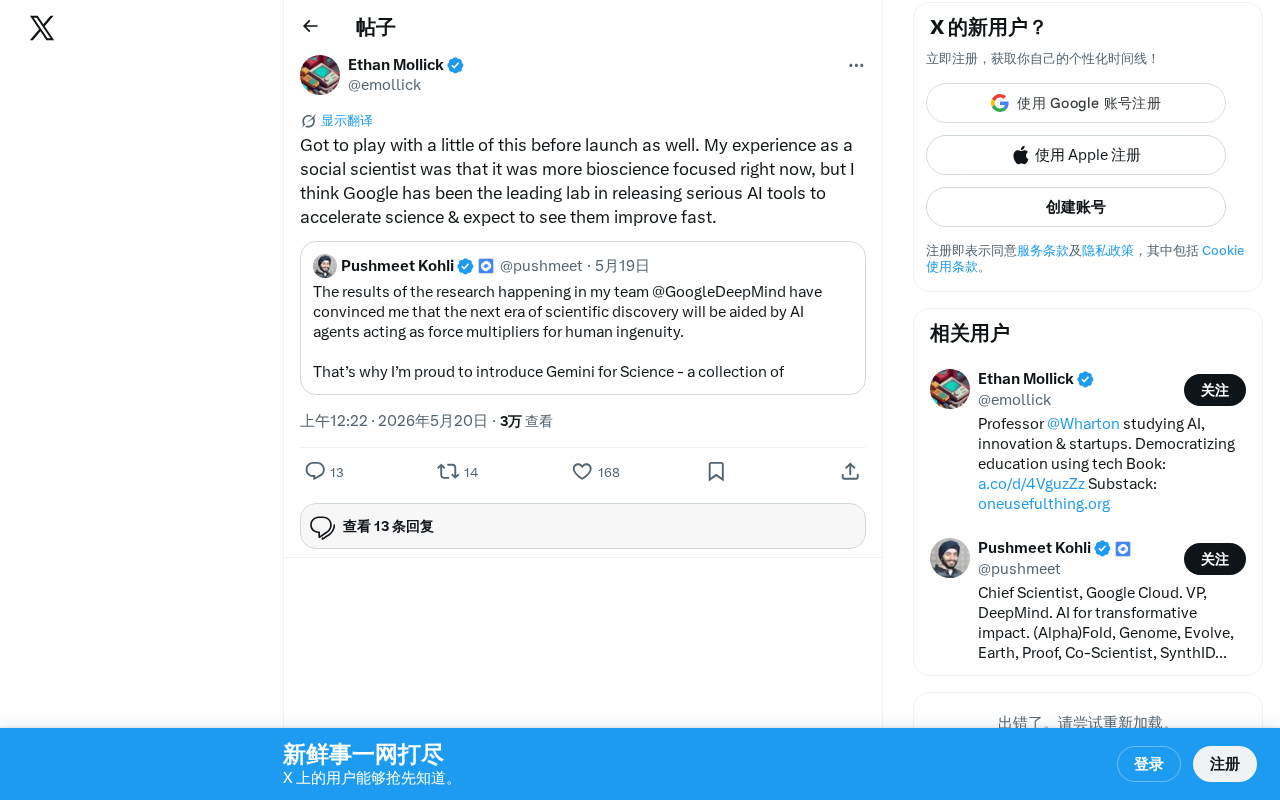
Social scientist reviews Google's AI research tools, highlighting its bio-science focus and cross-disciplinary potential.
A social science researcher shares early access experience with Google's latest AI research tools, noting their current biological science focus while praising Google's leadership in AI-accelerated research. The article analyzes why bio-sciences were prioritized, examines the competitive landscape, and discusses the challenges and opportunities for expanding these tools to social sciences and other disciplines.
A Social Scientist's First-Hand Experience
Recently, a social science researcher shared his experience of getting early access to Google's latest AI research tools on Twitter. As a scholar outside the biological sciences, he acknowledged that the tool currently leans more toward biological science, but also gave high praise to Google's sustained investment in AI-accelerated scientific research.
Behind this brief review lies an important trend in AI research tool development: major labs are systematically applying AI capabilities to accelerate scientific research, and Google holds a leading position in this space.
Google's AI Research Strategy
Why Is It Considered the Leading Lab?
The researcher explicitly stated that he considers Google to be "the leading lab in releasing serious AI tools to accelerate scientific research." This assessment is well-founded. From AlphaFold solving the protein folding problem to the release of various scientific computing tools, Google DeepMind has consistently transformed cutting-edge AI capabilities into usable research infrastructure.
The protein folding problem was a core challenge in structural biology for over 50 years—specifically, how to predict a protein's three-dimensional structure from its amino acid sequence alone. In 2020, Google DeepMind's AlphaFold2 achieved breakthrough results at CASP14 (Critical Assessment of protein Structure Prediction), reaching prediction accuracy comparable to experimental determination. In 2022, the team further released a structural prediction database covering over 200 million proteins, encompassing nearly all known proteins. This achievement was recognized by Nature as a major scientific breakthrough of the year, and Demis Hassabis and John Jumper were awarded the 2024 Nobel Prize in Chemistry. AlphaFold's significance lies not only in solving a specific problem but in proving that AI can produce paradigm-level impact in fundamental science.
Beyond AlphaFold, Google DeepMind has released a series of AI tools for research in recent years: GraphCast for medium-range weather forecasting, surpassing traditional numerical models in accuracy; GNoME (Graph Networks for Materials Exploration), which discovered over 2.2 million new stable crystal structures, dramatically accelerating materials science research; and AlphaGeometry, which achieved near-gold-medal performance on mathematical olympiad geometry problems. AlphaFold3, launched in late 2024, further expanded to predict complex structures involving proteins with DNA, RNA, and small molecule ligands. Together, these tools form an AI-empowered ecosystem spanning from fundamental science to applied research.
Unlike other tech companies that focus more on commercializing general-purpose large models, Google's investment in vertical research domains is deeper and more systematic. This differentiated strategy has earned it a unique reputation and trust within academia.
Competitive Landscape
In the AI-accelerated research space, beyond Google DeepMind, Meta AI has released ESMFold (protein structure prediction) and Galactica (a scientific literature large model), Microsoft Research has developed scientific discovery platforms and climate models, and Anthropic focuses more on foundational research in AI safety and reasoning capabilities. Among startups, Recursion Pharmaceuticals applies AI to drug discovery, and Insilico Medicine uses generative AI to design novel drug molecules. However, Google's unique advantage lies in its end-to-end capability integration—a complete chain from underlying compute (TPU clusters) and foundation models (Gemini series) to vertical application tools—giving it a structural advantage in systematically advancing research AI.
The Logic Behind Prioritizing Biological Sciences
The tool's current bias toward biological sciences is well-justified:
- High degree of data structuring: Biological science fields (genomics, proteomics, etc.) possess large amounts of structured data, making them more suitable for AI processing
- Relatively clear validation cycles: Experimental results can be verified through standardized procedures, making it easier to assess AI tool accuracy
- Significant commercial value: Drug development, gene therapy, and similar directions have clear paths to industrialization
By contrast, social sciences involve more unstructured data, cultural context, and value judgments, making AI tool adaptation considerably more difficult. The AI adaptation challenges facing social sciences (including political science, sociology, economics, psychology, etc.) are multidimensional. First is the data problem: social science data is often unstructured (interview transcripts, historical archives, field notes) and suffers from serious measurement bias and missing value issues. Second is the complexity of causal inference: social phenomena involve multiple causal pathways, counterfactual reasoning, and endogeneity problems—simple pattern recognition cannot replace theory-driven research design. Third is the ethical and value dimension: social science research often involves normative judgments (what is justice, what is development), which exceed the capability boundaries of current AI systems. Nevertheless, AI has already shown significant potential in automated literature reviews, large-scale text analysis, survey data processing, and statistical modeling assistance.
Future Outlook
The researcher expressed optimistic expectations—"looking forward to seeing them improve quickly." This confidence stems from several factors:
First, Google has a track record of continuous iteration in multi-disciplinary AI applications. From initially focusing on Go and protein folding to gradually expanding into materials science, weather forecasting, and other fields, its coverage continues to broaden.
Second, the general reasoning capabilities of large language models are improving, laying the foundation for cross-disciplinary applications. The text comprehension, causal reasoning, and statistical analysis capabilities needed for social sciences are precisely the areas where current models are advancing rapidly.
Third, the academic feedback loop is accelerating. Feedback from early adopters like this researcher will directly influence product iteration direction. Providing early access (Early Access or Alpha/Beta testing) to academic researchers is a critical component of product development for tech companies. This approach follows the logic of "user-driven innovation": domain experts can identify use cases and failure modes that engineering teams might overlook. In the AI research tools space, this feedback loop is particularly important because tool effectiveness is highly dependent on discipline-specific workflows, data types, and quality standards. Companies like Google typically organize this process through research collaboration programs, academic API access, and dedicated researcher communities, with early feedback directly feeding into product roadmap prioritization.
Implications for Researchers
For researchers outside the biological sciences, the current-stage recommendations are:
- Stay informed but don't be anxious—the disciplinary coverage of these tools is expanding
- Actively participate in early testing—feedback can influence product direction
- Think about how AI intersects with your discipline—plan ahead for integrating AI tools into your research workflow
AI-accelerated scientific research is no longer a vision—it's happening now. Sustained investment from leading labs like Google means that an increasing number of disciplines will benefit from this trend.
Key Takeaways
Related articles

Claude Code for Test Development in Practice: An AI Programming Workflow That Doubles Your Efficiency
A practical guide to Claude Code for test development: auto-generating test scripts, Plan Mode workflows, MCP + Playwright integration, and Subagent parallel tasks to build systematic AI-assisted workflows.

Hermes Agent Hands-On Review: An AI Efficiency Revolution for Indie Game Developers
Indie game developer reviews Hermes Agent vs OpenClaude: intelligent context compression, real-time Memory, remote control via Telegram, and practical use cases in game dev, social media, and email.

Vibe Coding Beginner's Guide: Tool Selection Across Three Categories with Practical Examples
A comprehensive guide to Vibe Coding's three tool categories: Agent frameworks, CLI Coding, and IDE tools, with practical examples including Snake game and data analysis workbench.