Hands-On with Tencent Cloud ADP 4.0: How an Enterprise-Grade Agent Development Platform Tackles the Agent Commercialization Challenge

Hands-on review of Tencent Cloud ADP 4.0's enterprise Agent platform tackling real-world commercialization challenges.
This hands-on review of Tencent Cloud ADP 4.0 examines how its enterprise-grade Agent development platform addresses the key barriers to Agent commercialization. Through four practical tests — rapid Agent creation, enterprise system connectivity via Connectors, automated LLM-as-a-Judge evaluation, and dual-layer Skill governance — the review validates ADP 4.0's full-lifecycle management approach spanning build, evaluate, integrate, distribute, govern, observe, and optimize.
The Commercialization Dilemma of Agents: Why Agent Products Are Hot but Hard to Monetize
The hottest direction in AI in 2025 is undoubtedly agents. Coding agents, presentation-making agents, research agents, food-delivery agents — new ones pop up every day. But if you look closely, you'll notice an awkward reality: Agent products are wildly popular, but they're incredibly hard to monetize.
In the AI domain, an Agent specifically refers to a software system capable of autonomously perceiving its environment, formulating plans, and executing actions. Unlike traditional conversational AI (such as early ChatGPT), Agents can invoke external tools, access databases, perform multi-step reasoning, and even dynamically adjust strategies based on feedback during execution. From late 2024 into 2025, as large language model reasoning capabilities advanced rapidly and technologies like Function Calling matured, Agents evolved from academic concepts to real products at breakneck speed. Leading players like OpenAI, Anthropic, and Google have all released Agent frameworks, while domestic Chinese companies including Baidu, Alibaba, and Tencent are accelerating their own efforts. However, there's a significant gap between a single-point Agent capability demo and enterprise-scale deployment — and that's the core contradiction the industry faces today.
The reason isn't complicated: most Agents solve personal use cases, and enterprises aren't buying in. Many Agent demos are jaw-dropping, but what enterprises truly care about has never been the demo effect. The core questions enterprises ask are:
- Can it scale to mass usage?
- Can it integrate with existing business systems?
- Can it handle complex tasks?
- Can it enforce access controls?
- Can issues be traced and audited?
These five core concerns actually correspond to classic non-functional requirements in software engineering. "Mass usage" involves concurrency handling, load balancing, and cost control — a single Agent API call to an LLM may seem cheap, but multiply it by thousands of employees using it daily, and token consumption becomes staggering. "Integrating with existing business systems" touches the deep waters of enterprise IT architecture, where most companies run dozens of heterogeneous systems like ERP, CRM, and OA, each with different data formats and interface standards. "Handling complex tasks" requires multi-turn reasoning and task decomposition capabilities, not simple Q&A. "Access control" and "issue tracing" are hard requirements for compliance and auditing — especially in heavily regulated industries like finance and healthcare, where every AI decision must have an auditable trail.
These challenges form a massive chasm between an Agent that "works" and one that "works well." After attending the Tencent Cloud AI Industry Application Conference, Bilibili creator "IT Coffee Shop" conducted a hands-on review of the newly upgraded Agent development platform ADP 4.0, aiming to verify whether this solution can truly solve enterprise-level deployment challenges.
ADP 4.0 Core Positioning: A Full-Lifecycle Management Platform for Agents
ADP 4.0's design philosophy covers the entire lifecycle of an Agent — from creation to deployment to ongoing operations — forming a complete chain of capabilities: Build → Evaluate → Integrate → Distribute → Govern → Observe → Optimize. This means enterprises can not only build Agents but actually put them to work, manage them, and continuously iterate.
The concept of full lifecycle management borrows from the DevOps and MLOps domains. In traditional software development, CI/CD (Continuous Integration/Continuous Delivery) is already a mature practice; in machine learning, MLOps addresses the end-to-end management of model training, deployment, and monitoring. Agent lifecycle management can be thought of as "Agent Ops" — it goes beyond just building Agents to cover evaluation and validation, production environment integration, multi-channel distribution, runtime governance, observability monitoring, and data-driven continuous optimization. The core value of this methodology lies in transforming Agents from one-off technical experiments into sustainably operated enterprise digital assets. Currently, platforms that truly offer complete Agent Ops capabilities remain rare in the industry, making this a key battleground for major cloud providers.
Test 1: Rapidly Creating Enterprise Agents with Cloud Mode
ADP 4.0 offers a Cloud mode that lets you quickly create Agents by describing requirements in natural language. Using an "Education Institution Enrollment Follow-up Agent" as an example, you simply input a rough description of your needs, and the system automatically performs a series of analyses to complete the initial configuration — including the Agent's basic settings and the skills it needs to load.
This approach saves a lot of initialization work. Of course, the system can't get everything perfect on the first try — you'll still need to fine-tune details afterward, such as adjusting prompts, adding tools or skills, etc. Then you add enrollment materials to the knowledge base (course offerings, promotional information, etc.), wait for the system to process them automatically, and the Agent is ready for initial use.
Test 2: Enterprise System Connectivity — Breaking Down Business Data Silos
In enterprise scenarios, an Agent that can merely "have conversations" is far from sufficient. The key is whether it can connect with existing enterprise systems. ADP 4.0's Connector feature is the focal point for solving this problem.
A Connector is a core component in the enterprise integration domain, with technical principles similar to iPaaS (Integration Platform as a Service). Traditionally, enabling data interoperability between different enterprise systems required developing large numbers of custom API interfaces — a process with long development cycles and high maintenance costs. Connectors provide pre-built standardized adapter layers that package commonly used enterprise applications (such as CRM, ERP, document collaboration tools, databases, etc.) into plug-and-play modules. In the Agent context, Connectors are even more significant: they transform an Agent from an "information island" into an intelligent node that can read and write real enterprise business data in real time. This capability directly determines whether an Agent can upgrade from a "chatbot" to a "business automation assistant." It's worth noting that the security design of Connectors is equally critical, requiring support for enterprise-grade security standards such as OAuth authentication, data masking, and the principle of least privilege.
During testing, we added a Tencent Docs connector in the application settings, linking a customer leads spreadsheet and a follow-up records spreadsheet to the Agent. After configuration, when querying a specific customer's follow-up records, the Agent returned information based on the spreadsheet content — essentially equivalent to connecting to an enterprise CRM system.

One detail worth mentioning: the Connector supports far more than just Tencent Docs. In the "Connectors & Tools" module, you can see the full range of supported enterprise-grade connectivity options, covering the mainstream enterprise application ecosystem.
Test 3: Automated Evaluation Before Release
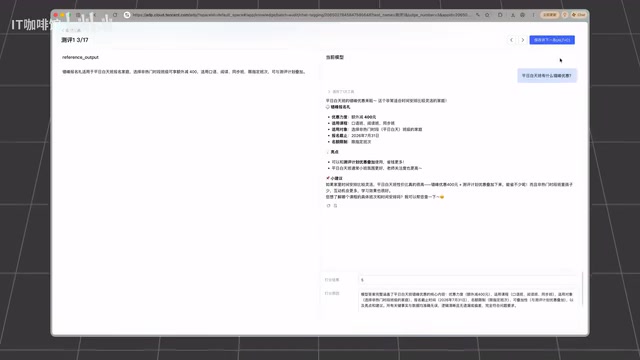
For enterprise-grade applications, rigor is paramount. ADP 4.0 includes a dedicated evaluation task mechanism before the release stage:
- Create a new evaluation task and upload an evaluation dataset (with scoring criteria defined according to a template)
- Choose a scoring method — it supports "Judge Model Scoring," where LLMs evaluate each other
- Select a model different from the Agent's as the judge, and write scoring prompts
- Run the evaluation and review detailed scoring results
LLM-as-a-Judge is an important innovation in AI evaluation over the past two years. Traditional AI evaluation relied on human annotation, which was expensive and inefficient; rule-based automated evaluation struggled to cover the complex scenarios of natural language generation. The core idea of LLM-as-a-Judge is to use an independent large language model as a reviewer that scores the target Agent's outputs according to preset criteria. Key design principles include: the judge model should use a different underlying model than the Agent being evaluated to avoid same-source bias; scoring prompts must clearly define evaluation dimensions (such as accuracy, completeness, safety, etc.); and the evaluation dataset should cover both typical scenarios and edge cases. Research shows that well-designed LLM judges can achieve over 80% agreement with human reviewers, making this a viable approach for large-scale Agent quality assurance.
Once the evaluation passes, the Agent can be published to multiple channels, including WeChat and WeCom (WeChat Work) ecosystems. For example, after configuring a WeCom smart bot, you can use it directly in WeCom group chats, while the web interface also supports simultaneous access. During the operational phase, detailed data dashboards are provided to support continuous data-driven optimization.
Test 4: Dual Safeguards — Skill Governance and Security Controls
In enterprises, Skill management is a core governance topic. In Agent architecture, a Skill refers to an independent functional module that an Agent can invoke — such as data queries, email sending, report generation, etc. Many enterprises are developing Skills in large quantities, and some have even set Skill KPIs. But "more" shouldn't mean "messy." As an enterprise's internal Agent ecosystem expands, the number of Skills can balloon rapidly — large enterprises may accumulate hundreds of Skills. Without effective governance, multiple risks emerge: redundant development wastes resources, inconsistent quality undermines business reliability, and unreviewed Skills may introduce security vulnerabilities or create compliance risks.
ADP 4.0's Skill governance mechanism embodies a dual security safeguard:
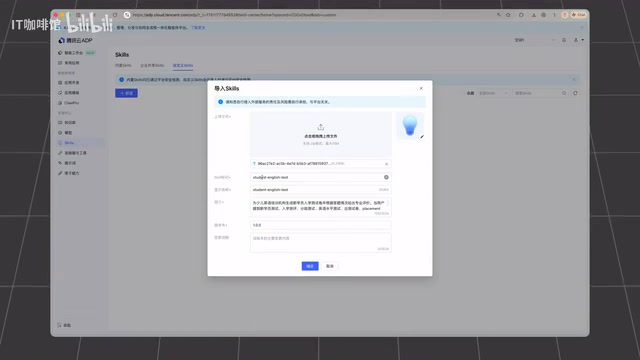
- First layer: Platform review — After uploading a custom Skill, ADP first reviews its content for security. Only after confirming it's safe can it be used on the platform, and a detailed security report is generated.
- Second layer: Administrator review — When a Skill is shared with other people in the enterprise, the enterprise administrator must review it again.
This dual governance mechanism draws from best practices in enterprise software supply chain security: platform-level review is similar to an app store's security scan, ensuring no malicious behavior at the code level; administrator review provides business compliance oversight, ensuring the Skill's functional boundaries align with internal enterprise policies. This governance model is especially important for enterprises pursuing "AI democratization" (enabling more non-technical employees to participate in Agent and Skill development), effectively preventing the risks that come with unchecked growth.
The Balancing Act of Enterprise Agent Deployment
Successfully deploying enterprise-grade Agents is essentially a balancing act: ease of use and efficiency on one side, stability and governance on the other. Every enterprise wants to find the optimal equilibrium.
ADP 4.0's core philosophy deserves recognition: getting an Agent up and running is just the beginning. The heavy lifting is making it fit into the existing enterprise environment, run reliably, and be governed securely. What enterprises need is a complete Agent Ops solution.
From our hands-on testing, while there are still plenty of details that could be optimized, ADP 4.0 is clearly attempting to address the core pain points of enterprise-grade Agent deployment in the right direction. AI is entering its second half, and the focus of the Agent second half is enterprise scenarios — whoever moves faster and executes better will determine the ultimate landscape of this space.
Related articles

Codex VS Claude Code: The Token Economics Behind a 10x Price Gap
Same coding task: Codex costs $15, Claude Code costs $155. Deep dive into the real reasons behind the 10x gap — it's not pricing, it's token volume, output style, and context strategy.
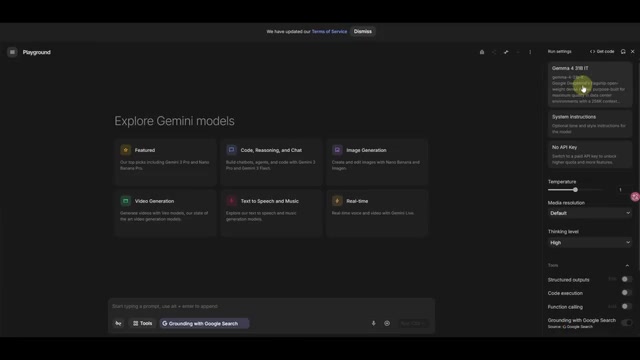
Gemma 4 Open-Source Model Local Deployment Guide: Ollama Installation & Mobile Setup
Step-by-step guide to deploying Google's Gemma 4 open-source model locally with Ollama and running the lightweight version on mobile with tool calling support.
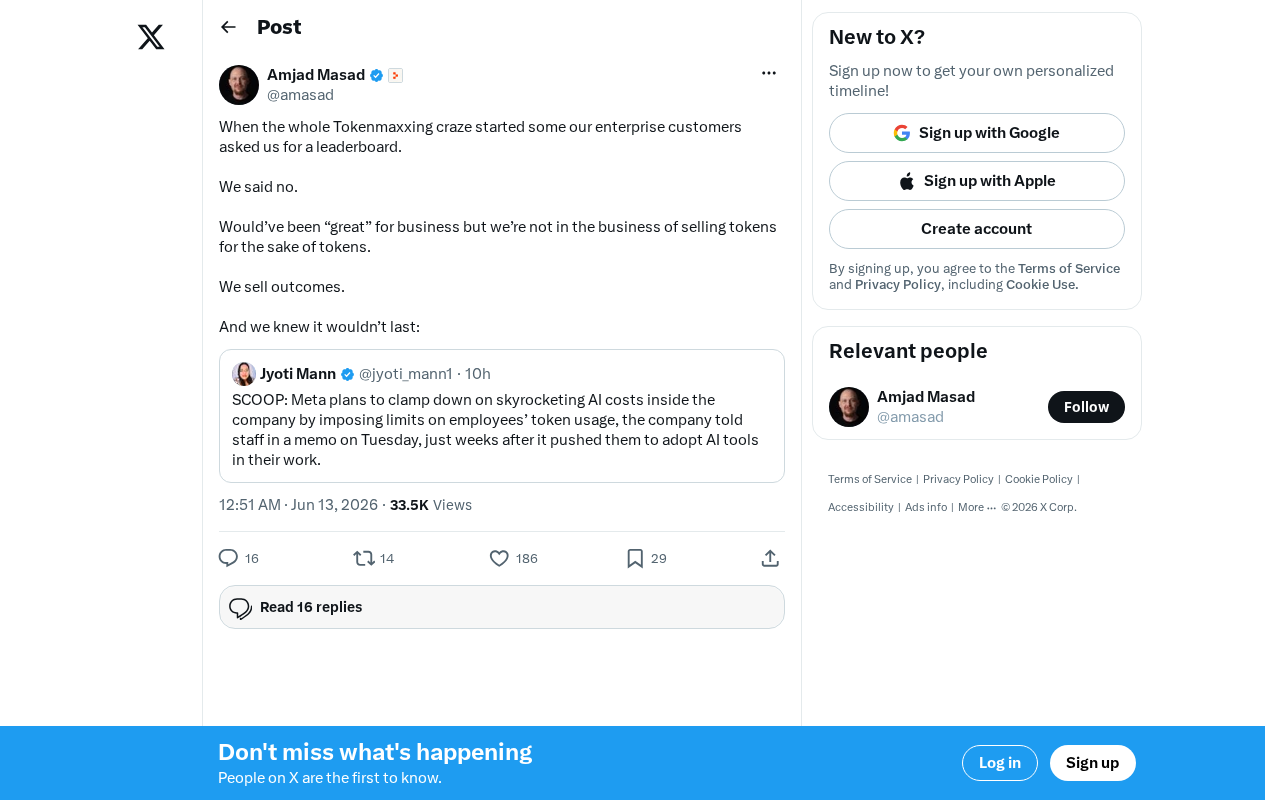
The Decline of Tokenmaxxing: Why Selling Outcomes Matters More Than Selling Tokens
The Tokenmaxxing craze is fading as enterprise AI procurement shifts from chasing Token counts to focusing on actual business outcomes. Learn why outcome-based AI evaluation is the right approach.