Harness Engineering: A Practical Guide to AI Programming — From Prompts to Mastery
Harness Engineering: A Practical Guide…
AI programming evolves from prompt engineering to Harness Engineering for enterprise-grade development.
AI programming has evolved through three stages: Prompt Engineering, Context Engineering, and Harness Engineering. To address enterprise-grade pain points like hallucinations, inconsistent code standards, and quality degradation, Harness Engineering provides a systematic methodology: AI handles 80%-90% of code generation while human engineers become architecture designers and AI directors. Through engineering-driven task decomposition, context management, and quality control workflows — powered by a Cloud Code + VS Code + high-quality LLM toolchain — it enables truly production-ready AI-assisted programming.
From Prompt Engineering to Harness Engineering: Three Evolutionary Leaps in AI Programming
The field of AI programming is undergoing a profound paradigm shift. Reports indicate that at major overseas companies like Anthropic and OpenAI, over 90% of code is now generated by AI large language models. Yet a significant number of developers domestically remain stuck in the "old-school coding" phase — or, having tried AI programming only to be frustrated by inconsistent code, model hallucinations, and declining quality, have reverted to writing code by hand.
The core issue isn't that AI programming doesn't work. It's that most people haven't yet mastered Harness Engineering — a systematic, engineering-driven methodology for AI-assisted programming. This article traces the evolution of AI programming techniques and takes a deep dive into how Harness Engineering helps developers truly harness AI for enterprise-grade project development.
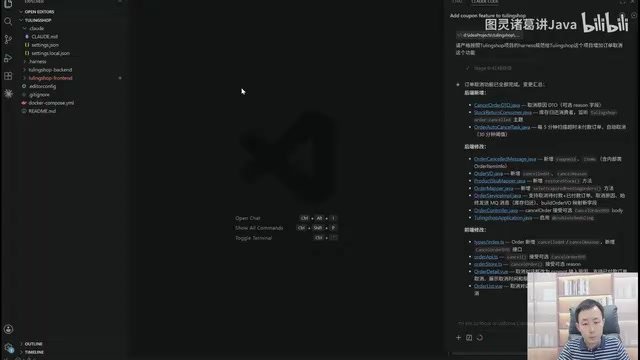
Three Stages of AI Prompt Evolution
Stage 1: Prompt Engineering
When ChatGPT burst onto the scene in late 2022, "prompt engineering" became the hottest concept around. Its essence is simple — ask and answer. You describe your problem clearly, and the AI responds. The clearer the question, the higher the quality of the answer.
Prompt engineering emerged during the early commercialization of large language models (LLMs). Its theoretical foundation lies in the autoregressive generation characteristics of the Transformer architecture — model output quality is highly dependent on how well-structured the input is. Early research found that techniques like few-shot learning and Chain-of-Thought (CoT) prompting could significantly improve model performance on reasoning tasks. However, prompt engineering has a clear ceiling: it is fundamentally a stateless, single-turn interaction that cannot handle complex tasks requiring cross-step memory and tool invocation.
This approach works well for simple, well-defined problems — things like "write me a sorting algorithm" or "explain what microservices are." But as task complexity increases, simple ask-and-answer quickly falls short.
Stage 2: Context Engineering
When we need AI to handle more complex tasks, a single prompt is far from sufficient. For example, if you ask AI to "write a technical article mimicking a specific author's style," it will almost certainly fail — because it has no idea what your style actually is.
The solution: provide context. Upload past articles, coding standards, project documentation, and other materials so the AI can learn first, then execute the task. This is the core idea behind context engineering.
The technical backbone of context engineering is Retrieval-Augmented Generation (RAG) and breakthroughs in long context window technology. Early GPT-3 had a context window of only 4K tokens, while the Claude 3 series expanded to 200K tokens, and Gemini 1.5 Pro reached up to 1 million tokens. This made it possible to inject large volumes of project documentation, codebases, and specification files into the context. RAG technology uses vector databases (such as Pinecone and Chroma) to perform semantic retrieval over knowledge bases, dynamically assembling the most relevant context fragments — solving the problem of ultra-long documents that can't be injected in full. The limitation of context engineering is that it remains a passive information supply mechanism; the AI cannot proactively invoke tools or execute multi-step tasks.
In the AI programming space, many developers are currently stuck at this stage: uploading parts of their company's codebase to an AI tool, having the AI mimic existing code conventions to generate new code, then manually pasting it back into the IDE. While this is a significant step up from pure prompt engineering, efficiency and quality remain limited.
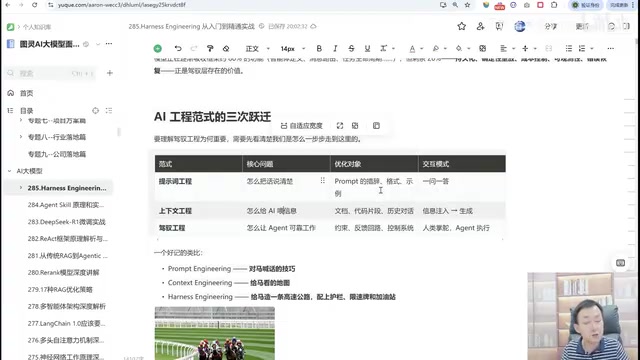
Stage 3: Harness Engineering
As the tasks AI needs to handle grow increasingly complex, AI Agent technology has emerged. Agents are no longer limited to simple ask-and-answer interactions — they can decompose complex tasks into multiple steps and execute them sequentially according to a workflow.
The core architecture of AI Agents typically follows the ReAct (Reasoning + Acting) paradigm: at each step, the model first reasons (Thought), then decides what action to take (Action), observes the result (Observation), and enters the next iteration. This loop enables Agents to break complex tasks into executable sub-task sequences. Modern programming Agents (such as Cursor, GitHub Copilot Workspace, and Claude Code) also integrate code execution sandboxes, file system read/write access, terminal command invocation, browser control, and other tool sets, forming a complete Tool Use / Function Calling capability. Multi-Agent collaboration frameworks (such as AutoGen and CrewAI) further allow multiple specialized Agents to collaborate, with each responsible for different roles like requirements analysis, code generation, and test verification.
For example, if you ask AI to book a flight, it will automatically decompose the task into: open a travel site → search for flights → compare prices → select a seat → place the order → make payment. Tools like Cloud Code, Codex, and Cursor are essentially AI Agents for the programming domain.
Harness Engineering goes a step further, building on top of Agents to provide a systematic methodology for harnessing these AI programming Agents, enabling them to handle enterprise-grade project development.
Why Beginners Can't Build Enterprise-Grade Projects
There's no shortage of marketing claiming that "even beginners can use AI programming to build projects from scratch." To be fair, this isn't entirely false — but there's a critical caveat: they're all building simple projects.
Building a static webpage, a small utility, or a demo — AI programming can indeed help someone with zero experience get results quickly. But real enterprise-grade projects — complex ERP systems, large-scale e-commerce platforms, internet products requiring microservice architectures and high-concurrency support — are an entirely different story.
The core pain points of AI programming in enterprise-grade projects include:
- Hallucination: AI-generated code looks reasonable but contains logical errors. This has deep technical roots — large language models are fundamentally statistical probability-based sequence prediction systems. Every token they generate is based on conditional probability maximization given the preceding context, not genuine logical reasoning. This means models may produce syntactically correct but semantically wrong code, such as calling non-existent APIs, misunderstanding business logic, or mishandling edge cases.
- Inconsistent code standards: Generated code clashes with the existing project's coding style and is incompatible.
- Quality degradation: As conversation turns increase, the weight of critical constraint information from earlier in the context window gets diluted (known as "attention drift"), causing AI output quality to gradually decline.
- Dead-loop deadlocks: When the AI can't solve a problem, dozens of interaction rounds still lead nowhere, and if the developer doesn't understand the underlying code, the project grinds to a halt.
Engineering measures to mitigate these issues include: structured output constraints, unit test-driven verification, layered code review, and controlling task granularity to stay within the model's reliable processing range — these are precisely the core issues that Harness Engineering aims to systematically address.
Core Principles of Harness Engineering
Harness Engineering — the name is quite apt. Its core principle is: AI generates 80%-90% of the code, but human engineers are responsible for harnessing the entire process.
This means the developer's role isn't replaced by AI — it undergoes a fundamental transformation:
- From code writer to architecture designer: Defining system architecture, module decomposition, and technology selection.
- From implementer to reviewer: Reviewing the quality, security, and standards compliance of AI-generated code.
- From executor to director: Guiding AI through engineering-driven approaches to generate code along the correct path.
In practice, Harness Engineering is implemented using a Cloud Code + VS Code development environment, paired with high-quality large models. In terms of model selection, Claude (by Anthropic) and DeepSeek represent two different technical approaches: the Claude series is renowned for its ultra-long context processing capability (200K tokens), strict instruction adherence, and code generation accuracy, excelling at understanding complex multi-file projects; DeepSeek stands out for being open-source, low-cost, and optimized for Chinese programming scenarios, with its DeepSeek-Coder series achieving near-GPT-4 performance on code completion benchmarks (HumanEval, MBPP), while also supporting local deployment to avoid data compliance risks. Through systematic context management, task decomposition, and quality control workflows, this toolchain brings AI programming up to enterprise-grade project standards.
Practical Insights: Engineering Thinking Is Key
When putting Harness Engineering into practice, several key principles deserve attention:
First, choose the right toolchain. Cloud Code + VS Code is the current mainstream AI programming environment. For the backend model, you can choose Claude (best results but may require VPN access) or domestic models like DeepSeek (already quite capable, with local deployment options for data security).
Second, understand the concepts but focus on practice. A lot of Harness Engineering content out there stays at the conceptual level. The real value lies in applying these methodologies to actual enterprise-grade projects.
Third, human value doesn't disappear — it levels up. In the AI programming era, developers no longer need to master how to write every line of code. Instead, they need to know how to design systems, decompose requirements, and verify AI output quality — skills that have become even more important.
Fourth, start with simple scenarios and gradually transition to complex projects. First validate AI programming's effectiveness on small modules, accumulate experience, and then scale up to project-level AI-engineered development.
Conclusion
AI programming is evolving from "toy" to "tool," from "demo-grade" to "enterprise-grade." As a critical methodology in this evolution, Harness Engineering provides developers with a clear path from "being able to use AI to write code" to "being able to use AI to build projects."
For developers still hesitating about whether to embrace AI programming, the question is no longer whether to use it, but how to use it well. Mastering the mindset and methods of Harness Engineering is the key to truly benefiting from this technological revolution.
Related articles
 Tutorials
Cursor + Codex Dual-IDE Collaboration: A Practical Methodology for Open-Source Project Customization
A complete methodology for open-source project customization based on real-world experience, detailing the Cursor+Codex dual-IDE workflow, seven-stage process, MVP validation, and AI source code reading techniques.
 Tutorials
Cursor Multi-Agent in Practice: Building a Full-Stack Next.js Blog in 50 Minutes
Build a full-stack blog in 50 minutes using Cursor IDE's multi-Agent mode with Next.js, Clerk auth, and Supabase. Learn the 4-phase AI Agent workflow and key integration pitfalls.
 Tutorials
Building an AI Software Factory from Scratch: A Cursor Engineer's Hands-On Experience with Multi-Agent Collaboration
Cursor engineer Eric shares practical insights on building an AI software factory: automation levels, guardrail design, parallel Agent management, and scaling to 1000+ Agents for 24/7 development.