Hermes Agent Practical Tutorial: Architecture Analysis and Three Automation Project Builds

A comprehensive Hermes Agent tutorial covering architecture, configuration, and three automation projects.
This article provides a complete guide to Hermes Agent, covering its modular architecture, Rules.md configuration for behavior control, and MCP service integration for extending capabilities. It walks through three practical projects: an AI news push bot with Feishu integration, fully automated tech blog development, and scheduled automatic code review, demonstrating how Hermes can be used both as a standalone tool and as a Python library for enterprise integration.
What is Hermes Agent?
Hermes Agent is a tool that has recently gained significant attention in the AI programming and automation space. It can function as a standalone AI Agent or be integrated into existing projects as a Python library, covering a full range of automation needs from code development to daily office tasks. A Chinese tech YouTuber recently released a comprehensive tutorial series covering everything from basics to hands-on projects, including Hermes's foundational concepts, architecture analysis, environment setup, and real-world business scenario implementations.
This article distills the core content from that tutorial, organizing the key knowledge points and practical application scenarios of Hermes Agent to help you quickly get started with this powerful AI Agent tool.
Hermes Agent Fundamentals and Architecture Analysis
Understanding the Overall Architecture
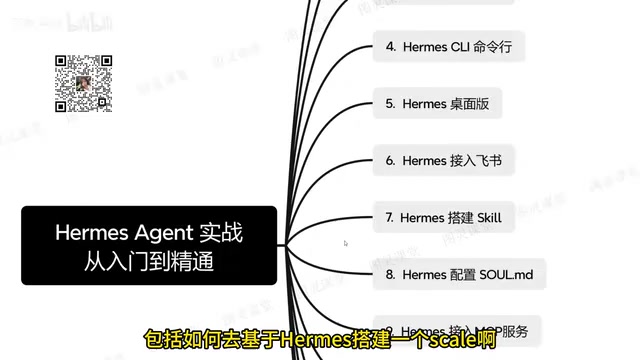
The first step in learning any tool is understanding its overall architecture. Hermes Agent's design philosophy centers on modularity and extensibility, with the core architecture comprising the following key components:
- Agent Core Engine: The central module responsible for task understanding, planning, and execution
- Tool Invocation Layer: Supports MCP (Model Context Protocol) service integration to extend the Agent's capability boundaries
- Integration Interfaces: Provides multiple usage methods including Python SDK, command-line tools, and desktop applications
The core engine of an AI Agent (intelligent agent) is typically built on Large Language Models (LLMs), with key capabilities including task decomposition (breaking complex goals into executable sub-steps), reasoning and planning (determining execution order and strategies), and tool invocation (selecting appropriate external tools at the right moment). This design pattern originates from the ReAct (Reasoning + Acting) framework, which allows AI to alternate between reasoning and action, forming a closed feedback loop. Unlike traditional single-turn conversations, the Agent engine possesses memory and state management capabilities, maintaining contextual coherence across multi-step tasks.
Understanding the collaboration between these modules is the foundation for subsequent hands-on development. Hermes's advantage lies in being an open framework rather than a closed system—developers can flexibly combine various modules according to their needs.
Environment Installation and Common Commands
The tutorial provides detailed coverage of Hermes's installation process, including both command-line and desktop versions. For developers, mastering common command-line operations is key to using Hermes efficiently.

The desktop installation provides a more user-friendly interface for those unfamiliar with the command line, lowering the barrier to entry. Regardless of which method you choose, the core functionality remains consistent, and developers can select based on their usage preferences.
Core Configuration: Rules.md and MCP Service Integration
How to Configure Rules.md
Rules.md is a critically important configuration file in Hermes Agent that defines the Agent's behavioral rules and constraints. Through proper Rules.md configuration, you can achieve the following objectives:
- Define the Agent's role positioning and domain expertise
- Standardize output format and style requirements
- Add safety constraints and boundary conditions
- Define handling strategies for specific scenarios
Rules.md is essentially a structured System Prompt engineering practice. In the AI Agent field, effectively constraining and guiding model behavior has always been a core challenge. Traditional prompts are often scattered throughout code, making them difficult to maintain and version-control. The practice of separating behavioral rules into a Markdown file borrows from the software engineering principle of "separating configuration from code," enabling non-technical personnel to participate in Agent behavior tuning. This pattern has similar implementations in Cursor's .cursorrules, Claude's CLAUDE.md, and other tools, and is becoming an industry convention for AI Agent configuration.
This is essentially creating a "work manual" for the AI Agent, giving it clear guidelines to follow when executing tasks. A well-crafted Rules.md configuration can significantly improve the Agent's output quality and consistency—a critical aspect that many beginners tend to overlook.
Integrating MCP Services to Extend Agent Capabilities
MCP (Model Context Protocol) is an important protocol standard in the current AI Agent ecosystem. Hermes's native support for MCP means it can seamlessly integrate with various external tools and data sources. Through MCP services, Hermes Agent can:
- Access real-time web data
- Operate databases and file systems
- Call third-party API services
- Collaborate with other AI tools
MCP is an open protocol standard introduced by Anthropic in late 2024, designed to solve the standardized connection problem between AI models and external tools/data sources. Before MCP, every AI tool needed to write specialized integration code for different external services, leading to severe ecosystem fragmentation. MCP adopts a client-server architecture and defines unified communication formats and tool description specifications, enabling any MCP-compatible AI Agent to plug-and-play with MCP services. Currently, hundreds of open-source MCP services are available, covering common scenarios such as file operations, database queries, web browsing, and API calls.
This extensible architectural design means Hermes's application scenarios go far beyond simple conversational interactions—it can truly participate in complex business processes.
Practical Project 1: AI News Push Bot
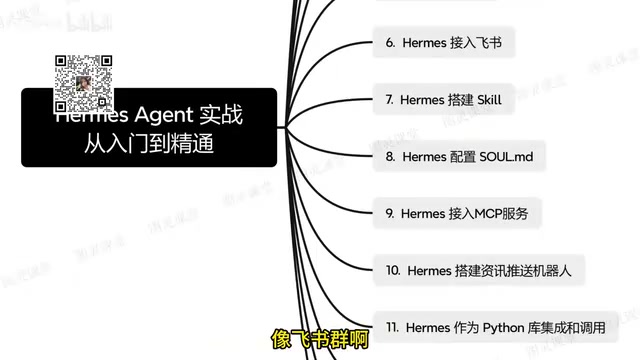
One of the most practically valuable cases in the tutorial is building an AI news push bot based on Hermes. The core workflow of this project is as follows:
- Data Collection: Periodically scrape hot AI news through MCP services or crawler tools
- Content Filtering and Summarization: Leverage Hermes Agent's intelligent analysis capabilities to filter news and generate summaries
- Scheduled Push: Deliver processed news to designated groups through instant messaging tools like Feishu (Lark)
Building an AI news push bot involves the coordination of multiple technical components. The data collection layer typically relies on RSS subscriptions, web crawlers, or API interfaces to obtain raw information; the content processing layer uses LLMs for deduplication, summary generation, and importance scoring; the push layer needs to interface with instant messaging platforms' Webhook or Bot APIs. Feishu bot integration is typically achieved through the Webhook URL provided by its open platform—developers simply need to send JSON data in the required format to the specified URL to complete message delivery. The scheduled trigger mechanism can be implemented through Cron jobs, cloud function timers, or the Agent's built-in scheduling capabilities.
This scenario closely aligns with real work needs. Many teams need to track industry developments, but manually curating news is both time-consuming and prone to omissions. By automating this with Hermes Agent, you not only save labor costs but also ensure information timeliness and comprehensiveness.
The Feishu integration is a key focus of the tutorial, demonstrating Hermes's excellent adaptability to Chinese workplace scenarios. Beyond Feishu, similar solutions can be extended to DingTalk, WeCom, and other platforms.
Practical Project 2: Fully Automated Personal Tech Blog Development
Another impressive practical case is using Hermes to fully automate the development of a personal tech blog website. This scenario fully demonstrates Hermes's powerful capabilities as an AI programming assistant:
- Project Initialization: Automatically generate project structure, configuration files, and base code
- Page Development: Automatically write frontend pages and backend logic based on requirement descriptions
- Content Generation: Leverage AI capabilities to automatically generate blog article content
- Deployment: Assist in completing project build and deployment processes
The development paradigm demonstrated in this case is known in the industry as "Vibe Coding" or "Intent-driven Development." In this mode, the developer's core work shifts from writing code to precisely describing requirements, reviewing AI-generated code, and making architecture-level decisions. This doesn't mean programming skills become unimportant—on the contrary, developers with solid programming foundations can better evaluate AI output quality, identify potential issues, and provide effective iterative guidance. This human-AI collaboration model is redefining the efficiency boundaries of software development.
The value of this case lies not only in the final blog website output but more importantly in demonstrating a completely new development paradigm—developers shift from "writing code line by line" to "describing requirements," with the AI Agent handling the actual coding implementation.
Practical Project 3: Scheduled Automatic Code Review
Code quality is an eternal topic in software engineering. The tutorial introduces how to use Hermes to implement scheduled automatic code reviews:
- Periodically scan project codebases
- Identify potential code quality issues, including code smells, security vulnerabilities, and performance bottlenecks
- Generate detailed review reports and correction suggestions
- Automatically submit Issues or PRs for tracking
AI-driven code review differs fundamentally from traditional static analysis tools (such as SonarQube, ESLint). Traditional tools perform pattern matching based on predefined rules and can only find known types of issues; LLM-based code review can understand code semantics and business logic, identifying deeper design problems. For example, it can detect naming inconsistencies, confused abstraction levels, potential concurrency issues, and other problems that require human judgment. Combined with Git Diff information, AI review can also focus on incremental changes and provide targeted improvement suggestions, which is highly consistent with how human code review works.
This is particularly valuable for small and medium-sized teams. Without dedicated code review personnel, Hermes Agent can serve as a "tireless code reviewer," continuously ensuring code quality.
Integration as a Python Library into Existing Projects
Hermes is not just a standalone tool—it can also be integrated into existing projects as a Python library. This means developers can directly invoke Hermes's Agent capabilities within their own applications, enabling deeper customization.
Typical integration scenarios include:
- Embedding intelligent customer service functionality in web applications
- Adding AI analysis stages to data processing pipelines
- Integrating intelligent test case generation into automated testing frameworks
- Building enterprise-level AI Agent platforms
This approach of providing Agent capabilities in library form belongs architecturally to a localized variant of "Agent-as-a-Service." Compared to calling remote APIs, local integration offers advantages including lower latency, better data privacy protection, and more flexible customization space. Developers can embed Hermes's reasoning capabilities into any business logic node through Python's decorator pattern or function call methods, enabling everything from simple text processing to complex multi-step workflow orchestration.
This flexible integration approach greatly expands Hermes's application boundaries, upgrading it from a single tool to a platform-level solution.
Summary: Recommended Learning Path for Hermes Agent
As a comprehensive AI Agent tool, Hermes Agent's core advantages lie in its openness and practicality. From news pushing to code review, from blog development to project integration, it covers multiple high-frequency scenarios in developers' daily work.
For readers looking to get started with AI Agent development, the following progressive learning path is recommended:
- First understand Hermes's overall architecture and core concepts
- Complete basic installation and command-line operation exercises
- Focus on mastering Rules.md configuration and MCP service integration
- Choose one practical scenario for hands-on practice
- Gradually explore more complex integration and customization development
AI Agents are moving from concept to implementation, and tools like Hermes are concrete manifestations of this trend. The AI Agent field is currently in a period of rapid development—from the AutoGPT hype of 2023, to multi-Agent collaboration frameworks in 2024, to the standardized ecosystem building represented by MCP in 2025—the entire industry is progressing from "functional" to "user-friendly." Mastering tools like Hermes is not just about learning a specific product; it's about understanding the design philosophy and engineering practices of AI Agents, adding a future-oriented core competency to your technology stack.
Related articles
Claude Code Installation & Setup Guide: Low-Cost Vibe Coding with Chinese AI Models
Step-by-step guide to installing Claude Code and configuring it with Chinese models like DeepSeek for low-cost vibe coding, including Node.js setup and CCSwitcher usage.
Keyroll: An In-Depth Look at a Stability-Focused Claude Refill Tool
In-depth review of Keyroll, a stability-focused Claude refill tool. Analyzing its core strengths, security implications, and compliance considerations for developers facing usage limits.
OpenLLMVTuber: A Deep Dive into the Open-Source AI Virtual Character Framework
Deep dive into OpenLLMVTuber, a 10K-star open-source AI virtual character framework integrating ASR, LLM, TTS, and Live2D with voice interruption, visual perception, and modular architecture.