Home Assistant: The Open-Source Solution to Smart Home Fragmentation
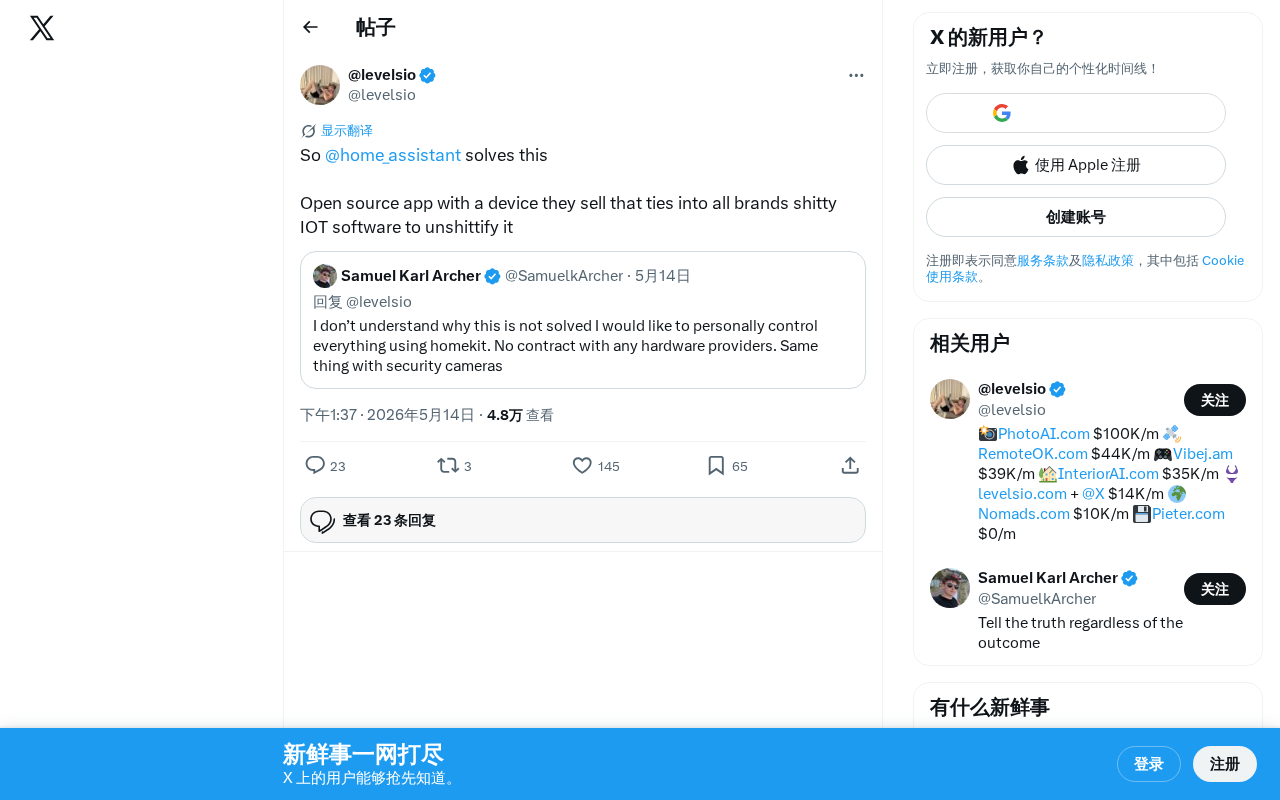
Home Assistant unifies fragmented smart home ecosystems through open-source, local-first integration.
Smart home fragmentation forces users to juggle multiple apps and incompatible ecosystems. Home Assistant, an open-source platform, solves this by supporting 2,000+ integrations, running locally without cloud dependency, and offering visual automations and local voice control — evolving from a geek tool into a mainstream solution.
The Smart Home "Legacy Code" Problem
Every smart home user has experienced this pain: five or six different brand apps installed on your phone — Xiaomi, Tuya, Philips, Broadlink… Each device trapped in its own walled garden, unable to communicate with the others. You want to set up a simple automation like "turn on the lights and AC when I unlock the door," only to realize the door lock and the light bulb don't even exist in the same ecosystem.
The "Walled Garden" is a classic concept in the tech industry, referring to how manufacturers lock users into their platform through closed hardware and software ecosystems. In the smart home space, this fragmentation goes beyond the app level — the deeper issue lies in the split across communication protocols: Wi-Fi, Bluetooth, Zigbee, Z-Wave, and proprietary RF protocols all operate in silos. Even when two devices are physically inches apart, they may be unable to communicate because they "speak different languages." To make matters worse, even devices using the same protocol are often further isolated by proprietary encryption or custom command sets at the application layer.
This is the current state of the IoT industry — every brand building its own mediocre smart home software, with users left as casualties of a fragmented ecosystem.
Home Assistant: The Open-Source Community's Answer
Home Assistant was built specifically to solve this problem. It's an open-source smart home platform that, paired with official hardware (Home Assistant Green/Yellow), can integrate virtually every IoT brand into a single, unified management layer.
Core Advantages
Universal Compatibility: Home Assistant supports over 2,000 integrations — from Xiaomi and HomeKit to Zigbee and Z-Wave protocol devices — covering nearly every smart home brand on the market. No matter what you've bought, it can be brought under one roof.
Zigbee and Z-Wave are two of the most widely adopted low-power wireless protocols in smart homes. Zigbee is based on the IEEE 802.15.4 standard, operates on the 2.4GHz band, supports mesh network topology, and can theoretically accommodate 65,000 nodes per network. It's used extensively by brands like IKEA TRÅDFRI and Philips Hue. Z-Wave operates on sub-GHz frequencies (varying by country — 908.42MHz in the US, 868.42MHz in Europe), offering better resistance to Wi-Fi interference but with a 232-node limit. Both support mesh networking — devices relay signals for each other, so the more devices on the network, the greater the coverage. Home Assistant communicates directly with these protocol devices via USB coordinators (such as the Sonoff Zigbee Dongle or Aeotec Z-Stick), bypassing vendor clouds entirely.
Local Execution: Unlike cloud-based solutions, Home Assistant runs on local hardware and doesn't depend on manufacturer servers. This means even if a brand shuts down its cloud service tomorrow, your devices will keep working.
The benefits of local execution go far beyond just "works offline." It means all device control logic, automation rules, and data storage happen on hardware inside your home, never traversing the internet. First, there's privacy: sensor data from your home (camera feeds, lock status, presence detection) never gets uploaded to third-party servers. Second, there's speed: local commands typically have millisecond-level latency, while cloud-based solutions must complete a round trip of "device → router → cloud server → router → device," adding hundreds of milliseconds or even seconds of delay. Third, there's reliability: the sudden bankruptcy of Insteon in 2023, which bricked millions of users' devices, and Google's shutdown of product lines like Nest Secure, are real-world examples of cloud dependency risks. Local architecture eliminates this type of "single point of failure" by design.
Open-Source Transparency: The code is fully open-source and community-driven. No hidden data collection, no sudden changes to terms of service — users truly own their smart home data.
From Geek Toy to Mainstream Solution
Home Assistant used to be seen as a toy for geeks — requiring you to set up your own server and write YAML configuration files. YAML (YAML Ain't Markup Language) is a human-readable data serialization format. In its early days, nearly all Home Assistant configuration depended on manually editing YAML files — from defining sensor entities to writing automation rules. Users needed to understand indentation syntax, the Jinja2 template engine, and entity ID naming conventions. A typical automation configuration could easily span dozens of lines of code, making it extremely unfriendly to non-technical users.
But over the past two years, the project has made a quantum leap in usability:
- Official Hardware: Home Assistant Green is plug-and-play, requiring zero technical background
- Visual Automations: Drag-and-drop scene and automation creation, no code editing required. Starting in 2020, the Home Assistant team pushed aggressively toward GUI-based workflows: the automation editor now supports visual drag-and-drop composition of conditions, triggers, and actions; the Dashboard introduced a WYSIWYG editing mode; and device integrations migrated from manual configuration to wizard-style "Config Flow" setup. This transformation drove Home Assistant's monthly active installations from roughly 300,000 in 2020 to over 1 million in 2024.
- Local Voice Assistant: A privacy-friendly integrated voice control system, replacing cloud-dependent alternatives like Siri and Alexa. Home Assistant's local voice assistant is built on open-source speech recognition engines (such as a locally deployed version of OpenAI Whisper and Piper TTS), with all voice processing handled on-device — no audio recordings are ever sent to any server. This stands in stark contrast to Siri, Alexa, and Google Assistant, all of which upload voice clips to the cloud for processing and have been repeatedly caught having human reviewers listen to user recordings. Users can build custom Voice Satellites using low-cost hardware like the ESP32, deploying voice entry points in every room at a total hardware cost as low as a few dollars per node. While local voice still can't match cloud giants in recognition accuracy and natural language understanding, it's more than sufficient for the relatively fixed command sets in smart home scenarios (e.g., "turn on the living room light" or "set the AC to 26 degrees").
Why Choose Open Source Over Commercial Platforms
The fundamental problem with commercial IoT platforms is a conflict of interest: brands want to lock users into their ecosystem, while users need cross-brand interoperability. Open-source solutions have no such conflict — their only goal is to make your devices work better together.
Final Thoughts
Smart homes shouldn't make life more complicated. When the industry fails to solve its own fragmentation problem, the open-source community delivers the most pragmatic answer: instead of waiting for manufacturers to shake hands, build a unified bridge layer on the user's side. Home Assistant proves that solving fragmentation doesn't require waiting for the next industry standard — the Matter protocol is still inching along.
Matter is a unified smart home protocol led by the Connectivity Standards Alliance (CSA, formerly the Zigbee Alliance), with Apple, Google, Amazon, Samsung, and other major players as participants. Matter runs over IP networks, with underlying support for Wi-Fi, Thread (an IPv6 Mesh protocol based on IEEE 802.15.4), and Ethernet, aiming to achieve "certify once, work everywhere." However, progress since the release of Matter 1.0 in October 2022 has been slow: the initial version only supported basic device categories like bulbs, plugs, and door locks, with cameras, robot vacuums, and other complex devices still on the roadmap; interoperability across vendor implementations remains inconsistent, with real-world experience falling far short of the "seamless collaboration" promise; and Matter itself doesn't solve cloud dependency — many Matter devices still require vendor clouds for firmware updates and advanced features. Home Assistant already supports running as a Matter controller, meaning that even if Matter eventually matures, Home Assistant can still serve as the unified management layer.
The open-source community has been running ahead all along.
Related articles

Claude Code for Test Development in Practice: An AI Programming Workflow That Doubles Your Efficiency
A practical guide to Claude Code for test development: auto-generating test scripts, Plan Mode workflows, MCP + Playwright integration, and Subagent parallel tasks to build systematic AI-assisted workflows.

Hermes Agent Hands-On Review: An AI Efficiency Revolution for Indie Game Developers
Indie game developer reviews Hermes Agent vs OpenClaude: intelligent context compression, real-time Memory, remote control via Telegram, and practical use cases in game dev, social media, and email.
Vibe Coding Beginner's Guide: Tool Selection Across Three Categories with Practical Examples
A comprehensive guide to Vibe Coding's three tool categories: Agent frameworks, CLI Coding, and IDE tools, with practical examples including Snake game and data analysis workbench.