Illinois Passes AI Safety Bill SB 315 with Public Endorsement from OpenAI
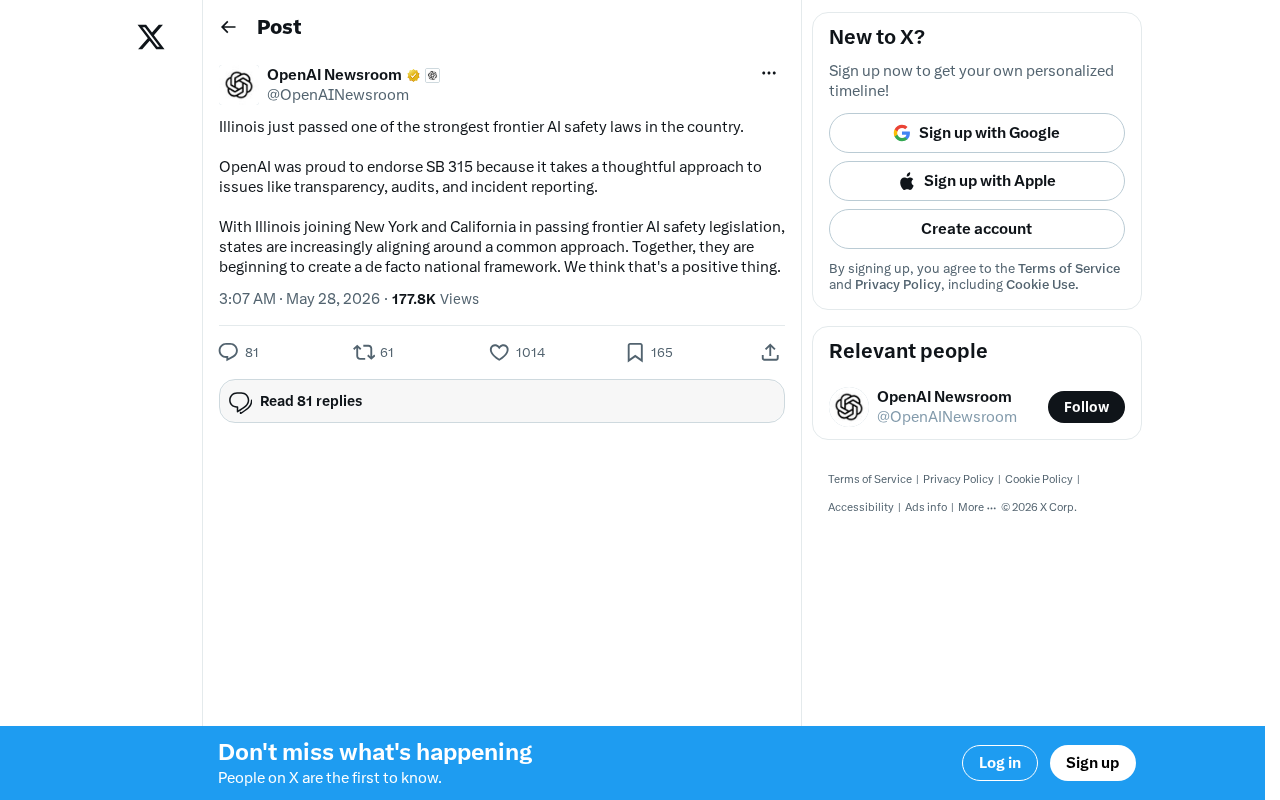
Illinois passes AI safety bill SB 315 with OpenAI's endorsement, advancing U.S. state-level AI regulation.
Illinois has passed SB 315, one of the strongest frontier AI safety bills in the U.S., with OpenAI publicly endorsing its "thoughtful approach" to transparency, auditing, and incident reporting. The bill joins similar legislation in New York and California, forming a de facto national AI regulatory framework as federal efforts stall. OpenAI's shift from opposing California's SB 1047 to supporting SB 315 signals that constructive dialogue between industry and lawmakers can yield balanced regulation.
Another U.S. State Passes Strong AI Safety Legislation
Illinois has just passed one of the strongest frontier AI safety bills in the country — SB 315. Notably, OpenAI publicly endorsed the bill, praising its "thoughtful approach" to key issues such as transparency, auditing, and incident reporting.
This development marks an important shift in the U.S. AI regulatory landscape — from confrontation to collaboration between tech giants and lawmakers, as state-level legislation gradually builds what is effectively a national regulatory framework.
Three Core Pillars of SB 315
Transparency Requirements: Building the Foundation of Public Trust
According to OpenAI's public statement, one of the core pillars of SB 315 is transparency. This means frontier AI model developers may be required to disclose key information about their models to the public or regulators, including training data sources, model capability boundaries, and known risks. Transparency requirements are among the most closely watched topics in global AI governance and form the foundation for building public trust.
From a technical perspective, AI model transparency spans multiple dimensions: training data transparency (data sources, data scale, data cleaning methods), model architecture transparency (parameter scale, network structure), capability and limitation transparency (benchmark results, known failure modes), and deployment transparency (use cases, user scale). Current industry discussions around transparency often center on "Model Cards" — a standardized documentation framework proposed by Google's research team in 2019 that requires developers to disclose a model's intended uses, performance metrics, and ethical considerations in a structured format. The EU AI Act similarly treats transparency as a core pillar, requiring high-risk AI systems to provide comprehensive technical documentation. SB 315's legislative approach in this direction is highly consistent with mainstream trends in global AI governance.
Audit Mechanisms: From Verbal Promises to Systematic Verification
The bill introduces audit mechanisms, meaning frontier AI systems will face some form of external or internal review. Establishing an audit regime helps ensure that AI developers don't just verbally commit to safety but must verify the effectiveness of their safety practices through systematic examination.
AI auditing refers to the process of systematically evaluating the design, development, deployment, and operation of AI systems to verify compliance with safety standards, ethical guidelines, and legal requirements. Currently, AI audits fall into three main categories: first-party audits (internal company self-assessments), second-party audits (conducted by clients or partners), and third-party audits (performed by independent organizations). In practice, the core challenges facing AI audits include: the "black box" nature of large language models makes internal mechanisms difficult to fully explain; the lack of unified audit standards and certification systems; and a severe shortage of qualified audit professionals. The AI Risk Management Framework (AI RMF) published by the National Institute of Standards and Technology (NIST) is widely regarded as an important reference benchmark for audit practices. By elevating auditing from industry self-regulation to a legal requirement, SB 315 is poised to accelerate the maturation of the AI audit ecosystem.
Incident Reporting: Driving Industry-Wide Learning
Incident reporting is another important component of the bill. Similar to accident reporting systems in the aviation and healthcare industries, AI incident reporting requires developers to promptly report safety incidents, helping the entire industry learn from individual cases and prevent similar issues from recurring.
Incident reporting systems have well-established precedents in high-risk industries. The Aviation Safety Reporting System (ASRS), operated by NASA, allows pilots and air traffic controllers to anonymously report safety concerns. Since its inception in 1976, the system has accumulated over 1.9 million reports and is considered a key mechanism behind continuous improvements in aviation safety. The healthcare industry's adverse event reporting systems (such as the FDA's MAUDE database) have similarly driven iterative improvements in medical device safety standards. AI incident reporting is still in its early stages — the OECD launched its AI Incidents Monitor in 2023, and the community-driven AI Incident Database has cataloged over 3,000 AI-related incidents. By elevating this practice from voluntary to legally mandated, SB 315 represents a significant step toward institutionalizing AI safety governance and could help establish a systematic safety learning mechanism for the AI industry similar to that of the aviation sector.
Why OpenAI Chose to Support SB 315
It's worth reflecting on why OpenAI proactively endorsed this bill. Previously, OpenAI had strongly opposed California's SB 1047, arguing that its provisions were overly restrictive. This shift in attitude sends an important signal: AI companies are not inherently opposed to regulation — they oppose unreasonable regulation.
To understand this shift, it helps to revisit the SB 1047 controversy. California's SB 1047, introduced by State Senator Scott Wiener in 2024, was one of the earliest frontier AI safety legislative efforts in the U.S. The bill required developers of large AI models with training costs exceeding $100 million to implement safety testing, establish "kill switch" mechanisms, and bear legal liability if their models caused serious harm. OpenAI, Google, Meta, and other tech giants jointly opposed the bill, citing concerns that the definition of "serious harm" was too vague and could create a chilling effect; that using training costs as a regulatory threshold lacked scientific basis; and that individual state legislation could lead to regulatory fragmentation. The bill was ultimately vetoed by California Governor Newsom, but the discussions it sparked profoundly influenced the legislative direction of subsequent state efforts. SB 315 has largely incorporated the lessons learned from SB 1047.
OpenAI described SB 315 as a "thoughtful approach," suggesting the bill strikes a good balance between safety requirements and room for innovation. For OpenAI, supporting a reasonable bill also helps shape its image as a responsible AI developer while establishing acceptable regulatory standards for the industry.
State-Level AI Legislation Is Building a "De Facto National Framework"
The Three-State Synergy Effect
With Illinois joining the fold, three major U.S. states — New York, California, and Illinois — have now passed frontier AI safety legislation. These three states represent the East Coast financial hub, the West Coast tech center, and the Midwest economic powerhouse, respectively, with their influence spanning the core of the American economy.
The Path from State Law to National Standards
As OpenAI noted in its statement, states are "increasingly converging around a common approach," effectively creating a "de facto national framework." Against the backdrop of slow progress on federal AI legislation, the coordination of state-level laws is filling the regulatory vacuum. While this bottom-up legislative approach is less efficient than unified federal legislation, its advantage lies in the ability to continuously iterate and optimize through each state's practical experience.
The slow progress of federal AI legislation in the U.S. has multiple causes. First, the two major parties fundamentally disagree on the scope and approach of AI regulation — Democrats tend to favor establishing comprehensive regulatory frameworks, while Republicans emphasize reducing government intervention to promote innovation. Second, the rapid pace of AI technology evolution makes it difficult for legislators to craft regulations that are both forward-looking and durable. Additionally, powerful tech industry lobbying has also slowed the legislative process to some extent. The Biden administration's AI Executive Order (Executive Order 14110), signed in October 2023, attempted to fill the legislative gap through executive action, but the Trump administration quickly revoked it upon taking office. In this context, state-level legislation has become the de facto regulatory frontier, creating a dynamic similar to how California's CCPA led the way in national data privacy standards. Notably, the precedent set by the California Consumer Privacy Act (CCPA) demonstrates that when a state with sufficient economic weight legislates first, companies often choose to adopt that state's standards as their baseline for nationwide operations, producing a de facto national impact — this "California effect" is now replaying in the AI regulatory arena.
Implications for Global AI Governance
The passage of Illinois's SB 315 and OpenAI's public support offer several important insights for global AI governance:
First, regulation and innovation are not a zero-sum game. Well-designed AI safety regulations can earn support from both businesses and the public.
Second, transparency, auditing, and incident reporting are becoming the "standard trio" of AI safety regulation. From the EU AI Act to U.S. state legislation, these three elements appear repeatedly and are forming a global consensus. The EU AI Act, which officially took effect in August 2024, is the world's first comprehensive AI regulatory law. It adopts a risk-based tiered regulatory approach, classifying AI systems into four levels — unacceptable risk, high risk, limited risk, and minimal risk — with varying compliance requirements for each tier. Unlike the EU's top-down unified legislative model, U.S. state legislation follows a bottom-up "jigsaw puzzle" pattern — states are converging on core elements like transparency, auditing, and incident reporting, but still differ in specific provisions, scope of application, and enforcement mechanisms. This variation both creates multi-compliance challenges for businesses and provides "policy laboratory" space for regulatory innovation. The parallel development of these two models offers different reference paths for AI legislation in other countries and regions worldwide.
Third, industry participation in the legislative process is crucial. OpenAI's shift from opposing SB 1047 to supporting SB 315 demonstrates that constructive dialogue can produce better regulatory outcomes.
As more states join this legislative wave, the U.S. AI regulatory landscape will become increasingly clear. For AI companies operating in the U.S., adapting to these compliance requirements in advance is no longer optional — it's mandatory.
Key Takeaways
Related articles

PiDeck 0.5.0 Released: Ten Versions in One Week, a Complete Overhaul of the Desktop AI Agent
PiDeck 0.5.0 completes the rebrand from PiDesktop, shipping 10 versions with ~100 changes in one week: design system overhaul, dark mode, LAN sharing, Git integration, and dual-layer proxy config.

Claude Fable 5 Hands-On Review: Double the Price — Is It Worth It?
Hands-on comparison of Claude Fable 5 vs Opus 4.8 on landing page design and website rebuilds. Detailed API pricing analysis and practical advice on whether double the cost delivers double the value.

Introduction to AI Literacy: How Teachers Can Build a Systematic Cognitive Framework
A teacher's guide to AI literacy: from AI history and LLM fundamentals to the Agent era, build a systematic cognitive framework and master tool selection strategies.