In-Depth Review of AI Companion Apps: Is 'Unrestricted' Roleplay Really Without Limits?

A critical review of AI companion roleplay apps and their claims of unrestricted, immersive interactions.
This article critically examines AI companion roleplay apps that claim to offer unrestricted, immersive character interactions. It analyzes core features like system prompt engineering, RAG-based memory, and character customization, while raising important concerns about the sustainability of free models given high inference costs, content compliance risks, and data privacy issues. The piece also surveys the competitive landscape and emerging multimodal trends in the AI companion industry.
Overview
Recently, a promotional video appeared on Bilibili for an AI companion chat application claiming to offer "high freedom" interactions, supposedly breaking through all conversation restrictions to deliver an immersive character interaction experience. This article analyzes the development trends and practical value of AI roleplay applications based on the content of that video.
Core Selling Points Analysis
Breaking Traditional AI Conversation Patterns
According to the video, the app's biggest feature is breaking free from the limitations of traditional AI conversations. Unlike the typical question-and-answer format, it emphasizes dialogue that unfolds "with emotion, detail, and scene-setting." Each AI response comes with background descriptions, action details, and even the character's inner thoughts, attempting to create an immersive sense of interacting with a real character.
From a technical perspective, this immersive conversational experience relies on the roleplay capabilities of large language models (LLMs). The core technologies include System Prompt engineering and context window management — by injecting character settings, personality traits, speaking styles, and other information into the system prompt, the model can continuously portray a specific character throughout the conversation. Current mainstream implementation approaches include fine-tuning based on pretrained models, Retrieval-Augmented Generation (RAG) for maintaining character memory, and dialogue style optimization based on RLHF (Reinforcement Learning from Human Feedback). The combined use of these technologies enables AI characters to exhibit richer narrative layers and emotional expression in conversations.
This design philosophy is nothing new in the AI roleplay space — Character.AI, Chai, and numerous domestic products have long been exploring similar directions. Character.AI, founded in 2022 by former Google LaMDA team members Noam Shazeer and Daniel De Freitas, is the benchmark product in this category, with monthly active users once exceeding 20 million. Its core advantage lies in a proprietary dialogue model deeply optimized for roleplay scenarios. Replika leans more toward emotional companionship and was already live before the GPT era. In the Chinese market, products like Xingye, Zhumengdao, and Maohe each have their own focus, with some performing even better than overseas competitors in Chinese-language contexts. That said, based on the video demonstration, this particular app does show improvement in narrative subtlety within Chinese contexts, with notably strong literary quality and scene-setting in its dialogues.

Character Library and Customization System
The product offers two levels of character acquisition:
- Preset Character Library: The platform provides a large collection of preset characters covering various types, with emphasis on plot-driving capabilities
- Full Customization: Users can create exclusive AI companion characters with complete control over everything from appearance design to backstory
Customization features are standard across AI companion apps today, but in actual use, character consistency and long-term memory are the real technical challenges. The character consistency problem is fundamentally rooted in context window limitations — when conversations exceed the model's context length limit (currently ranging from 8K to 128K tokens across mainstream models), early character setting information may be truncated or diluted, leading to what's known as "character collapse." To address this, the industry typically employs techniques such as conversation summary compression, key information extraction, and vector database retrieval, though results are still far from perfect. The video mentions "testing for days and not wanting to quit," but doesn't demonstrate whether the character maintains consistency in extended conversation scenarios.

A Rational Perspective on AI Companion Products
Key Considerations Before Use
1. Sustainability of the Free Model
The video title emphasizes "free to use," but the inference costs for AI conversation products are substantial. LLM inference costs are primarily determined by GPU compute consumption. Taking a GPT-4-level model as an example, the API call cost per conversation ranges from a few cents to tens of cents. Roleplay scenarios require carrying large amounts of character settings and conversation history as context, meaning the token consumption per request is far higher than in standard Q&A scenarios — potentially 3-5 times the cost of regular conversations. This means an AI companion app with a million daily active users could face monthly inference costs of several million dollars. Character.AI's decision to enter a technology licensing agreement with Google in 2024 was partly driven by sustained operational cost pressure.
Typically, these products adopt a free trial + paid unlock model. Common monetization strategies include: limiting daily conversation turns for free users, charging subscription fees for higher-quality models, inserting ads into conversations, or using smaller low-cost models for the free tier while reserving more powerful models for paid users. Users should pay attention to whether there are conversation limits, premium feature charges, or other restrictions in actual use.
2. Content Moderation and Compliance
The video's claim of "completely breaking through conversation restrictions" warrants caution. In the Chinese market, AI-generated content is strictly regulated by laws such as the Interim Measures for the Management of Generative AI Services, which require service providers to conduct safety reviews of generated content and prohibit generating content that violates laws and regulations. Internationally, the EU AI Act similarly imposes strict requirements on high-risk AI systems.
From a technical implementation standpoint, content safety is typically achieved through multi-layered filtering mechanisms: keyword filtering on the input side, Safety Alignment training at the model level, classifier review on the output side, and manual review sampling. If "breaking through conversation restrictions" means bypassing these safety mechanisms, the product faces risks of being taken down and legal liability. If it merely refers to a freer dialogue style and more open narratives, that's a normal product differentiation strategy — but the ambiguity of the marketing language itself should give users pause. Legitimate AI applications must comply with content safety regulations. Claims of being "unrestricted" often mean the product may carry compliance risks, or that content filtering mechanisms will still be triggered during actual use.
3. Data Privacy Considerations
When engaging in deep roleplay conversations with AI, users often input highly personal content. AI companion apps carry unique privacy risks: during immersive roleplay, users tend to unconsciously reveal their real emotional states, interpersonal relationship details, and even personal experiences. The sensitivity of this data far exceeds that of ordinary search queries or chat logs. In 2023, Italy's data protection authority temporarily banned Replika over privacy concerns, and a Mozilla Foundation investigation found that multiple AI companion apps had issues with excessive data collection and vague privacy policies.
When choosing such products, users should focus on several key questions: Is conversation data used for model training? Is data storage encrypted? Are servers located domestically? Is data completely erased after account deletion? For users with extremely high privacy requirements, some open-source solutions (such as locally deployed roleplay models based on LLaMA) can run in completely offline environments, fundamentally preventing data leakage — though they require a higher level of technical expertise. Always pay attention to a product's privacy policy and data storage practices to avoid sensitive information exposure.
Industry Development Trends in AI Roleplay
From a broader perspective, AI roleplay and virtual companion applications are undergoing rapid iteration:
- Technology: LLMs' roleplay capabilities continue to improve, with notable advances in emotional understanding and narrative coherence. Progress in Retrieval-Augmented Generation (RAG) and long context window technologies is gradually alleviating challenges around character memory and consistency.
- Product: The shift from pure text toward multimodal experiences (voice, image generation) is making interactions richer. On the voice front, real-time speech synthesis technologies like ElevenLabs and Fish Speech can already generate highly humanized character voices. On the visual front, image generation models like Stable Diffusion and DALL-E can generate character illustrations in real time based on conversation scenes, enhancing immersion. More cutting-edge directions include real-time facial expression driving combined with 3D virtual avatars, and dynamic scene rendering based on video generation models. However, the introduction of multimodal features also significantly increases computational costs and latency. Balancing experience richness with response speed is one of the core challenges in current product design.
- Market: Competition is fierce, with overseas products like Character.AI and Replika forming a red ocean alongside numerous domestic applications. The business model for this category universally faces challenges: there is a significant gap between high inference costs and users' willingness to pay. Finding a sustainable path to profitability remains a shared challenge across the industry.
Conclusion
This video is essentially promotional content, and the features it showcases — immersive dialogue, character customization, and free usage — are standard offerings in today's AI companion space. For interested users, we recommend trying the product firsthand before making judgments, while being mindful of personal privacy protection and maintaining a rational perspective on marketing claims like "the best" or "unrestricted."
Truly excellent AI roleplay products derive their core competitive advantage from long-term conversation character consistency, memory capabilities, and emotional subtlety — all of which require time to verify and cannot be judged from a single promotional video. In this rapidly evolving space, technological iteration moves extremely fast. Today's "breakthrough feature" may quickly become tomorrow's industry standard. Users should maintain rational expectations and focus on a product's long-term performance rather than short-term marketing.
Related articles
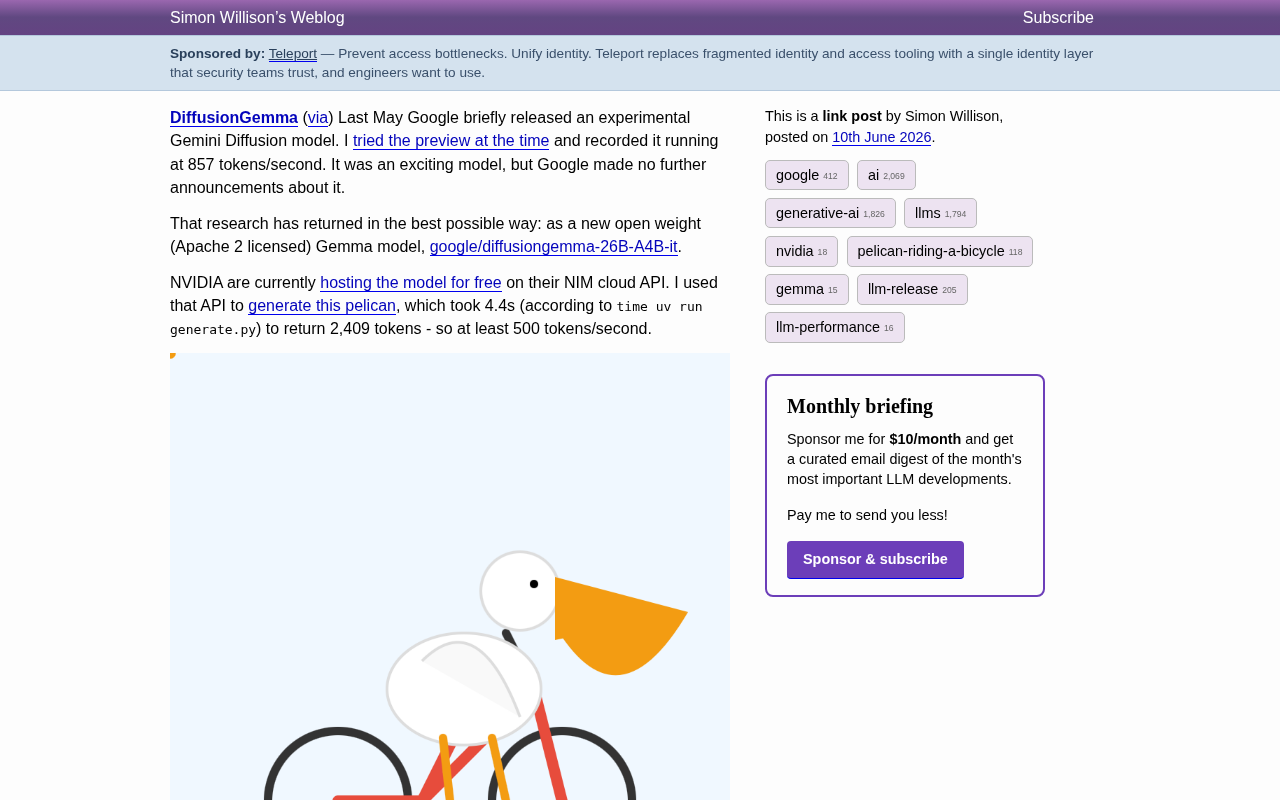
DiffusionGemma: Google's Open-Source Diffusion Language Model Exceeding 500 Tokens/s
Google releases DiffusionGemma, an open-source diffusion language model with Apache 2.0 license. The 26B-parameter MoE model achieves over 500 tokens/s in real-world tests.
Reviving a 28-Year-Old Quake 2 Custom …
Reviving a 28-Year-Old Quake 2 Custom Map with AI: New Possibilities in Digital Archaeology
A developer used AI tools to revive a 28-year-old Quake 2 custom map as a browser game, showcasing AI's new role in digital heritage restoration and game preservation.

Replit's Revenue Incentive Policy Explained: Earn Money on the Platform, Get Free Credits
Replit's new revenue incentive policy gives developers free credits when they earn money on the platform. A deep dive into its impact on indie developers and the AI platform landscape.