Replit's Revenue Incentive Policy Explained: Earn Money on the Platform, Get Free Credits
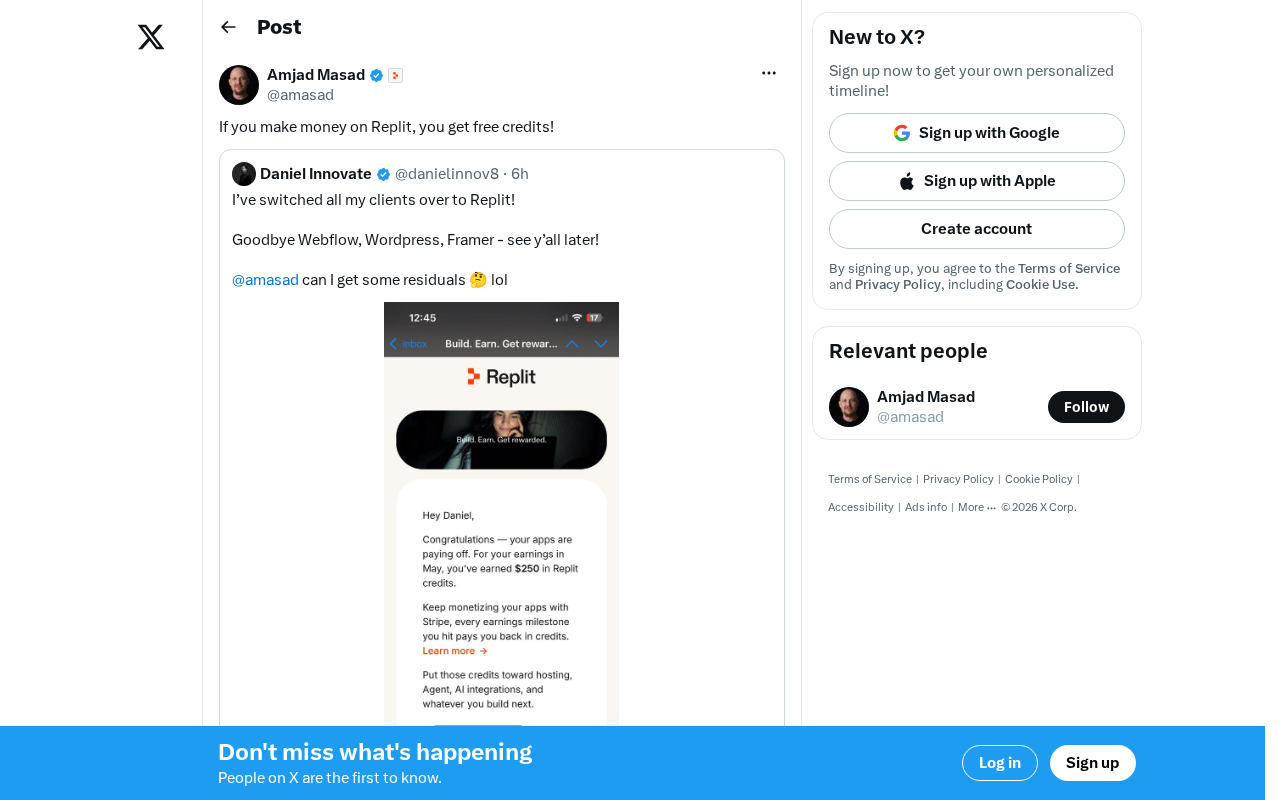
Replit rewards developers with free credits when they earn revenue on the platform, fueling a flywheel ecosystem.
Replit has announced a new incentive policy that grants developers free credits when they generate revenue on the platform. This strategy aims to lower barriers for indie developers, create a flywheel effect binding platform growth to developer success, and differentiate Replit from competitors like Cursor and GitHub Copilot by covering the full journey from coding to monetization.
Replit's New Incentive Policy
Replit recently announced an attractive new policy: if you earn money on the Replit platform, you can receive free usage credits. The announcement was made by Replit on social media, and while the full details haven't been disclosed yet, it has already generated widespread attention in the developer community.
Founded in 2016 by Amjad Masad, Replit was originally positioned as a browser-based online integrated development environment (IDE), allowing developers to write, run, and share code without configuring complex local development environments. Over the years, Replit has evolved from a simple online code editor into a full-stack development platform integrating AI programming assistants, cloud computing, application deployment, and database management. In 2023, Replit completed a $97 million Series B round led by a16z, reaching a valuation of $1.16 billion and officially joining the unicorn club. Its user base spans from coding beginners to professional indie developers, with over 20 million monthly active users. It's against this backdrop of platform scale and strategic ambition that this revenue incentive policy carries particular significance.
The core logic of this policy is crystal clear — Replit wants to use economic incentives to encourage more developers to build profitable applications and services on its platform, creating a positive-feedback ecosystem.
Why Replit's Revenue Incentive Policy Deserves Attention
Lowering the Barrier to Entry for Indie Developers
As a cloud-based development platform, Replit has been making aggressive moves in the AI programming space in recent years. Its AI coding assistant, Replit Agent, can already help users rapidly prototype applications and even complete full project deployments. Unlike traditional code completion tools, Replit Agent functions more like an AI development partner that understands natural language instructions — users simply describe the application they want to build, and the Agent automatically handles technology selection, code writing, environment configuration, and even deployment. This capability dramatically lowers the technical barrier to software development, enabling entrepreneurs without deep programming backgrounds to quickly turn ideas into working products.
However, as AI features become more deeply integrated, platform usage costs are also rising — AI calls, compute resources, deployment hosting, and more all consume credits. Replit's credits are the platform's internal virtual currency system. Users obtain credits through subscription plans or individual purchases, and credits are consumed on a usage basis each time they invoke an AI model (such as the underlying large language models like Claude or GPT), use cloud computing resources to run applications, or deploy applications to production environments via the Deployments service. For developers who frequently use AI features, monthly credit consumption can reach tens or even hundreds of dollars, creating significant cost pressure for indie developers and bootstrapping entrepreneurs.
The "earn money, get credits" policy is essentially telling developers: you don't need to invest a large amount of money upfront — as long as your project generates revenue, the platform will reinvest resources back into you. For indie developers and small teams, this is a very practical benefit.
Building a Platform Flywheel Effect
From a business strategy perspective, this initiative reflects Replit's ambition to create a closed-loop ecosystem:
- Developers build applications on Replit → using AI tools and cloud resources
- Applications generate revenue → proving the platform's commercial value
- Platform returns free credits → reducing developers' ongoing operational costs
- Developers invest in more projects → the platform ecosystem becomes more vibrant
This flywheel model mirrors the strategies of platforms like Shopify — when the platform's interests are deeply aligned with those of its creators, both sides are motivated to drive growth. The "Flywheel Effect" concept was originally introduced by management scholar Jim Collins in Good to Great, referring to a positive feedback mechanism where each component of a system reinforces the others, creating a self-accelerating cycle. In platform economics, the classic example of the flywheel effect is Amazon: more sellers bring a richer selection of products, attracting more buyers, and greater transaction volume in turn attracts more sellers. Shopify is another prime example — it doesn't just provide website-building tools but also offers merchant loans through Shopify Capital, processes payments through Shopify Payments, and builds a third-party ecosystem through its App Store, deeply tying merchant success to platform growth. Replit's revenue incentive policy replicates this exact logic: the platform is no longer just charging tool usage fees but is linking its own business model to developers' commercial success, thereby creating stronger user stickiness and ecosystem moats.
What Replit's Incentive Policy Means for Developers
The AI Programming Platform Competitive Landscape Is Shifting
The AI programming tools space is currently fiercely competitive. Products like Cursor, Windsurf, and GitHub Copilot are all vying for developer attention. Each tool has its own focus: GitHub Copilot, as the first AI programming assistant to achieve large-scale commercial adoption, is deeply integrated into mainstream IDEs like VS Code, with code completion and conversational programming as its core capabilities, backed by the massive ecosystems of GitHub and Microsoft. Cursor is an AI-native editor forked from VS Code, known for its powerful codebase context understanding and multi-model support, quickly becoming a favorite among professional developers. Windsurf (formerly Codeium) also positions itself as an AI-native IDE, emphasizing a "flow-based" programming experience and deep awareness of entire codebases. However, what these tools share in common is that they are fundamentally efficiency tools for the development phase — they help developers write code faster but don't directly participate in application deployment, operations, or monetization.
Replit's choice to differentiate through "monetization support" is a noteworthy strategic pivot. It aims to cover not just the "writing code" phase but the entire entrepreneurial pipeline from ideation, development, and deployment to monetization. This means Replit's real competitors may not just be other AI programming tools but also cloud deployment platforms like Vercel, Railway, and Render, and even no-code/low-code platforms like Bubble and Webflow.
For developers considering using AI tools to rapidly build SaaS products, small utilities, or automation services, Replit's policy provides an additional reason to choose the platform: it not only helps you write code and deploy, but also gives you more resources to keep growing after you start earning money.
Policy Details Developers Should Watch For
The specific rules of this policy remain unclear, and developers may need answers to several key questions before making decisions:
- Revenue threshold: How much do you need to earn to trigger free credits?
- Credit ratio: What's the ratio between returned credits and revenue earned?
- Revenue source restrictions: Is it limited to revenue from applications hosted via Replit Deployments?
- Duration: Is this a one-time promotion or a long-term policy?
The Bigger Trend: AI Development Platform Transformation
This move reflects a broader trend of AI development platforms transforming from "tool providers" to "commercialization infrastructure." Simply offering code completion or AI chat is no longer enough — platforms need to help developers complete the entire journey from idea to monetization.
Replit had already launched commercial features like Deployments and Bounties prior to this announcement, and the revenue incentive policy further strengthens its positioning as a "one-stop entrepreneurship platform." Replit Deployments allows developers to deploy applications built on the platform as production-grade services with one click, supporting custom domains, auto-scaling, and continuous operation — essentially compressing the deployment complexity of traditional cloud providers (like AWS and GCP) down to a few clicks. Bounties, launched by Replit in 2022, is a developer bounty marketplace where businesses or individuals can post paid development tasks, and developers on Replit can pick them up and earn payment, with the platform taking a percentage as a service fee. These two features address "how to get an application live and running" and "how to directly monetize development skills" respectively, and together with the revenue incentive policy, they form a complete commercialization support system.
This transformation from tool to infrastructure isn't unique to Replit. The entire AI development space is undergoing a profound paradigm shift: as AI dramatically reduces the marginal cost of software development, the bottleneck is no longer "can we build it" but "can we sell it." Whoever can provide distribution channels, payment integration, user acquisition, and other commercialization support beyond technical capabilities will hold the advantage in the next phase of platform competition.
In an era where AI is lowering the barriers to software development, whoever can help developers earn their first dollar from zero to one the fastest will win the platform war. Replit clearly understands this.
Key Takeaways
Related articles

AI Large Model Learning Roadmap Breakdown: Three Stages from Application Development to Model Fine-Tuning
Deep breakdown of a popular AI large model learning roadmap covering LangChain, RAG, Agent, and LoRA fine-tuning across three stages, with analysis of its strengths and limitations for career changers.

AI Agent Development: A Complete 6-Week Systematic Learning Roadmap
A 6-week systematic learning roadmap for AI Agent development, covering core architecture, ReAct principles, multi-agent collaboration, RAG integration, and deployment.
Four Core Advantages Frontend Developers Have When Transitioning to AI Agent Development
Frontend developers have key advantages for AI Agent development: TypeScript ecosystem fit, low-barrier full-stack bridging, and state management isomorphism. Learn the transition path here.