In-Game "Drone" Purchase Triggers Stripe Risk Review: A Survival Guide for Indie Developers
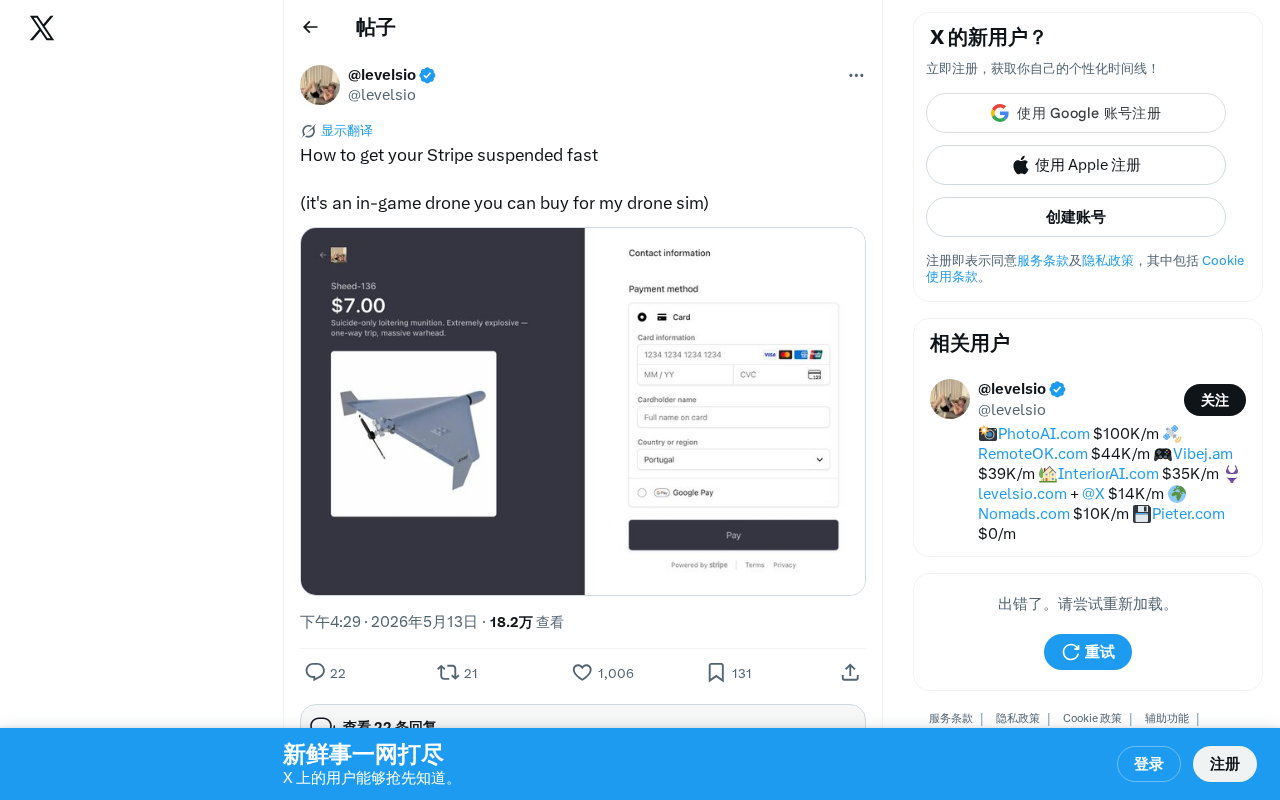
Indie dev's virtual drone items nearly got their Stripe account banned — here's how to avoid it.
An indie game developer's drone simulator triggered Stripe's automated risk controls simply because in-game purchases contained the word "drone." This article explains why payment platforms flag sensitive keywords, how Stripe Radar works, and provides practical tips for indie developers to avoid false bans through proper product labeling and proactive compliance.
When Your Payment System Misunderstands Your Product
An indie game developer recently shared a frustrating yet absurd experience on Twitter — his drone flight simulator game lets players purchase virtual drone items in-game, and this seemingly ordinary in-app purchase feature nearly got his Stripe payment account banned.
He joked: "How to speedrun getting your Stripe account suspended — (these are just purchasable in-game items in my drone simulator game)."
Stripe's Overzealous Risk Controls: Why In-Game Purchases Trigger Reviews
While this case reads like a joke, it reveals a widespread pain point among indie developers: automated risk control systems overreacting to sensitive keywords.
Mainstream payment platforms like Stripe use automated systems to scan merchant product descriptions, transaction notes, and other metadata to identify potential sales of prohibited goods. When the system detects keywords like "drone" — which in certain countries involves export controls or licensing requirements — it can automatically trigger a review or even freeze the account outright.
The Technical Architecture of Stripe Radar
Stripe's risk control system, called Radar, is built on machine learning models trained on transaction data from millions of merchants worldwide. Radar analyzes dozens of signal dimensions within milliseconds of a transaction occurring, including transaction amount patterns, IP geolocation, device fingerprints, and product description text. The text analysis layer uses a hybrid architecture combining rule engines and NLP models — hard-matching rules for explicitly prohibited keywords and probabilistic models to assess risk scores for gray-area products. When risk scores exceed a threshold, the system automatically triggers manual review or restricts account functionality. This "better safe than sorry" design philosophy stems from the heavily regulated payments industry — as a licensed payment institution, Stripe faces fines of millions of dollars or even license revocation if found to be facilitating prohibited transactions.
Why "Drone" Became a Payment-Sensitive Keyword
Drones have become sensitive keywords in payment risk systems due to increasingly strict drone regulations worldwide. In the United States, the Federal Aviation Administration (FAA) has explicit registration and certification requirements for drone sales and usage. In the EU, the drone classification management framework implemented in 2024 requires all sales channels to verify buyer qualifications. More critically, the U.S. Department of Commerce's Export Administration Regulations (EAR) list drones of certain specifications as controlled items — unauthorized cross-border sales may constitute a legal violation. As a critical link in the transaction chain, payment platforms have legal obligations (under the Bank Secrecy Act and anti-money laundering regulations) to ensure they don't facilitate prohibited transactions. This explains why the word "drone" receives such sensitive treatment.
Similar situations are not uncommon:
- Kitchen knife sellers flagged for the word "knife"
- Game items containing words like "weapon" or "gun" triggering risk controls
- Virtual goods transactions flagged as fraud due to vague descriptions
The Payment Compliance Dilemma for Indie Developers
For large game companies, payment compliance teams can proactively communicate with payment providers, submitting product documentation and qualification files. But indie developers typically lack these resources and experience — they usually integrate the Stripe API and go live immediately, only realizing the problem when they receive a risk control notification.
This dilemma reflects a structural problem across the entire creator economy. According to industry data, over 500,000 indie game developers globally attempt to build their own payment channels outside platforms like Steam and itch.io to capture higher revenue shares (platforms typically take 30%, while Stripe only charges 2.9% + 30 cents per transaction). However, directly integrating payment APIs means developers must bear compliance responsibilities themselves — including understanding PCI DSS data security standards, calculating sales tax across jurisdictions, handling refund disputes, and ensuring product description compliance. Large publishers typically have dedicated payment operations teams handling these matters, while indie developers are often left searching Stack Overflow and developer forums for answers.
Practical Tips for Indie Developers: How to Avoid Stripe False Bans
Clearly Label Virtual Goods in Product Descriptions
In your payment integration's product descriptions, always clearly prefix items with "Virtual Item," "In-Game Item," or similar labels. For example, changing "Drone - Racing Model X" to "[Virtual Game Item] Drone Skin - Racing Model X" can significantly reduce the likelihood of triggering risk controls.
Review Payment Platform Policies in Advance
Before choosing a payment provider, take time to read their Acceptable Use Policy. Platforms like Stripe and PayPal all maintain explicit lists of prohibited and restricted goods — understanding these rules can help you avoid unnecessary trouble.
Prepare Appeal Materials to Speed Up Account Recovery
If you get falsely flagged, rapid response is critical. Having game screenshots, product documentation, and app store links ready in advance can dramatically shorten the appeals process.
The Future of Automated Risk Controls: From Keyword Matching to Semantic Understanding
This minor incident highlights a fundamental contradiction in today's AI-driven automated risk control systems: How do you avoid false positives against legitimate merchants while pursuing efficiency and security?
As gaming, virtual reality, and other digital content industries flourish, virtual goods transactions are becoming increasingly diverse in category and description. Traditional keyword-matching risk models are clearly no longer adequate. Future payment risk systems will need stronger semantic understanding capabilities — the ability to distinguish between "a user buying a virtual drone in a game" and "a user purchasing a real drone online."
The Technical Path Toward Semantic Risk Controls
The evolution of payment risk controls from keyword matching to semantic understanding is essentially the application of NLP technology in financial compliance. Traditional keyword matching systems are similar to regex filtering — they can only identify surface-level text features without understanding context. Next-generation semantic risk models are beginning to incorporate pre-trained language models based on the Transformer architecture, capable of understanding the semantic difference between "purchasing a virtual drone skin in-game" and "purchasing a DJI Mavic 3 drone." For example, Stripe began testing a merchant classification system based on large language models in 2023, using comprehensive semantic analysis of merchant website content, transaction patterns, and user reviews to determine business nature. However, the challenge these systems face is asymmetric error costs — the legal consequences of letting a prohibited transaction through far outweigh those of falsely flagging a legitimate merchant, which makes these systems inherently biased toward conservatism by design.
Until that day arrives, indie developers will need to put extra thought into their product naming — at the very least, don't make your virtual item names look like you're smuggling weapons.
Related articles

Claude Code for Test Development in Practice: An AI Programming Workflow That Doubles Your Efficiency
A practical guide to Claude Code for test development: auto-generating test scripts, Plan Mode workflows, MCP + Playwright integration, and Subagent parallel tasks to build systematic AI-assisted workflows.

Hermes Agent Hands-On Review: An AI Efficiency Revolution for Indie Game Developers
Indie game developer reviews Hermes Agent vs OpenClaude: intelligent context compression, real-time Memory, remote control via Telegram, and practical use cases in game dev, social media, and email.
Vibe Coding Beginner's Guide: Tool Selection Across Three Categories with Practical Examples
A comprehensive guide to Vibe Coding's three tool categories: Agent frameworks, CLI Coding, and IDE tools, with practical examples including Snake game and data analysis workbench.