In the AI Era, Everyone Can Build an App — But Distribution Is the Real Bottleneck

AI makes building apps easy, but without distribution capability, products die in obscurity.
As AI coding tools like Cursor, Bolt, and Replit Agent eliminate development barriers, the real bottleneck for app entrepreneurs has shifted to distribution. Most indie developers lack three critical assets: an owned audience, paid acquisition budgets, and creative marketing talent. The article argues that competitive advantage is migrating from technical to distribution capability, and recommends building audiences first, choosing products with built-in viral mechanics, and targeting vertical niches.
When Development Is No Longer the Barrier, What Is?
As AI coding tools become increasingly prevalent, a profound industry paradox is emerging: the disappearance of technical barriers hasn't made success any easier — it's actually made competition more brutal.
Recently, a tech industry observer shared a brief but remarkably insightful take on Twitter that resonated widely:
"I think the challenge now is that everyone can build an app. But the problem is — almost no one has distribution."
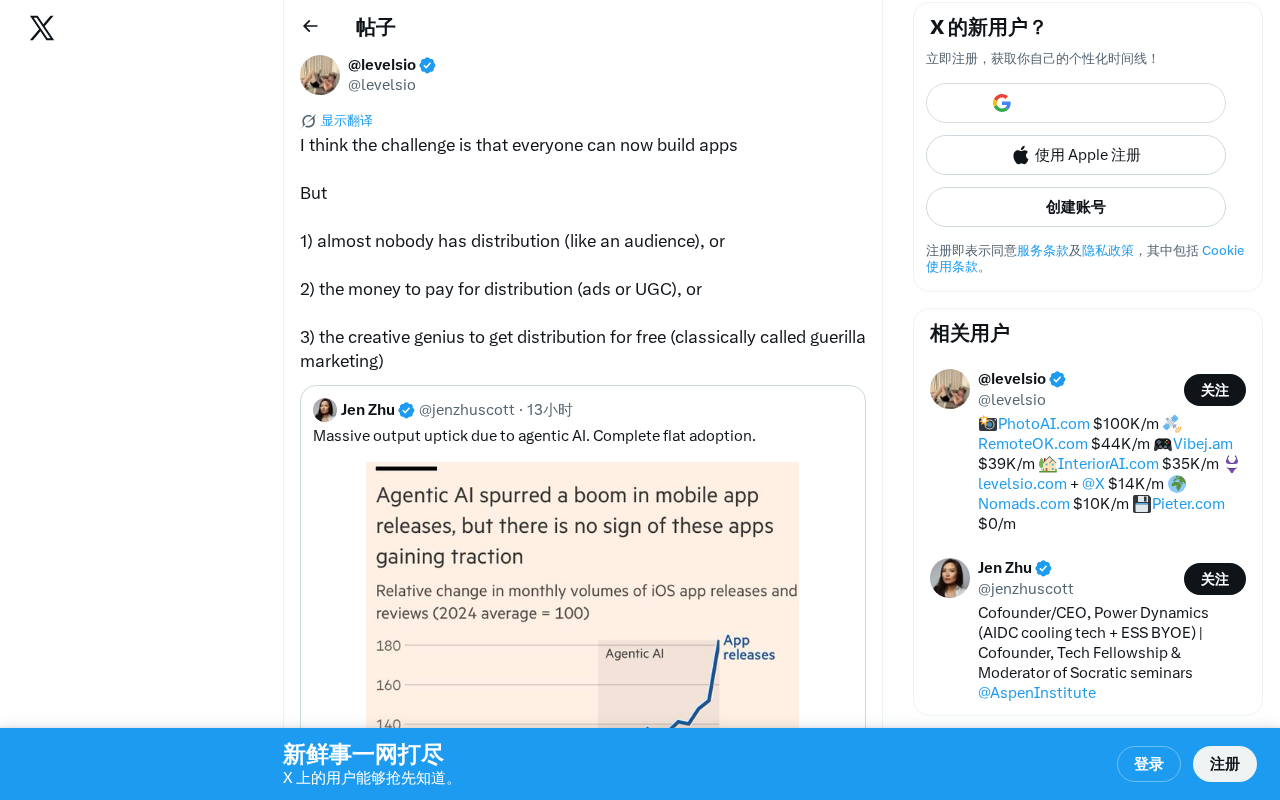
This statement precisely captures the core dilemma facing AI application entrepreneurs today. When tools like Cursor, Bolt, and Replit Agent enable anyone to build a fully functional application in just a few hours, "can you build it" is no longer the question — "can you get people to use it" is the line between life and death.
It's worth noting that these three tools represent three different paradigms in AI-assisted programming: Cursor is a VS Code-based AI code editor that understands entire codebases and generates context-aware code; Bolt (by StackBlitz) allows users to generate full-stack web applications directly from natural language descriptions; and Replit Agent can autonomously plan, write, and deploy complete applications from scratch. Together, they've compressed software development timelines from weeks to hours and lowered the skill threshold from years of programming experience to simply being able to clearly describe requirements. It's precisely this disruptive efficiency gain that has made "distribution capability" rather than "development capability" the new scarce resource.
The Three-Layered Distribution Dilemma
In a business context, distribution refers to the systematic ability to deliver products or services to target users. Venture capitalist Peter Thiel elaborated on this concept in Zero to One, arguing that even the best products are doomed to fail without effective distribution channels. Distribution encompasses multiple dimensions: channel reach (can you access target users), conversion efficiency (can you turn exposure into usage), and retention mechanisms (can you keep users active). In the internet era, the core of distribution has shifted from physical channels to attention acquisition.
The observer categorized the lack of distribution into three levels, each pointing to a fatal weakness of indie developers and small teams:
No Owned Audience (Audience Base)
Having a loyal audience — whether social media followers, email list subscribers, or community members — is the ideal distribution channel. But the reality is that the vast majority of developers don't possess this "built-in traffic" capability. They excel at writing code and designing products but have never cultivated a personal brand or content presence.
In an era where AI has driven development costs toward zero, creators, KOLs, and community operators who have accumulated audiences over time have actually become the most advantaged "product managers." They don't need to be technical geniuses — they just need to know what users want and then rapidly build it with AI tools.
No Budget for Paid Acquisition
If you don't have owned traffic, the traditional solution is to buy it — running ads or incentivizing user-generated content (UGC). But this requires real money, and customer acquisition costs continue to climb across all platforms.
According to industry data, the average customer acquisition cost (CAC) for mobile apps on iOS exceeded $3.50 per install in 2024, while paid user acquisition costs for SaaS products range from tens to hundreds of dollars. CPM (cost per thousand impressions) on Meta and Google's advertising platforms has risen over 60% in the past five years. Meanwhile, Apple's ATT (App Tracking Transparency) policy and Google's gradual phase-out of third-party cookies have significantly reduced the efficiency of precision targeting, further driving up the effective cost of acquisition.
For indie developers, this creates a vicious cycle: no users means no revenue, no revenue means no budget for acquisition, and no acquisition means no users — ever. Even though AI has reduced development costs to nearly zero, marketing and acquisition costs haven't decreased at all — they've actually increased due to intensified competition.
Lacking Creative Marketing Talent
The third path is "guerrilla marketing" — gaining free attention through creativity, topicality, or viral spread. This is the most aspirational path but also the least replicable. It depends on a deep understanding of human nature, precise timing, and a certain ineffable creative intuition.
History offers notable examples: Dropbox's early referral reward mechanism is a textbook case of Growth Hacking — each successful friend referral earned both parties an extra 500MB of storage, growing users from 100,000 to 4 million in 15 months. Hotmail was even more ingenious: in 1996, every email sent through Hotmail automatically included a footer line reading "Get your free email at Hotmail," leveraging users' daily communication behavior for zero-cost distribution, acquiring 12 million users in 18 months. In recent years, some products have ignited viral spread through clever interactions on Twitter/Reddit, following the same fundamental logic — transforming the act of using the product into an act of distribution, making every user part of the distribution channel.
But behind these success stories lie countless failed attempts using the same strategies that went unnoticed. Viral spread exhibits strong power-law distribution characteristics: a tiny number of cases achieve exponential growth, while the vast majority of attempts have a K-factor (viral coefficient) well below 1, meaning the propagation chain quickly decays naturally.
Practical Implications for AI App Entrepreneurs
This observation reveals a fundamental shift in AI-era entrepreneurship: competitive advantage is migrating from "technical capability" to "distribution capability."
When anyone can build a SaaS product with AI over a weekend, market supply will explode. Economist Herbert Simon predicted as early as 1971: "A wealth of information creates a poverty of attention." This assertion has been validated to the extreme in an era of AI-generated app proliferation. According to Sensor Tower data, the total number of apps across Apple's App Store and Google Play Store exceeds 5 million, while users actually use no more than 30 apps per month on average. As AI tools drive further explosive growth in app supply, users' discovery costs will surge dramatically, and competition for organic app store rankings will intensify. What's scarce isn't the product — it's users' cognitive bandwidth.
For entrepreneurs looking to win in this new era, the following strategies deserve serious consideration:
-
Build an audience before building a product: Before writing a single line of code, invest time in establishing influence and trust in your target domain. This strategy is known as the "Audience-First" model in startup circles, with notable practitioners including Sahil Lavingia (founder of Gumroad) and Daniel Vassallo. The typical execution path is: first build professional credibility and a follower base in a specific domain through consistent high-quality content output (blogs, Twitter threads, YouTube videos, newsletters), then discover real needs through deep engagement with your audience, and finally leverage existing trust relationships and distribution channels to rapidly validate and promote your product. The core advantage of this model: you have users on day one of launch, and their feedback quality is extremely high, enabling rapid iteration toward Product-Market Fit.
-
Choose product forms with built-in distribution properties: For example, collaboration tools naturally possess network effects — each new user invites colleagues to join, creating a self-reinforcing growth flywheel. Content tools' output itself serves as a distribution vehicle — content created with your tool carries product watermarks or links, making every share a free impression. The success of products like Figma, Notion, and Canva has deeply benefited from this kind of inherent distribution mechanism.
-
Go deep in vertical scenarios: Rather than building a general-purpose tool and fighting in a red ocean, find a niche market that's small enough but painful enough, where word-of-mouth spreads most efficiently. The advantage of vertical markets is that user groups are highly concentrated (easy to reach), needs are highly consistent (easy to satisfy), and community ties are tight (easy for word-of-mouth). A scheduling system serving dental clinics might acquire paying users more easily than a generic calendar management tool, because dental clinic owners recommend useful tools to each other at industry conferences and in group chats.
Conclusion: Distribution Capability Determines AI Startup Success or Failure
The democratization of technology is a double-edged sword. It lowers the barrier to creation but raises the bar for success. After AI makes "building it" effortless, "selling it" becomes the only thing that matters. This isn't a technology problem — it's a business problem, a marketing problem, a human nature problem.
This phenomenon isn't appearing for the first time in tech history. WordPress let anyone build a website, but only a few sites gained traffic. YouTube let anyone publish videos, but only a tiny fraction of creators reached a million subscribers. Shopify let anyone open an online store, but the vast majority of stores generate less than $100 in monthly sales. Every democratization of creative tools has been accompanied by an exponential increase in the importance of distribution capability. The proliferation of AI coding tools is merely the latest iteration of this historical pattern.
The most successful entrepreneurs of the AI era will likely not be the best programmers, but the people who best understand distribution. They might be vertical-niche bloggers with a hundred thousand followers, industry veterans with twenty years of deep expertise, or creative talents with innate marketing instincts — and AI is simply the tool in their hands that has finally become sharp enough.
Related articles

Claude Code for Test Development in Practice: An AI Programming Workflow That Doubles Your Efficiency
A practical guide to Claude Code for test development: auto-generating test scripts, Plan Mode workflows, MCP + Playwright integration, and Subagent parallel tasks to build systematic AI-assisted workflows.

Hermes Agent Hands-On Review: An AI Efficiency Revolution for Indie Game Developers
Indie game developer reviews Hermes Agent vs OpenClaude: intelligent context compression, real-time Memory, remote control via Telegram, and practical use cases in game dev, social media, and email.
Vibe Coding Beginner's Guide: Tool Selection Across Three Categories with Practical Examples
A comprehensive guide to Vibe Coding's three tool categories: Agent frameworks, CLI Coding, and IDE tools, with practical examples including Snake game and data analysis workbench.