iOS 27 Built-in Bill Splitting: Snap a Photo to Split the Check, Taking Direct Aim at Venmo
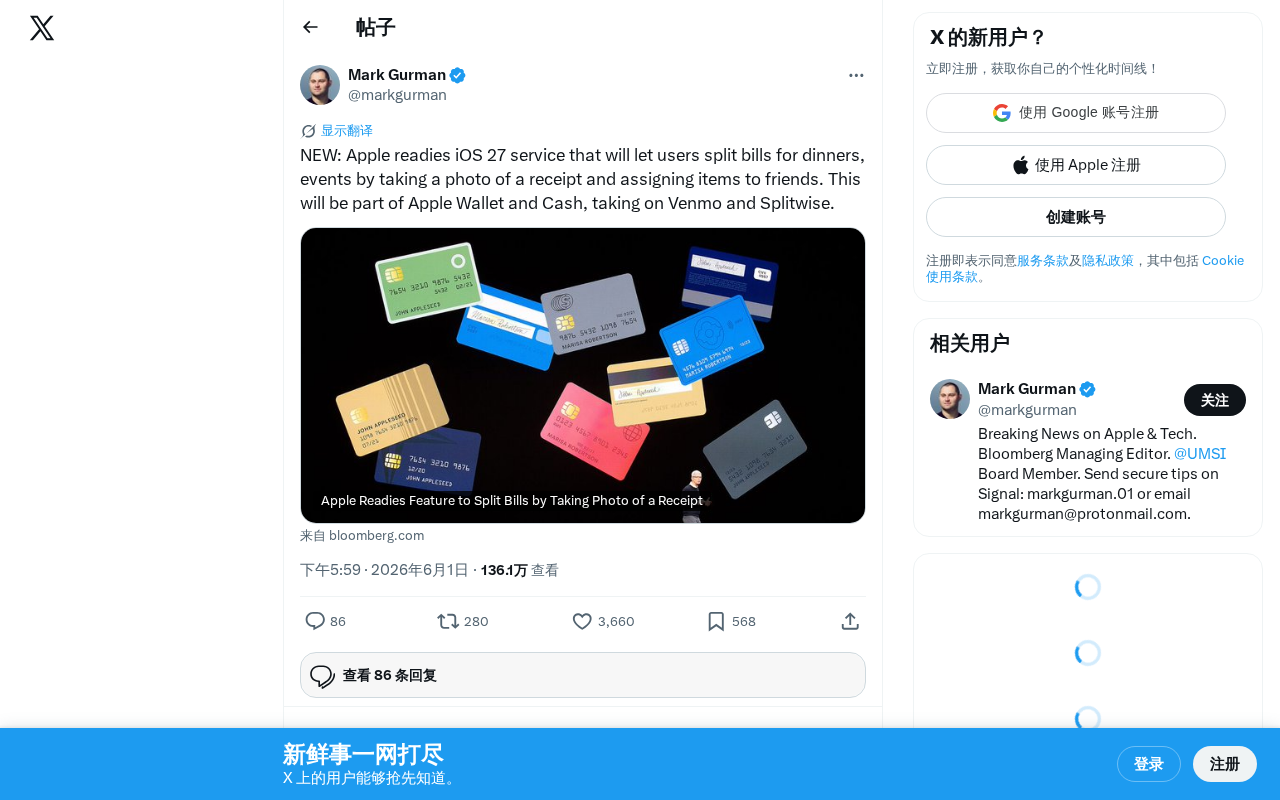
iOS 27 adds photo-based bill splitting to Apple Wallet, directly challenging Venmo and Splitwise.
Apple is preparing a bill splitting feature for iOS 27 that lets users photograph receipts, automatically identify items via AI, assign them to friends, and collect payments through Apple Cash. Leveraging system-level integration of camera hardware, Apple Intelligence, and iMessage contacts, this feature directly targets Venmo and Splitwise while advancing Apple Wallet's transformation into a comprehensive financial management platform.
Apple Wallet Is About to Get a Major Update
According to the latest disclosure from renowned tech leaker Mark Gurman, Apple is preparing a brand-new bill splitting service for iOS 27. Users will simply need to take a photo of a receipt to assign expense items to different friends, enabling intelligent bill splitting.
Mark Gurman is a senior technology reporter at Bloomberg, widely recognized as one of the most reliable sources on Apple. He has been covering Apple news since 2011 with an extremely high accuracy rate, predicting Apple's product roadmap months or even years in advance on multiple occasions. His Power On newsletter is essential reading for tracking Apple developments in the industry. His leaks are typically based on supply chain information and Apple insiders, making them far more credible than those of average tech bloggers.
This feature will be integrated into Apple Wallet and Apple Cash, directly competing with popular third-party bill-splitting apps like Venmo and Splitwise.
iOS 27 Bill Splitting Feature Explained: Snap a Photo to Split the Bill
Core Workflow
Based on currently disclosed information, the new service follows a very intuitive workflow:
- Take a photo of the receipt: After a group dinner or event, users photograph the paper receipt with their iPhone
- Intelligent recognition: The system automatically identifies individual expense items on the receipt using OCR and AI technology
- Assign items: Users assign different expense items to the corresponding friends
- Request payment: Complete the transfer and collection through Apple Cash
OCR (Optical Character Recognition) is the technology that converts text in images into editable text. Receipt recognition is a relatively complex application scenario within the OCR field, as receipt formats vary widely, print quality is inconsistent, and receipts may have creases or stains. Modern receipt recognition typically combines deep learning models to not only recognize text but also understand the structured information on receipts—distinguishing between product names, unit prices, quantities, subtotals, taxes, and totals. Apple's Live Text feature introduced in iOS 15 already demonstrated its on-device text recognition capabilities, and the addition of Apple Intelligence will further improve accuracy at the semantic understanding level.
This workflow seamlessly connects photo recognition, social assignment, and payment transfer into three linked steps, offering a much smoother experience compared to manual calculations or using third-party apps.
Apple's System-Level Technical Advantages
Apple has unique system-level advantages in the bill splitting scenario. The iPhone's camera hardware combined with Apple Intelligence's AI capabilities can achieve high-precision receipt recognition; the Contacts app and iMessage's social graph make friend assignment simple; and Apple Cash's payment infrastructure ensures convenient fund transfers.
Apple Cash is a P2P (peer-to-peer) payment service launched by Apple in 2017, allowing users to send or receive funds directly through iMessage. Funds are stored on a virtual debit card within Apple Wallet and can be used for Apple Pay purchases or transferred to a bank account. Apple Cash is backed by Green Dot Bank for banking services and is protected by FDIC deposit insurance. Unlike Venmo, Apple Cash is deeply integrated into the iOS system, requires no additional app downloads, and transaction information is not publicly displayed in a social feed, placing greater emphasis on user privacy.
This end-to-end integration capability is something third-party apps like Venmo and Splitwise cannot easily replicate.
Market Impact: Apple Strikes at the Heart of Social Payments
A Direct Threat to Venmo and Splitwise
Bill splitting is one of the highest-frequency use cases in social payments. Venmo is a mobile payment platform owned by PayPal, founded in 2009, with over 90 million active users. Its core feature is making payments social—users' transaction activity (excluding amounts) is displayed in a public social feed, a design that makes it extremely sticky among younger users. Venmo's business model includes instant transfer fees (1.75%), merchant payment fees, and financial products like the Venmo credit card. In 2023, Venmo's total payment volume exceeded $270 billion. Its splitting feature allows users to create group requests, but it lacks native receipt photo recognition capabilities.
Splitwise took a different path. Founded in 2011 with over 100 million users globally, it focuses on group expense tracking and long-term splitting—tracking daily expenses between roommates, shared costs for travel groups, and using smart algorithms to minimize the number of settlements needed. For example, multiple debts among three people can be simplified into one or two transfers. Splitwise itself doesn't process payments but integrates with payment platforms like Venmo and PayPal to complete actual transfers. Its Pro version launched in 2023 added receipt scanning functionality, but the experience still isn't as smooth as system-level integration.
Apple's move means building this core functionality directly into the operating system, posing a direct threat to these third-party apps.
Historical experience shows that when Apple systemizes the core features of third-party apps, usage rates of those apps tend to decline significantly. This behavior is known in the tech industry as "Sherlocking"—originating from Apple's 2002 launch of the Sherlock search tool that directly replicated the functionality of the third-party app Watson. Subsequent typical cases include: Night Shift replacing f.lux (screen color temperature adjustment), Screen Time replacing Moment (screen time tracking), the flashlight feature making dozens of paid flashlight apps obsolete, and the Journal app's impact on diary apps like Day One. This practice has sparked ongoing antitrust controversy—Apple leverages its platform advantage to pre-install features on billions of devices, making it nearly impossible for third-party developers to compete.
However, Venmo and Splitwise still have differentiation opportunities in cross-platform support, complex splitting logic, and social feed features. Particularly given that Android users account for approximately 72% of the global smartphone market, cross-platform capability remains an important competitive moat.
Apple Wallet's Strategic Positioning
The choice to launch this feature in iOS 27 indicates that Apple is continuously strengthening Apple Wallet's ecosystem value. Apple Wallet (originally named Passbook) launched with iOS 6 in 2012, initially only storing boarding passes, movie tickets, and other passes. The addition of Apple Pay in 2014 made it a mobile payment gateway; Apple Card in 2019 (a credit card in partnership with Goldman Sachs) further expanded its financial services footprint; and since 2022 it has supported digital IDs and driver's licenses. Apple's long-term vision is for Apple Wallet to completely replace the physical wallet, covering all scenarios including payments, identification, access keys, and transit cards.
From Apple Pay to Apple Card, to Apple Cash and now bill splitting, Apple is building a complete personal financial management closed loop. The addition of bill splitting marks Apple Wallet's transformation from a passive "storage tool" to an active "financial management platform." Each new feature increases user dependency on the Apple ecosystem and raises the cost of switching to Android.
Several Key Questions Still to Watch
Several key questions remain unclear:
- Regional availability: Apple Cash is currently only available in the US market. Will this bill splitting feature expand to more regions? Given different financial regulatory requirements and payment infrastructure differences across countries, international expansion faces considerable compliance challenges. In the Chinese market, WeChat and Alipay already offer mature bill splitting features; in Europe, neobanks like Revolut and N26 offer similar services.
- Cross-platform compatibility: What happens if some friends at dinner are Android users? This is a long-standing challenge for Apple's closed ecosystem. The iMessage "green bubble" issue has already sparked widespread discussion, and platform lock-in in payments could trigger even greater social controversy.
- Complex scenario support: Can complex splitting logic like taxes, tips, and discounts be properly handled? Different sales tax rates across US states, the 15%-25% variable tip range in tipping culture, and scenarios involving coupons and membership discounts all place higher demands on AI recognition and allocation algorithms.
Following Apple's convention, iOS 27 is expected to be officially announced at WWDC (Worldwide Developers Conference, typically held in June each year), when we'll see more details. Whether this feature can truly shake Venmo and Splitwise's market positions will depend on the final product experience and ecosystem coverage.
Key Takeaways
Related articles

Claude Code for Test Development in Practice: An AI Programming Workflow That Doubles Your Efficiency
A practical guide to Claude Code for test development: auto-generating test scripts, Plan Mode workflows, MCP + Playwright integration, and Subagent parallel tasks to build systematic AI-assisted workflows.

Hermes Agent Hands-On Review: An AI Efficiency Revolution for Indie Game Developers
Indie game developer reviews Hermes Agent vs OpenClaude: intelligent context compression, real-time Memory, remote control via Telegram, and practical use cases in game dev, social media, and email.
Vibe Coding Beginner's Guide: Tool Selection Across Three Categories with Practical Examples
A comprehensive guide to Vibe Coding's three tool categories: Agent frameworks, CLI Coding, and IDE tools, with practical examples including Snake game and data analysis workbench.